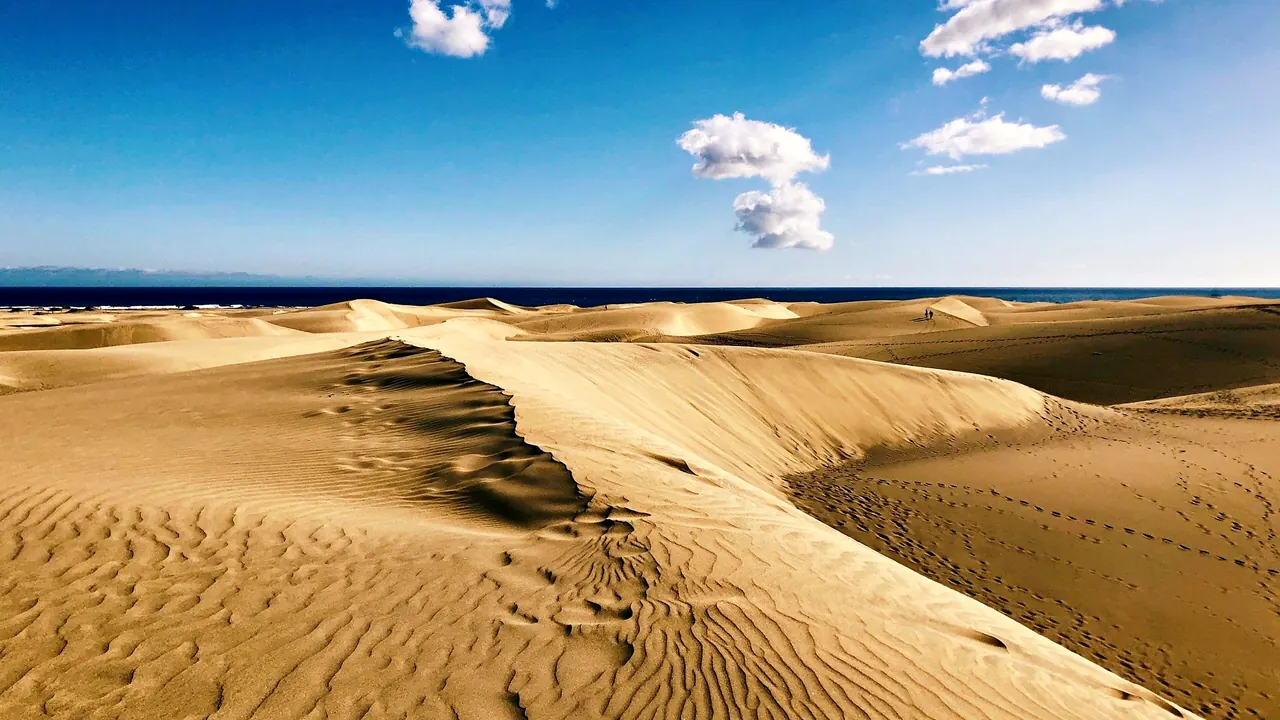
Photos: Gran Canaria by Marcela Střelcová, CC BY-SA 4.0, cropped.
Gran Canaria or La Palma?
Our verdict in twelve categories, each scored against the same fixed benchmark cities, and the climate month by month, so you can choose for your trip.
Choose Gran Canaria for
- nightlife
- beaches
- families
Gran Canaria is the better pick for a sun vacation with plenty going on around it. The south has long sandy beaches and dunes, Las Palmas gives you a real capital with the old streets of Vegueta, tapas bars and a proper night out, and the resorts are built for families. The mountain interior is dramatic enough that walkers lose little, and a motorway and good buses cover the essentials without a car.
Choose La Palma for
- nature and the outdoors
- prices
La Palma is for travellers who come for the land itself and want quiet. The Caldera de Taburiente, the volcano route and the laurel forest of Los Tilos make it the stronger walking island, and the dark skies above the Roque de los Muchachos are something no beach resort can offer. In return, expect black sand, early nights, simple food with unusual local wine, and a hire car for almost everything.
Scoreboard
Twelve categories on one fixed scale from 0 to 100. The shaded stretch is the gap between the two.
Your match
Pick a travel style or drag the sliders, and both match scores follow your weighting.
Wins on nightlife and beaches with your weighting.
Wins on nature and the outdoors and prices with your weighting.
What matters to you?
Category by category
What the scores mean for a trip.
Beaches & swimming
Gran Canaria is the beach island of the two. The south coast has miles of golden sand at Maspalomas and Playa del Inglés and calm coves at Amadores, Puerto Rico and Mogán. In Las Palmas, the reef-sheltered Las Canteras makes a real city beach.
La Palma has only a handful of small black sand and pebble beaches. The safest are at Puerto Naos, Tazacorte and Los Cancajos, and elsewhere there is surf and strong currents. The rock pools at Charco Azul are a pleasant alternative, but on La Palma a swim fills an afternoon between walks rather than a week.
Food & drink
Both islands share the Canarian basics: wrinkled potatoes with mojo, grilled cheese and gofio. Gran Canaria has far more places to eat them. Las Palmas has the tapas bars of Vegueta and Triana and its market, and the harbours of Agaete and Arguineguín serve the day's catch, though the southern promenades are best avoided for dinner.
On La Palma the choice of restaurants is narrow and the cooking plain, so the interest lies in what the island makes. Look for its almond sweets, the Malvasia from the black-ash vineyards of Fuencaliente and the piny vino de tea of the north-west.
Culture & sights
Gran Canaria has more to see. In Las Palmas, Vegueta holds the cathedral, the Casa de Colón and the Museo Canario. Outside the city, the painted cave at Gáldar and the UNESCO-listed caves of Risco Caído give the pre-Hispanic past real depth.
La Palma's heritage is smaller and mostly in Santa Cruz, along Calle Real and the balconied houses on the seafront. Its main ancient site is the spiral petroglyphs at La Zarza. Neither island is worth visiting for culture alone, but La Palma's sights fill fewer days.
Nightlife
Here the gap is wide. Gran Canaria has two kinds of night out. One is the long-running gay scene and late bars around the Yumbo in Playa del Inglés. The other is the Spanish rhythm of Las Palmas, with terrace bars, weekend clubs and a carnival that lasts for weeks.
La Palma has a few squares in Santa Cruz and Los Llanos that get busy at weekends, and no clubs at all. Its one big party is the Los Indianos day at carnival. The rest of the year, evenings end after dinner, often under the stars.
Nature & outdoors
Both islands have dramatic volcanic interiors, but La Palma's is the more extraordinary. It has the Caldera de Taburiente, the crater rim at Roque de los Muchachos at about 2,400m, the Ruta de los Volcanes down to the lava of the 2021 eruption and the laurel forest of Los Tilos. Above it all are some of the clearest night skies in Europe.
Gran Canaria's mountains around Roque Nublo and the Tejeda caldera still make superb hiking, and it has things La Palma lacks: the protected desert of the Maspalomas dunes, windsurfing at Pozo Izquierdo and long winter climbs for road cyclists.
Day trips
Gran Canaria gives you far more for a day out. From the south you can drive to Tejeda, Teror, Arucas and Agaete, Las Palmas fills a full city day on its own, and fast ferries from Agaete make Tenerife an easy outing.
La Palma's outings are gentler: Santa Cruz against Los Llanos, the harbour at Tazacorte and the Fuencaliente wineries. Ferries run to Tenerife and La Gomera, but the connections are slow enough that other islands work better as separate stays.
Good for families
Gran Canaria is much the easier island with children. Sheltered sandy beaches at Amadores and Anfi, resort pools and children's clubs, Palmitos Park, the water parks and the aquarium in Las Palmas can fill a week without long drives.
La Palma suits older children who enjoy walking. They have the short trails in Los Tilos, the pools at Charco Azul, whale-watching boats and the volcano visitor centre. Younger children have little beyond a small animal park, and sandy beaches are scarce. On both islands the winding mountain roads are hard on children who get car-sick.
Getting around
Gran Canaria's main route is simple. A motorway and good buses link Las Palmas, the airport and the southern resorts, so a beach stay works without a car, and you only need to hire one to explore the interior.
La Palma comes close to needing a car for everything. The tunnel under the ridge links Santa Cruz and Los Llanos quickly, but buses to trailheads are too sparse to plan hikes around, the northern roads are slow hairpins, and linear walks often end with a taxi back to the car.
Shopping & style
Of the two, only Gran Canaria has real shopping. In Las Palmas there are independent shops along Calle Mayor de Triana and the chains and a department store on Avenida Mesa y López, and there are weekly markets in Puerto de Mogán and Teror.
La Palma has almost no fashion shopping, but its souvenirs are distinctive: hand-rolled cigars, silk from El Paso, embroidered linen and Malvasia wine.
Affordability
The two cost much the same. Both benefit from the low Canary Islands sales tax on fuel and drink, and La Palma is a touch cheaper day to day. Where they differ is in what you pay for. Gran Canaria's winter high season pushes up the better resort hotels, but packages and apartments keep cheaper options open, and with good buses a car is optional.
On La Palma you stay in apartments and rural houses and eat plain village food at modest cost. On the other hand, a hire car is almost unavoidable and budget rooms are few, so winter stays need booking well ahead.
Live music & performing arts
Gran Canaria has a real concert life in Las Palmas. The Auditorio Alfredo Kraus on the seafront is home to the island's philharmonic orchestra, the Teatro Pérez Galdós runs an opera season, and the carnival drag gala is a show in its own right.
La Palma has the Teatro Circo de Marte in Santa Cruz and village fiestas with timple players and folk dances, and both islands host concerts in the winter Canary Islands music festival. On most evenings, though, nothing is on, unless your visit falls in a year of the Bajada de la Virgen, held every five years.
Wellness & relaxation
Neither island has thermal springs, so the difference is in how you rest. Gran Canaria has the facilities: large hotel spas around Meloneras and Maspalomas, seawater thalassotherapy circuits, and quiet rural houses in the north for anyone who wants silence.
La Palma has few spas, and its calm comes from the island itself: a rural house among vineyards, a long walk by day and a dark sky at night. It suits switching off rather than spa treatments.
When should you go?
Pick your month. The climate figures are measured averages, not a forecast.
Gran Canaria in July
La Palma in July
Daytime high, °C
Rainfall in the month, mm
Where the figures come from
Gran Canaria's temperatures are measured 28 km from the centre, at Gran Canaria - Canary Islands.
Gran Canaria has no rain gauge within 25 km of the centre, so its rainfall comes from a gridded climate dataset read at the destination rather than from a gauge further away.
Temperature and rainfall are climate normals, averaged over the years shown. Gran Canaria: 1991-2020 normals, Gran Canaria - Canary Islands (27.7 km from centre). La Palma: 1991-2020 normals, La Palma / Aeropuerto (7.5 km from centre).
Both islands are mild all year. Daytime highs run from about 21°C in winter to 27°C or 28°C in August, so neither is ever too hot or too cold for walking around town. The sea follows the same curve on both, from around 19°C in late winter to its warmest in September and October, when a swim is most comfortable.
The difference is rain and sun. Around Gran Canaria's main resort area it stays almost dry all year, summers are very sunny, and beach weather holds even in winter. Where most visitors stay on La Palma, it is clearly wetter from October to February, with December the wettest month at about 75mm, and there are fewer sunny hours in every season. Late spring and early autumn are the best times there for long walks, while a winter stay means accepting some cloud and showers.
Which traveller are you?
For a beach and sun trip, Gran Canaria wins twice over. The south stays sunnier and drier through the winter, and its sand is golden and plentiful. La Palma has only a few small black-sand coves, and many of them face heavy surf.
On an outdoors trip, La Palma is the one to choose. Its slopes are so steep that most walks become real mountain days, often above the cloud. After dark, the protected skies make stargazing part of the trip as well.
For a food and nightlife trip, pick Gran Canaria. You can eat your way round the old quarter of Las Palmas and stay out well past midnight. La Palma offers a narrow choice of restaurants, and its evenings end after dinner.
Before you go
| Measure | Gran Canaria | La Palma |
|---|---|---|
| Official language | Spanish | Spanish |
| Currency | Euro (EUR) | Euro (EUR) |
| Sockets | CF230 V, 50 Hz | CF230 V, 50 Hz |
| Driving side | Right | Right |
| Time zone | UTC, UTC+1 in summer | UTC, UTC+1 in summer |
| Emergency number | 112 | 112 |
| Main airport | Gran Canaria Airport (LPA)122 non-stop destinations | La Palma Airport (SPC)22 non-stop destinations |
| Public holidays this year | 12 days | 12 days |
By the numbers
| Measure | Gran Canaria | La Palma |
|---|---|---|
| Population | 863,943 | 86,194 |
| People per km² | 554 | 122 |
| Swim season, months above 21 °C | 6 months | 7 months |
Where else could you go?
Every comparison below shares a destination with this one, so you can follow Gran Canaria or La Palma somewhere new.
- La Gomeravs La Palma
- Tenerifevs Gran Canaria
- Tenerifevs La Palma
- La Gomeravs Gran Canaria
- Fuerteventuravs Gran Canaria
- Lanzarotevs Gran Canaria