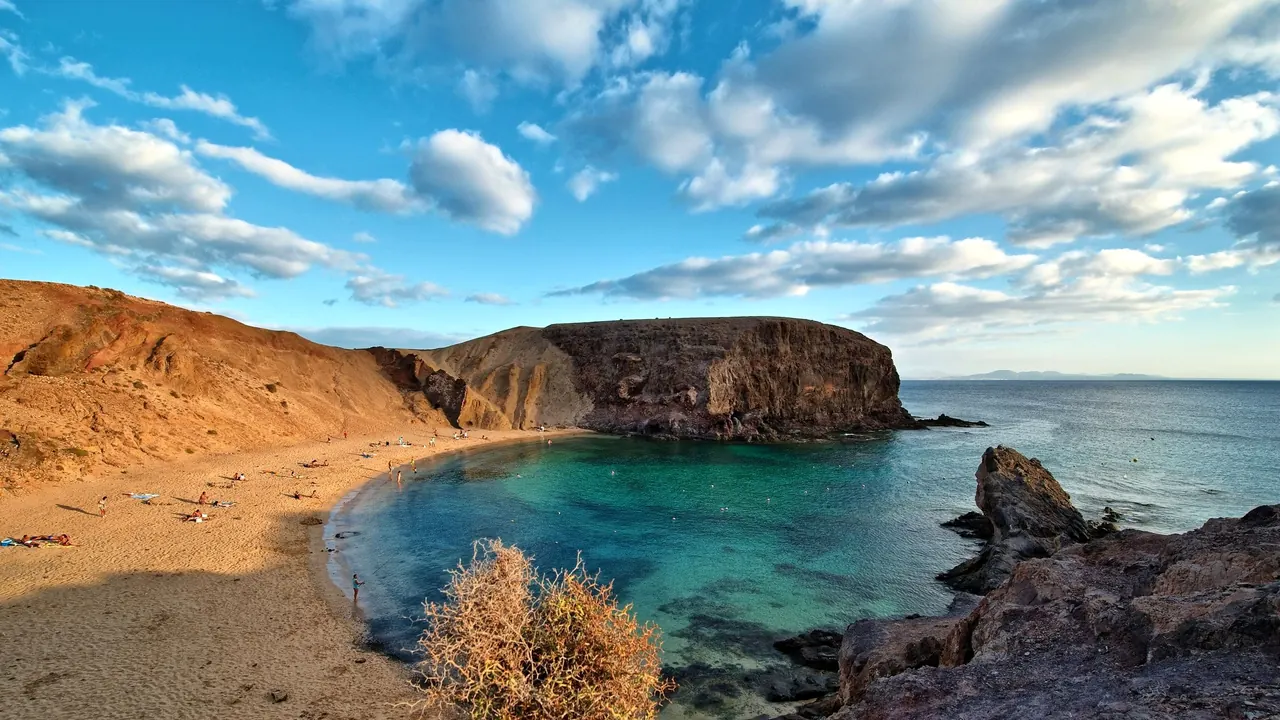
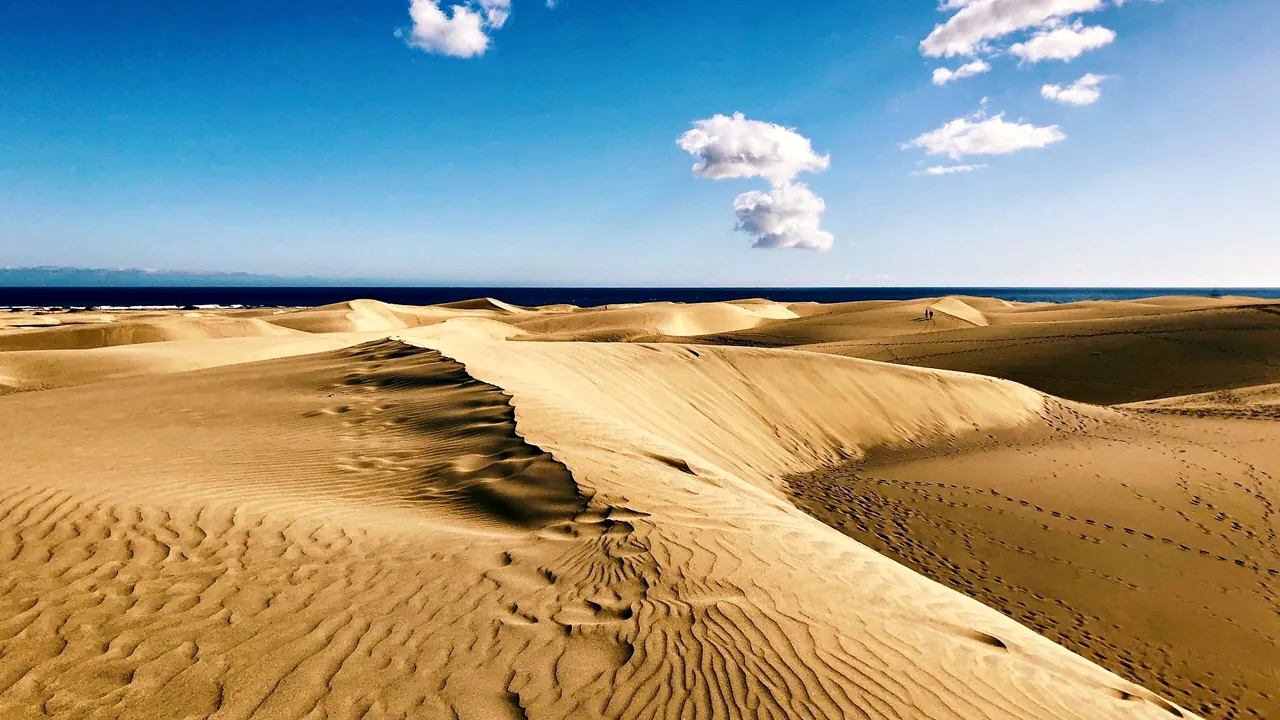
Photos: Lanzarote by Lviatour, CC BY-SA 3.0, cropped; Gran Canaria by Marcela Střelcová, CC BY-SA 4.0, cropped.
Lanzarote or Gran Canaria?
Our verdict in twelve categories, each scored against the same fixed benchmark cities, and the climate month by month, so you can choose for your trip.
Choose Lanzarote for
Lanzarote does not lead in any category we score.
If you want quiet and a striking landscape, Lanzarote is the better pick. It is smaller and lower-built, with white villages and no high-rises. Its sights are the lava fields of Timanfaya and César Manrique's lava-tube gardens and cliff lookouts. Evenings end early, shopping and live music are thin, and the beaches are fewer, but the island is easy to drive end to end and very restful.
Choose Gran Canaria for
- live music and the arts
- nightlife
- shopping
Gran Canaria is the island to choose for range. It pairs a long run of dune-backed southern beach with a real Spanish city in Las Palmas, so one stay can take in tapas bars in Vegueta, a concert at the Auditorio Alfredo Kraus, late nights out and mountain walks around Roque Nublo. It suits couples, groups and families who want plenty to fill a fortnight, and travellers who get restless after two days on a sunlounger.
Scoreboard
Twelve categories on one fixed scale from 0 to 100. The shaded stretch is the gap between the two.
Your match
Pick a travel style or drag the sliders, and both match scores follow your weighting.
Has no clear advantage with the weighting you have chosen.
Wins on live music and the arts and nightlife with your weighting.
What matters to you?
Category by category
What the scores mean for a trip.
Beaches & swimming
Gran Canaria has the better and more varied beaches. Maspalomas and Playa del Inglés give you miles of sand beside the dunes. The south-western coves at Amadores, Puerto Rico and Mogán are calm and sheltered, and Las Canteras gives Las Palmas a reef-protected city beach that Lanzarote has no equivalent for.
Lanzarote's best are the golden Papagayo coves near Playa Blanca, with clear water below low cliffs, plus easy town beaches in Puerto del Carmen. The steady wind is more noticeable there, and Famara's big beach is for surfers rather than swimmers. The water temperature is much the same on both.
Food & drink
The two islands share a Canarian table of wrinkled potatoes, mojo, gofio and goat's cheese. Gran Canaria offers more ways to eat it well, thanks to the tapas bars of Vegueta and Triana, the Mercado de Vegueta, harbour fish at Agaete and Arguineguín, and its own rum and mountain cheeses.
Lanzarote has less depth and little fine dining. Its standout is the malvasía wine of La Geria, grown in ash hollows behind stone walls, best paired with a fish lunch at El Golfo or Arrieta. On both islands, the resort strips are the place to avoid for meals.
Culture & sights
The two are evenly matched, but their culture is very different. Gran Canaria's is historic: the fifteenth-century Vegueta quarter with its cathedral and the Casa de Colón, the Museo Canario, the painted cave at Gáldar and the UNESCO cave sites of Risco Caído.
Lanzarote's culture is largely modern and the work of one man. César Manrique's lava-tube garden at Jameos del Agua, his homes in Tahíche and Haría and the Mirador del Río are its landmarks, and old Teguise adds some earlier history.
Nightlife
Gran Canaria is clearly livelier after dark, with two distinct scenes. Playa del Inglés has a large gay scene around the Yumbo centre that runs late all year. Las Palmas offers a Spanish night of terrace bars and weekend clubs, and its winter carnival lasts for weeks.
On Lanzarote, going out means Puerto del Carmen's pubs, karaoke and a few clubs, with some weekend bars along the Charco de San Ginés in Arrecife. Elsewhere the island is quiet by late evening.
Nature & outdoors
Both islands have outstanding landscapes, but of different kinds. Gran Canaria rises to nearly 2,000m, with the Tejeda caldera, Roque Nublo, deep ravines and the Tamadaba pine forest, so it is the better island for long hikes on stone paths and for shade.
Lanzarote is starker. Timanfaya's red and black cones rise from bare lava, Famara's cliffs drop to the sea and the green lagoon lies at El Golfo. It has stronger wind for surfing and kitesurfing, but almost no trees.
Day trips
Gran Canaria offers more varied outings, because the island itself holds them: Tejeda and Teror inland, Arucas and Agaete on the north coast, Puerto de Mogán and a full day in Las Palmas. Tenerife is reachable by fast ferry.
Lanzarote's best day out is a short crossing, to car-free La Graciosa or to Corralejo on Fuerteventura, each about half an hour away. Its own sights, Teguise, Haría and La Geria, fit into a single loop.
Good for families
Gran Canaria has the edge for families, thanks to more sheltered beaches such as Amadores and Anfi and a wider choice of attractions, including Palmitos Park, water parks and a large aquarium in Las Palmas. The winding mountain roads can trouble children who get car sick.
Lanzarote is simpler. Its calm resort beaches, such as Playa Dorada, are good for small children, and no drive is long. Its attractions are fewer and smaller, though the hot-ground demonstrations at Timanfaya go down well with children. Keep a close eye on sun and wind.
Getting around
Getting around is similar on both: buses work along the main resort corridor, and a hire car is needed for the interior. The difference is terrain. On Gran Canaria the mountain roads are narrow and full of hairpins, so short distances take a long time, while Lanzarote is about 60km long with good, quiet roads and easy driving.
Shopping & style
Gran Canaria is better for shopping, mainly because of Las Palmas. Calle Mayor de Triana has independent shops and Mesa y López has the chains and a department store, and the markets at Teror and Mogán add local cheese and crafts.
Lanzarote's highlight is the Sunday market in Teguise, plus aloe vera, olivine jewellery and Manrique designs sold at his sites. Beyond that, there is little more than resort beachwear.
Affordability
Costs are broadly similar, and on both islands lower local taxes and cheap car hire help. On Gran Canaria, eating in local bars in Las Palmas and the inland villages stretches a budget. On Lanzarote, the separate admissions to Timanfaya and the Manrique centres add up over a stay, and Playa Blanca's upscale hotels cost more.
Live music & performing arts
Gran Canaria is far ahead here, because Las Palmas has a proper cultural life: the philharmonic at the ocean-front Auditorio Alfredo Kraus, drama and an opera season at the Teatro Pérez Galdós, and the carnival galas.
Lanzarote has little on in most weeks. When a concert does take place in the lava-tube auditoriums at Jameos del Agua or Cueva de los Verdes, the setting and acoustics make it memorable.
Wellness & relaxation
Gran Canaria offers more for spa-goers, with large hotel spas around Meloneras and Maspalomas, seawater thalassotherapy centres and rural houses in the cool northern hills.
Lanzarote's spas, in Playa Blanca and Costa Teguise, are fewer. Its strength is its pace: low white villages, retreat houses and the stillness of Haría or La Graciosa.
When should you go?
Pick your month. The climate figures are measured averages, not a forecast.
Lanzarote in July
Gran Canaria in July
Daytime high, °C
Rainfall in the month, mm
Where the figures come from
Gran Canaria's temperatures are measured 28 km from the centre, at Gran Canaria - Canary Islands.
Gran Canaria has no rain gauge within 25 km of the centre, so its rainfall comes from a gridded climate dataset read at the destination rather than from a gauge further away.
Temperature and rainfall are climate normals, averaged over the years shown. Lanzarote: 1991-2020 normals, Lanzarote / Aeropuerto (7.1 km from centre). Gran Canaria: 1991-2020 normals, Gran Canaria - Canary Islands (27.7 km from centre).
Both islands are warm enough for the beach all year, and their calendars run closely together. Winter afternoons reach about 21°C on each. What little rain there is falls between October and March, and Gran Canaria is slightly the wetter island, with December its wettest month at around 31mm. From April to September both are close to rainless. Lanzarote runs a touch hotter in high summer, about 30°C in August against 28°C on Gran Canaria. It also gets more sunshine in most months, so in July and August its shadeless lava country is hard going at midday.
The sea is the same Atlantic on both. It is coolest in late winter and warmest in September and October, at about 23°C. For walking and sightseeing, the months from November to April are the most comfortable on either island, and Gran Canaria's high interior gives hikers cooler mountain air.
Which traveller are you?
On a food and nightlife trip, choose Gran Canaria. Las Palmas has tapas bars in Vegueta and Triana, late Spanish dinners and weekend clubs, and Playa del Inglés runs late all year. Lanzarote mostly goes to bed after dinner, apart from Puerto del Carmen's pubs.
For a beach and sun trip, Gran Canaria has more choice. Maspalomas and its dunes, the sheltered coves of Amadores and Mogán, and Las Canteras in the capital give you options in every mood. Lanzarote's Papagayo coves are lovely, but there are fewer of them and the island is windier.
For divers and snorkellers, Lanzarote has something Gran Canaria cannot match: the Museo Atlántico off Playa Blanca, where sculptures stand on the seabed. Add good diving off Playa Chica and you have a reason to choose the smaller island.
Before you go
| Measure | Lanzarote | Gran Canaria |
|---|---|---|
| Official language | Spanish | Spanish |
| Currency | Euro (EUR) | Euro (EUR) |
| Sockets | CF230 V, 50 Hz | CF230 V, 50 Hz |
| Driving side | Right | Right |
| Time zone | UTC, UTC+1 in summer | UTC, UTC+1 in summer |
| Emergency number | 112 | 112 |
| Main airport | César Manrique-Lanzarote Airport (ACE)80 non-stop destinations | Gran Canaria Airport (LPA)122 non-stop destinations |
| Public holidays this year | 12 days | 12 days |
By the numbers
| Measure | Lanzarote | Gran Canaria |
|---|---|---|
| Population | 163,467 | 863,943 |
| People per km² | 207 | 554 |
| Swim season, months above 21 °C | 5 months | 6 months |
Where else could you go?
Every comparison below shares a destination with this one, so you can follow Lanzarote or Gran Canaria somewhere new.
- Fuerteventuravs Lanzarote
- Tenerifevs Gran Canaria
- La Gomeravs Gran Canaria
- Fuerteventuravs Gran Canaria
- La Palmavs Gran Canaria
- Tenerifevs Lanzarote