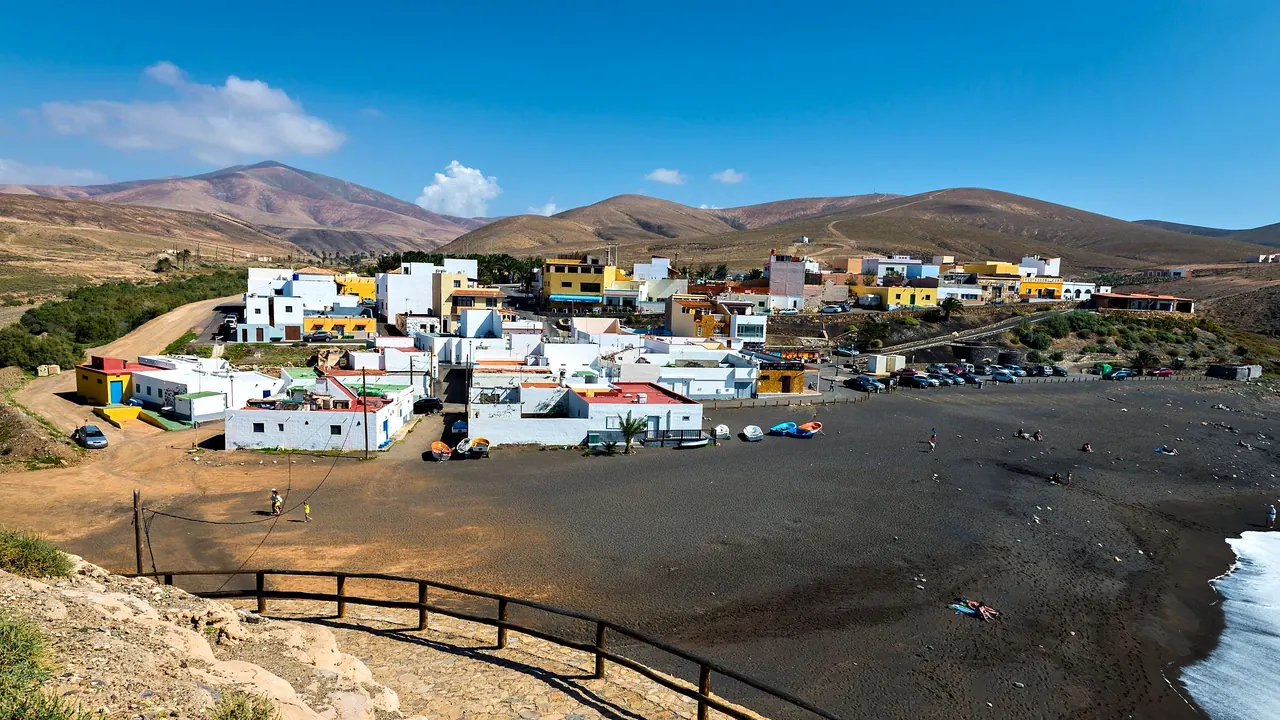
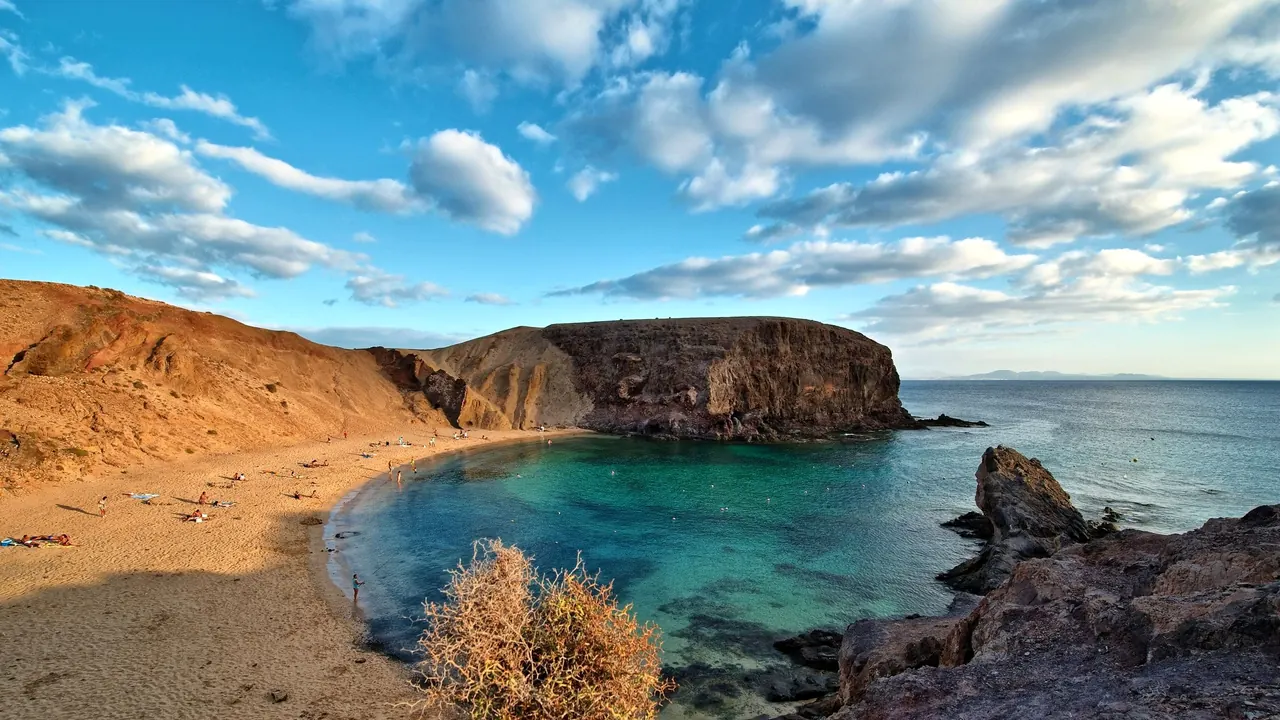
Photos: Fuerteventura by Magic K, Pexels License; Lanzarote by Lviatour, CC BY-SA 3.0, cropped.
Fuerteventura or Lanzarote?
Our verdict in twelve categories, each scored against the same fixed benchmark cities, and the climate month by month, so you can choose for your trip.
Choose Fuerteventura for
- beaches
- prices
Fuerteventura is for people who want the beach above all else. Its sands are longer, paler and emptier, from the dunes at Corralejo to the tidal lagoon at Sotavento. Its steady wind makes it one of the great windsurfing and kitesurfing islands. It is also a little kinder on the budget. In return you accept thin culture, quiet evenings and long drives between the north and the south.
Choose Lanzarote for
- culture and sights
- day trips
- live music and the arts
Lanzarote suits travellers who want their days in the sun broken up with things to see. César Manrique's lava-tube gardens and cliff lookouts, the scorched cones of Timanfaya and the malvasía bodegas of La Geria give it far more to explore. Because the island is compact, all of it is within easy reach of one base. The beaches are good rather than outstanding, sheltered coves and town strands instead of miles of open sand.
Scoreboard
Twelve categories on one fixed scale from 0 to 100. The shaded stretch is the gap between the two.
Your match
Pick a travel style or drag the sliders, and both match scores follow your weighting.
Wins on beaches and prices with your weighting.
Wins on culture and sights and day trips with your weighting.
What matters to you?
Category by category
What the scores mean for a trip.
Beaches & swimming
Fuerteventura wins on sheer scale. Its beaches are open stretches of pale sand where you can walk for an hour and still have space to yourself, but that openness comes with the wind. Calm water means choosing an east or south-facing shore, or one of the reef-sheltered pools at El Cotillo on the windier west coast. The southern resorts of Esquinzo and Morro Jable are where the long sands and the gentler sea come together.
Lanzarote's beaches are smaller and more enclosed: coves under low cliffs, and town beaches with a promenade behind them. That shelter is their strength. The water at Playa Blanca and Puerto del Carmen is calm without any searching, and lunch is never far from your towel. The black sand at Janubio adds a colour Fuerteventura's pale shores lack, while Famara, like Fuerteventura's Cofete, is a beach to look at rather than swim from.
Food & drink
The local cooking is much the same on both islands: wrinkled potatoes with mojo sauce, goat, gofio and grilled fish, best eaten in the fishing villages. On Fuerteventura that means Ajuy, El Cotillo and Morro Jable. The island's prize is its protected majorero goat cheese, and most of its wine comes from elsewhere.
Lanzarote comes out ahead mainly because of its wine. Malvasía from vines planted in pits of black ash in La Geria is worth a tasting afternoon among the bodegas. Seafront tables in El Golfo and Arrieta add good fish. On both islands the resort menus are international, and fine dining is scarce.
Culture & sights
This is where the two islands differ most. On Lanzarote, César Manrique turned lava tubes, quarries and cliffs into gardens, homes and lookouts. Visiting Jameos del Agua, the Jardín de Cactus and the Mirador del Río can fill several days, and the old streets of Teguise and the Museo Atlántico on the seabed add more.
Fuerteventura's heritage is small and rural: the fortified church at Betancuria, the Casa de los Coroneles in La Oliva, windmills and the sacred mountain of Tindaya. It is worth a drive, but it does not make a trip.
Nightlife
Neither island is a place for a big night out, but Lanzarote gives you more choice. Puerto del Carmen's seafront and old harbour have pubs, karaoke and a few late clubs all year, and Arrecife's Charco de San Ginés gets busy with locals at weekends.
On Fuerteventura, evenings out mostly mean Corralejo. Its main street and harbour have cocktail and music bars full of surfers, which suits a drink after a windy day better than dancing until late.
Nature & outdoors
Lanzarote has the more dramatic scenery. The rust-red cones of Timanfaya, where the ground is still hot just below the surface, the tall Famara cliffs and the green lagoon at El Golfo look unlike anywhere else. It also has diving off Playa Blanca and quiet volcanic roads for cyclists.
Fuerteventura's appeal is more about space: shifting dunes, the empty Cofete coast, walks up Calderón Hondo and the islet of Lobos. Its real strength is on the water, with serious windsurfing and kitesurfing at Sotavento and Flag Beach and reef breaks for surfers around El Cotillo. Neither island has much shade.
Day trips
Each island's best day trip is the short ferry to the other one. Lanzarote also has La Graciosa, a car-free island with sand streets only half an hour by boat from Órzola. On land, Teguise, Haría and the wine villages of La Geria make a satisfying loop.
From Fuerteventura, after the trip to Lanzarote, the choice is a drive through Betancuria, Tefía and Ajuy, or a longer ferry to Gran Canaria. Beyond those, there is more empty landscape than places to visit.
Good for families
Both islands are easy for families, and the differences are in the details. Fuerteventura's shallow tidal lagoons are perfect for toddlers. It also has the large zoo near La Lajita and the glass-bottom boat to Lobos.
Lanzarote's short drives make outings easier, and its calm town beaches at Playa Dorada and Playa Grande are good for paddling. Children love the geysers and hot-ground demonstrations at Timanfaya. On both islands, the wind and the west-coast currents need watching.
Getting around
You will want a hire car on either island, but Lanzarote is easier to get around. It is only about 60km long, so a drive anywhere is short, and buses connect Arrecife, the airport and the three main resorts reasonably well.
Fuerteventura is longer, about two hours by car from Corralejo to Morro Jable. Its buses run too rarely to get you to beaches and villages comfortably, and Cofete can only be reached on dirt tracks.
Shopping & style
Shopping is modest on both islands, but Lanzarote has more worth buying. The Sunday market fills the old town of Teguise. The shops at Manrique's sites sell prints and objects based on his designs, and there is olivine jewellery and malvasía wine to take home.
Fuerteventura's best shopping is the craft market in Lajares and the surf shops in Corralejo. The souvenirs worth carrying home are majorero cheese and local pottery.
Affordability
Fuerteventura is slightly cheaper. Its apartments and mid-range resort hotels are reasonably priced, and most of its attractions are beaches, which are free.
Lanzarote's accommodation is moderate in Puerto del Carmen and Costa Teguise but costs more around the villas of Playa Blanca, and Timanfaya and the Manrique centres each charge admission. On both islands, low Canarian taxes keep drinks and fuel cheap, and prices rise in the winter high season.
Live music & performing arts
On both islands, live performance mostly means folk groups playing the timple at village fiestas and cover bands in the resort bars. Fuerteventura adds only the occasional concert at the auditorium in Puerto del Rosario, so don't plan on an evening of music or theatre there.
Lanzarote has one thing worth planning around: a classical, jazz or world-music concert inside the lava tubes at Jameos del Agua or Cueva de los Verdes, where the acoustics are remarkable. In winter, the Canary Islands music festival brings a few orchestral concerts, and Arrecife has a small municipal theatre.
Wellness & relaxation
Neither island has a bathing tradition, so you will be relying on hotel spas. On both, the real draw is the slow pace. On Fuerteventura, the yoga and surf retreats around Lajares and El Cotillo combine rest with time on the water.
Lanzarote has thalasso pools in the bigger hotels of Playa Blanca and Costa Teguise. Its quietest places to switch off are the white villages of Haría and Uga and the island of La Graciosa.
When should you go?
Pick your month. The climate figures are measured averages, not a forecast.
Fuerteventura in July
Lanzarote in July
Daytime high, °C
Rainfall in the month, mm
Where the figures come from
Fuerteventura's temperatures are measured 31 km from the centre, at Fuerteventura / Aeropuerto.
Fuerteventura has no rain gauge within 25 km of the centre, so its rainfall comes from a gridded climate dataset read at the destination rather than from a gauge further away.
Temperature and rainfall are climate normals, averaged over the years shown. Fuerteventura: 1991-2020 normals, Fuerteventura / Aeropuerto (31.1 km from centre). Lanzarote: 1991-2020 normals, Lanzarote / Aeropuerto (7.1 km from centre).
The two islands have almost the same climate. Around Fuerteventura's main resorts it is dry from April to September. What rain there is falls between October and March in short, light spells, and December is the wettest month at about 26mm. Lanzarote follows the same pattern, though its October is noticeably wetter than Fuerteventura's. Winter days on both are mild rather than hot but still fine for a sheltered beach. The Atlantic runs from about 18°C in late winter to 23°C in September and October, so a swim is refreshing in any month and never truly warm. Both islands get long hours of sunshine, most of all in July.
The real difference comes in high summer. Lanzarote is a touch hotter and sunnier, reaching about 30°C in August against Fuerteventura's 28°C, and you feel that heat on its shadeless lava fields, where much of the walking and sightseeing is. Fuerteventura's slightly cooler summer is easier for long beach days. For exploring on foot, spring and late autumn are the comfortable seasons on both islands.
Which traveller are you?
For a beach and sun trip, Fuerteventura is the better choice. Its white sands run for miles at Corralejo and along the Jandía peninsula, and the shallow lagoons give calm water. Lanzarote's Papagayo coves are lovely but much smaller.
On a culture and arts trip, Lanzarote wins clearly. Manrique's sites, the old capital of Teguise and the occasional concert inside a lava tube fill several days. Fuerteventura's Betancuria and windmills take an afternoon or two.
On a trip on a tight budget, Fuerteventura stretches money a little further. Apartments, village fish lunches and drinks are reasonably priced, and it has few paid sights. On Lanzarote, the admission charges at Timanfaya and the Manrique centres add up over a week.
Before you go
| Measure | Fuerteventura | Lanzarote |
|---|---|---|
| Official language | Spanish | Spanish |
| Currency | Euro (EUR) | Euro (EUR) |
| Sockets | CF230 V, 50 Hz | CF230 V, 50 Hz |
| Driving side | Right | Right |
| Time zone | UTC, UTC+1 in summer | UTC, UTC+1 in summer |
| Emergency number | 112 | 112 |
| Main airport | Fuerteventura Airport (FUE)70 non-stop destinations | César Manrique-Lanzarote Airport (ACE)80 non-stop destinations |
| Public holidays this year | 12 days | 12 days |
By the numbers
| Measure | Fuerteventura | Lanzarote |
|---|---|---|
| Population | 127,043 | 163,467 |
| People per km² | 78 | 207 |
| Swim season, months above 21 °C | 5 months | 5 months |
Where else could you go?
Every comparison below shares a destination with this one, so you can follow Fuerteventura or Lanzarote somewhere new.
- Gran Canariavs Fuerteventura
- Gran Canariavs Lanzarote
- Tenerifevs Fuerteventura
- Tenerifevs Lanzarote
- La Gomeravs Fuerteventura
- La Gomeravs Lanzarote