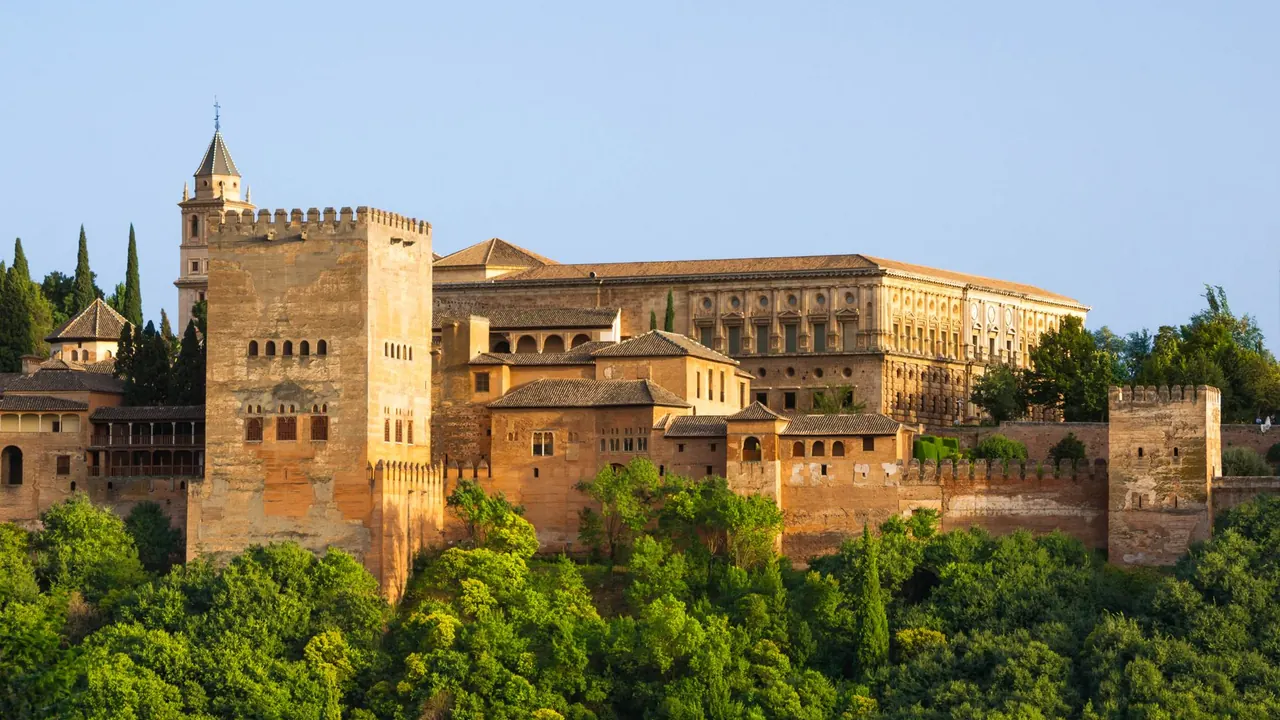
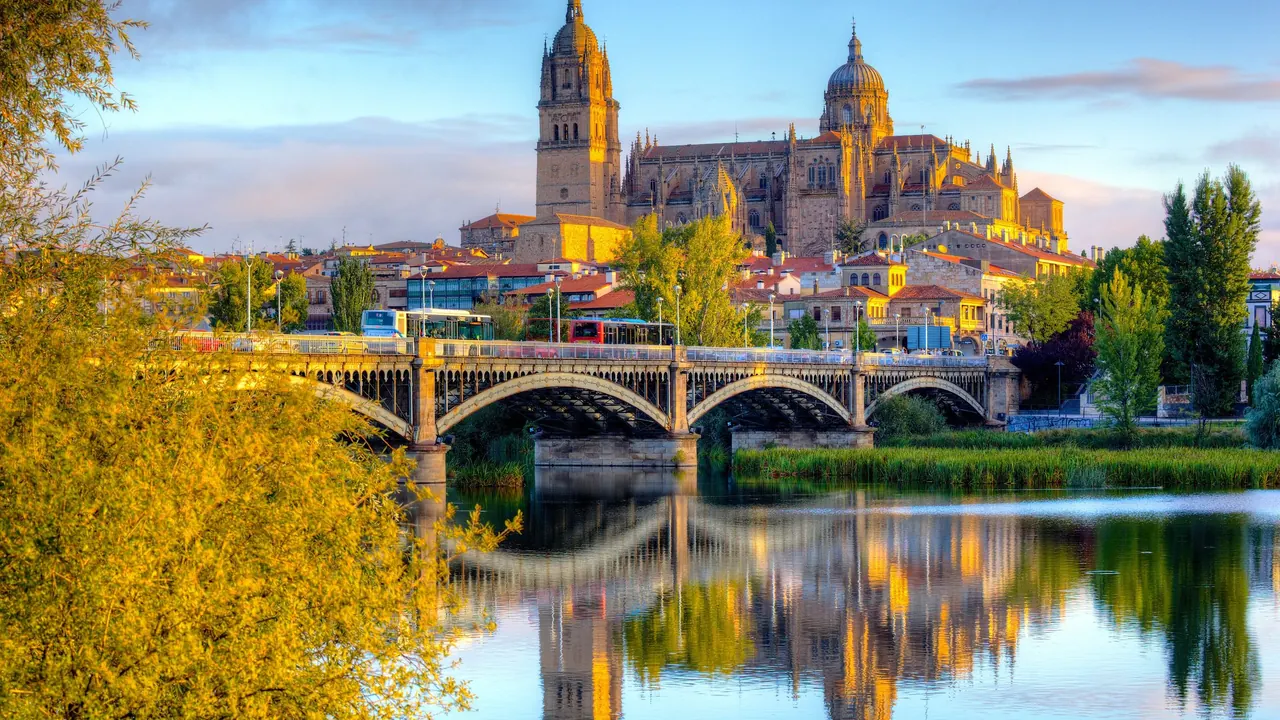
Photos: Granada by Jebulon, CC0; Salamanca by Jiuguang Wang, CC BY-SA 3.0 ES, cropped.
Granada or Salamanca?
Our verdict in twelve categories, each scored against the same fixed benchmark cities, and the climate month by month, so you can choose for your trip.
Choose Granada for
- beaches
- nature and the outdoors
- live music and the arts
Granada suits a traveller who wants more than a handsome old town. It has the Alhambra and the Moorish lanes of the Albaicín, flamenco in the cave houses of Sacromonte, and the Sierra Nevada close enough for a morning's hiking or a day on the ski slopes. It is the better choice for a longer stay that mixes sightseeing with mountains and perhaps a day on the coast, as long as you don't mind steep, cobbled hills.
Choose Salamanca for
- getting around
- nightlife
- prices
Pick Salamanca for a compact, easy-going weekend in golden stone. The Plaza Mayor, the University and the two cathedrals are all a short walk apart, and student bars keep the centre lively from Thursday onwards. It asks less of your legs than hilly Granada and fits well into a wider tour of Old Castile, but it has less to offer once the sights are done.
Scoreboard
Twelve categories on one fixed scale from 0 to 100. The shaded stretch is the gap between the two.
Your match
Pick a travel style or drag the sliders, and both match scores follow your weighting.
Wins on beaches and nature and the outdoors with your weighting.
Wins on getting around and nightlife with your weighting.
What matters to you?
Category by category
What the scores mean for a trip.
Beaches & swimming
Neither is a beach city, but Granada at least has the sea within reach. The Costa Tropical is about an hour south over the mountains, where the pebble and dark-sand coves of Salobreña, Almuñécar and La Herradura make a good day of swimming and snorkelling.
Salamanca is a long day's drive from any coast, so swimming means a municipal pool or a river beach on the Tormes on a hot afternoon. If the sea matters to you at all, Granada is the only one of the two that can offer it.
Food & drink
Both cities eat at the bar counter, moving from one tapas bar to the next, and in both a drink usually comes with a free plate. The difference is what is on it. Granada adds an Andalusian and Moorish touch: fried aubergine with cane honey, remojón salad of orange and salt cod, and mint tea with pastries in the teterías of Calderería Nueva.
Salamanca is meatier and more Castilian. Expect Guijuelo ibérico ham, hornazo, roast suckling pig and morucha beef, with wines from Toro and Ribera del Duero close by. Neither city has much fine dining or international cooking.
Culture & sights
The Alhambra gives Granada the edge. Its Nasrid palaces and Generalife gardens are a monument on another level, and the Albaicín, the Royal Chapel, the Carthusian monastery and the cave houses of Sacromonte add both Moorish and Christian history. Salamanca answers with a beautifully unified old town in golden sandstone, where the baroque Plaza Mayor, the carved University façade and the Old and New Cathedrals are all a few minutes apart.
Museums play a minor part in both cities, and each takes two or three days to see. Granada's sights have more variety, while Salamanca's stand out for how well they fit together, especially when the stone is floodlit at night.
Nightlife
Students run the night in both cities, on the late Spanish timetable that starts with tapas. Granada's scene is spread across the city: bars on Calle Elvira near Plaza Nueva, terraces in the Realejo and student clubs around Pedro Antonio de Alarcón.
Salamanca's is a little livelier and more concentrated. From Thursday to Saturday the streets around the Plaza Mayor and Calle Bordadores fill with Spanish and foreign students, and the dance bars stay open well past 3am. Neither city has much serious clubbing or cocktail culture, and both go quiet in high summer.
Nature & outdoors
Here Granada is far ahead. The Sierra Nevada fills its skyline and the slopes above Pradollano are about 45 minutes away, with skiing in winter and summer routes towards Mulhacén and the Veleta. The Alpujarras and the Dílar valley add chestnut woods, terraced slopes and old mule paths, some starting right at the edge of the city.
Salamanca stands on the flat Meseta, and the Tormes riverside paths are the only green space close by. The Sierra de Francia, Las Batuecas and the Arribes del Duero gorge are rewarding, but they are about an hour away and hard to reach without a car.
Day trips
Granada has the bigger names within easy reach by train. Córdoba and its Mezquita are about an hour and a half away, Málaga a little over an hour, and Antequera's dolmens closer still. Úbeda, Baeza, Guadix and the white villages of the Alpujarras make good days out by road.
Salamanca makes a fine base for Old Castile. Ávila's walls and Zamora's Romanesque churches are both about an hour away, and Ciudad Rodrigo and the half-timbered villages of La Alberca and Mogarraz are full of character. Many of the villages, though, really need a car.
Good for families
Granada has the one big attraction for children that Salamanca lacks. The Parque de las Ciencias, with its planetarium and butterfly house, fills most of a day, and the Alhambra's fountains hold younger children's attention. The catch is the steep, stepped Albaicín and Alhambra hill, which are hard going with a pushchair.
Salamanca is flatter and largely pedestrian, and children enjoy hunting for the frog and the astronaut carved into the stonework and climbing the cathedral towers. But it has no zoo, aquarium or theme park, so a day or two is enough.
Getting around
Both cities are best seen on foot, but Salamanca makes it easier. Almost everything is in a largely pedestrian old town you can cross in about twenty minutes, on cobbles that only slope gently. Granada's flat lower town is just as easy, but the Alhambra, the Albaicín and Sacromonte are on steep hills, and you will be glad of the small red minibuses that climb up to them.
Leaving town is a different matter. Granada's trains reach Córdoba and Málaga, and Salamanca's reach Madrid and Valladolid. For the mountain villages around either city, a car helps.
Shopping & style
Granada's Moorish crafts give it the edge. Taracea inlaid woodwork, blue and green Fajalauza ceramics and guitars from the city's workshops are the things worth carrying home. The Alcaicería, the rebuilt silk market beside the cathedral, is an atmospheric place to browse, even if much of what it sells is lamps and slippers for visitors.
In Salamanca the best buys are edible: ibérico ham, sausages and cheese from the Mercado Central. The other local find is charro jewellery, the province's traditional silver filigree buttons and pendants. For everything else, both cities have Spanish high-street chains and a department store, Granada around Calle Recogidas and Salamanca along Calle Toro, but little luxury or independent design.
Affordability
Both are among the cheaper historic cities in Spain, and the free tapa with a drink keeps eating out cheap in each. In Granada, costs rise around the Alhambra: boutique stays in the Albaicín, terraces with a view of the palace and flamenco shows aimed at visitors.
In Salamanca, the extras are admission fees for the cathedrals, the University and the towers, which add up over a full day. Rooms there cost more on festival weekends and around Easter, but with everything in walking distance you will spend almost nothing on transport.
Live music & performing arts
Flamenco and a festival in the Alhambra's palaces put Granada well ahead for an evening out. In the Sacromonte caves you can see the zambra, the city's own close-quarters flamenco, and the small peñas of the Albaicín offer rougher evenings. Every summer since 1952, the International Festival of Music and Dance has put on concerts and ballet in the palaces and in the Generalife's open-air theatre, and the City of Granada Orchestra plays through the rest of the year.
Salamanca's best-known music happens in the street: tunas of caped students singing under the arcades of the Plaza Mayor. Otherwise, the Teatro Liceo hosts touring productions, but with no resident major orchestra or opera season, keen concertgoers will find little to go to.
Wellness & relaxation
Bathing is part of Granada's Moorish inheritance. Hammams in the lower Albaicín recreate the warm, tepid and cold pools of the old Arab baths, which suits an evening after a day on the hills, and the real spa towns of Lanjarón in the Alpujarras and Alhama de Granada, with its thermal waters, are both within an hour.
Salamanca has only hotel spas and a few small bath houses in town, with the balneario at Ledesma and the Roman springs of Baños de Montemayor a drive away. Its strength is calm: siesta hours and quiet cloisters such as San Esteban and Las Dueñas.
When should you go?
Pick your month. The climate figures are measured averages, not a forecast.
Granada in July
Salamanca in July
Daytime high, °C
Rainfall in the month, mm
Temperature and rainfall are climate normals, averaged over the years shown. Granada: 1991-2020 normals, Granada / Caserío Hospicio (5 km from centre). Salamanca: 1991-2020 normals, Salamanca / Matacan (13.9 km from centre).
Granada is the warmer of the two in every month. Through the winter it is also clearly sunnier, though the two are level in March and Salamanca has a touch more sun in September. Winter shows the gap best. Granada reaches about 13°C by day in January against Salamanca's 9°C, so a walk round the Alhambra is still pleasant, while the plain around Salamanca is cold and clear. Summer turns it round. Granada climbs to about 35°C in July and August, too hot for its hills in the afternoon, though good weather for a day on the Costa Tropical. Salamanca peaks nearer 31°C, still hot but easier on foot.
Both cities are almost dry in midsummer. The rain returns in autumn, peaking in October in Salamanca and in November in Granada. Granada is at its best in April and May, and October is still worth it for walking: days of around 24°C and plenty of sunshine between the first autumn showers. Salamanca is most comfortable in May and June and again in September, before the autumn rain and the winter cold set in.
Which traveller are you?
On an outdoors trip, Granada wins easily. The Sierra Nevada starts about 45 minutes away, with summer hikes towards Mulhacén, winter skiing and the terraced Alpujarras valleys. Salamanca's sierras and the Arribes del Duero canyon are an hour off and need a car.
For a culture and arts trip, Granada offers more. You get the Alhambra, the Albaicín and the Royal Chapel by day, then flamenco in the Sacromonte caves and a summer music festival staged in the palaces. Salamanca's golden old town is lovely, but its stage programme is thin.
For a short city break, Salamanca is the easier choice. Its sights are packed into a largely pedestrian old town you can cross on foot in about twenty minutes, two days covers them, and student bars fill weekend evenings. Granada's steep hills slow a short visit down.
Before you go
| Measure | Granada | Salamanca |
|---|---|---|
| Official language | Spanish | Spanish |
| Currency | Euro (EUR) | Euro (EUR) |
| Sockets | CF230 V, 50 Hz | CF230 V, 50 Hz |
| Driving side | Right | Right |
| Time zone | UTC+1, UTC+2 in summer | UTC+1, UTC+2 in summer |
| Emergency number | 112 | 112 |
| Elevation | 693 m | 798 m |
| Main airport | F.G.L. Airport Granada-Jaén Airport (GRX)16 km from centre13 non-stop destinations | Adolfo Suárez Madrid–Barajas Airport (MAD)184 km from centre239 non-stop destinations |
| Public holidays this year | 12 days | 12 days |
By the numbers
| Measure | Granada | Salamanca |
|---|---|---|
| City population | 233,975 | 146,110 |
| People per km² | 2,659 | 3,690 |
| Museums within 10 km | 20 | 13 |
| UNESCO World Heritage sites within 50 km | 1 | 1 |
Where else could you go?
Every comparison below shares a destination with this one, so you can follow Granada or Salamanca somewhere new.
- Malagavs Granada
- Cordobavs Granada
- Marbellavs Granada
- Rondavs Granada
- Madridvs Salamanca
- Toledovs Salamanca