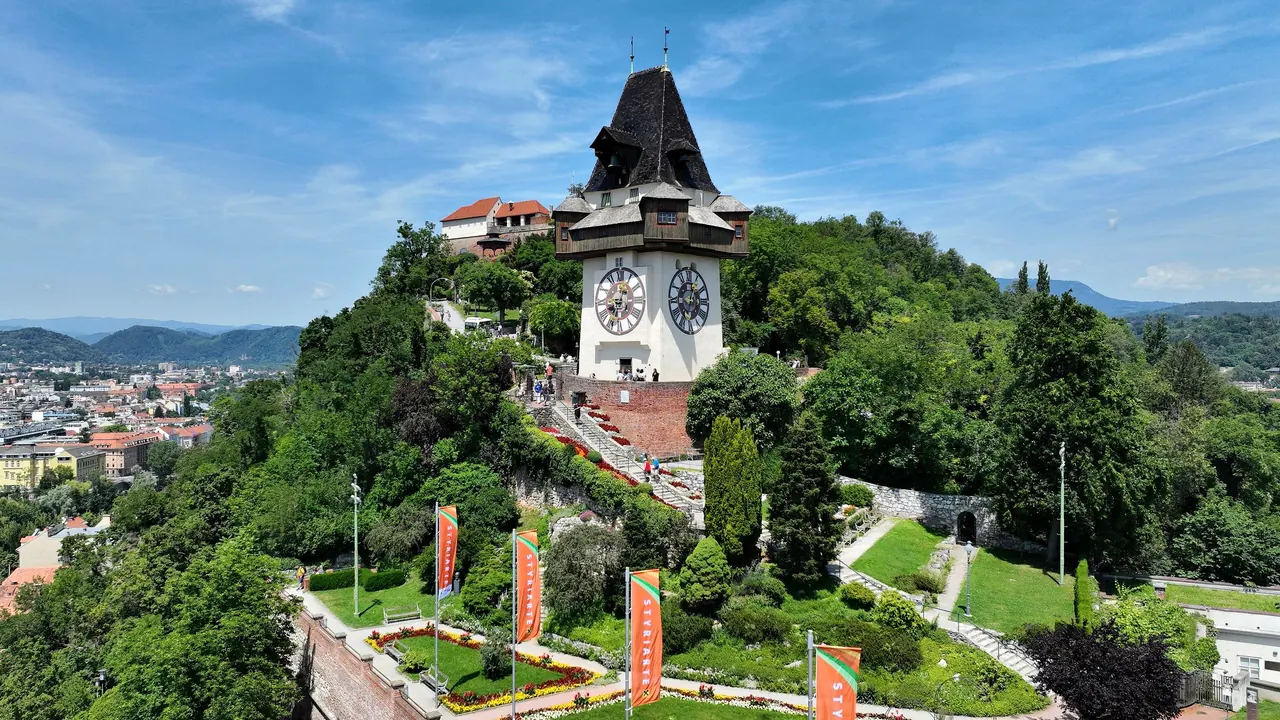
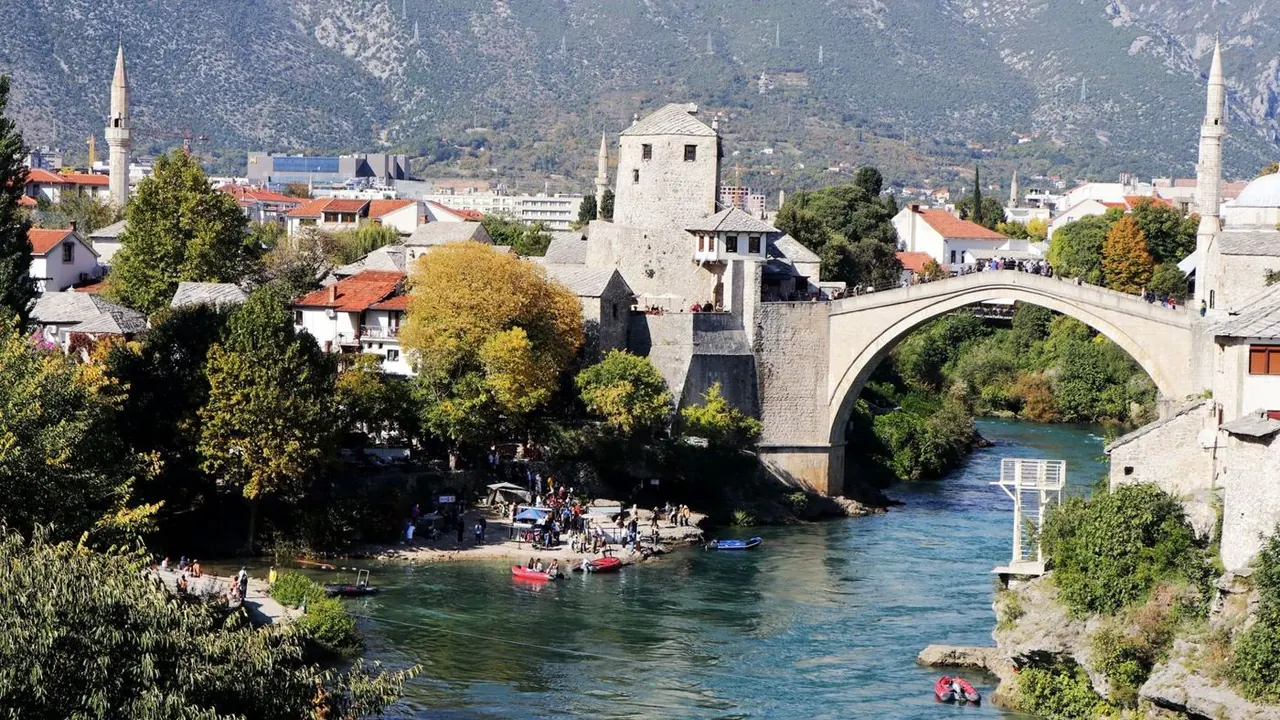
Photos: Graz by C.Stadler/Bwag, CC BY-SA 4.0, cropped; Mostar by Alan Wang, Pexels License.
Graz or Mostar?
Our verdict in twelve categories, each scored against the same fixed benchmark cities, and the climate month by month, so you can choose for your trip.
Choose Graz for
- live music and the arts
- getting around
- wellness
Graz suits travellers who want a well-kept, easy city with a lot going on. It has a preserved old town and castle hill, Styrian food and wine, a serious opera house and festivals, and green hills and thermal spas about an hour away. It works especially well for families and for anyone who wants to see plenty without needing a car in town.
Choose Mostar for
- prices
- beaches
Mostar is the better pick for a shorter, cheaper and more atmospheric stop, built around one extraordinary bridge and the Ottoman lanes beside it. Come here for low costs, a hard recent history you can still see, and rugged karst country close by. In return, expect quiet evenings, little on stage and a car or tour for most outings.
Scoreboard
Twelve categories on one fixed scale from 0 to 100. The shaded stretch is the gap between the two.
Your match
Pick a travel style or drag the sliders, and both match scores follow your weighting.
Wins on live music and the arts and getting around with your weighting.
Wins on prices and beaches with your weighting.
What matters to you?
Category by category
What the scores mean for a trip.
Beaches & swimming
Neither city is for a beach vacation, but Mostar has better swimming within reach. There is the wide pool under the Kravica waterfalls about 40km south, a cold plunge into the Neretva from the rocks, and the Adriatic at Neum a little over an hour's drive away.
Graz has nothing like the sea. What it has are the former gravel pits on the plain south of town, the Schwarzlsee above all, with grassy banks that suit a hot afternoon and little more.
Food & drink
Graz is the better place to eat, because it has a whole regional larder to explore. You get pumpkin seed oil on almost everything, cold fried chicken salad, Wurzelfleisch, and morning farmers' markets at Kaiser-Josef-Platz and Lendplatz. Crisp Sauvignon Blanc comes from wine hills under an hour away.
Mostar's cooking is satisfying but narrow: charcoal-grilled ćevapi in somun bread, burek and slow-cooked stews. The Žilavka and Blatina wines are worth trying, and a Bosnian coffee from a copper džezva is a pleasure in itself. Walk away from the bridge-view terraces for the better meals.
Culture & sights
Graz has more to see over more days. Its whole old town of arcaded courtyards and red roofs climbs to the Schlossberg and the clock tower, the Landeszeughaus holds its seventeenth-century armoury, and Schloss Eggenberg and the blue Kunsthaus add range.
Mostar's appeal is one powerful landmark. Stari Most was destroyed in 1993 and rebuilt stone by stone, and divers still jump from it. Around it are the Ottoman houses, the minaret you can climb and the war-scarred former front line, which together tell a more raw story in a much smaller space.
Nightlife
Graz has the livelier evenings, thanks to its students. Bars fill the old town lanes of the Bermuda Triangle around Mehlplatz, and Lend has artier places across the river, though the city empties noticeably in the summer break. Mostar's nights mostly mean a long dinner on a terrace facing the lit bridge, and the old town turns quiet once the day visitors leave.
Nature & outdoors
Both have fine country close by, and Graz edges ahead on ease of access. The Schöckl has a cable car and paragliders, the Mur cycle path runs straight out of town, and the Gesäuse's limestone walls offer proper alpine hiking within about two hours.
Mostar's landscape is wilder and harsher: bare karst under Velež and the jagged Prenj, rafting in the Neretva canyons, and the Buna bursting from a cliff at Blagaj. Its fierce summer heat confines serious walking to spring and autumn.
Day trips
The two are about even, but the outings are very different in character. From Graz you head into gentle Styrian country: the South Styrian Wine Road and its taverns, Riegersburg on its volcanic crag, the abbey library at Admont, or Maribor in Slovenia by train.
Mostar's trips are to small Ottoman and medieval places instead. There is the dervish tekke at Blagaj, walled Počitelj, the stećci tombstones at Stolac, and the train ride through the Neretva gorge to Sarajevo. From both cities a car or tour makes most of these far easier.
Good for families
Beyond the castle hill and its famous slide, Graz has more to fill a longer stay with children. The Herberstein wildlife park, the old farmhouses at Stübing and the summer toboggan runs on the Schöckl all make easy half-days. The city has no zoo, aquarium or theme park, though, so after a few days the fun is in the countryside.
Mostar has less to offer families beyond its single big outing, a swim beneath the Kravica waterfalls, so it works as a stop of a day or two rather than a base. Nothing much there is designed with children in mind. What it does have is the easy welcome children get in its restaurants, where nobody minds a noisy table.
Getting around
Graz is far simpler. Its centre is flat and largely pedestrianised, trams run to Eggenberg and the station on one ticket, and a funicular climbs the castle hill. Mostar's sights are all a short walk apart, but the polished cobbles need good shoes, and beyond the old town the city buses are little use, so Blagaj, Počitelj and Kravica mean a taxi, car or tour.
Shopping & style
Neither city is a place to shop for fashion, and in both the best souvenirs are local. Graz still gives you more to browse. There are traditional shops in the old buildings of the Herrengasse and the sloping Sporgasse, the old Kastner & Öhler department store with its rooftop view, and small design studios in Lend. The things most worth taking home are pumpkin seed oil, Schilcher rosé and regional chocolate.
Mostar's shopping is almost entirely the Kujundžiluk. A few coppersmiths there still hammer coffee sets by hand, surrounded by a lot of imported souvenir stock.
Affordability
Mostar costs a good deal less. Family-run guesthouses, grilled meat and a bottle of Herzegovinian wine are all cheap, and only the bridge-view terraces and old town rooms in midsummer charge more. Graz charges normal Austrian prices for dinners and wine. Student lunch menus, combined museum tickets and a walkable centre keep a stay there reasonable rather than cheap.
Live music & performing arts
Here the gap is wide. Graz has Austria's second-largest opera house, the Schauspielhaus and the Musikverein. It also has two festivals with real reputations, Styriarte for early music and steirischer herbst for the avant-garde, and a jazz scene fed by its music university.
Mostar has a national theatre and a youth theatre, both performing mostly in local languages, plus open-air concerts in summer. For most of the year live music there means the occasional band in a café.
Wellness & relaxation
Graz wins because of its surroundings rather than the city itself. About an hour east lie the thermal villages of Styria, including Hundertwasser's Bad Blumau and the big warm pools at Loipersdorf, which are open to day visitors. In Mostar the old hammam is a monument rather than a working bath, so rest there means slow coffees and the quiet early mornings by the river.
When should you go?
Pick your month. The climate figures are measured averages, not a forecast.
Graz in July
Mostar in July
Daytime high, °C
Rainfall in the month, mm
Temperature and rainfall are climate normals, averaged over the years shown. Graz: 1991-2020 normals, Graz Airport (7.9 km from centre). Mostar: 1991-2020 normals, Mostar (0.9 km from centre).
Graz has warm summers, peaking at about 27°C in July, but June to August are also its wettest months, with showery spells bringing about 125mm a month. That warmth still makes July and August the time for the lakes south of the city. For walking the old town and the hills, May, June and September are the most comfortable, with mild days and long sunny hours. Winters are cold, close to 3°C by day, but they are the driest part of the year.
Mostar is hotter and follows the opposite rain pattern. July and August reach about 33°C in the valley. They are dry and very sunny, which is good for the pool at Kravica but too hot for the stone lanes at midday. From September the rain sets in and builds to about 190mm in November and December, so its winters are milder than Graz's but much wetter. Mostar is at its best in May and early June, when the heat is manageable and the rain has eased. Graz is the better choice for late summer walking and for a dry, if cold, winter visit.
Which traveller are you?
On a family trip with young children, Graz is the clear choice. Children can ride up the Schlossberg and slide down inside it, and there is a children's museum and buggy-friendly trams. Mostar's steep, slippery cobbles and summer heat make it hard work with small children.
For a culture and arts trip, Graz offers far more. It has a whole historic centre, the armoury, Eggenberg palace and a full opera and festival season. Mostar's bridge and Ottoman houses are moving, but you will have seen them in a day or two, and there is little on stage.
On a trip with a tight budget, Mostar goes much further. Family guesthouses, plates of ćevapi and local wine cost little, and good value is only a few streets from the bridge. Graz is fair for Austria but never cheap.
Before you go
| Measure | Graz | Mostar |
|---|---|---|
| Official language | German, Austrian Sign Language | Croatian, Serbian, Bosnian |
| Currency | Euro (EUR) | Convertible Mark (BAM) |
| Sockets | CF230 V, 50 Hz | CF230 V, 50 Hz |
| Driving side | Right | Right |
| Time zone | UTC+1, UTC+2 in summer | UTC+1, UTC+2 in summer |
| Emergency number | 112 | 112 |
| Elevation | 353 m | 60 m |
| Main airport | Graz Airport (GRZ)9 km from centre26 non-stop destinations | Sarajevo International Airport (SJJ)68 km from centre38 non-stop destinations |
| Public holidays this year | 16 days | 8 days |
By the numbers
| Measure | Graz | Mostar |
|---|---|---|
| City population | 306,971 | 105,448 |
| People per km² | 2,406 | 90 |
| Museums within 10 km | 29 | 3 |
| UNESCO World Heritage sites within 50 km | 1 | 1 |
Where else could you go?
Every comparison below shares a destination with this one, so you can follow Graz or Mostar somewhere new.