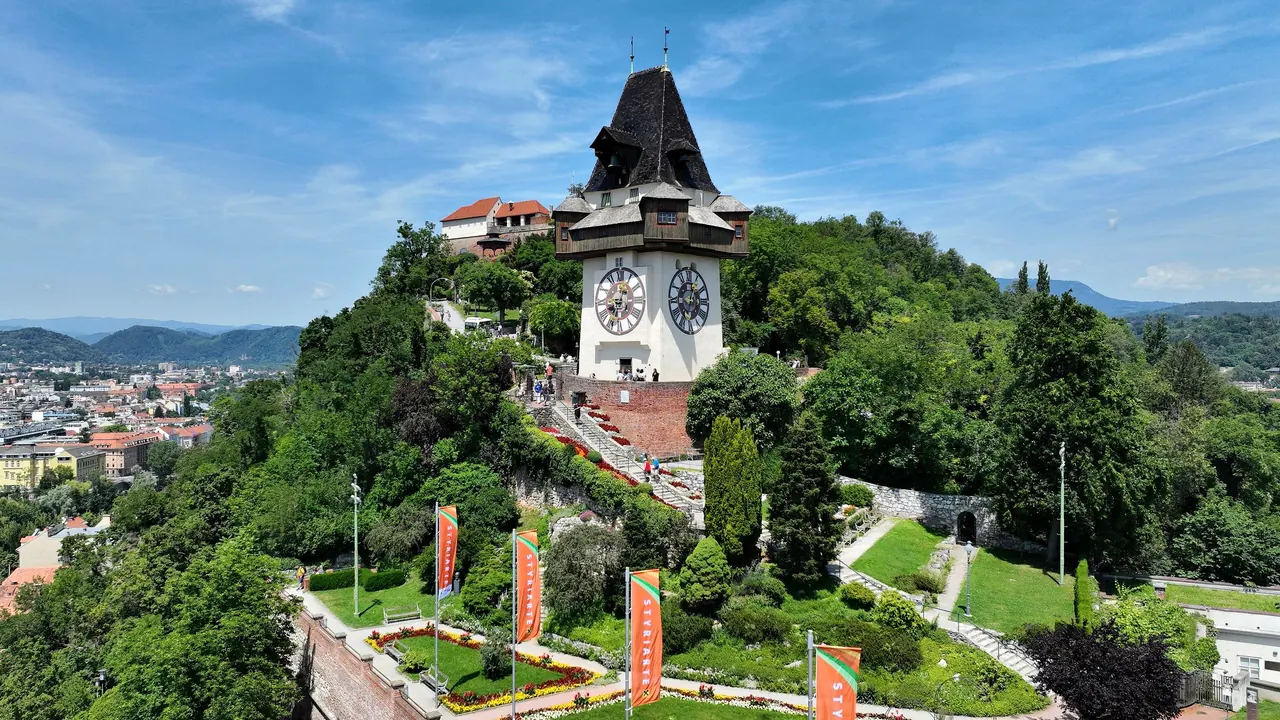
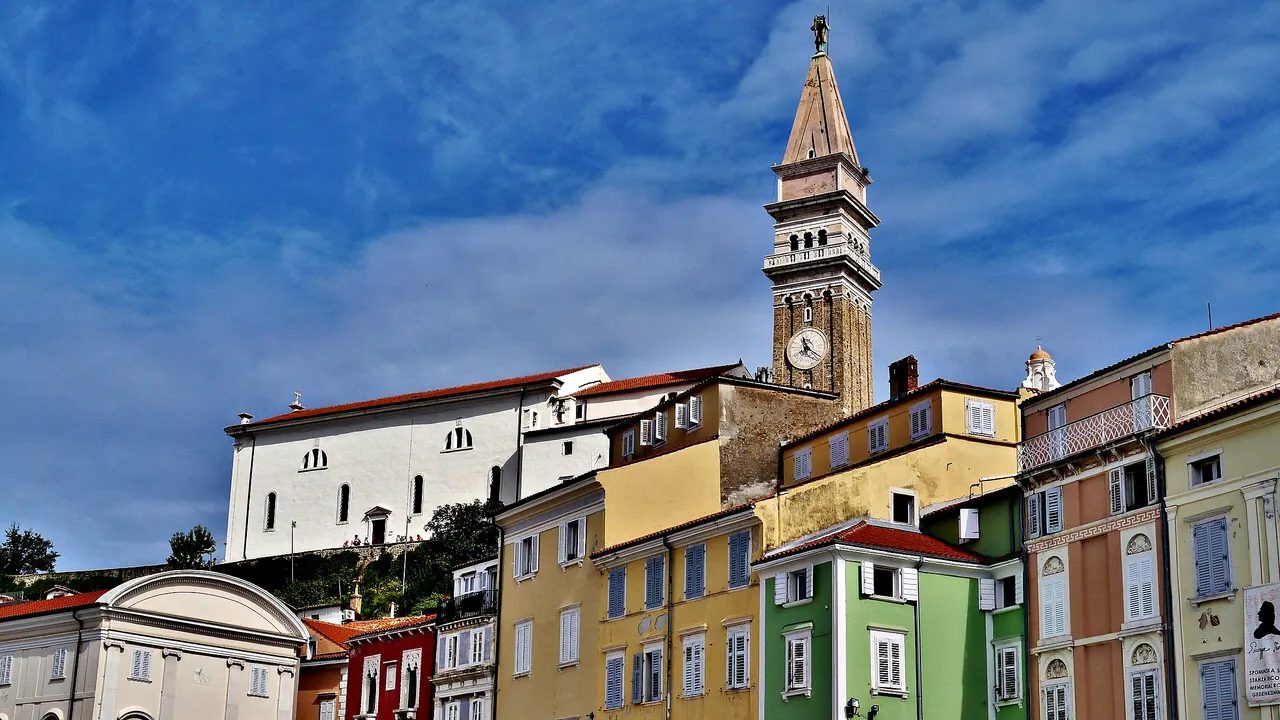
Photos: Graz by C.Stadler/Bwag, CC BY-SA 4.0, cropped; Piran by Zairon, CC BY-SA 4.0, cropped.
Graz or Piran?
Our verdict in twelve categories, each scored against the same fixed benchmark cities, and the climate month by month, so you can choose for your trip.
Choose Graz for
- live music and the arts
- shopping
- food and drink
Graz suits travellers who want a real small city to explore. It has one of Central Europe's best-kept old towns, a seventeenth-century armoury and a Baroque palace, an opera house with a full season, Styrian cooking and student bars. There are also proper hills and alpine walking within reach, and in town you can do everything on foot or by tram.
Choose Piran for
- beaches
- day trips
- wellness
Choose Piran when the sea is the point of the trip. It is a car-free Venetian peninsula where you swim off the rocks, eat grilled fish by the harbour and watch the sunset over the bay. The salt-pan spas are next door, and Trieste, the Istrian hill towns and, by summer boat, Venice are all within reach. Evenings are quiet and there is little to buy or attend, so it rewards a slow few days more than a busy itinerary.
Scoreboard
Twelve categories on one fixed scale from 0 to 100. The shaded stretch is the gap between the two.
Your match
Pick a travel style or drag the sliders, and both match scores follow your weighting.
Wins on live music and the arts and shopping with your weighting.
Wins on beaches and day trips with your weighting.
What matters to you?
Category by category
What the scores mean for a trip.
Beaches & swimming
Graz has no sea at all. On hot afternoons its people head to the old gravel pits south of town, the Schwarzlsee above all, which make a pleasant break but no reason to visit.
In Piran the Adriatic starts at the foot of the town walls. You swim from concrete platforms and ladders around the Punta, Fiesa's pebble cove is a short walk away, and Portoroz and Strunjan have sand. This is not a coast of long sandy beaches, but from June to September you can swim in clear sea water every day.
Food & drink
Graz has much more to eat. Styrian cooking has its own character, from cold fried chicken salad dressed with pumpkin seed oil to pork boiled with horseradish. The markets at Kaiser-Josef-Platz and Lendplatz trade every morning except Sunday, and the Buschenschank taverns of the southern wine hills are under an hour away.
Piran eats well but within a narrow range: fish, squid and scampi buzara in simple konobas, with Malvazija, Refosk and salt from the local pans. After a few dinners the harbour menus start to repeat, while Styrian cooking keeps a week interesting even though Graz offers little beyond Austrian food.
Culture & sights
Graz fills two or three days of sightseeing. There are the arcaded Renaissance courtyards and Baroque façades of the old town, the Landeszeughaus with its thousands of suits of armour and Schloss Eggenberg with its peacocks. The blue Kunsthaus across the Mur is the modern counterpoint.
In Piran the town itself is the sight. You wander Venetian Gothic lanes around Tartini Square and climb to St George's campanile and the walls for the view. The maritime museum and the Minorite cloister are modest, and one day is enough.
Nightlife
Neither town is for serious clubbing, but Graz's students give it a proper night out. Bars crowd the lanes of the Bermuda Triangle around Mehlplatz, Lend has artier places and a few clubs stay open late at weekends, though it all quietens in the long summer break.
A night in Piran is a glass of wine on Tartini Square or the Punta at sunset, and the town is still soon after. For a casino or a summer club you have to go along the shore to Portoroz.
Nature & outdoors
Graz has mountains close at hand. The Schöckl has a cable car, trails and paragliders launching from the top, the Mur cycle path runs straight out of town, and the Bärenschützklamm gorge climbs past waterfalls on wooden ladders. Within about two hours, the Gesäuse and Hochschwab offer real alpine hiking.
Piran's outdoors is gentler and centred on the coast. There are the flysch cliffs and clifftop path at Strunjan, wading birds on the Secovlje salt pans, kayaking under the cliffs and the Parenzana cycle route inland. The Karst and the Skocjan caves make a good day out, but there is no high ground nearby.
Day trips
Piran sits where three countries meet, so it has the wider choice of outings. Trieste is under an hour away, Rovinj, Porec, Motovun and Groznjan lie south in Croatian Istria, Predjama Castle is about an hour inland and summer boats cross the gulf to Venice.
From Graz the outings stay mostly within Styria: the South Styrian Wine Road, Riegersburg on its volcanic crag and the open-air museum at Stübing, with Admont's great library and Maribor across the border further out. Each has a Lipizzaner stud farm close by, at Piber and Lipica, and both cities are easiest to explore with a car.
Good for families
For children, the Schlossberg makes Graz: they ride the glass lift or the funicular up, come back down by a long slide inside the hill and take the Märchenbahn through fairytale scenes in the rock tunnels. The FRida & freD children's museum in the Augarten adds hands-on exhibitions and theatre, and in summer the Schöckl has toboggan runs.
Piran works best for a few relaxed days by the sea. The old town is closed to cars, the water is calm and warm in summer and the harbour aquarium suits younger children. Swimming means concrete ledges and ladders, though, and the lanes up to the church are steep, so for sand and shallow water families go along the shore to Portoroz. Restless older children may run short of things to do on a longer stay.
Getting around
Graz is the easier place to get around. Trams run along Herrengasse to the station and Eggenberg, buses fill the gaps on the same ticket, a funicular climbs the Schlossberg and cycling along the Mur is flat and simple.
Inside Piran you need no transport, because the car-free peninsula takes a quarter of an hour to cross on foot. Drivers leave their cars in the garage at the edge of town and take the shuttle in. There is no railway and the regional buses are slow, so a hire car matters more here.
Shopping & style
Graz has proper shopping streets in Herrengasse and the sloping Sporgasse. The old Kastner & Öhler department store has a roof terrace over the old town, Lend has design and vintage shops, and specialist shops sell traditional costume and loden.
Piran has a few galleries, craft shops and harbour souvenir stalls. In both towns the best things to take home are edible: pumpkin seed oil and Schilcher rosé from Graz, salt flower from the Secovlje pans and Istrian olive oil from Piran.
Affordability
The two cost about the same overall. The difference is in when you pay. Graz is fair all year: students keep lunch menus and bakeries good value, hotels only climb around festivals and trade fairs, and combined tickets cover the Joanneum museums.
Piran's costs follow the season. Old town rooms are scarce and dear in July and August, and harbour restaurants charge for the view. Simpler konobas, a bed in Portoroz or an off-season visit bring costs down, and swimming and walking cost nothing.
Live music & performing arts
Graz has live performance across the year, and a visitor without German is still well served: ballet at the Opera, orchestral and chamber evenings at the Musikverein, and jazz in clubs and concert halls, fed by the music university's well-known programme. Spoken theatre is another matter. The Schauspielhaus and the cabaret stages work almost entirely in German.
Piran's season is short and almost entirely music, so language does not matter. In the warm months, the violinist's home town plays classical concerts in its churches, the Minorite cloister and on Tartini Square, which makes a fine single evening rather than a programme to plan a trip around. Out of season, a night of live music means a drive to Trieste or Ljubljana.
Wellness & relaxation
Piran has its spas right next door. Portoroz offers seawater pools, brine baths and salt-pan mud, there is an open-air thalasso spa among the Secovlje lagoons and Strunjan has a seawater resort. All of it comes with a car-free town that makes slowing down easy.
Graz itself has only public pools and hotel spas. The thermal villages of eastern Styria, including Bad Blumau with its Hundertwasser resort and Loipersdorf, are about an hour away. Back in town, the coffee houses and the Stadtpark set a calm pace.
When should you go?
Pick your month. The climate figures are measured averages, not a forecast.
Graz in July
Piran in July
Daytime high, °C
Rainfall in the month, mm
Temperature and rainfall are climate normals, averaged over the years shown. Graz: 1991-2020 normals, Graz Airport (7.9 km from centre). Piran: 2005-2020 (sunshine 1991-2020, rainfall 1991-2020) normals, Portoroz (1.2 km from centre).
Graz has four distinct seasons. Summer is warm, with July highs around 27°C, but it is also the wettest time of year, with about 125mm of rain in each summer month. That makes May and September the most comfortable months for walking the old town and the hills. Winters are cold and fairly dry, with daytime highs only a few degrees above freezing.
Piran is the warmer of the two in every month and the sunnier one through the summer. Its swimming season runs from June to September, and the sea peaks at 25°C. July highs near 30°C make the steep lanes hard work at midday, so May, June and September are better for sightseeing. The rain comes in autumn, peaking at 125mm in November, and winters are mild compared with Graz.
Which traveller are you?
For a beach and sun trip, Piran is the clear pick. You swim in clear Adriatic water from the platforms below the old walls, with Fiesa's pebbles and the sand at Portoroz close by. Graz can only offer former gravel-pit lakes on hot afternoons.
On a culture and arts trip, Graz has far more to offer. It has a historic centre with a great armoury and a Baroque palace, plus opera, theatre, orchestral concerts and two festivals. Piran's Venetian lanes fill a pleasant day, and its concerts are mostly in summer.
On a food and nightlife trip, Graz wins on both counts. There is Styrian cooking with pumpkin seed oil, morning markets and wine taverns nearby, then student bars in the Bermuda Triangle and Lend. In Piran the harbour menus repeat and the town goes quiet early.
Before you go
| Measure | Graz | Piran |
|---|---|---|
| Official language | German, Austrian Sign Language | Slovene |
| Currency | Euro (EUR) | Euro (EUR) |
| Sockets | CF230 V, 50 Hz | CF230 V, 50 Hz |
| Driving side | Right | Right |
| Time zone | UTC+1, UTC+2 in summer | UTC+1, UTC+2 in summer |
| Emergency number | 112 | 112 |
| Elevation | 353 m | 7 m |
| Main airport | Graz Airport (GRZ)9 km from centre26 non-stop destinations | Trieste Airport (TRS)34 km from centre32 non-stop destinations |
| Public holidays this year | 16 days | 21 days |
By the numbers
| Measure | Graz | Piran |
|---|---|---|
| City population | 306,971 | 3,787 |
| People per km² | 2,406 | 85 |
| Museums within 10 km | 29 | 5 |
| UNESCO World Heritage sites within 50 km | 1 | 4 |
| Swim season, months above 21 °C | - | 4 months |
Where else could you go?
Every comparison below shares a destination with this one, so you can follow Graz or Piran somewhere new.