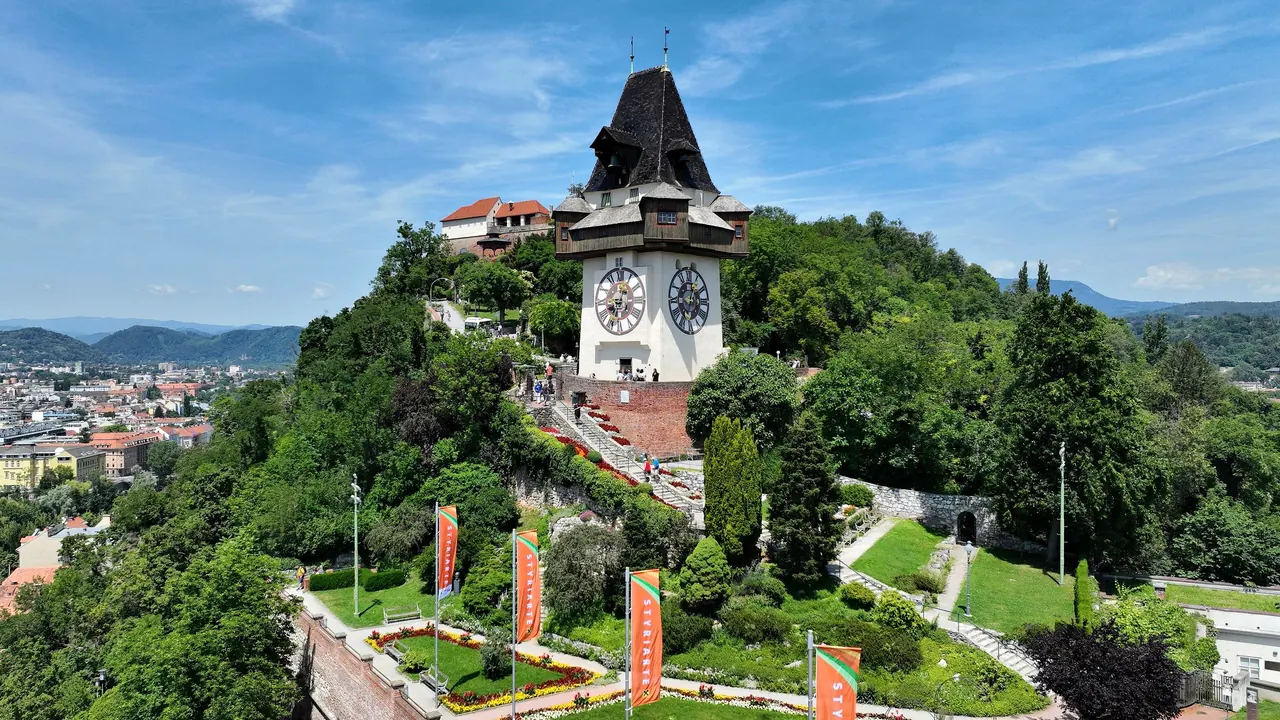
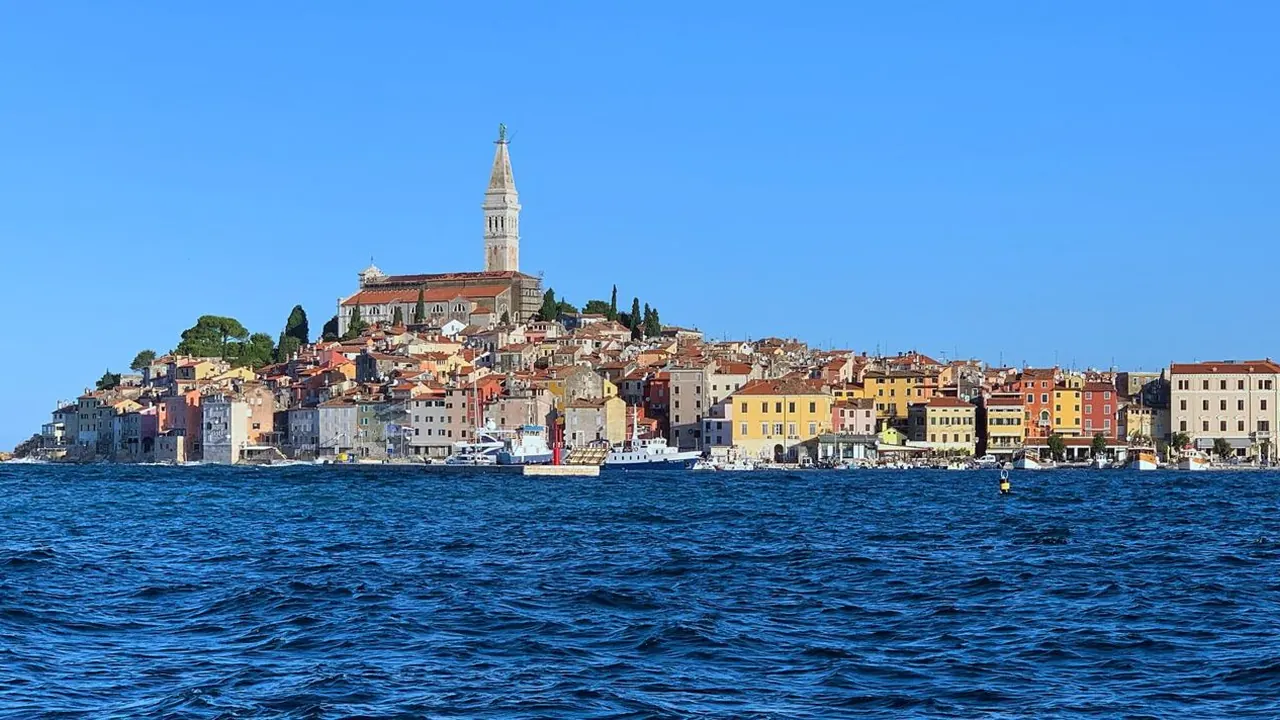
Photos: Graz by C.Stadler/Bwag, CC BY-SA 4.0, cropped; Rovinj by Vyacheslav Bukharov, CC BY-SA 4.0, cropped.
Graz or Rovinj?
Our verdict in twelve categories, each scored against the same fixed benchmark cities, and the climate month by month, so you can choose for your trip.
Choose Graz for
- live music and the arts
- culture and sights
- getting around
Graz suits travellers who want a small city with real depth. It has a well-kept Renaissance and Baroque old town, the great armoury of the Landeszeughaus, an opera house with a full season, and Styrian cooking and wine on its doorstep. The centre is flat and served by trams, so no car is needed in town, and city days combine easily with walks on the Schöckl or in the southern wine hills. It also works outside summer, which Rovinj largely does not.
Choose Rovinj for
- beaches
- day trips
Rovinj is the choice for a slow summer week by the Adriatic. You get clear water off the rocks below the old town, islands a taxi boat away, fish dinners on the harbour and sunsets from the stones. Sightseeing in the town takes an afternoon and the nights are calm, so it suits couples and anyone who wants the sea at the centre of the trip. A car opens up Roman Pula, Porec and the Istrian hill towns.
Scoreboard
Twelve categories on one fixed scale from 0 to 100. The shaded stretch is the gap between the two.
Your match
Pick a travel style or drag the sliders, and both match scores follow your weighting.
Wins on live music and the arts and culture and sights with your weighting.
Wins on beaches and day trips with your weighting.
What matters to you?
Category by category
What the scores mean for a trip.
Beaches & swimming
This is Rovinj's strongest side, and Graz has nothing to match it. Rovinj gives you very clear Adriatic water reaching the mid-twenties in late summer. You swim from limestone ledges and pebble coves through the Golden Cape pines, from the stones right under the old town walls, or from the islands of St Catherine and Red Island. Bring water shoes, and don't expect sand.
Graz is far inland. Swimming there means the former gravel pits on the plain to the south, such as the Schwarzlsee, with grassy banks and kiosks. They are pleasant on a hot day, but nobody travels there for them.
Food & drink
Graz has the deeper food culture. Pumpkin seed oil is poured on almost everything, there are cold fried chicken salads and pork with horseradish, and the markets at Kaiser-Josef-Platz and Lendplatz run six mornings a week. Crisp southern Styrian whites are poured in rustic Buschenschank taverns under an hour away.
Rovinj has fine raw material, including scampi buzara, truffle pasta, Malvazija and Teran wine. But too many harbour menus are written for passers-by, and cheap everyday eating is scarce. The best meals tend to be in a few refined dining rooms or in konobas out in the countryside.
Culture & sights
Graz has far more to see. Its old town of red roofs and arcaded courtyards climbs to the cathedral and the Mausoleum of Ferdinand II, with the Uhrturm on the Schlossberg above it. The Landeszeughaus armoury and the palace at Eggenberg are each worth a visit on their own, and the Kunsthaus brings a modern contrast. Plan two or three full days.
In Rovinj the old town itself is the sight. Venetian houses are stacked up the former island to St Euphemia, whose bell tower you can climb. Add the Batana House and a small town museum, and an afternoon covers it.
Nightlife
Neither is a clubbing destination, but Graz has more going on after dark. Its large student population keeps the bar lanes around Mehlplatz busy, the bars in Lend are artier, and a few clubs stay open late at weekends. It goes quiet in the long summer break.
Rovinj's evening is a long dinner and then a drink on the rocks at sunset. A handful of waterfront bars keep going in high season, but the old town is mostly asleep by midnight and very quiet out of summer.
Nature & outdoors
Graz has the bigger landscapes. The Schöckl rises above the city with a cable car, trails and paragliders. The Bärenschützklamm gorge climbs past waterfalls on wooden ladders, and the limestone walls of the Gesäuse and Hochschwab offer real alpine hiking within about two hours.
Rovinj's outdoors is gentler and centred on the sea. You can walk or cycle the flat paths of the Golden Cape, kayak or dive around the islands and wrecks, and take a boat up the green Lim Fjord. Inland there are quiet vineyard roads, but no mountains.
Day trips
Both are good bases for outings, but the outings are different. From Graz, most trips go into the countryside: the South Styrian Wine Road, Riegersburg on its volcanic crag, the Lipizzaners at Piber and the vast abbey library at Admont. Maribor is an easy train ride over the Slovenian border.
Rovinj's trips lean more towards history. Pula has its Roman amphitheatre, Porec has the Euphrasian Basilica's sixth-century mosaics, and Motovun and Groznjan are hill towns above the truffle woods. Piran and Trieste are within reach too. Either way, a car is almost essential.
Good for families
Graz is the easier place with young children. The trams take buggies, and the Schlossberg alone fills a day, with a glass lift up, a long underground slide down and the Märchenbahn fairytale train in the rock. There is also a dedicated children's museum in the Augarten.
Rovinj offers boat trips, gelato and resort pools, and the Golden Cape paths suit pushchairs. However, the rocky shore needs close watching, the polished old town cobbles are hard work, and there is little in town made for children.
Getting around
Graz is much easier to get around. The centre is flat and mostly free of cars. Trams run along the Herrengasse to the main station and out to Eggenberg, and one ticket covers both trams and buses. A lift and a funicular spare you the climb up the Schlossberg, and the banks of the Mur are easy cycling. You only need a car once you head for the wine hills and the mountains.
Rovinj is just as easy on foot within the town. A shore promenade leads to the swimming rocks and the Golden Cape paths, and taxi boats cross to the islands. There is no railway, though. Intercity buses connect it with the main towns, such as Pula, Porec and Zagreb, but they don't reach the hill towns or the wineries, so a car matters far more here than in Graz. Graz's level streets are easy going, while Rovinj's old town means a climb over steep, worn stone. Drivers there also face a summer search for parking that visitors to Graz can skip, since nobody needs a car in that city.
Shopping & style
Graz has more to browse, though neither is a shopping destination. The Herrengasse and the sloping Sporgasse have a historic department store and traditional shops, Lend has vintage and design studios, and you can buy loden, pumpkin seed oil and Schilcher to take home.
Rovinj's shopping is mostly regional produce like truffles, olive oil and lavender, plus the galleries along Grisia. There are no fashion streets, and the choice thins out once summer ends.
Affordability
Graz is the cheaper stay overall, though it is fair rather than cheap. Its students keep plenty of good lunch menus and bakeries in business, and the walkable centre keeps transport costs down.
Rovinj is among the pricier spots on the Croatian coast in July and August. Harbour restaurants charge for the view, and fish sold by weight adds up quickly. Private apartments, campsites and a visit in late spring or September bring the cost down.
Live music & performing arts
The gap here is wide. Graz has Austria's second-largest opera house, a main theatre and a long-standing concert society. It also has Styriarte in early summer, the avant-garde steirischer herbst in autumn and a jazz scene fed by the music university.
Rovinj's stage is seasonal and small: the odd concert in St Euphemia, music on the squares and sometimes the bitinada, the old unaccompanied singing of the fishermen. For anything bigger you go to the arena in Pula.
Wellness & relaxation
Graz is better for a proper soak, because Styria's thermal belt lies about an hour to the east. Bad Blumau's resort, designed by Hundertwasser with wavy lines and grass roofs, and the large warm pools and saunas at Loipersdorf, Bad Waltersdorf and Bad Radkersburg all make easy day outings. Rovinj has nothing like them. In Graz itself, the calm comes from the coffee houses, the Stadtpark and the shaded paths on the Schlossberg.
In Rovinj you relax by the sea rather than in a spa. Treatments mean a resort hotel near the Golden Cape, but a late swim off the rocks and a walk under the pines at dusk do much the same job. That ease belongs to the shoulder months. In July and August the harbour lanes fill up and you have to walk out of town for quiet, while Graz keeps its unhurried pace.
When should you go?
Pick your month. The climate figures are measured averages, not a forecast.
Graz in July
Rovinj in July
Daytime high, °C
Rainfall in the month, mm
Where the figures come from
Rovinj's temperatures are measured 64 km from the centre, at Trieste.
Rovinj has no rain gauge within 25 km of the centre, so its rainfall comes from a gridded climate dataset read at the city rather than from a gauge further away.
Temperature and rainfall are climate normals, averaged over the years shown. Graz: 1991-2020 normals, Graz Airport (7.9 km from centre). Rovinj: 1991-2020 normals, Trieste (63.7 km from centre).
Graz has cold, dry winters, with January highs near 3°C, and spring warms quickly through April and May. Summer is warm and the sunniest part of the year, but it is also the wettest, at around 125mm a month from June to August, so expect showery spells. July and August are the only months for the bathing lakes south of town. May and September are milder than midsummer, though still showery, and that makes them the most comfortable time for walking the old town and the hills. Late autumn turns grey and chilly.
Rovinj's year has a different shape: dry summers and wet autumns. The sea is warm enough for long swims from late June to September and reaches about 26°C in August, while in May it is still cool at around 18°C. July brings the most sunshine. Rain builds through autumn and peaks in November at about 102mm. Winters stay mild, much milder than inland Graz, but they are grey and too cool for the sea.
Which traveller are you?
On a beach and sun trip, Rovinj is the clear pick. It has clear Adriatic water, kilometres of swimming rocks in the Golden Cape park and taxi boats to quieter island coves. Graz offers only gravel-pit lakes south of the city for a hot afternoon.
For a culture and arts trip, Graz is far richer. You can explore its arcaded old town, Schloss Eggenberg and the armoury full of suits of armour, then spend the evening at the opera, the Schauspielhaus or a Styriarte concert. Rovinj's sights fill one slow afternoon.
For a short city break, Graz works better. The pedestrianised centre is flat, the trams are simple, and there are farmers' markets every morning and student bars at night. Rovinj is lovely for a walk, but it really needs a car and a longer seaside stay.
Before you go
| Measure | Graz | Rovinj |
|---|---|---|
| Official language | German, Austrian Sign Language | Croatian |
| Currency | Euro (EUR) | Euro (EUR) |
| Sockets | CF230 V, 50 Hz | CF230 V, 50 Hz |
| Driving side | Right | Right |
| Time zone | UTC+1, UTC+2 in summer | UTC+1, UTC+2 in summer |
| Emergency number | 112 | 112 |
| Elevation | 353 m | 0 m |
| Main airport | Graz Airport (GRZ)9 km from centre26 non-stop destinations | Pula Airport (PUY)31 km from centre34 non-stop destinations |
| Public holidays this year | 16 days | 14 days |
By the numbers
| Measure | Graz | Rovinj |
|---|---|---|
| City population | 306,971 | 12,968 |
| People per km² | 2,406 | - |
| Museums within 10 km | 29 | 1 |
| UNESCO World Heritage sites within 50 km | 1 | 1 |
| Swim season, months above 21 °C | - | 4 months |
Where else could you go?
Every comparison below shares a destination with this one, so you can follow Graz or Rovinj somewhere new.