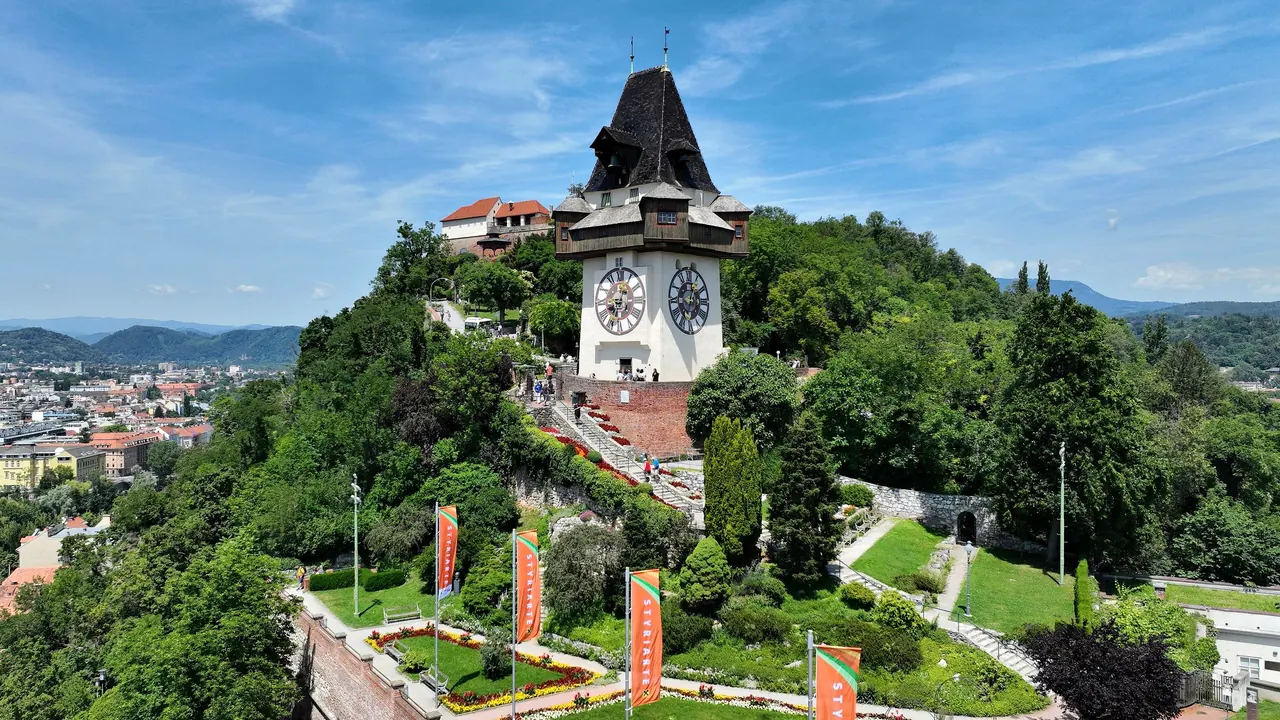
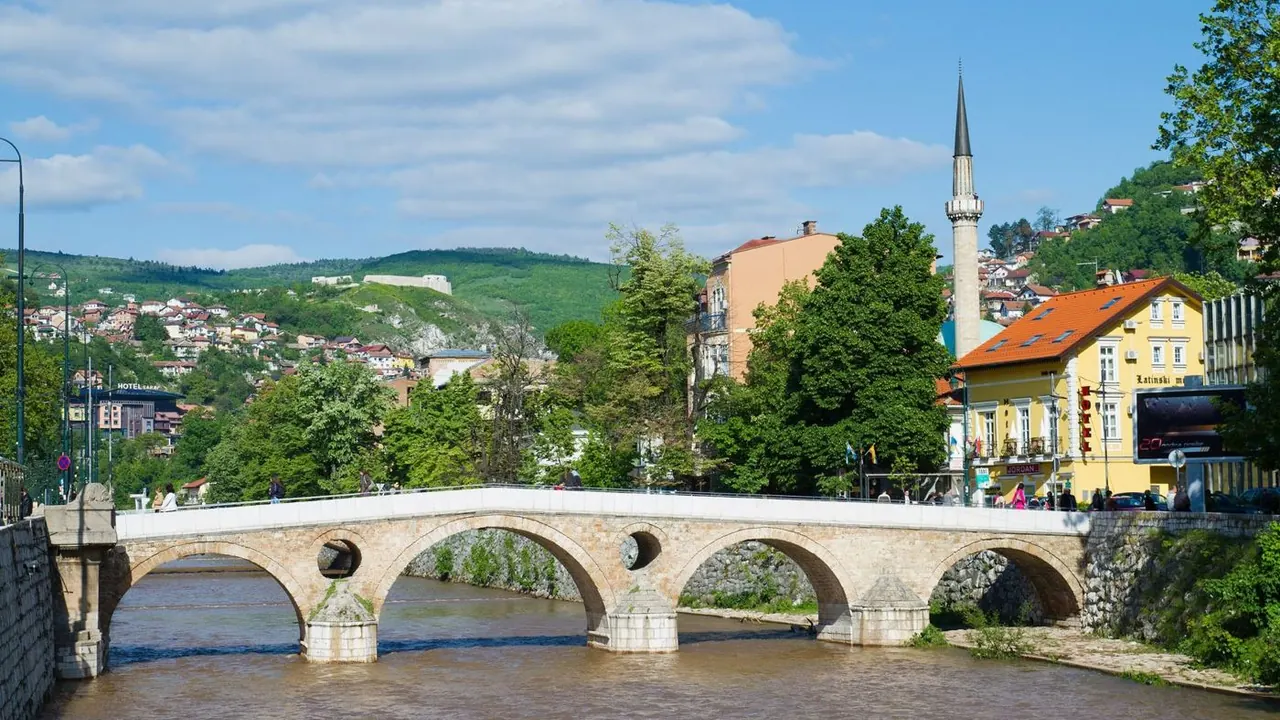
Photos: Graz by C.Stadler/Bwag, CC BY-SA 4.0, cropped; Sarajevo by Tumi-1983, CC0.
Graz or Sarajevo?
Our verdict in twelve categories, each scored against the same fixed benchmark cities, and the climate month by month, so you can choose for your trip.
Choose Graz for
- families
- getting around
- live music and the arts
Graz suits travellers who want a few easy, orderly days. The old town is flat and mostly pedestrianised, the trams go where you need them, and there is a full calendar of opera and festivals. Children have plenty to do, from the Schlossberg slide to the museum in the Augarten. It is the steadier choice for families and for anyone who puts comfort and an evening at the theatre ahead of saving money, and the wine country and spa villages are close by.
Choose Sarajevo for
- prices
- nature and the outdoors
- nightlife
Pick Sarajevo if you want a city that costs little and stays with you. The Ottoman bazaar runs straight into Austro-Hungarian avenues, the siege is remembered all over town, and mountains rise from the city's edges. That makes it the stronger draw for walkers, skiers and anyone on a budget. It asks for more patience with children, though, and with getting around once you leave the tram line.
Scoreboard
Twelve categories on one fixed scale from 0 to 100. The shaded stretch is the gap between the two.
Your match
Pick a travel style or drag the sliders, and both match scores follow your weighting.
Wins on families and getting around with your weighting.
Wins on prices and nature and the outdoors with your weighting.
What matters to you?
Category by category
What the scores mean for a trip.
Beaches & swimming
Neither city is a place to come for swimming, but Graz has the more practical summer dip. The former gravel pits south of town, Schwarzlsee above all, have jetties and grassy banks and water of around 23°C in high summer. They are close enough for an afternoon out.
Sarajevo has cold mountain rivers, pools and the Jablanica lake on the road south. The Adriatic is about three hours away, so swimmers should add a few days on the coast after their stay.
Food & drink
Both cities eat well within a narrow range, but from very different kitchens. Graz cooks from the Styrian countryside: pumpkin seed oil on almost everything, cold fried chicken salad, farmers' markets every morning and crisp white wine from the hills an hour south.
Sarajevo serves Ottoman-Balkan comfort food: ćevapi from the grills of Baščaršija, pita sold by weight and lamb cooked under a metal lid, with the slow ritual of Bosnian coffee at the centre of it all. Choose Graz for wine and market produce, Sarajevo for grills, pastries and coffee. Neither has much international cooking.
Culture & sights
The two are equally rewarding but very different in mood. Graz is a beautifully kept Renaissance and Baroque town, with the Schlossberg clock tower, the Landeszeughaus armoury packed with armour, Schloss Eggenberg and the Kunsthaus for modern contrast.
Sarajevo is about faiths meeting and recent history. A mosque, two cathedrals and a synagogue stand within a short walk of the Ottoman bazaar, the Latin Bridge marks the assassination of 1914, and the siege is remembered at the Tunnel of Hope and the War Childhood Museum. Graz is the more handsome of the two, Sarajevo the more moving.
Nightlife
Neither is a clubbing city, and in both the students keep things going. In Graz, people go out in the lanes of the Bermuda Triangle around Mehlplatz and in the artier bars of Lend, and wine bars set the tone. The city goes quiet over the long summer break.
In Sarajevo, the evening happens in café-bars that fill from the afternoon and get louder as night falls, with cellar bars near Ferhadija and many nights ending over rakija. Drinks are cheaper, and unlike Graz the city is livelier in summer than during term.
Nature & outdoors
Sarajevo has the wilder setting. Mountains rise straight from the city, and a cable car from the Old Town climbs Trebević past the overgrown Olympic bobsleigh track. Jahorina and Bjelašnica, with skiing, open ridges and the shepherds' village of Lukomir, are less than an hour away, though trails are only lightly marked.
Graz is greener and gentler. It has the Schöckl and its cable car, the Mur cycle path and walks through the vineyards to the south. Proper alpine hiking in the Gesäuse is about two hours away, and the ski slopes are further off than Sarajevo's.
Day trips
Both have a good spread of outings, and in both a car or tour makes them easier. From Graz the trips are into the countryside: the South Styrian Wine Road and its taverns, Riegersburg on its volcanic crag, the Lipizzaner stud at Piber, the monastic library at Admont, and Maribor across the border by train.
From Sarajevo the trips are about history, on slower roads. The train follows the Neretva gorge to the bridge at Mostar, Konjic has Tito's bunker, and Blagaj, Počitelj, Travnik and the bridge at Višegrad are all within reach. Go to Graz for wine and landscape, Sarajevo for Ottoman bridges and the twentieth century.
Good for families
Graz is plainly the better choice with children. It is compact, clean and calm. Families can ride the Schlossberg's glass lift or funicular up, then come down by a long slide inside the hill, and a fairytale train runs through tunnels in the rock. FRida & freD in the Augarten is a proper children's museum, and the Herberstein wildlife park and the summer toboggan runs on the Schöckl fill extra days.
Sarajevo welcomes children warmly, and the cable car, the horse-drawn carriages to Vrelo Bosne and the small zoo make pleasant outings. Its main sights are about war, though, the hillside streets are steep, and smoke from the grills and winter smog are hard on small lungs.
Getting around
Graz is the easier city to get around. The centre is flat and largely pedestrianised, trams run along the Herrengasse to the station and Eggenberg on one simple ticket, and cycling along the Mur is easy. Nobody misses a car until they head into the countryside.
Sarajevo's old core is walkable too, and the tram along the valley floor is simple to use, but it is really a single line. Away from it, the buses and minibuses climbing the steep neighbourhoods are harder to follow. The airport, the Tunnel of Hope and the ski mountains are best reached by taxi or tour, though taxis there are cheap.
Shopping & style
Graz has the somewhat broader choice. There are high-street and traditional shops in the historic buildings of the Herrengasse and Sporgasse, a grand nineteenth-century department store with a rooftop view, and design and vintage shops in Lend. The best things to take home are edible: pumpkin seed oil, Schilcher rosé and craft chocolate.
Sarajevo's shopping is concentrated in Baščaršija. Coppersmiths on Kazandžiluk still hammer out coffee sets, and the old Bezistan market sells kilims and filigree jewellery, though much of it is souvenir stock. It is the more atmospheric place to browse, but there is little worth seeking out beyond the bazaar.
Affordability
Sarajevo is far easier on the wallet. Grilled ćevapi, pita from the bakeries and coffee in the bazaar cost very little, sit-down meals stay modest, and central guesthouses cost well below Western European levels. Only the Old Town and the summer film festival push prices up.
Graz is fair for Austria rather than cheap. Student lunch menus and bakeries help, and walking the centre costs nothing, but dinners, wine and hotels cost what they usually do in Austria.
Live music & performing arts
Graz has much more to see on stage. Its Opera, the second largest house in Austria, runs a full season of opera, operetta and ballet, and the Musikverein holds orchestral and chamber concerts. Styriarte in early summer and steirischer herbst in autumn are the high points of the year, and the music university feeds a strong jazz scene.
Sarajevo's National Theatre and Philharmonic offer a modest programme, and the city's highlights are the MESS theatre festival in autumn and the jazz festival in November. What Sarajevo has that Graz does not is sevdah, slow and melancholy love songs you may hear in traditional restaurants.
Wellness & relaxation
Graz has more spa choices, though they lie outside the city. About an hour east, Styria's thermal villages include Hundertwasser's Bad Blumau, Loipersdorf and Bad Waltersdorf, all with large warm pools and saunas open to day visitors. In town, the Stadtpark and the shaded Schlossberg paths are good for a quiet hour.
Sarajevo's answer is Ilidža, at the end of the tram line, with sulphurous springs used since Roman times and the shaded avenue of Vrelo Bosne nearby. It is easier to reach without a car but offers less choice. The historic hammam is no longer a working bath, and winter smog makes the city feel less restful.
When should you go?
Pick your month. The climate figures are measured averages, not a forecast.
Graz in July
Sarajevo in July
Daytime high, °C
Rainfall in the month, mm
Temperature and rainfall are climate normals, averaged over the years shown. Graz: 1991-2020 normals, Graz Airport (7.9 km from centre). Sarajevo: 1991-2020 (rainfall 1971-2000) normals, Sarajevo-Bejelave (2 km from centre).
The two cities have almost the same temperatures through the year, so the real difference is rain. Both are cold from December to February, with daytime highs only a few degrees above freezing. Both are warmest in July and August at around 28°C, which is fine for walking but tiring on Sarajevo's steep hillside steps. Graz has the drier winter, with only 20mm in January. Summer is its wettest season, though, at about 125mm a month from June to August, so a summer stay should allow for wet spells. July and August are also the months when its bathing lakes are warm enough to swim.
Sarajevo's rain is spread evenly through the year, staying between 64mm and 95mm a month, so no season is really dry and none is soaked. This makes its summer drier than Graz's and its winter wetter and greyer, with a little less sunshine in midwinter. In both cities, May, June and September are the best months for sightseeing on foot. Sarajevo's winter is better spent skiing in the mountains above than walking the valley streets.
Which traveller are you?
On a family trip with young children, Graz is the easier city. It has an underground slide and a fairytale train inside the Schlossberg, a children's museum, trams that take buggies and a calm, flat centre. Sarajevo has steep slopes, sights centred on war and smog in winter.
For a trip on a tight budget, Sarajevo goes much further. Ćevapi, burek and coffee in the bazaar cost very little, trams and taxis are cheap, and central guesthouses cost far less than in Graz, where Austrian prices make a stay fair but never cheap.
On an outdoors trip, Sarajevo's mountains are closer and higher. A cable car from the Old Town climbs Trebević, the Olympic ski mountains are under an hour away, and Lukomir and rafting on the Neretva lie beyond. Graz has gentler hills, and its alpine hiking is further out.
Before you go
| Measure | Graz | Sarajevo |
|---|---|---|
| Official language | German, Austrian Sign Language | Croatian, Serbian, Bosnian |
| Currency | Euro (EUR) | Convertible Mark (BAM) |
| Sockets | CF230 V, 50 Hz | CF230 V, 50 Hz |
| Driving side | Right | Right |
| Time zone | UTC+1, UTC+2 in summer | UTC+1, UTC+2 in summer |
| Emergency number | 112 | 112 |
| Elevation | 353 m | 518 m |
| Main airport | Graz Airport (GRZ)9 km from centre26 non-stop destinations | Sarajevo International Airport (SJJ)7 km from centre38 non-stop destinations |
| Public holidays this year | 16 days | 8 days |
By the numbers
| Measure | Graz | Sarajevo |
|---|---|---|
| City population | 306,971 | 275,524 |
| People per km² | 2,406 | 1,947 |
| Museums within 10 km | 29 | 26 |
| UNESCO World Heritage sites within 50 km | 1 | 1 |
Where else could you go?
Every comparison below shares a destination with this one, so you can follow Graz or Sarajevo somewhere new.