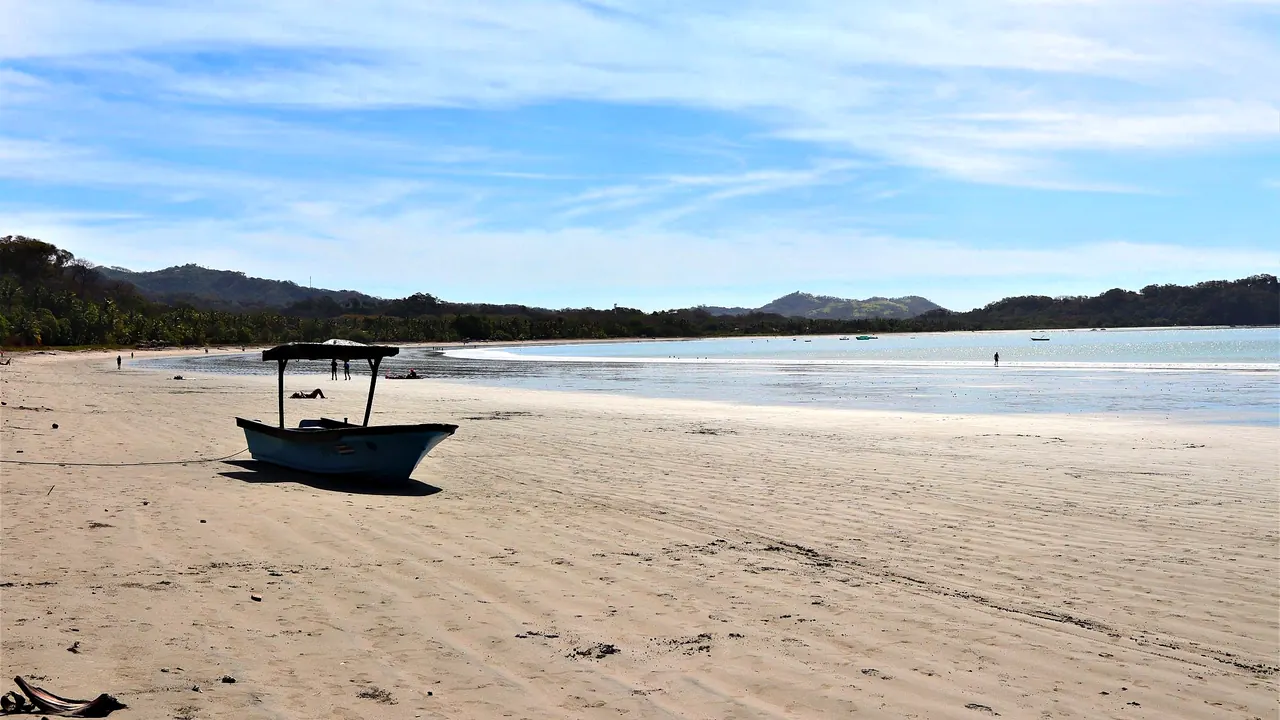
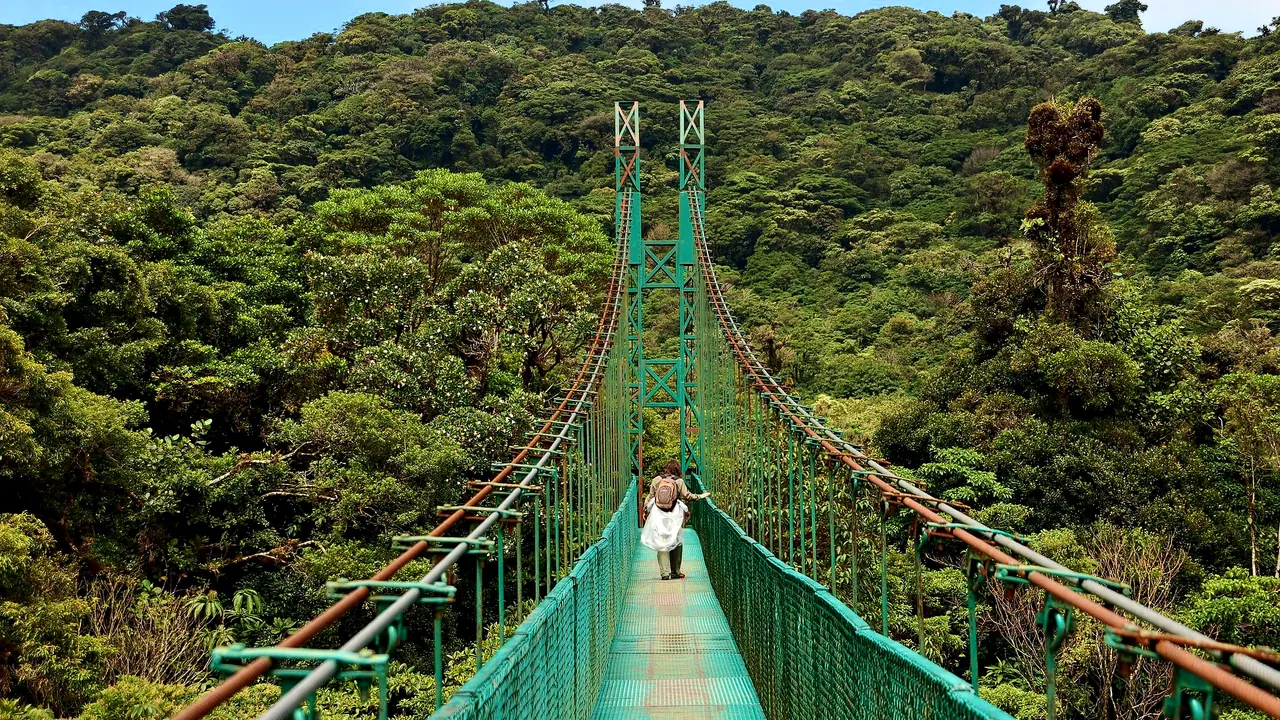
Photos: Guanacaste by ismael jim, Pexels License; Monteverde by Matthias Bethke, CC BY-SA 4.0, cropped.
Guanacaste or Monteverde?
Our verdict in twelve categories, each scored against the same fixed benchmark cities, and the climate month by month, so you can choose for your trip.
Choose Guanacaste for
- beaches
- wellness
- nightlife
Guanacaste suits travellers who want the sea at the centre of their trip. It has warm swimming in sheltered bays and surf at Tamarindo and Nosara, with yoga and volcanic hot springs for unwinding and a few lively evenings when you want them. It is also the easier choice with young children, thanks to calm beaches and resorts set up for families.
Choose Monteverde for
- nature and the outdoors
- prices
Pick Monteverde for the cloud forest itself. Birders, walkers and anyone who prefers cool mountain air to beach heat will get more from a few days of dawn walks, canopy bridges and night tours on the ridge, and it is a little easier on the wallet. Because the coast and the mountain offer such different trips, many people simply do both.
Scoreboard
Twelve categories on one fixed scale from 0 to 100. The shaded stretch is the gap between the two.
Your match
Pick a travel style or drag the sliders, and both match scores follow your weighting.
Wins on beaches and wellness with your weighting.
Wins on nature and the outdoors and prices with your weighting.
What matters to you?
Category by category
What the scores mean for a trip.
Beaches & swimming
Guanacaste is a beach destination first. Its warm Pacific bays range from calm water at Conchal, Flamingo and the Papagayo coves to the surf breaks of Tamarindo and Playa Guiones, and further south Sámara's reef-sheltered bay is the gentlest swim.
Monteverde has no swimming at all. The nearest coast is the Gulf of Nicoya around Puntarenas, two hours down winding roads, so anyone who wants sand on the same trip should add a few nights on the Guanacaste coast before or after the cloud forest.
Food & drink
Neither place is a food destination, but Guanacaste gives you more choice. Besides the casados, ceviche and fried snapper of the beach sodas, it has its own corn-based country cooking in Liberia, Santa Cruz and Nicoya, and Tamarindo and Nosara add sushi, Italian and smarter restaurants aimed at visitors.
In Monteverde, most of the eating is in Santa Elena, and there is little choice in the evening. The local strengths are produce rather than dishes: coffee from the surrounding slopes, which you can taste on farm tours, and cheese from the dairy the Quaker settlers founded.
Culture & sights
Culture is thin in both places, but Guanacaste at least has a few things to see: the adobe streets of Liberia, Nicoya's colonial church, the Chorotega potters of Guaitil, the Santa Rosa hacienda where a battle was fought in 1856, and sabanero rodeos. Monteverde's interest lies in its story, the Quaker settlers of the early 1950s who farmed the land and protected the forest. You feel that history in the community rather than seeing it in buildings or museums.
Nightlife
Tamarindo gives Guanacaste a real night out, with sunset beach bars, a short strip of dance spots and a young crowd of surfers and backpackers. Playas del Coco adds a smaller, rougher bar scene, but the rest of the coast goes to bed early.
In Monteverde the evening outing is a guided night walk looking for sloths, tarantulas and tree frogs, perhaps followed by a drink in Santa Elena. There are no clubs, and most people turn in early for dawn birding.
Nature & outdoors
Both are wildlife trips, but Monteverde's cloud forest is the more remarkable setting. Moss, orchids and bromeliads cover the trees along the continental divide, hanging bridges cross the canopy, and birders come for the quetzal, bellbirds and many species of hummingbird. Costa Rica's zip-line tours began here, and the mild air keeps long walks comfortable.
Guanacaste offers a different set of landscapes: the dry forest of Santa Rosa, the fumaroles and mud pots of Rincón de la Vieja, crocodiles and storks in the Palo Verde wetlands, and nesting turtles at Playa Grande and Ostional. The heat limits hiking to the early hours, and the forest turns brown in the dry months.
Day trips
Guanacaste has more within reach for a day out. You can visit Liberia's colonial streets and market, the plazas of Santa Cruz and Nicoya and the potters of Guaitil, or try another beach town along the coast for a change of scene. Monteverde is the excursion itself: Puntarenas, two hours away, is hardly worth the round trip, and Arenal is about three hours away, so it works better as the next stop on your route.
Good for families
Guanacaste is easier with children of most ages. Calm beaches at Playa Hermosa, Flamingo and Sámara and the kids' clubs of the Papagayo resorts sit alongside zip-lines, river safaris to see crocodiles, and hot springs. The things to plan around are the midday heat and the rips on the surf beaches of Tamarindo and Nosara.
Monteverde suits school-age children who love animals, with hanging bridges, butterfly gardens and night walks with a torch. It is harder with toddlers: the trails are wet and steep, a buggy is no use, and there is no beach to fall back on.
Getting around
Both are awkward without help, but in opposite ways. Guanacaste is easy to reach, since Liberia's airport is within an hour of the northern beaches. After that, though, the region spreads along a long coast where a car is the practical choice, and the dirt roads to Nosara and Ostional favour a four-wheel drive.
Monteverde is the reverse. Getting there means a slow mountain road, but once you arrive you can manage without a car, using taxis, the small bus to the reserves and the hotel pick-ups included with most tours.
Shopping & style
Guaitil's Chorotega pottery, burnished in red, black and cream and sold from family workshops there and around Santa Cruz, is the one purchase worth seeking out in Guanacaste. Otherwise the coast has surf and beachwear shops in Tamarindo and Nosara and a few boutiques selling linen and jewellery.
Monteverde's equivalent is the embroidery and handicrafts of the community's women's artisan cooperative, along with bags of coffee and chocolate grown on the surrounding slopes. Beyond that, Santa Elena has souvenir and outdoor-gear shops, and a keen shopper will not stay busy for long in either place.
Affordability
Guanacaste is the more expensive of the two. In the dry season, beach hotels, the Papagayo resorts, car hire, surf lessons and restaurants aimed at visitors all charge North American prices, and park fees for foreigners add to the bill. You can bring the cost down by staying in hostels or simple cabinas in Tamarindo, Sámara or Coco, eating at local sodas and coming in the green season.
Monteverde costs less from day to day, since hostels, guesthouses and sodas keep the basics manageable. Most of the money goes on the reasons you came: reserve entry, a guide to spot the wildlife, canopy tours, night walks and the shuttle up the mountain.
Live music & performing arts
Neither has any theatre or concert programme to plan a trip around. What differs is the music you might come across. In Guanacaste there is folk dance and marimba at village fiestas and Liberia's July celebrations, plus live bands in some beach bars. In Monteverde, a restaurant sometimes puts on local musicians and the community holds the occasional small concert.
Wellness & relaxation
Guanacaste is the stronger choice for a restorative stay. Nosara is a yoga destination known around the world, with retreat centres in the forest behind Playa Guiones. The volcanic ground at Rincón de la Vieja feeds hot springs and mud baths, and there are resort spas on the Papagayo peninsula as well.
Monteverde has no hot springs, few spas and only some yoga classes. Its calm comes from cool, misty air, birdsong at dawn and lodge balconies over the trees, so if you want pools and massages, plan them for another stop on your route.
When should you go?
Pick your month. The climate figures are measured averages, not a forecast.
Guanacaste in July
Monteverde in July
Daytime high, °C
Rainfall in the month, mm
Where the figures come from
Guanacaste's temperatures are measured 57 km from the centre, at Liberia.
Guanacaste has no rain gauge within 25 km of the centre, so its rainfall comes from a gridded climate dataset read at the destination rather than from a gauge further away.
Monteverde has no weather station within reach, so its figures come from a gridded climate model rather than a measured record, and read a broad area rather than one spot.
Temperature and rainfall are climate normals, averaged over the years shown. Guanacaste: 1991-2020 normals, Liberia (56.7 km from centre). Monteverde: 1991-2020 normals, TerraClimate 4 km grid at the town, no weather station within 90 km.
Around Guanacaste's main beach area, the dry season runs from December to April, and from January to March there is almost no rain. The heat builds steadily, though, reaching 36°C in March and April, so walks and hikes are best done early in the morning. The sea stays around 28°C all year. Rain sets in from May, eases a little in July and is heaviest in September and October, when October brings about 377mm.
Monteverde, up on its ridge, stays mild all year, with highs around 23°C that are comfortable for walking at any hour. Its driest stretch is February to April, although the ridge is often windy and misty then. From May to November the afternoons bring heavy rain, wetter than on the coast. The two share the same dry season, so December to April is the easiest time to combine them.
Which traveller are you?
On a beach and sun trip, Guanacaste is the obvious choice. It has warm Pacific water, calm coves at Conchal and on the Papagayo peninsula, and surf at Tamarindo and Playa Guiones. Monteverde sits on a mountain ridge with no swimming at all.
For an outdoors trip built around wildlife, Monteverde comes out ahead. It has cloud-forest trails, hanging bridges, quetzals for birders and the original zip-line canopy tours, and the mild air makes walking pleasant all day. On Guanacaste's hot coast, hiking is mostly limited to the early morning.
On a relaxing and wellness trip, Guanacaste has far more to offer. There are yoga retreats in Nosara, hot springs and mud baths at Rincón de la Vieja, and resort spas on the Papagayo peninsula. Monteverde gives you quiet and birdsong, but no thermal pools.
Before you go
| Measure | Guanacaste | Monteverde |
|---|---|---|
| Official language | Spanish | Spanish |
| Currency | Costa Rican Colon (CRC) | Costa Rican Colon (CRC) |
| Sockets | AB120 V, 60 Hz | AB120 V, 60 Hz |
| Driving side | Right | Right |
| Time zone | UTC-6 | UTC-6 |
| Emergency number | 911 | 911 |
| Elevation | - | 1,330 m |
| Main airport | Daniel Oduber Quirós International Airport (LIR)30 non-stop destinations | Juan Santamaría International Airport (SJO)76 km from centre49 non-stop destinations |
| Public holidays this year | 11 days | 11 days |
By the numbers
| Measure | Guanacaste | Monteverde |
|---|---|---|
| Population | 412,808 | 5,386 |
| People per km² | 40 | 101 |
| Museums within 10 km | - | 1 |
| UNESCO World Heritage sites within 50 km | - | 1 |
| Swim season, months above 21 °C | 12 months | 12 months |
Where else could you go?
Every comparison below shares a destination with this one, so you can follow Guanacaste or Monteverde somewhere new.
- La Fortunavs Monteverde
- Santa Teresa, Costa Ricavs Monteverde
- San Jose, Costa Ricavs Monteverde
- Tamarindovs Monteverde
- La Fortunavs Guanacaste
- Granada, Nicaraguavs Monteverde