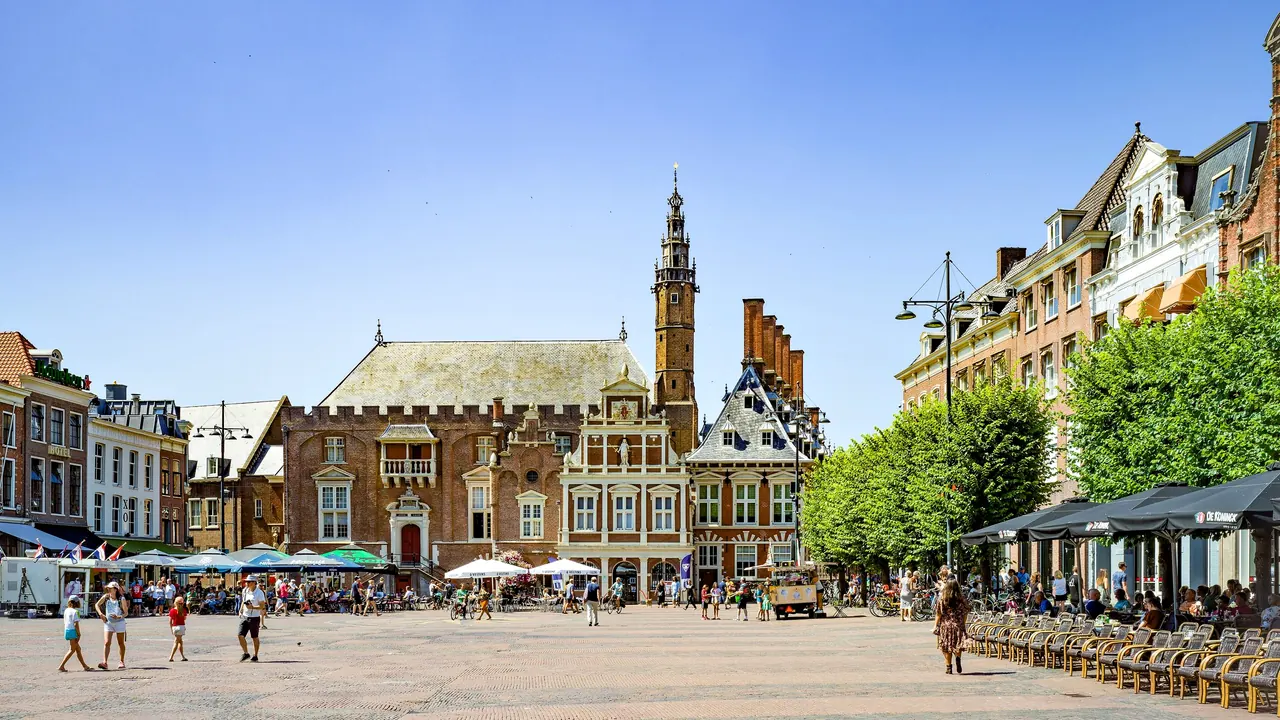
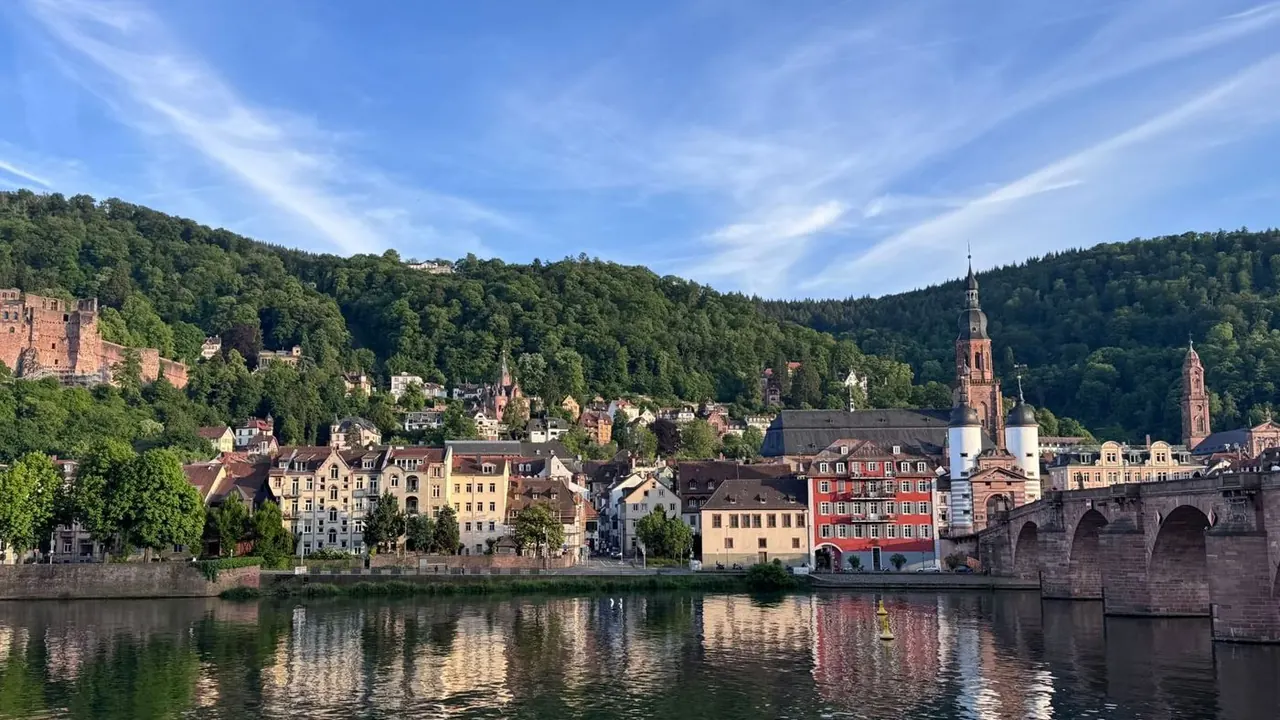
Photos: Haarlem by Moroder, CC BY-SA 4.0, cropped; Heidelberg by Kuanling Chen, Pexels License.
Haarlem or Heidelberg?
Our verdict in twelve categories, each scored against the same fixed benchmark cities, and the climate month by month, so you can choose for your trip.
Choose Haarlem for
- beaches
- shopping
- day trips
Haarlem is the better choice if you want a calm, good-looking small base with half of the Netherlands within easy reach. Amsterdam, Leiden and The Hague are short train rides away, the dunes and the North Sea start at the edge of town, and the side streets off the Grote Markt make for some of the best browsing in either city. It suits travellers who want to mix city days, cycling and a breezy afternoon on the sand, and who don't mind paying northwest European prices.
Choose Heidelberg for
- prices
- families
- nightlife
Families and anyone who likes hills, forest and wine will find more in Heidelberg. A funicular climbs to a castle ruin and wooded trails, and the zoo, the river boats and the big technology museum nearby keep children busy. In term time the student bars give the evenings a bit more life, and a stay costs a little less. There is no sea, so beach lovers should look elsewhere.
Scoreboard
Twelve categories on one fixed scale from 0 to 100. The shaded stretch is the gap between the two.
Your match
Pick a travel style or drag the sliders, and both match scores follow your weighting.
Wins on beaches and shopping with your weighting.
Wins on prices and families with your weighting.
What matters to you?
Category by category
What the scores mean for a trip.
Beaches & swimming
Haarlem has a real coast on its doorstep. Zandvoort's long beach is a short train ride away, the quieter, dune-backed sand at Bloemendaal aan Zee is reachable by bike, and pavilions line the shore in summer. The North Sea is cool and often windy, though, so a beach day here usually means walking, sheltering from the wind and a quick dip rather than long swims.
Heidelberg has no beach at all. The Neckar is not for swimming, so on hot days people use the town's outdoor pools or drive about half an hour to the gravel-pit lakes on the Rhine plain.
Food & drink
Neither city is a serious food destination, and both serve good regional cooking without much depth. In Haarlem the strength is beer. The town has a long brewing history and a good craft scene, and you can drink it in brown cafés and on terraces around the Grote Markt, with raw herring and kibbeling from the Saturday market.
Heidelberg's strength is wine. Riesling and Pinot come from the Bergstrasse vineyards at the edge of town, and the food is hearty Baden cooking, with white asparagus in spring. Skip the tourist places on the Hauptstrasse and eat in Neuenheim or the village wine taverns, while the student population keeps cheap meals easy to find.
Culture & sights
The two are about level for culture, but they offer different things. Haarlem is a city of art and quiet interiors: Frans Hals portraits, the 18th-century oval room at Teylers, the almshouse courtyards behind plain doors and the great organ in St Bavo.
Heidelberg's appeal is its setting and its scholarly past. The red sandstone castle ruin stands above the river, the Old Bridge crosses the Neckar, and the student prison walls are covered in graffiti from Germany's oldest university. Either city fills two easy days.
Nightlife
Heidelberg has a little more going on after dark, at least in term time. The pubs packed into the Untere Strasse fill up late, old student taverns sit nearby, and there are a few clubs out towards the station. Outside term the town goes quiet early.
Haarlem's evenings are sociable but low-key, mostly terraces and brown cafés around the Grote Markt and the Botermarkt, with almost no clubbing. Its advantage is that Amsterdam is only fifteen minutes away by train, which is closer than Heidelberg's big-night options in Mannheim or Frankfurt.
Nature & outdoors
Both have good countryside right at the edge of town, but the landscapes are very different. Haarlem's is flat and coastal: the dunes, pine woods and lakes of Zuid-Kennemerland, with Highland cattle and wild ponies, long beach walks and the striped bulb fields towards Leiden in spring.
Heidelberg has woods and slopes. You can take the Philosophers' Walk, ride the funicular up the Königstuhl for hours of forest trails, or cycle the Neckar valley past castles, and the sandstone crags of the Palatinate Forest are about an hour away. Choose it if you want some climbing on your walks.
Day trips
Haarlem has the edge for day trips because so many major cities are close by train. Amsterdam is fifteen minutes away, Leiden twenty, and The Hague, Delft, Utrecht and Rotterdam are all easy, along with Alkmaar's cheese market and Zaanse Schans. The rail network is dense enough that you hardly need to plan.
Heidelberg is a strong base too, but its outings are mostly smaller and historic: Speyer's cathedral, Schwetzingen's palace gardens, Worms, Maulbronn and the castle villages up the Neckar. Some, like the Palatinate wine villages, are easier by car.
Good for families
Heidelberg has more ready-made attractions for children. The funicular ride is an outing in itself, and there is a fairy-tale park at the top, a compact zoo by the river and boat trips past castles. The Technik Museum Speyer, where children can climb into a submarine and a space shuttle, and a large theme park are both within reach. The main drawback is that the cobbled, sloping Altstadt is hard work with a pushchair.
Haarlem is relaxed and largely car-free, with dunes, beach and playgrounds in the national park. But it has no zoo, aquarium or theme park, so families usually go to Amsterdam for those.
Getting around
Haarlem is a little easier to get around. The station sits at the edge of a flat centre you can cross on foot in twenty minutes, and bike paths run all the way to the dunes and the sea.
In Heidelberg the main station is a fair way west of the Altstadt, so most visitors take a tram in, and the cobbles and the steep path to the castle slow you down. The funicular and a single fare system across the Rhine-Neckar region make up for much of that.
Shopping & style
Haarlem is clearly the better place to shop. Gierstraat, Kleine Houtstraat and Schagchelstraat are full of independent fashion, interiors, bookshops and delicatessens, and on market days the main square fills with flowers and cheese.
Heidelberg's long Hauptstrasse has department stores and familiar chains at one end and cuckoo clocks, beer steins and Studentenkuss chocolates at the other. A bottle of Bergstrasse wine is the best thing to take home, and serious shoppers go to Mannheim or Frankfurt.
Affordability
Neither town is cheap, but Heidelberg costs somewhat less. Its student cafés, bakeries and simple taverns keep meals reasonable, the regional transport ticket is good value for day trips, and you can save on hotels by staying in Mannheim and coming in by train.
Haarlem has few hotels for the number of visitors, and the rooms tend to be small for the price, especially in tulip season. Market stalls and lunches keep daily spending down, but train fares for frequent outings add up.
Live music & performing arts
The two have similar programmes for small towns, each with its own speciality. Haarlem's is the organ: St Bavo's great instrument is played in regular concerts and hosts a long-running international organ festival. The Philharmonie covers classical music, and the Stadsschouwburg's theatre is mostly in Dutch.
Heidelberg has its own opera at the municipal theatre. In spring the Heidelberger Frühling festival brings chamber music, and in summer the castle courtyard becomes an open-air stage. Haarlem visitors have to go to Amsterdam for opera.
Wellness & relaxation
Both towns have only small facilities for wellness in town, and the big sauna or thermal complexes are a short trip away. Haarlem has a few saunas and beauty spas of its own, and the large Dutch day-spa complexes with outdoor pools and gardens are in the wider region. Most visitors unwind on foot or by bike in the dunes instead.
Heidelberg's in-town choice is mostly hotel spas. Its real advantage is warm water: the Kraichgau thermal baths with saline pools are about half an hour away, and Baden-Baden is about an hour south. In town, the calm places are the Neckar meadows and the forest paths, away from the midday crowds on the Hauptstrasse.
When should you go?
Pick your month. The climate figures are measured averages, not a forecast.
Haarlem in July
Heidelberg in July
Daytime high, °C
Rainfall in the month, mm
Where the figures come from
Haarlem has no rain gauge within 25 km of the centre, so its rainfall comes from a gridded climate dataset read at the city rather than from a gauge further away.
Haarlem's sunshine is measured 49 km from the centre, at De Bilt.
Temperature and rainfall are climate normals, averaged over the years shown. Haarlem: 1991-2020 normals, Amsterdam Airport Schiphol (12.7 km from centre). Heidelberg: 1991-2020 (sunshine 1971-2000) normals, Heidelberg (4.5 km from centre).
Both cities are at their best from May to September, but their summers feel different. Haarlem stays mild, with highs of about 22°C in July and August, and the North Sea warms to about 19°C only in August. That makes high summer the time for beach afternoons and a quick dip, but the water is never really warm. The sunniest stretch runs from April to July. After that the rain builds and peaks in October at about 109mm, so autumn is the wettest time for cycling and canal walks.
Heidelberg gets warmer, reaching about 26°C in July and August, its sunniest months. That is pleasant for the river meadows and wine taverns, and still comfortable for walking the Altstadt. July brings its heaviest rain, mostly as summer showers, and its winters are drier than Haarlem's, especially in January and February. Both cities are cold and grey from November to February, so a winter visit is better for museums and cafés than for time outdoors.
Which traveller are you?
On a beach and sun trip, Haarlem is the only real option of the two. Zandvoort's sand is ten minutes away by train and Bloemendaal is a bike ride through the dunes. Heidelberg has outdoor pools and gravel-pit lakes, but no sea.
For a shopping trip, Haarlem wins easily. Independent boutiques, design shops and delicatessens fill the lanes south and west of the Grote Markt. In Heidelberg most of the Hauptstrasse is high-street chains and souvenir stalls, and keen shoppers end up going to Frankfurt.
On a family trip with children, Heidelberg offers more ready-made fun: the funicular, a fairy-tale park on the Königstuhl, a riverside zoo, Neckar boat trips and aircraft to climb into at Speyer. In Haarlem, families have to travel to Amsterdam for attractions like these.
Before you go
| Measure | Haarlem | Heidelberg |
|---|---|---|
| Official language | Dutch | German |
| Currency | Euro (EUR) | Euro (EUR) |
| Sockets | CF230 V, 50 Hz | CF230 V, 50 Hz |
| Driving side | Right | Right |
| Time zone | UTC+1, UTC+2 in summer | UTC+1, UTC+2 in summer |
| Emergency number | 112 | 112 |
| Elevation | 2 m | 114 m |
| Main airport | Amsterdam Airport Schiphol (AMS)12 km from centre287 non-stop destinations | Frankfurt Main Airport (FRA)69 km from centre281 non-stop destinations |
| Public holidays this year | 11 days | 12 days |
By the numbers
| Measure | Haarlem | Heidelberg |
|---|---|---|
| City population | 162,543 | 156,092 |
| People per km² | 5,064 | 1,433 |
| Museums within 10 km | 28 | 17 |
| UNESCO World Heritage sites within 50 km | 5 | 4 |
| Swim season, months above 21 °C | None | - |
Where else could you go?
Every comparison below shares a destination with this one, so you can follow Haarlem or Heidelberg somewhere new.
- Amsterdamvs Haarlem
- The Haguevs Haarlem
- Utrechtvs Haarlem
- Rotterdamvs Haarlem
- Frankfurtvs Heidelberg
- Stuttgartvs Heidelberg