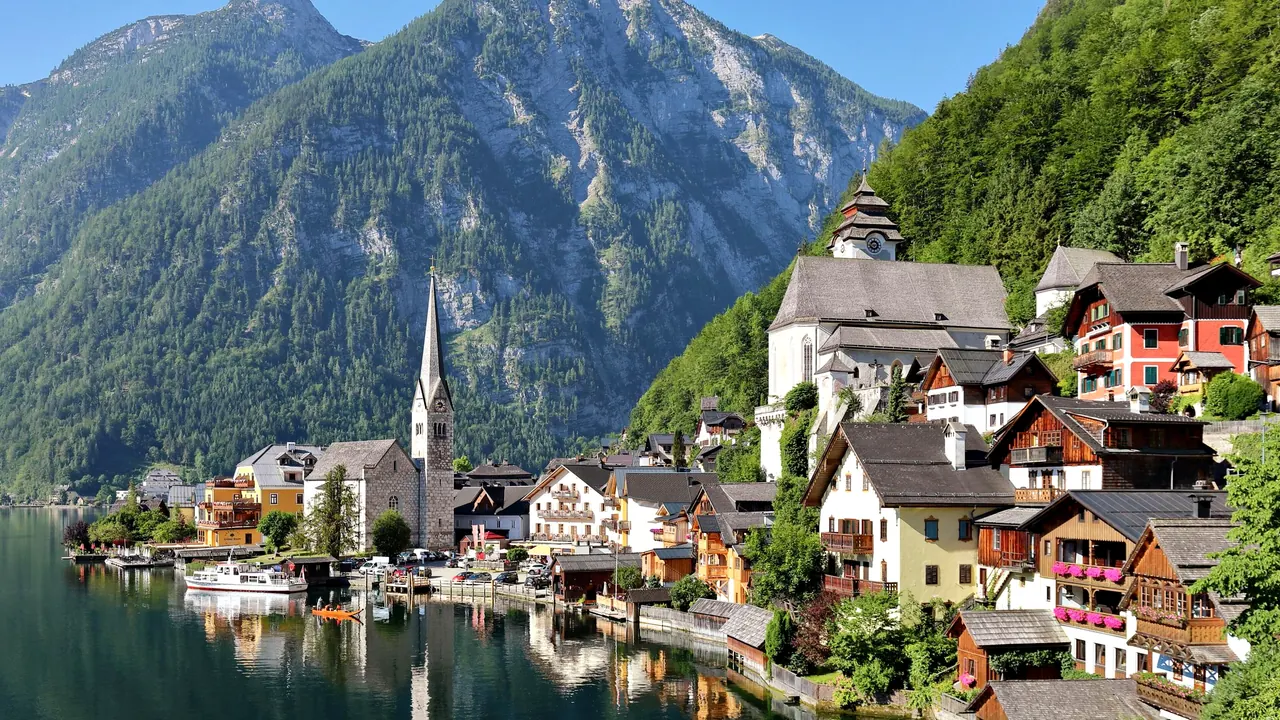
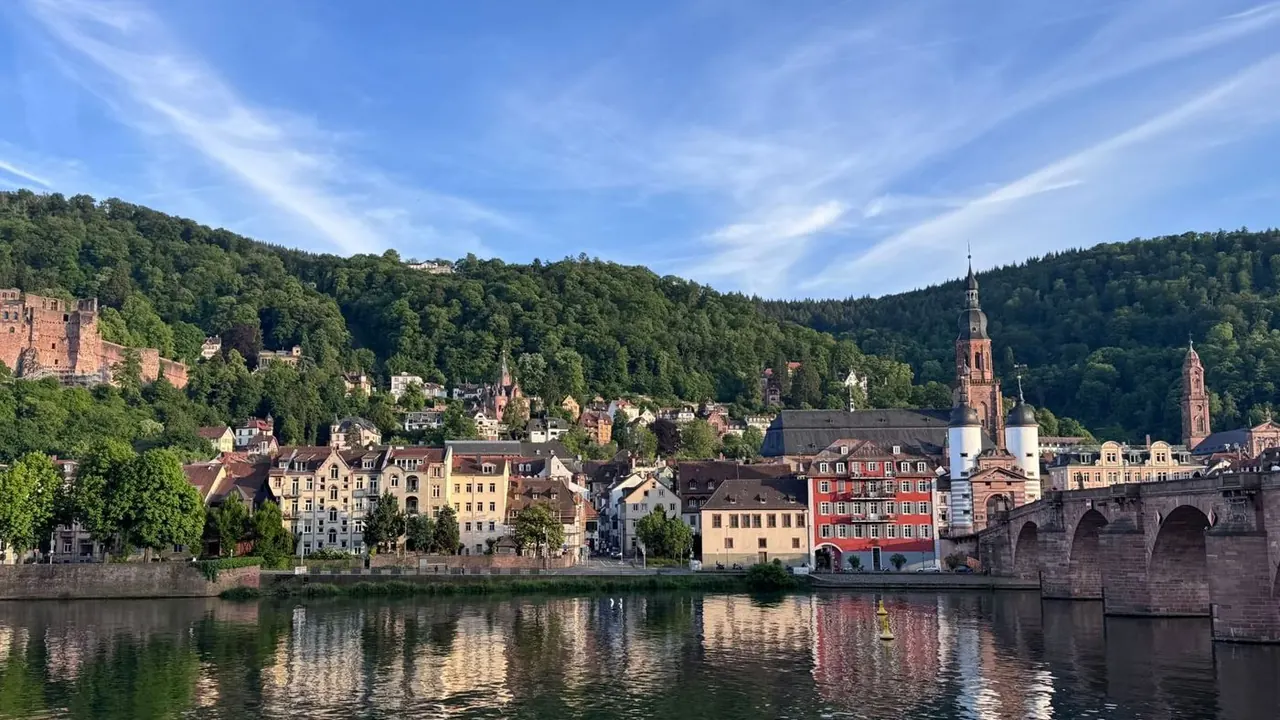
Photos: Hallstatt by C.Stadler/Bwag, CC BY-SA 4.0, cropped; Heidelberg by Kuanling Chen, Pexels License.
Hallstatt or Heidelberg?
Our verdict in twelve categories, each scored against the same fixed benchmark cities, and the climate month by month, so you can choose for your trip.
Choose Hallstatt for
- nature and the outdoors
- beaches
- wellness
Choose Hallstatt if the mountains are the point of the trip. The village sits under the Dachstein, with cable cars, ice caves, glacier valleys and lake paths starting from the door, and once the day visitors leave the evenings are very quiet. It suits walkers, photographers and couples who want early mornings on the water and don't mind simple food, a lot of rain and high room prices.
Choose Heidelberg for
- live music and the arts
- nightlife
- shopping
Heidelberg is the better all-round town. It has a castle and an old university town to explore, a theatre season and a student bar lane for the evenings, Baden wine with dinner, and trams and trains that make day trips easy. Families, culture lovers and anyone without a car will find it easier and better value, and the walking there is in gentle wooded hills rather than high mountains.
Scoreboard
Twelve categories on one fixed scale from 0 to 100. The shaded stretch is the gap between the two.
Your match
Pick a travel style or drag the sliders, and both match scores follow your weighting.
Wins on nature and the outdoors and beaches with your weighting.
Wins on live music and the arts and nightlife with your weighting.
What matters to you?
Category by category
What the scores mean for a trip.
Beaches & swimming
Neither is a swimming destination, but Hallstatt at least has water you can get into. Hallstätter See is clear and cold, and you can swim from the jetty lawn at the north end of the village or the lido at Obertraun. It works best as a bracing dip after a hike in July or August.
Heidelberg's Neckar is not a river for swimming. On a hot day, the choice is a city outdoor pool or a gravel-pit lake on the Rhine plain about half an hour away.
Food & drink
Heidelberg eats noticeably better. It has Baden and Kurpfalz dishes such as Maultaschen and Schäufele, white asparagus in spring, and Riesling and Pinot from the Bergstrasse vineyards at the edge of town. The best meals are in the Altstadt side streets, in Neuenheim and in the wine villages, and students keep cheap food plentiful.
Hallstatt has a handful of guesthouse dining rooms serving schnitzel and goulash. The one local dish is char or whitefish from the lake, and kitchens can close early. For pastries and more choice, people go to Bad Ischl.
Culture & sights
Heidelberg has more to see over a longer stay. The red sandstone castle with its Great Tun, the baroque Altstadt, the Old Bridge, the university's Student Prison and the Kurpfälzisches Museum easily fill a day or two.
Hallstatt's sights are fewer but very old. The village is the heart of a UNESCO landscape, salt has been mined in the mountain for seven thousand years, and the Iron Age Hallstatt culture of early Europe takes its name from finds here. The salt mine, the museum and the painted skulls of the Beinhaus make a memorable but short day.
Nightlife
Heidelberg has a real night out, although a student-sized one. The Untere Strasse fills with small bars in term time, old student taverns sit nearby, and there are a few clubs towards the station. For anything bigger, people take the train to Mannheim.
Hallstatt has essentially nothing after dinner. The evening means a glass of wine by the water and a walk along the dark lake, which many overnight guests come for.
Nature & outdoors
This is where Hallstatt wins easily. Sheer Alpine country rises straight from the lakeshore. There is the Five Fingers platform on the Krippenstein, the Giant Ice Cave and the Mammoth Cave, the Echerntal path towards the glacier, hut-to-hut hiking and via ferratas, and freeride and ski touring in winter.
Heidelberg's outdoors is softer and greener. You can climb the Philosophers' Walk, take the funicular up the Königstuhl for forest trails, find Celtic ramparts on the Heiligenberg and cycle the Neckar valley. It suits walkers and cyclists rather than mountaineers.
Day trips
Heidelberg is the better base for day trips, mostly because the trains make them easy. Speyer's Romanesque cathedral, the Schwetzingen palace gardens, Worms, Lorsch and Maulbronn are all close, Frankfurt and Mainz are about an hour away, and Strasbourg is possible as a long day.
From Hallstatt you can visit the Salzkammergut lake towns: imperial Bad Ischl, St Wolfgang, Gmunden on the Traunsee and Altaussee, with Salzburg about an hour and a half away by car. They are lovely, but without a car the buses and lakeside railway need planning.
Good for families
Heidelberg is easier with children. There is the funicular to the Königstuhl with a small fairy-tale park at the top, a compact zoo by the Neckar and river boat trips. Within reach are the Technik Museum Speyer, with a space shuttle and submarine to climb into, and a large theme park.
Hallstatt has a few highlights for children: the wooden miners' slides in the salt mine and, for older children, the ice caves. Its single steep lane is crowded at midday and hard work with a pushchair, so families usually stay in Obertraun.
Getting around
Both centres are walkable, and both have steep, uneven streets. Heidelberg is far easier once you go further. Trams take you in from the station, a funicular runs up to the castle, and one fare system covers buses, trams and the S-Bahn across the Rhine-Neckar region.
Hallstatt village takes minutes to cross on foot. To get there, though, you take a small boat from the station on the far shore, and regional buses are sparse outside summer, so many visitors find a car worth having.
Shopping & style
Heidelberg gives you a proper shopping street. The long pedestrian Hauptstrasse has chain stores and department stores at one end, cuckoo clocks and Studentenkuss chocolates at the other, and independent bookshops and boutiques in the side lanes. A bottle of Bergstrasse wine is the best thing to take home.
Hallstatt's shopping is a half-hour stroll past souvenir shops on one lane. Salt from the local mine, carved wood and schnapps are what you will find there.
Affordability
Heidelberg is the cheaper of the two. Its hotels are its main expense, with prices around the western German norm. Bakeries, student cafés and simple taverns keep meals cheap, and the regional transport ticket makes day trips good value.
Hallstatt has few rooms and visitors from around the world, so lodging is well above the Austrian average and resort-level meals add up. The salt mine, funicular and cable car all charge on top. Budget travellers stay in Bad Goisern or Bad Ischl and visit Hallstatt for the day.
Live music & performing arts
The two are far apart here. Hallstatt has nothing you could plan an evening around. Music there is a matter of luck: the brass band at a feast day, or a church concert if you happen to be there in summer. For a real night of opera or operetta, you have to make the trip to Bad Ischl or Salzburg.
Heidelberg, small as it is, gives you something to book on almost any visit. The town theatre in the Altstadt puts on opera, plays, dance and orchestral concerts through its season. In spring the Heidelberger Frühling festival brings chamber music, and in summer performances move into the ruined castle courtyard, which is the most memorable setting either town offers.
Wellness & relaxation
Neither has spa baths of its own, and both rely on nearby spa towns. From Hallstatt it is Bad Ischl's historic salt-brine baths, along with Bad Aussee and Bad Goisern. From Heidelberg it is the thermal pools of the Kraichgau and, a little further, Baden-Baden.
The calm itself feels different. Hallstatt's quiet comes from mist on the lake at dawn and an empty lakeshore in the evening. Heidelberg's comes from summer evenings on the Neckar meadows in Neuenheim and unhurried wine taverns.
When should you go?
Pick your month. The climate figures are measured averages, not a forecast.
Hallstatt in July
Heidelberg in July
Daytime high, °C
Rainfall in the month, mm
Where the figures come from
Hallstatt's temperatures are measured 56 km from the centre, at Salzburg.
Hallstatt has no rain gauge within 25 km of the centre, so its rainfall comes from a gridded climate dataset read at the city rather than from a gauge further away.
Temperature and rainfall are climate normals, averaged over the years shown. Hallstatt: 1991-2020 normals, Salzburg (55.5 km from centre). Heidelberg: 1991-2020 (sunshine 1971-2000) normals, Heidelberg (4.5 km from centre).
Hallstatt and Heidelberg have much the same temperatures through the year, cold in winter and warm in summer, with Heidelberg a degree or two milder. From June to August both reach the mid-20s, peaking around 25°C at Hallstatt and 26°C in Heidelberg. That is warm enough for a cold swim in the lake at Hallstatt and long evenings by the Neckar. The real difference is rain. Hallstatt is far wetter all year and wettest in summer, with about 178mm in July against 80mm in Heidelberg, so mountain days there often bring showers and low cloud.
For walking, May, June and September are the best months in both places, warm without being hot. From April to August Heidelberg has more sunshine as well as less rain, and in September the two are about level. Hallstatt gets more sun in March and October, and stays the sunnier of the two through the winter, when snow on the Krippenstein brings ski touring. Heidelberg's months from November to February see little sun and suit museums better than viewpoints.
Which traveller are you?
On an outdoors trip, Hallstatt is the clear choice. It has real Alpine country: the Krippenstein cable car, the Dachstein ice caves, the Echerntal waterfalls and the walk to the Gosausee. Heidelberg's Odenwald forest trails and the Neckar cycle path are pleasant, but much gentler.
For a culture and arts trip, Heidelberg offers much more. There is the castle ruin, Germany's oldest university with its Student Prison, and a municipal theatre with opera and concerts, plus music festivals in spring and summer. Hallstatt's salt mine and Beinhaus fill a fascinating day, not a week.
On a food and nightlife trip, Heidelberg is the only real choice. You get Kurpfalz cooking, local Riesling, wine taverns in the surrounding villages and the student pubs of the Untere Strasse. In Hallstatt you will find lake fish, Austrian standards and a village that is silent by late evening.
Before you go
| Measure | Hallstatt | Heidelberg |
|---|---|---|
| Official language | German, Austrian Sign Language | German |
| Currency | Euro (EUR) | Euro (EUR) |
| Sockets | CF230 V, 50 Hz | CF230 V, 50 Hz |
| Driving side | Right | Right |
| Time zone | UTC+1, UTC+2 in summer | UTC+1, UTC+2 in summer |
| Emergency number | 112 | 112 |
| Elevation | 511 m | 114 m |
| Main airport | Salzburg Airport (SZG)55 km from centre64 non-stop destinations | Frankfurt Main Airport (FRA)69 km from centre281 non-stop destinations |
| Public holidays this year | 16 days | 12 days |
By the numbers
| Measure | Hallstatt | Heidelberg |
|---|---|---|
| City population | 741 | 156,092 |
| People per km² | 12 | 1,433 |
| Museums within 10 km | 3 | 17 |
| UNESCO World Heritage sites within 50 km | 2 | 4 |
Where else could you go?
Every comparison below shares a destination with this one, so you can follow Hallstatt or Heidelberg somewhere new.
- Salzburgvs Hallstatt
- Frankfurtvs Heidelberg
- Stuttgartvs Heidelberg
- Baden-Badenvs Heidelberg
- Strasbourgvs Heidelberg
- Bledvs Hallstatt