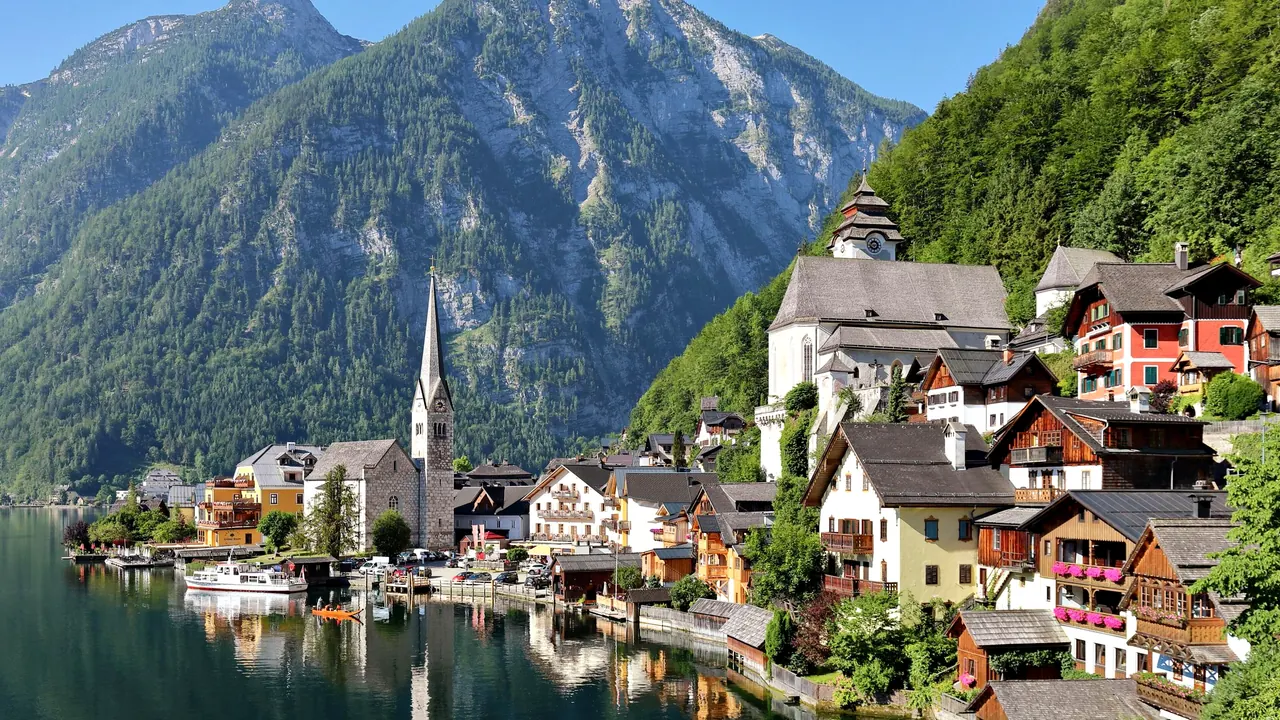
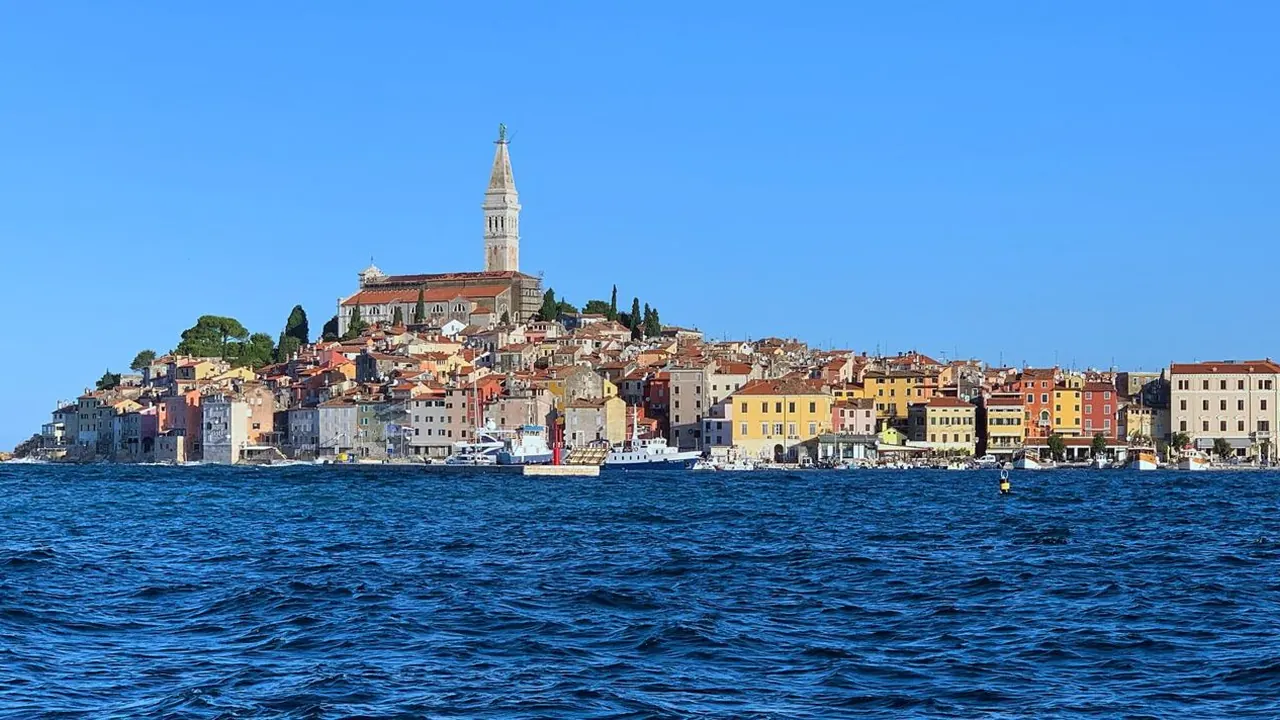
Photos: Hallstatt by C.Stadler/Bwag, CC BY-SA 4.0, cropped; Rovinj by Vyacheslav Bukharov, CC BY-SA 4.0, cropped.
Hallstatt or Rovinj?
Our verdict in twelve categories, each scored against the same fixed benchmark cities, and the climate month by month, so you can choose for your trip.
Choose Hallstatt for
- nature and the outdoors
- getting around
- wellness
Hallstatt is for travellers who want mountains rather than a beach. The village sits on a lake under the Dachstein, with ice caves, the Krippenstein cable car, high paths and winter ski touring, and its salt-mining history goes back to prehistory. It suits walkers and couples who are happy with quiet evenings, a short list of sights and simple Austrian food. It is at its best if you stay the night, after the day visitors have gone.
Choose Rovinj for
- beaches
- food and drink
- nightlife
For a summer by the sea, Rovinj makes far more sense. You can swim in warm, clear Adriatic water off the rocks of the Golden Cape, eat Istrian truffles and fish, drink local wine and spend the evenings walking the Venetian old town. That makes it an easy week for couples and families. It is still a small town with little nightlife, but it has more to eat, drink and swim in than Hallstatt, and a stay costs a little less.
Scoreboard
Twelve categories on one fixed scale from 0 to 100. The shaded stretch is the gap between the two.
Your match
Pick a travel style or drag the sliders, and both match scores follow your weighting.
Wins on nature and the outdoors and getting around with your weighting.
Wins on beaches and food and drink with your weighting.
What matters to you?
Category by category
What the scores mean for a trip.
Beaches & swimming
Rovinj is by far the better place to swim. Limestone ledges, pebble coves and bathing platforms run for kilometres through the Golden Cape park, the Adriatic stays warm and clear all summer, and taxi boats go to quieter coves on St Catherine and Red Island. The only thing missing is sand.
In Hallstatt a swim means a cold dip in a deep Alpine lake that reaches about 20°C at its warmest. You can get in from a small lawn and jetty in the village or from the lido at Obertraun. It is refreshing after a hike, but there is little shore to lie on and the season is short.
Food & drink
Neither town is a destination for food, but you will eat noticeably better in Rovinj. It draws on what Istria produces: scampi buzara, fuži pasta with truffle, peppery olive oil and Malvazija and Teran wines. There are a few refined restaurants in town and family konobas in the hills that serve slow-cooked meat.
Hallstatt has a few guesthouse dining rooms serving schnitzel, goulash and dumplings, plus one local speciality: char and whitefish from the lake. Dinner ends early once the day visitors leave. For more choice, people drive to Bad Ischl and its old patisseries.
Culture & sights
Both towns are their own main sight and take no more than a day to see, but the kind of history is different. Hallstatt's is very old. You can go inside the mountain to see seven thousand years of salt mining, learn the prehistoric story that gave the Hallstatt culture its name, and see the painted skulls of the Beinhaus.
Rovinj's is Venetian. The old town fills a former island, with pastel houses climbing to the Church of St Euphemia, and you can climb its bell tower. The Batana House tells the story of the local fishing boats.
Nightlife
Neither is a place for a big night out, but Rovinj at least has some evening life. On summer nights there are cocktail and wine bars on the waterfront, drinks on the rocks at sunset and a couple of late places for dancing in high season. Hallstatt has almost nothing after dark beyond dinner on a terrace and a walk by the lake, and for many people staying overnight that quiet is the point.
Nature & outdoors
This is Hallstatt's great strength and the clearest difference between the two. The Dachstein rises straight from the village. There is the Krippenstein cable car to the Five Fingers platform, the Giant Ice Cave and the Mammoth Cave, the waterfalls of the Echerntal and the walk to the Gosausee, with via ferratas in summer and freeride and ski touring in winter.
Rovinj's outdoors is gentler and mostly about the sea. Kayaking and diving around the archipelago, cycling the flat paths of the Golden Cape and a boat trip into the Lim Fjord make pleasant days, but there are no mountains.
Day trips
Hallstatt's outings are imperial and Alpine. You can visit the Habsburg Kaiservilla at Bad Ischl, the pilgrimage church and altarpiece at St Wolfgang, the lake castle at Gmunden and the Styrian lakes around Altaussee. Salzburg makes a long but worthwhile day. Without a car, most of this can still be done by bus and the lakeside railway if you plan ahead.
Rovinj's trips are Roman and Istrian. Pula's amphitheatre and the mosaics of the Euphrasian Basilica at Porec are each a short drive away. Inland, the hill towns of Motovun and Groznjan sit above the truffle forests, and Piran and Trieste are just across the border. Rovinj has slightly more within reach, but almost all of it needs a car.
Good for families
Rovinj works slightly better with children, mainly because it is easy to fill a summer with swimming, gelato and boat trips to the islands. The campsites and resorts around town have pools and playgrounds. The rocky shore means water shoes, though, and the steep cobbles are hard work with a pushchair.
Hallstatt has better single outings: the salt mine, with its miners' slides and underground lake, and the ice caves for older children. But the village is one narrow, crowded slope, so families usually stay in Obertraun and visit for a few hours.
Getting around
Both are small enough to walk everywhere, with centres largely closed to traffic and steep stretches underfoot. You reach Hallstatt by a small boat from the railway station across the lake, and regional buses go on to Obertraun, Gosau and Bad Ischl, though they run less often outside summer.
Rovinj has no railway, only intercity buses. Within town, though, a waterfront promenade leads straight into the Golden Cape and taxi boats run to the islands. In both places a car makes it much easier to see the wider region.
Shopping & style
Hallstatt's one distinctive buy is salt from the mine above the village. The souvenir shops along the main lane sell it, along with carved wood, dirndl accessories and schnapps, and half an hour covers them all.
Rovinj gives you more to browse. The galleries and artists' studios on Grisia give the old town some character, and Istrian truffle products, olive oil, Malvazija and Teran make better presents than most souvenirs. Even so, there is no fashion shopping in either town.
Affordability
Neither town is a cheap stay, but Rovinj costs less overall. Hallstatt has only a handful of rooms and visitors from all over the world competing for them, so lakeside guesthouses are booked up early in summer and cost more than most of Austria. Each of the main outings, the salt mine, the funicular and the Dachstein cable car, also has to be paid for. The usual way to save is to sleep in Obertraun, Bad Goisern or Bad Ischl and spend the day in the village.
Rovinj's old town and upmarket hotels charge the same as other popular Mediterranean resorts in July and August, and a harbourside dinner of fish, priced by weight, can be expensive. Outside those places it is easier to keep costs down than in Hallstatt. Private apartments and the big campsites cost less, bakeries and the market make lunch simple, and you can walk everywhere in town. Late spring and September are cheaper again.
Live music & performing arts
In Hallstatt, music means the village brass band on feast days and the odd church concert in summer. There is no hall to plan an evening around. For a proper performance you go out of the village, to Bad Ischl's summer operetta or to Salzburg's opera and concert season.
Rovinj has a little more of its own, all of it in summer. There are classical concerts in St Euphemia and open-air music on the squares and the harbour, and you may hear the bitinada, the unaccompanied singing linked to the batana fishing boats. Big concerts are held in Pula's Roman arena, a short drive south.
Wellness & relaxation
The two towns are about equally good for winding down, in different ways. Hallstatt has little spa life of its own, but Bad Ischl's salt-brine baths and thermal complex are half an hour away. The real rest comes early and late in the day, with mist on the lake and the tour groups gone.
Rovinj's version is Mediterranean: spas in the resort hotels along the Golden Cape, long lunches, late swims and walks in the pines. It is calmest in May, June and September, as the old town lanes fill up in high summer.
When should you go?
Pick your month. The climate figures are measured averages, not a forecast.
Hallstatt in July
Rovinj in July
Daytime high, °C
Rainfall in the month, mm
Where the figures come from
Hallstatt's temperatures are measured 56 km from the centre, at Salzburg.
Hallstatt has no rain gauge within 25 km of the centre, so its rainfall comes from a gridded climate dataset read at the city rather than from a gauge further away.
Rovinj's temperatures are measured 64 km from the centre, at Trieste.
Rovinj has no rain gauge within 25 km of the centre, so its rainfall comes from a gridded climate dataset read at the city rather than from a gauge further away.
Temperature and rainfall are climate normals, averaged over the years shown. Hallstatt: 1991-2020 normals, Salzburg (55.5 km from centre). Rovinj: 1991-2020 normals, Trieste (63.7 km from centre).
Hallstatt is best from late spring to early autumn. June to August is warm enough for long hikes, but those are also the wettest months, with around 178mm of rain in July, so expect rain and mist. September is cooler and a little drier. Winter is cold, around 3°C by day in January, and suits snow rather than walking around the village.
Rovinj has the longer and sunnier season. The sea is warm enough for swimming from June to September and reaches about 26°C in August, and July gets about 300 hours of sunshine. The rain comes in autumn and peaks at around 102mm in November. Winters are mild but get little sun. For walking the old town, late spring and September are the most comfortable months.
Which traveller are you?
For a beach and sun trip, Rovinj is the obvious choice. It has warm, clear Adriatic water off the rocks, pine shade in the Golden Cape and taxi boats to island coves. Hallstatt has a cold Alpine lake and a short, wet swimming season.
On an outdoors trip, Hallstatt wins easily. The Dachstein starts at the edge of the village, with the Krippenstein cable car, ice caves, the Gosausee walk, via ferratas and winter ski touring. Rovinj offers gentle kayaking, cycling and coast paths.
For a food and nightlife trip, Rovinj is the better choice, though neither town is lively. It has Istrian truffles, shellfish, Malvazija wine, waterfront bars and sunset drinks on the rocks. Hallstatt has lake fish, kitchens that close early and silent evenings.
Before you go
| Measure | Hallstatt | Rovinj |
|---|---|---|
| Official language | German, Austrian Sign Language | Croatian |
| Currency | Euro (EUR) | Euro (EUR) |
| Sockets | CF230 V, 50 Hz | CF230 V, 50 Hz |
| Driving side | Right | Right |
| Time zone | UTC+1, UTC+2 in summer | UTC+1, UTC+2 in summer |
| Emergency number | 112 | 112 |
| Elevation | 511 m | 0 m |
| Main airport | Salzburg Airport (SZG)55 km from centre64 non-stop destinations | Pula Airport (PUY)31 km from centre34 non-stop destinations |
| Public holidays this year | 16 days | 14 days |
By the numbers
| Measure | Hallstatt | Rovinj |
|---|---|---|
| City population | 741 | 12,968 |
| People per km² | 12 | - |
| Museums within 10 km | 3 | 1 |
| UNESCO World Heritage sites within 50 km | 2 | 1 |
| Swim season, months above 21 °C | - | 4 months |
Where else could you go?
Every comparison below shares a destination with this one, so you can follow Hallstatt or Rovinj somewhere new.
- Salzburgvs Hallstatt
- Triestevs Rovinj
- Venicevs Rovinj
- Ljubljanavs Rovinj
- Bledvs Hallstatt
- Grazvs Hallstatt