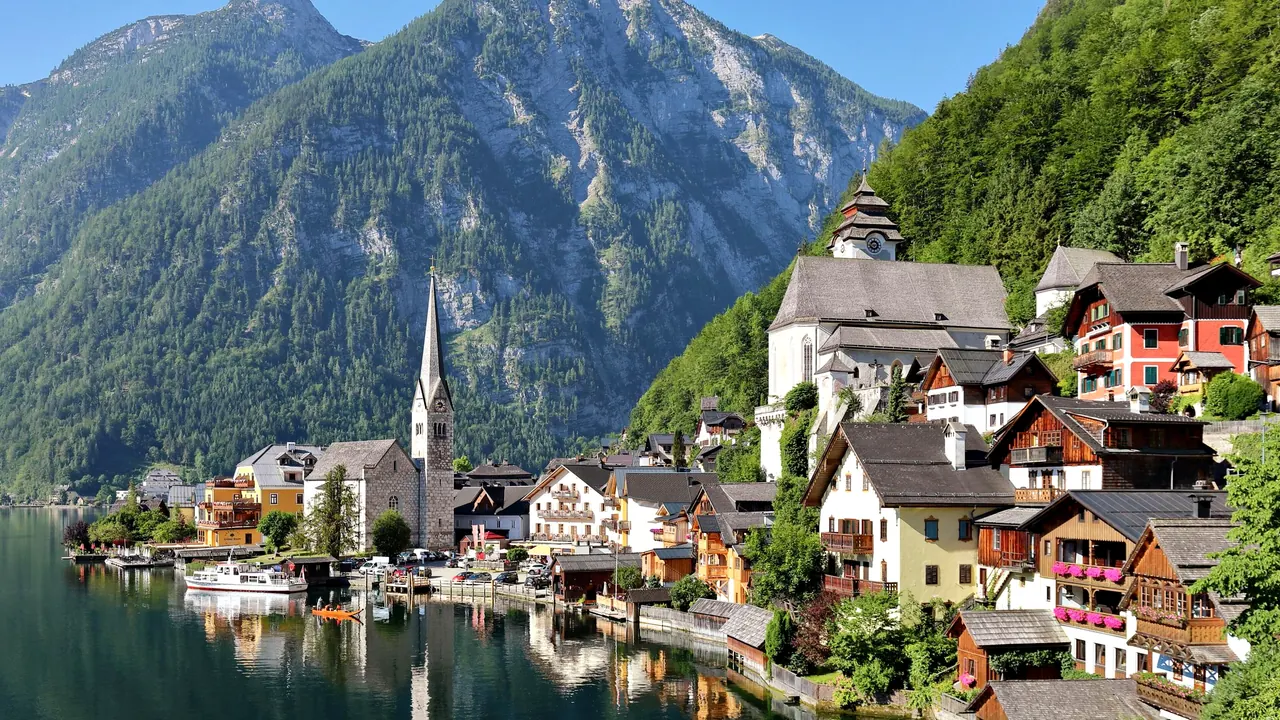
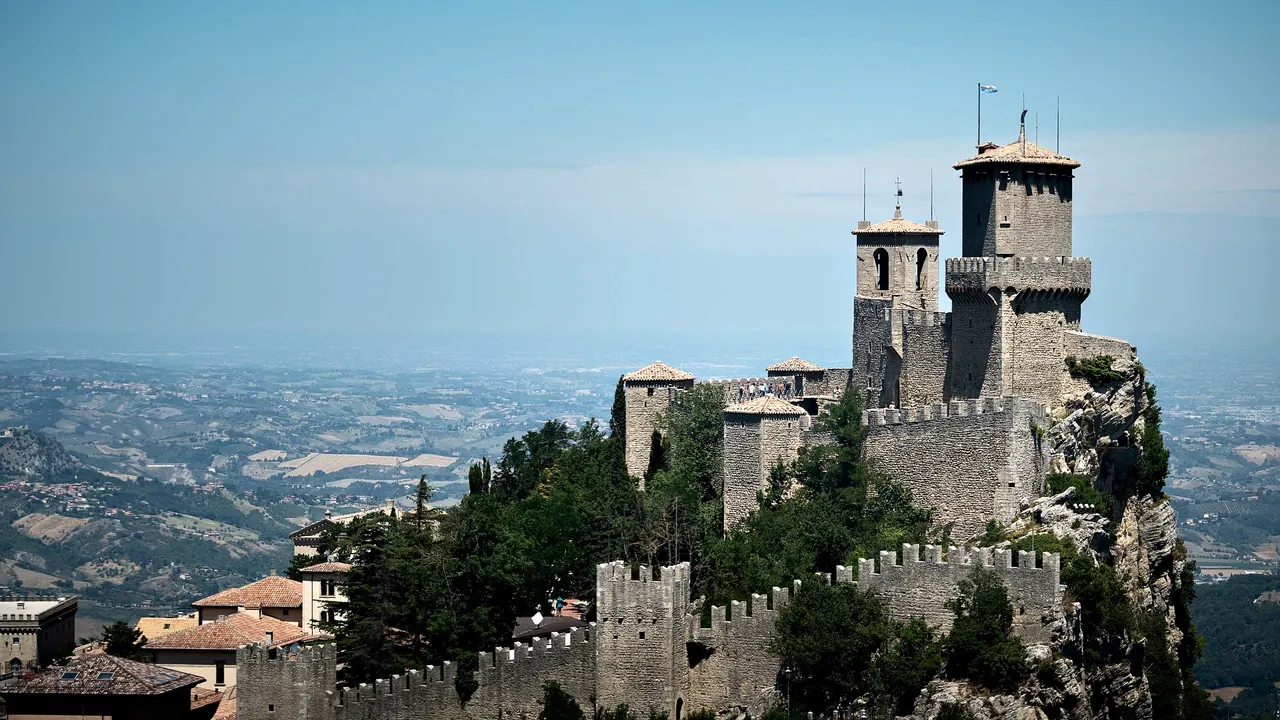
Photos: Hallstatt by C.Stadler/Bwag, CC BY-SA 4.0, cropped; San Marino by Tibor Szabo, Pexels License.
Hallstatt or San Marino?
Our verdict in twelve categories, each scored against the same fixed benchmark cities, and the climate month by month, so you can choose for your trip.
Choose Hallstatt for
- nature and the outdoors
- wellness
- getting around
Hallstatt is for travellers who want mountains on the doorstep. The Dachstein, the ice caves, the walk to Gosausee and hut-to-hut hiking all start from the village, and when the day visitors leave in the evening, the lake goes very quiet. It suits walkers and couples who will pay for a lakeside room and are happy with simple food and early nights.
Choose San Marino for
- prices
- beaches
- food and drink
San Marino makes more sense as a base for a wider trip in central Italy. The summit town has its towers and the story of an ancient republic. Urbino, San Leo, Ravenna and the Rimini beaches are all within reach. It is gentler on the wallet, the warm sea is close in summer and a car makes it a strong hub, but the mountain itself offers pleasant walks rather than serious outdoor country.
Scoreboard
Twelve categories on one fixed scale from 0 to 100. The shaded stretch is the gap between the two.
Your match
Pick a travel style or drag the sliders, and both match scores follow your weighting.
Too close to call, 2 points apart
Wins on nature and the outdoors and wellness with your weighting.
Wins on prices and beaches with your weighting.
What matters to you?
Category by category
What the scores mean for a trip.
Beaches & swimming
Neither is a beach destination, but San Marino comes closer. In Hallstatt, swimming means a cold, bracing dip in Hallstätter See, from the jetty at the northern end of the village or the lido at Obertraun. The steep shores leave little room for a towel.
From San Marino, the sandy Romagna shore at Rimini and Riccione is about half an hour down the hill. The water there is warm and shallow, and the beaches are lined with umbrellas and beach clubs. You go there for the day rather than staying by the sea, but it is a proper beach day, which Hallstatt cannot offer.
Food & drink
San Marino eats better because it draws on the cooking of the Romagna and Montefeltro hills: hand-rolled tagliatelle, passatelli in broth, piadina, and the republic's own Sangiovese wine. The best meals are in the family trattorias of Borgo Maggiore rather than on the summit terraces.
Hallstatt's choice is narrower. Guesthouses serve Austrian standards, the one real highlight is char and whitefish from the lake, and kitchens close early. Neither place is worth a trip for the food, but San Marino has the countryside just over the border to fall back on.
Culture & sights
In both places the town itself is the main sight, and neither needs much more than a day. San Marino has a little more to see: three towers on the Monte Titano ridge, the cliffside path between Guaita and Cesta, and the Palazzo Pubblico and basilica of one of the world's oldest republics.
Hallstatt's history goes back much further but covers less ground. It has seven thousand years of salt mining, the mine itself, the burial finds that gave the Hallstatt culture its name, and the painted skulls of the Beinhaus. It is the more unusual story, but there is less to fill a second day.
Nightlife
Neither has a night out to speak of, and both go quiet once the day visitors leave. The difference is what lies nearby. In Hallstatt an evening means dinner and a walk by the dark lake, with nowhere livelier within easy reach. From San Marino, the late seafront bars and clubs of Rimini and Riccione are a drive down the hill in summer.
Nature & outdoors
This is the widest gap between the two. Hallstatt sits beneath the Dachstein massif, with the Krippenstein cable car, the Five Fingers platform over a sheer drop, the ice cave and the Mammoth Cave, and the walk to Gosausee. There are via ferratas in summer and freeride and ski touring in winter.
San Marino's outdoors is gentler: paths around a limestone ridge of about 740m, woods down to Borgo Maggiore and quiet cycling roads through the Montefeltro hills. It is lovely for a morning walk, but there is no high mountain country to fill a week.
Day trips
San Marino has the stronger and more varied list of outings: the fortress of San Leo, Renaissance Urbino, Ravenna's Byzantine mosaics, Rimini's Roman arch and bridge, and the beach. Bologna is within range by train from Rimini.
From Hallstatt, the outings are mostly the lake towns of the Salzkammergut, such as Bad Ischl with its Kaiservilla, St Wolfgang and Gmunden, with Salzburg as a long day out. In both places a car makes the difference. Without one, Hallstatt depends on buses and the lakeside railway, and San Marino on its single bus to Rimini.
Good for families
For families the two are much the same, and both have steep, crowded streets that are hard work with a pushchair. Hallstatt's best moments are underground and up high: the salt mine with its wooden slides and underground lake, and the Krippenstein cable car and ice caves for older children.
San Marino's towers and battlements are a hit on the summit, but most of its family attractions are down on the coast: Italia in Miniatura, Fiabilandia, waterparks and shallow beaches. It suits families with a car who want the sea as part of the trip.
Getting around
Hallstatt is the easier of the two to manage. The village takes a few minutes to cross and is mostly free of traffic. A boat links it to the railway across the lake, and regional buses reach Obertraun, Gosau and Bad Ischl, though there are fewer outside summer.
San Marino's centre is also walkable, but nearly every street climbs or drops, and its only regular public link is the bus from Rimini. Buses between the republic's villages are infrequent, and you really need a car for the hill towns around it.
Shopping & style
San Marino gives a shopper more to do. Lower taxes than in Italy bring Italian buyers in for perfume, watches, leather and spirits, an outlet centre on the valley floor adds fashion brands, and collectors seek out the republic's stamps and coins. Hallstatt has a single lane of souvenir shops, where salt from the local mine is the one buy really worth taking home.
Affordability
San Marino is noticeably easier on the wallet. Its hotels and the trattorias in the lower villages are priced like provincial central Italy, the sights cost little, and only the summit terraces and the most convenient hotels charge extra for the view.
Hallstatt has few rooms and visitors from all over the world, so rooms, meals and the paid attractions all cost a lot. Budget travellers usually sleep in Obertraun, Bad Goisern or Bad Ischl and come in for the day.
Live music & performing arts
Neither has a programme to plan an evening around, so the difference lies in the occasional event. Hallstatt has its brass band, church concerts and folk music on feast days, and Bad Ischl's summer operetta is half an hour away. San Marino's highlight is the Medieval Days festival each summer, with costumed musicians, crossbow contests and flag-throwers, and for a real season it looks to Bologna or Pesaro.
Wellness & relaxation
Hallstatt has the better claim to a restful stay, partly because it sits in a spa region. Bad Ischl's historic brine baths and thermal complex are half an hour away, Bad Aussee and Bad Goisern have their own spa traditions, and early mornings on the misty lake are calm in themselves.
San Marino has no bathing tradition and only a few hotel spas, so the rest it offers is the quiet of the walls in the evening. The thermal spas on the coast and in the Apennines need a separate outing. In both places, crowds fill the streets in the middle of the day.
When should you go?
Pick your month. The climate figures are measured averages, not a forecast.
Hallstatt in July
San Marino in July
Daytime high, °C
Rainfall in the month, mm
Where the figures come from
Hallstatt's temperatures are measured 56 km from the centre, at Salzburg.
Hallstatt has no rain gauge within 25 km of the centre, so its rainfall comes from a gridded climate dataset read at the city rather than from a gauge further away.
San Marino's temperatures are measured 52 km from the centre, at Frontone.
San Marino has no rain gauge within 25 km of the centre, so its rainfall comes from a gridded climate dataset read at the city rather than from a gauge further away.
Temperature and rainfall are climate normals, averaged over the years shown. Hallstatt: 1991-2020 normals, Salzburg (55.5 km from centre). San Marino: 1991-2020 normals, Frontone (51.5 km from centre).
Hallstatt's walking season runs from May to September, with highs of about 25°C in July and August. Summer is also its wettest time, with around 178mm of rain in July. Even so, those months get the most sunshine, so plan for clear mornings and wet spells. From December to February it is close to freezing and dark early. That suits the ski slopes on the Krippenstein, but it is hard going for anyone who came to walk.
San Marino is warmer and drier in summer. July reaches about 30°C, which makes the steep streets hard work at midday, but the Adriatic below warms to around 26°C in August, so July and August are the beach months. May, June and September are the best times for walking the walls. The rain arrives in autumn and peaks at about 105mm in November, the reverse of Hallstatt's wet summers.
Which traveller are you?
On an outdoors trip, Hallstatt is the clear choice. From the village you can reach the Dachstein cable car, the ice caves, the Echerntal waterfalls, via ferratas and the classic walk to Gosausee. San Marino offers only short walks along its ridge and quiet cycling roads.
For a trip on a tight budget, San Marino is the better fit. Its hotels and its trattorias in the lower villages are priced like provincial Italy, and the sights cost little. Hallstatt's few rooms, resort-priced meals and paid attractions add up quickly.
On a relaxing and wellness trip, Hallstatt has the edge. Bad Ischl's historic brine baths are half an hour away, and the misty mornings and empty evenings by the lake are restful. San Marino has little beyond a few hotel spas.
Before you go
| Measure | Hallstatt | San Marino |
|---|---|---|
| Official language | German, Austrian Sign Language | Italian |
| Currency | Euro (EUR) | Euro (EUR) |
| Sockets | CF230 V, 50 Hz | CFL230 V, 50 Hz |
| Driving side | Right | Right |
| Time zone | UTC+1, UTC+2 in summer | UTC+1, UTC+2 in summer |
| Emergency number | 112 | 112 |
| Elevation | 511 m | 675 m |
| Main airport | Salzburg Airport (SZG)55 km from centre64 non-stop destinations | Bologna Guglielmo Marconi Airport (BLQ)114 km from centre98 non-stop destinations |
| Public holidays this year | 16 days | 18 days |
By the numbers
| Measure | Hallstatt | San Marino |
|---|---|---|
| City population | 741 | 4,040 |
| People per km² | 12 | 569 |
| Museums within 10 km | 3 | 19 |
| UNESCO World Heritage sites within 50 km | 2 | 2 |
| Swim season, months above 21 °C | - | 4 months |
Where else could you go?
Every comparison below shares a destination with this one, so you can follow Hallstatt or San Marino somewhere new.
- Salzburgvs Hallstatt
- Assisivs San Marino
- Florencevs San Marino
- Bolognavs San Marino
- Sienavs San Marino
- Bledvs Hallstatt