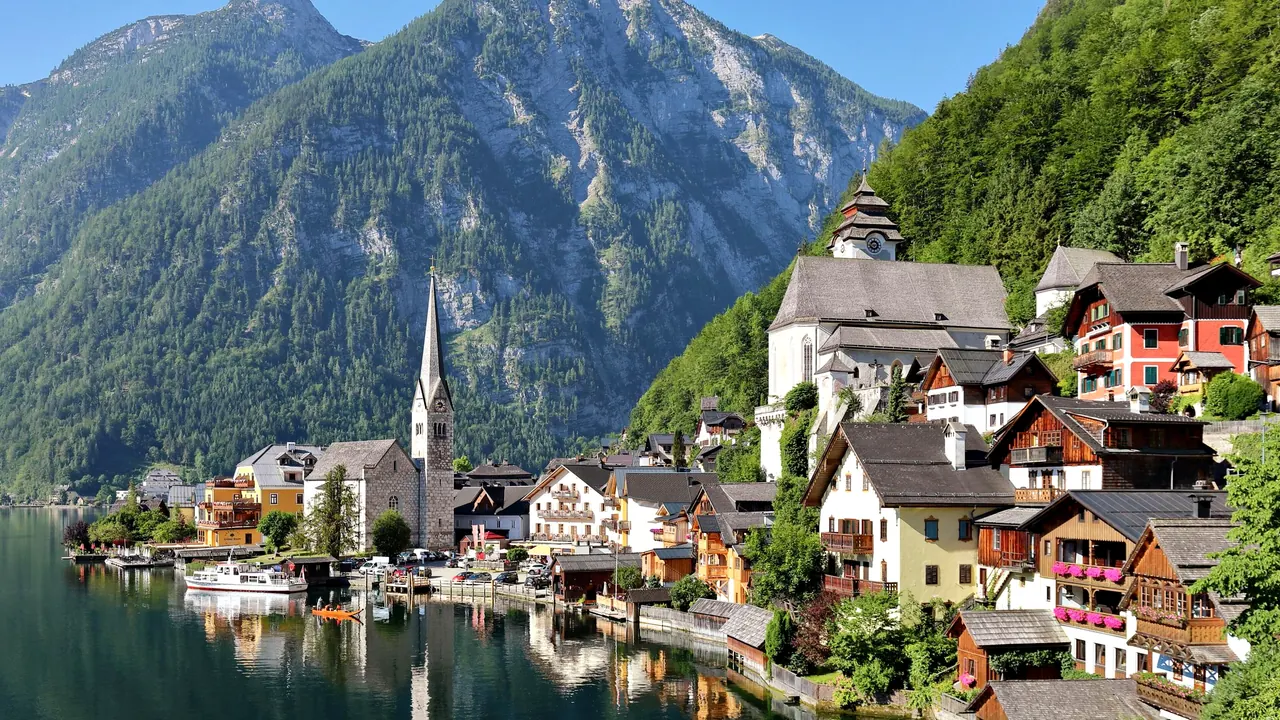
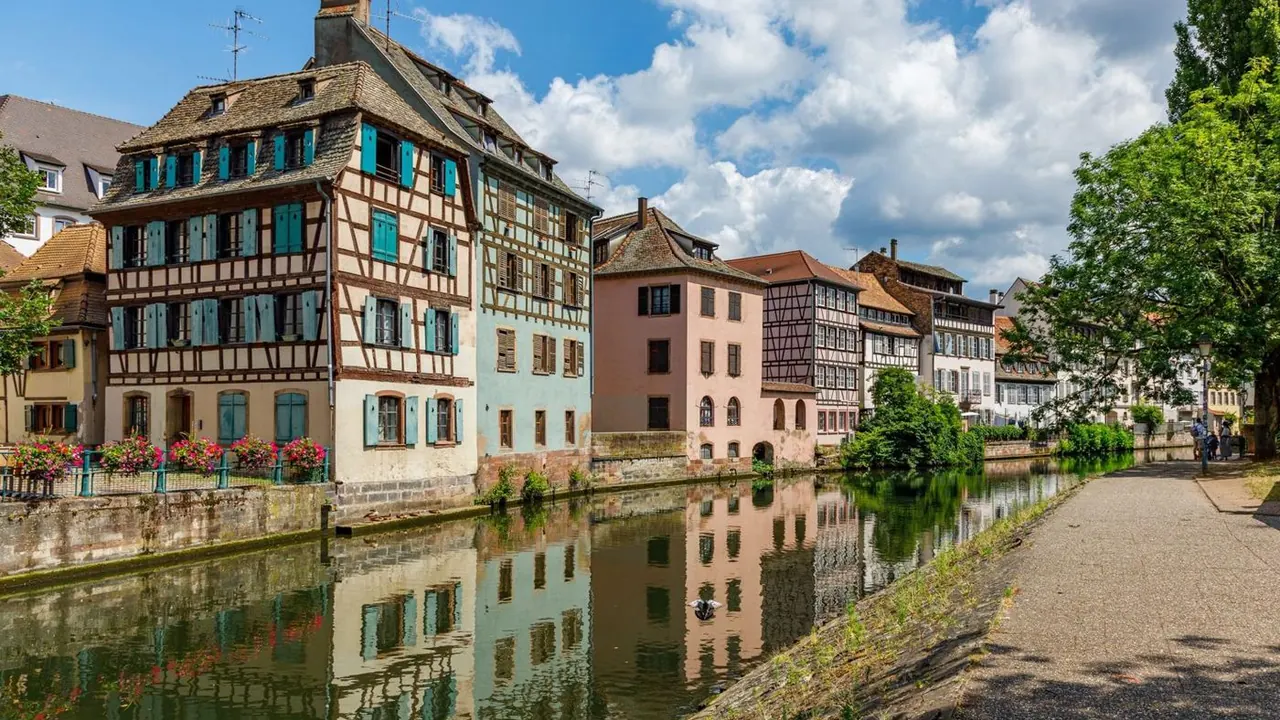
Photos: Hallstatt by C.Stadler/Bwag, CC BY-SA 4.0, cropped; Strasbourg by Edoardo Colombo, Pexels License.
Hallstatt or Strasbourg?
Our verdict in twelve categories, each scored against the same fixed benchmark cities, and the climate month by month, so you can choose for your trip.
Choose Hallstatt for
- nature and the outdoors
- beaches
Hallstatt is for walkers and anyone who wants the high Alps right outside the door: the Dachstein, the ice caves, the walk to the Gosausee and a still lake at dawn. It works best as a short, quiet stay built around the mountains and the salt mine. You give up varied food and any kind of evening life, and rooms cost a lot for what is a single lakeside lane.
Choose Strasbourg for
- live music and the arts
- food and drink
- nightlife
Strasbourg suits travellers who want a city to fill both the days and the evenings: the cathedral and its museums, Alsatian dinners in a winstub with local Riesling, a season of opera and theatre, and trams that make everything easy. It is also the better base for moving on, with Colmar, the wine villages and the Black Forest all within reach, and staying there costs less.
Scoreboard
Twelve categories on one fixed scale from 0 to 100. The shaded stretch is the gap between the two.
Your match
Pick a travel style or drag the sliders, and both match scores follow your weighting.
Wins on nature and the outdoors and beaches with your weighting.
Wins on live music and the arts and food and drink with your weighting.
What matters to you?
Category by category
What the scores mean for a trip.
Beaches & swimming
Neither is a swimming destination, but Hallstatt at least has its lake right in front of it. The Hallstätter See is deep, clear and cold, with a bathing lawn in the village and a lido at Obertraun, and it makes a good bracing dip after a hike in July or August.
In Strasbourg, people swim in old gravel pits such as the Baggersee, which you can reach by tram. They have grassy banks and lifeguards in high summer, so they are pleasant on a hot afternoon, but they lack the clear mountain water and the scenery of an Alpine lake.
Food & drink
Here Strasbourg is far ahead. Alsatian cooking gives it a strong identity, from choucroute and baeckeoffe in wood-panelled winstubs to Munster cheese at the covered market. There are serious fine-dining tables in the city and the nearby villages, and the wine comes from vineyards just to the south.
Hallstatt has a few guesthouse dining rooms serving schnitzel and goulash, and the one local dish worth looking for is char or whitefish from the lake. Kitchens close early, and for anything more you go to Bad Ischl and its historic patisseries.
Culture & sights
Strasbourg has enough for several days: the pink sandstone cathedral with its astronomical clock, the timber-framed streets of the Grande Ile and Petite France, the German-built Neustadt, and museums ranging from the three collections in the Palais Rohan to modern art by the river.
Hallstatt's history goes much further back but takes up much less time. Seven thousand years of salt mining, the Iron Age graves that gave the Hallstatt culture its name, the mine itself and the painted skulls of the Beinhaus make a memorable day, and the village on its lakeside ledge is as much the sight as any single building.
Nightlife
Strasbourg's evenings are modest but real: student bars in Krutenau and around Place Saint-Étienne, beer cellars and summer terraces on the quays, though there are few clubs and little goes on after midnight. Hallstatt has nothing like it, since once the day visitors leave, an evening out means dinner, a glass of wine by the water and a walk along the lake in the dark.
Nature & outdoors
For mountain scenery, Hallstatt is in a different league from Strasbourg. The Dachstein rises almost straight out of the lake, so a morning can start in the village and end on a high limestone plateau or on a path climbing past waterfalls towards the glacier. The Gosausee, with the whole massif reflected in its water, is one of the great views of the Alps. Rain and lake mist are frequent, and in winter the slopes above Obertraun are used for freeride and ski touring.
Strasbourg's countryside is gentler, and you have to travel to reach it. The city is flat and green, with the Orangerie park and woodland along the Rhine where storks and beavers live, and level bike routes that follow the river and the canals into Germany. For hills you go about an hour west to the Vosges, with forest paths, ruined castles and Mont Sainte-Odile, or east to the fir woods and higher ridges of the Black Forest.
Day trips
Both sit in regions full of good outings, but Strasbourg offers more variety and much easier connections. Colmar is about half an hour by train, and the Alsace wine route, Baden-Baden, Freiburg, Basel and Heidelberg add up to villages, spa towns and cities in two countries.
From Hallstatt, the outings are the lake towns of the Salzkammergut, such as Bad Ischl with its Kaiservilla, St Wolfgang and Gmunden, with Salzburg about an hour and a half away by car. Without a car, each trip means working around buses and the lakeside railway.
Good for families
Strasbourg is the easier place with children. The centre is flat and largely car-free, and there are boat trips through Petite France, storks and rowing boats in the Orangerie and the hands-on Le Vaisseau science centre, with Europa-Park about an hour away.
Hallstatt has a few real highlights for children, the salt mine's wooden slides and underground lake and the ice caves for older ones. But the single steep lane is hard going with a pushchair, so families often stay in Obertraun and come over for a few hours.
Getting around
Both centres are easy to explore on foot, but Strasbourg is far better if you don't have a car. Trams run from the centre to the station, the European quarter and across the Rhine to Kehl, and separated cycle lanes often make a bike the quickest way around.
You can cross Hallstatt on foot in minutes, though the lanes are steep. The difficulty is getting in and out: the station is on the far shore and a small boat crosses to the village, and buses to Obertraun, Gosau and Bad Ischl are infrequent outside summer, so many visitors bring a car.
Shopping & style
Strasbourg is good for a proper afternoon's shopping, with chain stores and a department store around Place Kléber, independent bookshops and delicatessens near the cathedral, and regional things to take home such as Soufflenheim pottery, printed linens and Alsace wine. Shopping in Hallstatt is one lane of souvenir shops, and the thing worth buying is salt from the local mine.
Affordability
Neither is cheap, but Strasbourg is easier on the wallet. Winstub meals, wine by the pichet and the trams are reasonably priced, and the cathedral and old town cost nothing. Hotels are the main expense, especially during the Christmas market and the weeks when the European Parliament sits.
Hallstatt has few rooms and visitors from all over the world, so staying in the village costs well above the Austrian average, and the salt mine, funicular and cable car add up. The usual way round this is to sleep in Obertraun or Bad Ischl and visit for the day.
Live music & performing arts
Strasbourg has a genuine season: the Opéra national du Rhin on Place Broglie, a full philharmonic programme, the Théâtre National de Strasbourg and the autumn Musica festival of contemporary music, plus jazz and touring bands.
Hallstatt has a brass band on feast days and the occasional summer concert in its churches. For a proper evening of music, you would go to Salzburg or to Bad Ischl's summer operetta.
Wellness & relaxation
Both rely partly on spa towns nearby. From Hallstatt, Bad Ischl's salt-brine baths are half an hour away, and from Strasbourg, Baden-Baden's Friedrichsbad and Caracalla baths are under an hour across the Rhine. Strasbourg comes out ahead because it also has its own tiled Bains municipaux and an easy, unhurried pace of canal walks and riverside cycling.
In Hallstatt, the calm comes at the beginning and end of the day: mist on the lake in the early morning and quiet after the tour groups leave. At midday the lane is packed, so a restful stay means spending those hours on the water or up in the hills.
When should you go?
Pick your month. The climate figures are measured averages, not a forecast.
Hallstatt in July
Strasbourg in July
Daytime high, °C
Rainfall in the month, mm
Where the figures come from
Hallstatt's temperatures are measured 56 km from the centre, at Salzburg.
Hallstatt has no rain gauge within 25 km of the centre, so its rainfall comes from a gridded climate dataset read at the city rather than from a gauge further away.
Temperature and rainfall are climate normals, averaged over the years shown. Hallstatt: 1991-2020 normals, Salzburg (55.5 km from centre). Strasbourg: 1991-2020 normals, Strasbourg (9.1 km from centre).
Both follow the same Central European pattern of cold winters and summers that peak at around 25°C to 26°C in July and August, but they get very different amounts of rain. Hallstatt is wettest when it is warmest, with about 178mm in July, so a summer hiking trip has to allow for showers and low cloud. The lake is only warm enough for a bracing swim in July and August. September is a good compromise, with highs around 20°C and less rain than midsummer. In winter the mountains are for snow sports, and it is too cold to enjoy strolling in the village.
Strasbourg is much drier all year, with summer rain closer to 70mm and long sunny days from May to August, so it is the more reliable choice for walking the old town in summer. Late spring and September are the most comfortable months for sightseeing on foot. From November to January the days are short, grey and cold in both places, and Strasbourg gets especially little sun in those months.
Which traveller are you?
On an outdoors trip, Hallstatt is the clear choice. The Krippenstein cable car, the Dachstein ice caves, hut-to-hut routes and via ferratas all start at the edge of the village. Strasbourg offers flat cycling, and you have to travel to the Vosges for any height.
For a culture and arts trip, Strasbourg wins easily. The cathedral and its clock, Petite France, the Neustadt and the Palais Rohan museums fill several days, and opera, the philharmonic and the national theatre fill the evenings. Hallstatt's history fits into a single day.
On a food and nightlife trip, choose Strasbourg. You can have choucroute and tarte flambée in a winstub with a pichet of Riesling, then move on to student bars in Krutenau or the summer terraces by the river. In Hallstatt, after a dinner of lake fish, the village goes completely quiet.
Before you go
| Measure | Hallstatt | Strasbourg |
|---|---|---|
| Official language | German, Austrian Sign Language | French |
| Currency | Euro (EUR) | Euro (EUR) |
| Sockets | CF230 V, 50 Hz | CE230 V, 50 Hz |
| Driving side | Right | Right |
| Time zone | UTC+1, UTC+2 in summer | UTC+1, UTC+2 in summer |
| Emergency number | 112 | 112 |
| Elevation | 511 m | 132 m |
| Main airport | Salzburg Airport (SZG)55 km from centre64 non-stop destinations | Strasbourg Airport (SXB)10 km from centre43 non-stop destinations |
| Public holidays this year | 16 days | 11 days |
By the numbers
| Measure | Hallstatt | Strasbourg |
|---|---|---|
| City population | 741 | 293,771 |
| People per km² | 12 | 3,752 |
| Museums within 10 km | 3 | 21 |
| UNESCO World Heritage sites within 50 km | 2 | 3 |
Where else could you go?
Every comparison below shares a destination with this one, so you can follow Hallstatt or Strasbourg somewhere new.
- Baden-Badenvs Strasbourg
- Salzburgvs Hallstatt
- Colmarvs Strasbourg
- Stuttgartvs Strasbourg
- Baselvs Strasbourg
- Heidelbergvs Strasbourg