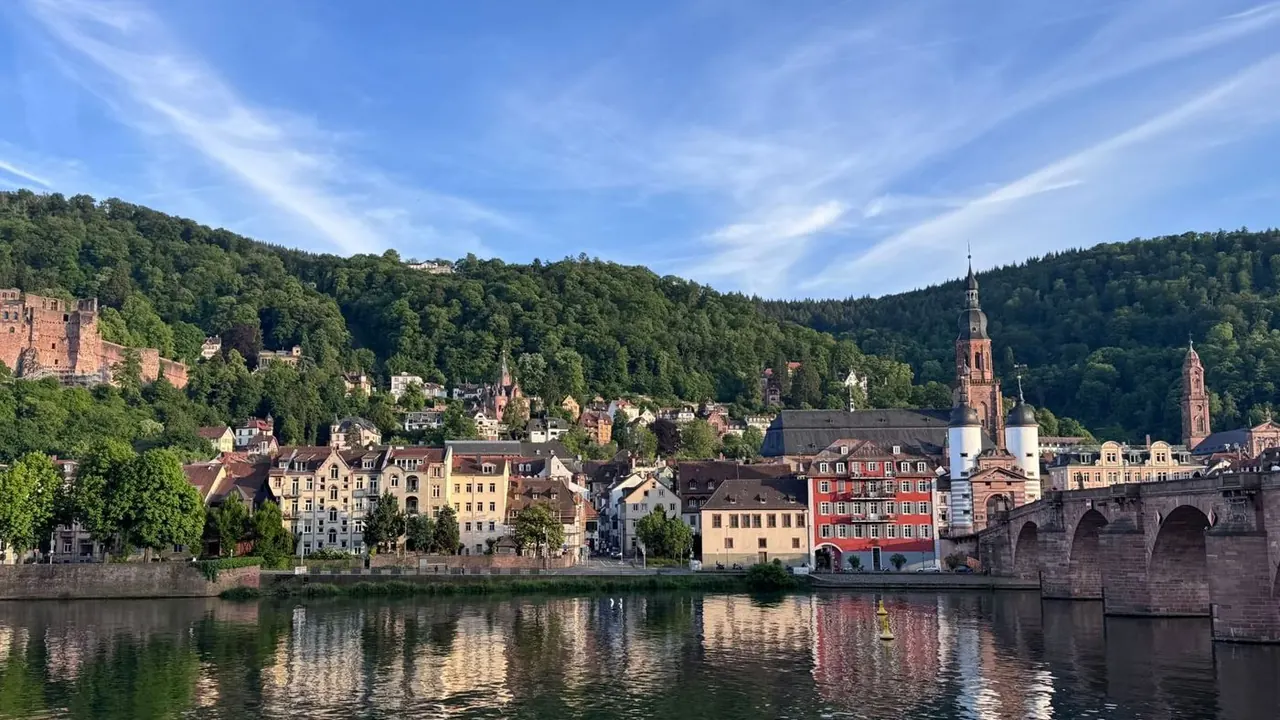
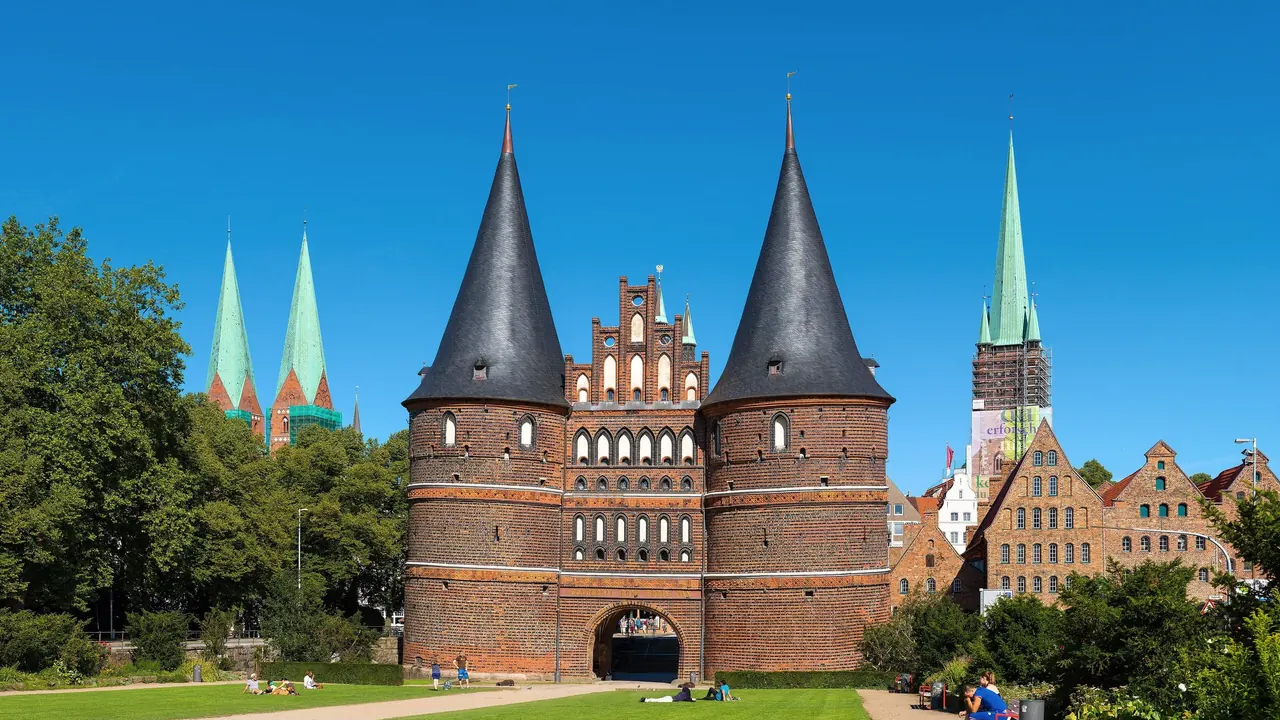
Photos: Heidelberg by Kuanling Chen, Pexels License; Lubeck by Christian Wolf (www.c-w-design.de), CC BY-SA 3.0 DE, cropped.
Heidelberg or Lubeck?
Our verdict in twelve categories, each scored against the same fixed benchmark cities, and the climate month by month, so you can choose for your trip.
Choose Heidelberg for
- day trips
- nature and the outdoors
- nightlife
Heidelberg suits a traveller who wants a base more than one set piece. Forest starts at the edge of the Altstadt, and the Rhine plain around it is full of cathedral towns and palaces within easy reach. The student lanes also give its evenings more life than Lübeck's. It works best for walkers, cyclists and anyone happy to spend half the stay on trains to Speyer, Worms or the Palatinate wine villages.
Choose Lubeck for
- beaches
- culture and sights
- prices
Choose Lübeck for the richer old town and for the sea. The brick Gothic island city is the stronger place for sightseeing, and Travemünde's sandy beach is a short train ride away, which a river town far inland cannot offer. Rooms are easier on the budget too. It suits a slower summer stay that mixes Hanseatic streets with beach afternoons, as long as you are happy with quiet evenings.
Scoreboard
Twelve categories on one fixed scale from 0 to 100. The shaded stretch is the gap between the two.
Your match
Pick a travel style or drag the sliders, and both match scores follow your weighting.
Too close to call, level with your weighting
Wins on day trips and nature and the outdoors with your weighting.
Wins on beaches and culture and sights with your weighting.
What matters to you?
Category by category
What the scores mean for a trip.
Beaches & swimming
This is the clearest gap between the two. Lübeck has a real seaside within its own city limits: Travemünde's long sandy beach with its hooded wicker beach chairs, plus Timmendorfer Strand and Scharbeutz further up the bay. All of it is on calm, shallow Baltic water that is good for paddling.
Heidelberg has only outdoor pools and the gravel-pit lakes on the Rhine plain. Even so, Lübeck's sea stays cool, so think of a few beach afternoons added to a city stay rather than a swimming vacation.
Food & drink
Neither city is a food destination, but they eat very differently. Heidelberg is wine country, with Riesling from the Bergstrasse and the Palatinate, hearty Baden dishes and white asparagus in spring. The better meals are in the Altstadt side streets, in Neuenheim and in the village wine taverns.
Lübeck looks to the sea and to the confectioner. Expect herring and fish sandwiches from harbour kiosks, Rotspon wine from the old cellars, marzipan around the town hall, and dinner at long tables in the sea captains' guild house.
Culture & sights
Both have compact, photogenic old towns, but Lübeck's is the bigger draw. Its island of brick Gothic churches, merchants' houses with stepped gables and quiet courtyards is a UNESCO World Heritage site. The Hansemuseum and the Buddenbrookhaus also give it more depth in museums.
Heidelberg's strength is one romantic picture: the castle ruin above the Neckar, the Old Bridge and the old university with its graffiti-covered Student Prison. It is a lovely day or two, but there is less to fill a longer stay.
Nightlife
Heidelberg has the livelier evenings, thanks to its students. The Untere Strasse is packed with small bars that fill up late during term, and the old student taverns are worth a visit in themselves. Lübeck is quieter still: a few wine bars on the Obertrave, Travemünde's promenade in summer, and most of the city asleep by midnight. For a big club night, both send you on by train, Heidelberg to Mannheim or Frankfurt and Lübeck to Hamburg.
Nature & outdoors
Heidelberg has more to do outdoors right on its doorstep. Wooded hills rise straight from the old town, with the Philosophers' Walk on one side of the river and the Königstuhl on the other, and Celtic ramparts and monastery ruins hidden among the trees on the Heiligenberg. The Neckar valley cycle path, the vineyard walks of the Bergstrasse and the sandstone crags of the Palatinate Forest, an hour west, give you several days of walking and riding.
Lübeck's country is flatter, a landscape of rivers, reeds, lakes and shore. Its highlights are canoeing on the Wakenitz, the clifftop walk along the Brodtener Steilufer and long, level cycle routes by the coast. It suits paddlers and easy cyclists, but it has nothing like Heidelberg's hill walking.
Day trips
Heidelberg is the better base. The great Romanesque cathedrals of Speyer and Worms, the palace gardens of Schwetzingen, the abbeys of Lorsch and Maulbronn, castle villages up the Neckar and the Palatinate wine towns are all within about an hour. Frankfurt and Mainz are easy by train, and Strasbourg works as a long day.
Lübeck has fewer outings, but strong ones: a day in Hamburg, its sister Hanseatic town Wismar and Schwerin's island castle. After those and the lake towns of Ratzeburg and Eutin, the list runs short.
Good for families
Both are small, safe and easy with children, but the outings differ. In Heidelberg the highlights are the funicular ride, the fairy-tale park on the Königstuhl, the zoo by the river and the aircraft and submarine you can climb into at the Technik Museum Speyer. The cobbles and slopes are hard work with a pushchair, though.
Lübeck's flat old town is easier on small legs. In summer its shallow beach and Hansa-Park turn a visit into a seaside stay, but out of season Heidelberg has more for children.
Getting around
Both are easy without a car, in different ways. Lübeck's old town island is compact, the station is just across the river from the Holstentor and the train to the beach takes about twenty minutes. Heidelberg's Altstadt is a long strip with the station well to the west, so you take a tram in, but one fare system across the Rhine-Neckar region makes trips out of town simpler.
Shopping & style
What goes home in the suitcase sets these two apart: Bergstrasse wine and Studentenkuss chocolates from Heidelberg, and boxes of marzipan from Lübeck. Heidelberg's shopping runs along the Hauptstrasse, one of the longest pedestrian streets in Germany. It starts with chain stores at the western end and turns to cuckoo clocks and beer steins near the market square.
Lübeck is the better place to browse. Behind the chain stores of Breite Strasse, small independents, galleries and craft shops are tucked into the courtyard passages around the Hüxstrasse and Fleischhauerstrasse. For fashion in depth, Heidelberg shoppers take the train to Mannheim or Frankfurt, and Lübeck's go to Hamburg.
Affordability
Lübeck is easier on the wallet, mainly because of the rooms. Its old town and station area have plenty of moderately priced hotels and guesthouses. Heidelberg has too few rooms for its visitors, and they fill up with congresses and graduations, so many people stay in Mannheim and come in by train.
Eating out is reasonable in both, at student cafés in Heidelberg and fish kiosks in Lübeck. The exception in Lübeck is the coast: a beach stay in Travemünde in July and August costs noticeably more than one in town.
Live music & performing arts
Heidelberg's set piece is the summer castle festival, when musicals, plays and concerts are staged in the courtyard of the ruin. The Heidelberger Frühling brings chamber music in spring, and Mannheim's larger opera house is twenty minutes away by train.
Lübeck's equivalent is its organ tradition: Buxtehude played at the Marienkirche, and concerts there are still a highlight. The Schleswig-Holstein Music Festival fills its halls and churches in summer. Both cities also have a municipal theatre for opera and drama and a resident orchestra, so there is a proper season in either.
Wellness & relaxation
For a proper soak, Heidelberg looks inland, to the thermal bath complexes and saline pools of the Kraichgau spa towns half an hour away and to Baden-Baden an hour south. In town, you slow down on the Neckar meadows in Neuenheim and on the forest paths above the river.
Lübeck's spa tradition comes from the sea. Travemünde has been a seaside spa resort since the early nineteenth century, and the bay has wellness hotels and an indoor seawater pool complex at Scharbeutz. Its quiet courtyards and riverside benches are as calming as anything in Heidelberg.
When should you go?
Pick your month. The climate figures are measured averages, not a forecast.
Heidelberg in July
Lubeck in July
Daytime high, °C
Rainfall in the month, mm
Temperature and rainfall are climate normals, averaged over the years shown. Heidelberg: 1991-2020 (sunshine 1971-2000) normals, Heidelberg (4.5 km from centre). Lubeck: 1991-2020 normals, Luebeck-Blankensee (6 km from centre).
Heidelberg is in one of Germany's warmest corners, and that shows from spring onwards. By May it is pleasant for walking, and July and August reach about 26°C, a couple of degrees warmer than Lübeck. Summer is also its wettest stretch and July its rainiest month, so expect some thundery afternoons. Late spring and September are the most comfortable months for the climb to the castle and the forest trails.
Lübeck runs cooler and is at its sunniest in May, when it gets more sunshine than Heidelberg. The beach only really works in July and August, when the Baltic reaches about 18°C to 19°C, which is refreshing rather than warm. In both cities November to February is cold, grey and short on sun, with highs of around 5°C. That time of year is better for museums than for long walks.
Which traveller are you?
On a beach and sun trip, Lübeck is the only real option of the two. Travemünde's sandy shore and the resorts along the bay are within half an hour, with calm, shallow water, while Heidelberg has only pools and gravel-pit lakes.
For an outdoors trip, Heidelberg is the better choice. The Odenwald woods begin at the edge of town, the funicular lifts you to the forest trails on the Königstuhl, and the Neckar cycle path and the Palatinate Forest add days of walking and riding.
On a culture and arts trip, Lübeck has the deeper old town: a UNESCO-listed Hanseatic island of brick Gothic churches, with the Hansemuseum and the Buddenbrookhaus. Both cities have a theatre and an orchestra, but Lübeck's organ concerts in the Marienkirche are something Heidelberg lacks.
Before you go
| Measure | Heidelberg | Lubeck |
|---|---|---|
| Official language | German | German |
| Currency | Euro (EUR) | Euro (EUR) |
| Sockets | CF230 V, 50 Hz | CF230 V, 50 Hz |
| Driving side | Right | Right |
| Time zone | UTC+1, UTC+2 in summer | UTC+1, UTC+2 in summer |
| Emergency number | 112 | 112 |
| Elevation | 114 m | 13 m |
| Main airport | Frankfurt Main Airport (FRA)69 km from centre281 non-stop destinations | Hamburg Helmut Schmidt Airport (HAM)53 km from centre120 non-stop destinations |
| Public holidays this year | 12 days | 10 days |
By the numbers
| Measure | Heidelberg | Lubeck |
|---|---|---|
| City population | 156,092 | 217,061 |
| People per km² | 1,433 | 1,013 |
| Museums within 10 km | 17 | 23 |
| UNESCO World Heritage sites within 50 km | 4 | 1 |
| Swim season, months above 21 °C | - | None |
Where else could you go?
Every comparison below shares a destination with this one, so you can follow Heidelberg or Lubeck somewhere new.
- Hamburgvs Lubeck
- Frankfurtvs Heidelberg
- Stuttgartvs Heidelberg
- Baden-Badenvs Heidelberg
- Strasbourgvs Heidelberg
- Freiburgvs Heidelberg