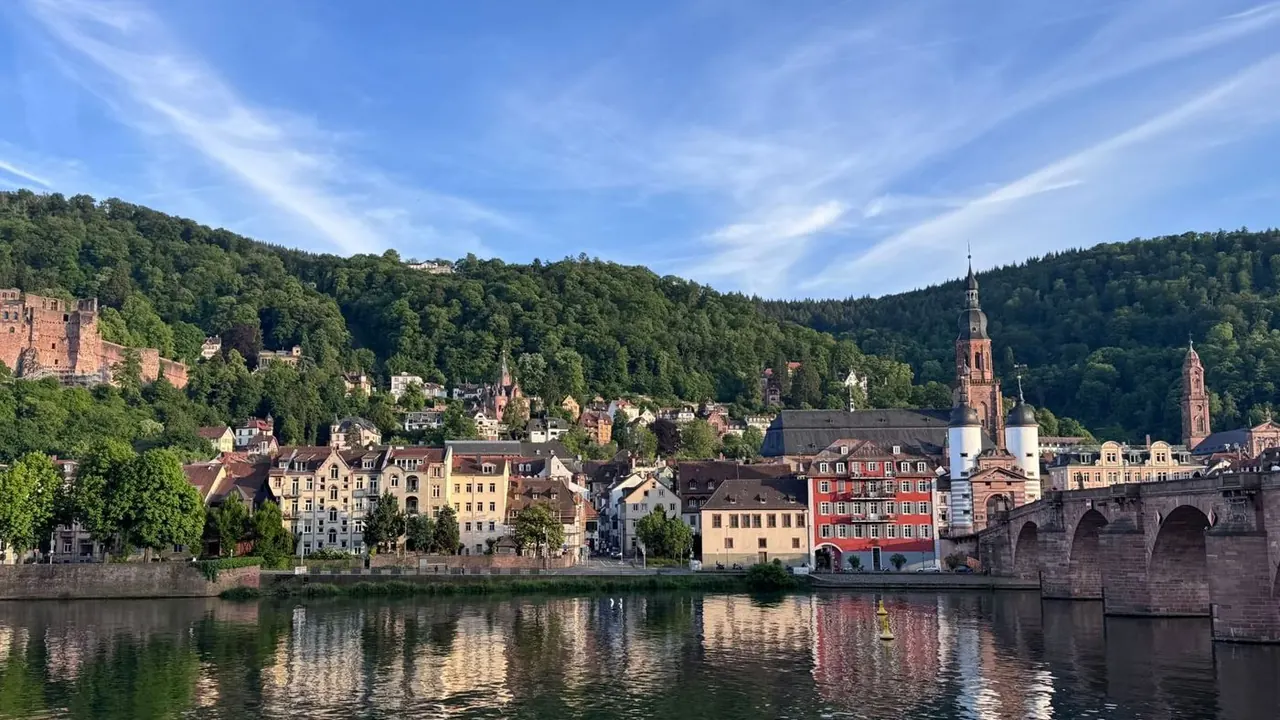
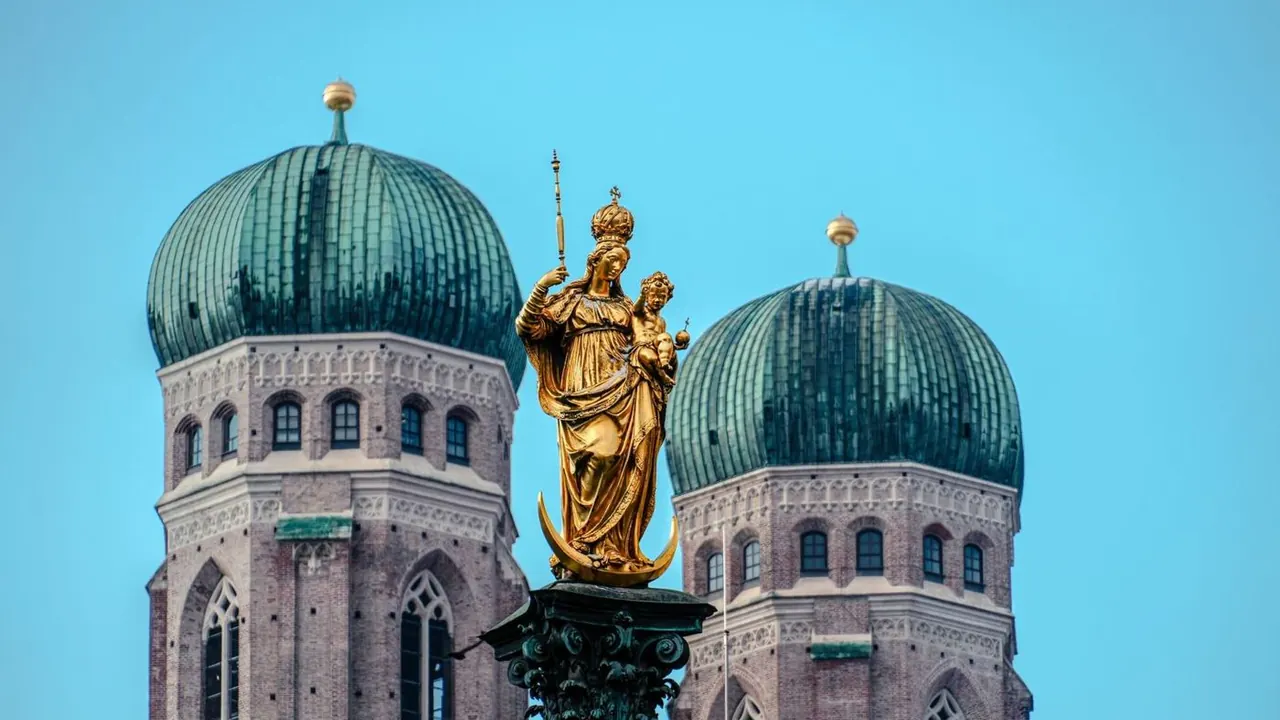
Photos: Heidelberg by Kuanling Chen, Pexels License; Munich by 0xd1ma, Pexels License.
Heidelberg or Munich?
Our verdict in twelve categories, each scored against the same fixed benchmark cities, and the climate month by month, so you can choose for your trip.
Choose Heidelberg for
- prices
Heidelberg suits a slower, smaller trip: a castle ruin above an intact baroque old town, a famous university, forest paths starting at the edge of the Altstadt and wine villages on the Bergstrasse. It works best for travellers who want two or three unhurried days, a romantic townscape and easy hops to Speyer or the Palatinate, and who would rather spend somewhat less than they would in Bavaria's capital.
Choose Munich for
- live music and the arts
- shopping
- food and drink
Munich is the stronger choice for almost everything else. It has world-class opera and orchestras, the great painting collections of the Kunstareal, the Alps within reach for hiking or skiing, and beer gardens, clubs and serious shopping. It is a better fit for a longer stay, for families who need more to fill the days and for anyone who wants a large city with the mountains on the horizon, provided they accept the highest prices in Germany.
Scoreboard
Twelve categories on one fixed scale from 0 to 100. The shaded stretch is the gap between the two.
Your match
Pick a travel style or drag the sliders, and both match scores follow your weighting.
Wins on prices with your weighting.
Wins on live music and the arts and shopping with your weighting.
What matters to you?
Category by category
What the scores mean for a trip.
Beaches & swimming
Neither city is a place for a beach vacation, but Munich does summer swimming much better. People sunbathe on the gravel banks of the Isar at the Flaucher, and the clear Starnberger See and Ammersee, with their jetties and lawns, are under an hour away by S-Bahn.
Heidelberg has only outdoor pools and the gravel-pit lakes on the Rhine plain, about half an hour away. They are fine for a hot afternoon, but nobody would plan a day around them.
Food & drink
Heidelberg's food is the cooking of Baden and the Kurpfalz, with Schäufele, Maultaschen, Flammkuchen and white asparagus in spring. Its real strength is wine from the Bergstrasse and the Palatinate. The catch is the Hauptstrasse, where the places aimed at day-trippers are hit and miss, so the better meals are in the side streets, in Neuenheim or in the village wine taverns.
Munich offers more and better food. Its beer halls and chestnut-shaded beer gardens are an experience in their own right, the Viktualienmarkt is good for grazing, coffee and cake is taken seriously and there is a respectable tier of fine dining. In short, one city is for wine lovers and the other for beer and a bigger choice of tables.
Culture & sights
Heidelberg's appeal is one compact, very photogenic picture: the red sandstone castle ruin, an Altstadt that escaped wartime bombing, and the oldest university in Germany with its graffiti-covered Student Prison. It is lovely, but most visitors have seen it in a day or two.
Munich is a different order of city for sights. The Kunstareal alone holds the Alte Pinakothek, the Pinakothek der Moderne, the Glyptothek and the Blue Rider painters of the Lenbachhaus. Add the Residenz, Nymphenburg and the Deutsches Museum and you have days of museum-going, though its old town was largely rebuilt after the war.
Nightlife
Going out in Heidelberg depends on the university term. The Untere Strasse fills with students in small pubs and old fraternity taverns, but on weeknights and out of term the town goes quiet early, and anyone after a proper club night takes the train to Mannheim or Frankfurt.
Munich gives a fuller night out without leaving town. Evenings often start in a beer hall, and the Glockenbachviertel and Gärtnerplatz have cocktail and gay bars, with a few techno clubs going until morning at weekends. It stays more polished than wild, except during the Oktoberfest on the Theresienwiese.
Nature & outdoors
Munich has the Alps. Garmisch, the Zugspitze, Tegernsee and the Five Lakes are about an hour away by train, which means proper alpine hiking in summer and skiing in winter. In the city, the English Garden, with surfers on the Eisbach, and the Isar cycle paths are big green spaces.
Heidelberg's countryside is gentler but closer. The Odenwald woods begin right at the edge of the old town, with the Philosophers' Walk, the Königstuhl and the Celtic ramparts on the Heiligenberg, and cycling along the Neckar valley. It is walking country rather than mountains.
Day trips
Both are excellent bases, but Munich's list has the bigger names. Salzburg and Innsbruck are across the border, the old towns of Nuremberg, Regensburg and Augsburg are easy by train, and Neuschwanstein and Herrenchiemsee draw visitors from all over the world.
Heidelberg's outings are shorter and quieter. The cathedrals of Speyer and Worms, the palace gardens at Schwetzingen, Maulbronn monastery and the castle villages up the Neckar are all close, and the wine villages of the Palatinate make a mellow day out.
Good for families
Munich is the easier city with children. Transport takes pushchairs, there are playgrounds in every park and often in the beer gardens too, and there is plenty to see: the large Hellabrunn zoo along the Isar, the hands-on sections of the Deutsches Museum, the transport museum and the lake beaches in summer.
Heidelberg is small and safe. The funicular to the Königstuhl, with its fairy-tale park, the compact zoo and the Technik Museum Speyer, where children can climb into a submarine, make good outings. However, the cobbled, sloping Altstadt is hard work with a pushchair, and the town runs out of things for children sooner.
Getting around
In Heidelberg you mostly walk. The sights line the pedestrianised Hauptstrasse between the river and the castle hill, although the station is a tram ride away, the cobbles are uneven and the castle approach is steep unless you take the funicular. One fare system across the Rhine-Neckar area makes regional trips simple.
Munich is easier to get around, even though it is far bigger. The flat old town is compact, and the integrated U-Bahn, S-Bahn and tram network reaches Nymphenburg, the Olympic Park, the airport and the lakes. Delays on the central S-Bahn line are the main drawback.
Shopping & style
Heidelberg's shopping comes down to one long street, while Munich has several distinct shopping districts. The Hauptstrasse runs from chain stores at its western end to cuckoo clocks, beer steins and Studentenkuss chocolates near the market square. The best thing to take home is a bottle of Bergstrasse wine, and serious shoppers take the train to Mannheim or Frankfurt.
In Munich the luxury houses line Maximilianstrasse and the Theatinerstrasse arcades, department stores fill the Kaufingerstrasse axis, and Glockenbach and Schwabing have independent boutiques. The signature buy is Tracht from specialist tailors, and in December the Christmas markets add craft stalls.
Affordability
Heidelberg is the cheaper stay, but only up to a point. Hotel rooms are few for the number of visitors and fill up for congresses, graduations and summer weekends, so many people stay in Mannheim and come in by train. Student cafés and simple taverns keep meals reasonable.
Munich is the most expensive city in Germany, with dear rooms all year and very dear ones during the Oktoberfest and the trade fairs. A picnic in a beer garden, the free parks and lakes and the token Sunday museum fees help, but the overall bill is higher.
Live music & performing arts
Munich is one of Europe's great music cities. The Bavarian State Opera in the National Theatre is a world-class company, the city has three major orchestras, and there is chamber opera in the gilded rococo Cuvilliés Theatre and operetta at the Gärtnerplatztheater. A visitor can find something worth booking on almost any night of the season.
Heidelberg does well for its size. There is opera and drama at the municipal theatre, the Heidelberger Frühling chamber music festival in spring and summer performances in the castle courtyard, where the ruins make the backdrop. For a bigger house, Mannheim is twenty minutes away.
Wellness & relaxation
With no thermal baths of its own, Heidelberg sends spa-goers out of town, either to the saline pools of the Kraichgau about half an hour away or to Baden-Baden about an hour south. What the town offers instead is calm: evenings on the Neckar meadows in Neuenheim and quiet forest paths above the Philosophers' Walk.
Bathing in Munich starts in the centre. The Art Nouveau Müller'sches Volksbad on the Isar has vaulted pools and a Roman-style steam bath, the public saunas keep up the German infusion rituals, and the vast thermal complex at Erding is about forty minutes away. Long afternoons in a beer garden or on the lawns of the English Garden slow the pace as well.
When should you go?
Pick your month. The climate figures are measured averages, not a forecast.
Heidelberg in July
Munich in July
Daytime high, °C
Rainfall in the month, mm
Temperature and rainfall are climate normals, averaged over the years shown. Heidelberg: 1991-2020 normals, Heidelberg (4.5 km from centre). Munich: 1991-2020 normals, München (1.9 km from centre).
Heidelberg and Munich follow much the same temperature curve. Heidelberg is a degree or so warmer all year, reaching about 26°C in July and August against Munich's 25°C. In both, late spring and early autumn are the most comfortable months for walking the streets. Winters are cold and grey in each, though Heidelberg's December is the gloomier of the two and Munich gets noticeably more winter sun.
Rain is where they part. Heidelberg's rainfall is fairly even through the year and peaks at about 80mm in July, so May, June and September all suit its riverside evenings and forest walks. Munich's wet season runs from May to August, with up to 121mm in June, so summer mountain hikes there come with a real chance of wet days. September is drier and still mild, which makes it the more reliable month for the Alps. In both cities the swimming months are the warm stretch from June to early September.
Which traveller are you?
For a short city break, Heidelberg is the easier pick. The castle, the Old Bridge, the university and the Student Prison all sit along one walkable strip, so two days cover the town properly without much planning or transport.
On a culture and arts trip, Munich is far ahead. It has the old masters of the Alte Pinakothek, the Residenz and Nymphenburg, the Deutsches Museum and the Bavarian State Opera with three major orchestras, enough to fill a week of days and evenings.
On a trip with a tight budget, Heidelberg costs less overall. Rooms in town are scarce, but staying in Mannheim and riding in by train works well, and student cafés and the regional ticket keep the days cheap. Munich is dear all year.
Before you go
| Measure | Heidelberg | Munich |
|---|---|---|
| Official language | German | German |
| Currency | Euro (EUR) | Euro (EUR) |
| Sockets | CF230 V, 50 Hz | CF230 V, 50 Hz |
| Driving side | Right | Right |
| Time zone | UTC+1, UTC+2 in summer | UTC+1, UTC+2 in summer |
| Emergency number | 112 | 112 |
| Elevation | 114 m | 519 m |
| Main airport | Frankfurt Main Airport (FRA)69 km from centre281 non-stop destinations | Munich Airport (MUC)29 km from centre210 non-stop destinations |
| Public holidays this year | 12 days | 12 days |
By the numbers
| Measure | Heidelberg | Munich |
|---|---|---|
| City population | 156,092 | 1,505,036 |
| People per km² | 1,433 | 4,844 |
| Museums within 10 km | 17 | 74 |
| UNESCO World Heritage sites within 50 km | 4 | 1 |
Where else could you go?
Every comparison below shares a destination with this one, so you can follow Heidelberg or Munich somewhere new.