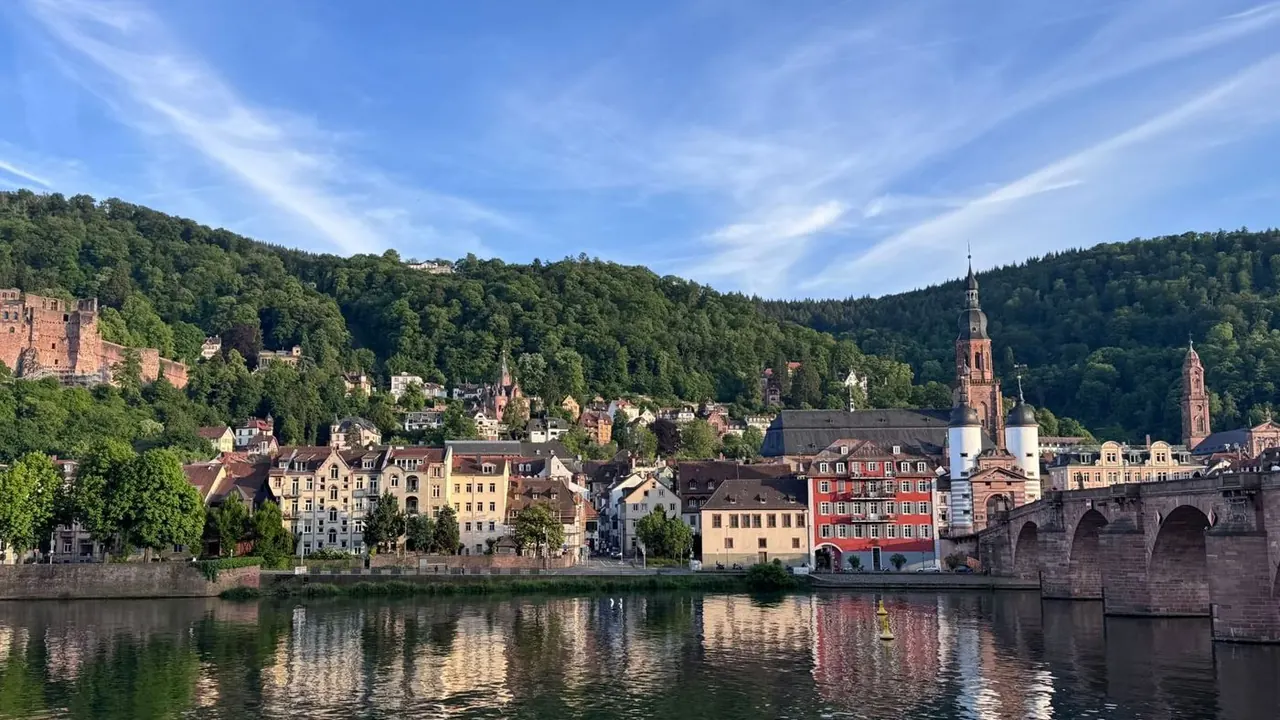
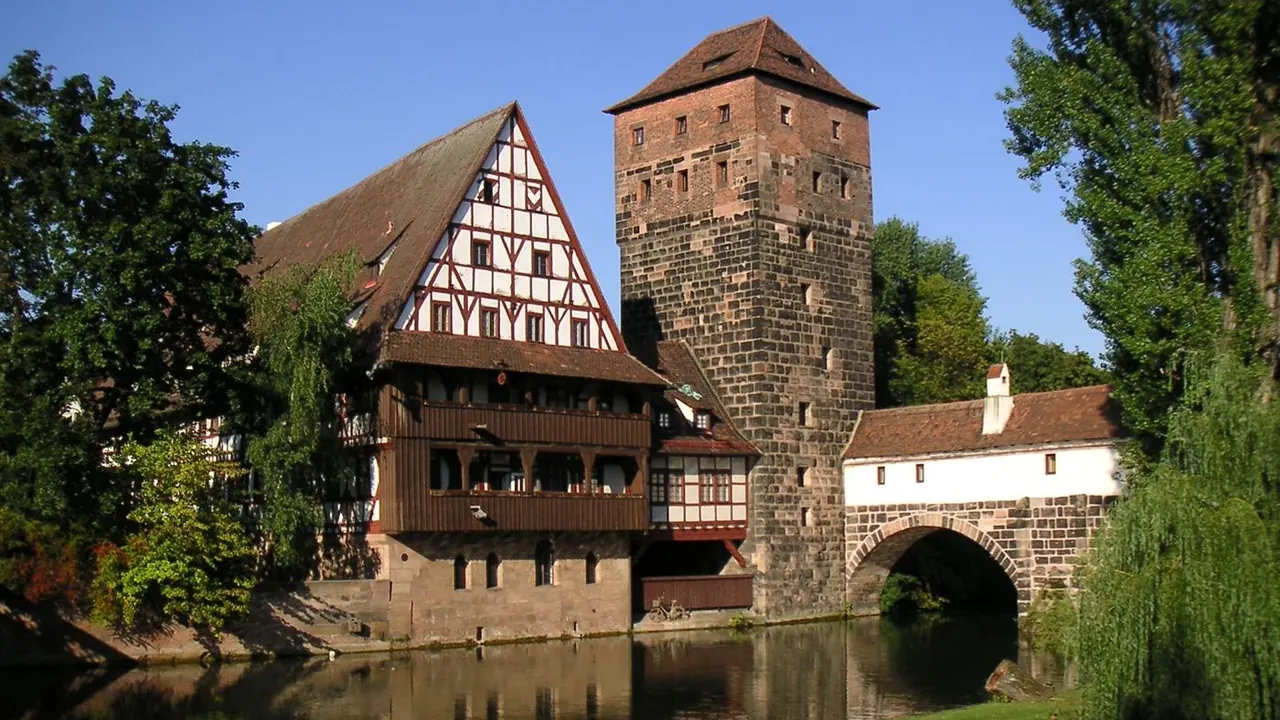
Photos: Heidelberg by Kuanling Chen, Pexels License; Nuremberg by Horst Gutmann, CC BY 2.0, cropped.
Heidelberg or Nuremberg?
Our verdict in twelve categories, each scored against the same fixed benchmark cities, and the climate month by month, so you can choose for your trip.
Choose Heidelberg for
- nature and the outdoors
Heidelberg suits a slower, smaller trip built around a romantic setting: the castle ruin above the Neckar, forest paths that start at the edge of the old town, and wine from the Bergstrasse vineyards. Its sights take a day or two, after which it works best as a base for the Rhine cathedrals at Speyer and Worms and the Palatinate wine villages. Pick it if a pretty town, gentle walks and a glass of Riesling matter more than a long list of museums.
Choose Nuremberg for
- food and drink
- culture and sights
- prices
Nuremberg gives you more to do in the city itself. There is the walled medieval core and the imperial castle, a national museum that can fill a whole day, and the sobering twentieth-century sites of the Rally Grounds and Courtroom 600. It also eats and drinks with more character, with bratwurst, Lebkuchen and Franconian beer, and it is cheaper and easier to get around. Choose it for a history-heavy city break with Bamberg, Regensburg and Würzburg within reach.
Scoreboard
Twelve categories on one fixed scale from 0 to 100. The shaded stretch is the gap between the two.
Your match
Pick a travel style or drag the sliders, and both match scores follow your weighting.
Wins on nature and the outdoors with your weighting.
Wins on food and drink and culture and sights with your weighting.
What matters to you?
Category by category
What the scores mean for a trip.
Beaches & swimming
Neither city is a place to swim, but Nuremberg has the better summer fallback. The Franconian Lake District, about an hour south, is a chain of reservoirs led by the Brombachsee, with grassy shores, small sandy strips and room for sailing. It makes a proper day out with children in July or August.
Heidelberg makes do with outdoor pools and the flooded gravel pits on the Rhine plain, about half an hour away. They are fine for a hot afternoon, but they are not much of an outing and nothing to plan a trip around.
Food & drink
Heidelberg's strength is in the glass rather than on the plate. Riesling and Pinot come from the Bergstrasse vineyards on the edge of town, spring brings white asparagus, and the cooking is hearty Baden fare such as Maultaschen and Flammkuchen. The places on the Hauptstrasse that cater to day-trippers are uneven, so the better meals take some seeking out in the Altstadt side streets, in Neuenheim or in the village wine taverns.
Nuremberg's food has a clearer identity, and there is more to look forward to at the table. Finger-sized bratwurst grilled over beechwood come on pewter plates, Lebkuchen is sold all year, and Franconia's dense spread of small breweries supplies the taverns and the beer gardens along the Pegnitz, including cloudy, unfiltered Kellerbier. Beyond that the restaurants are ordinary, but the taverns alone are a reason to linger.
Culture & sights
Nuremberg has more depth. Inside the near-complete medieval walls are the Kaiserburg, St Sebaldus, St Lorenz and Dürer's house, and the Germanisches Nationalmuseum could take a day on its own. Then there is a second, darker layer that Heidelberg has no equivalent for: the vast Rally Grounds with their documentation centre, and Courtroom 600 where the war crimes trials took place.
Heidelberg's appeal is more picturesque than encyclopaedic. Its red sandstone castle ruin looks down on an old town that survived far more intact than Nuremberg's carefully rebuilt centre. The university, Germany's oldest, adds the Old University and the graffiti-covered Student Prison. It is beautiful and quickly seen.
Nightlife
Evenings are much the same size in both, low-key and bar-based, but they feel different. Heidelberg's night out is squeezed into the Untere Strasse and the old student taverns, lively in term time and quiet out of it, and for a proper club you take the train to Mannheim or Frankfurt.
Nuremberg's most interesting nights are outside the walls in Gostenhof, where cafés turn into bars and alternative venues fill the old working-class streets. In summer the crowd spills onto the riverbanks.
Nature & outdoors
Both offer gentle walking and cycling country rather than drama. Heidelberg has the advantage that the woods start right at the old town. You can take the funicular up the Königstuhl, walk the Philosophers' Walk, or find Celtic ramparts on the Heiligenberg, all without needing transport out of town.
Nuremberg's own Reichswald is flat pine forest. Its best scenery is Franconian Switzerland, an hour north-east, where limestone towers, caves and some of Germany's best-known rock climbing give it a rougher character than anything near Heidelberg.
Day trips
Both are excellent bases, and the choice comes down to which region you want. From Heidelberg you get the Rhine: the great cathedrals of Speyer and Worms, Schwetzingen's palace gardens, Maulbronn's monastery, the Palatinate wine villages, and Strasbourg if you are willing to make a long day of it.
From Nuremberg you get Franconia and Bavaria: Bamberg's smoked-beer taverns, Regensburg on the Danube, Würzburg's Residence, the walled towns of Rothenburg and Dinkelsbühl, and Munich by fast train.
Good for families
Both are safe, manageable cities with children, and both have steep cobbled climbs to the castle. Heidelberg's highlights are the funicular ride with a small fairy-tale park at the top and the Technik Museum Speyer, where children can climb into a space shuttle.
Nuremberg plays on its toy-making past with a Toy Museum and a railway museum full of locomotives. It also has a large zoo in old wooded quarries with a dolphin house, and a play park run by a toy brand in Zirndorf.
Getting around
Nuremberg is the easier city to arrive in and move around. The station sits just outside the southern gate, the walled centre is small enough to walk across, and the U-Bahn and trams reach the zoo, the Rally Grounds and the Palace of Justice on one ticket.
Heidelberg's Altstadt is a long, narrow strip, and the main station is some way west of it, so most arrivals take a tram in. After that, the Rhine-Neckar fare system makes regional hops to Speyer or Schwetzingen easy without a car.
Shopping & style
Neither is a shopping destination, and each has chain stores along its main pedestrian streets. Heidelberg's Hauptstrasse is the longer stroll, with independent bookshops in the side lanes, and Bergstrasse wine is the best thing to take home.
Nuremberg's souvenirs are more particular to the place: Lebkuchen in decorated tins, wooden toys and the workshops of the Handwerkerhof. In Advent the Christkindlesmarkt makes the city a real shopping trip, which Heidelberg has nothing to match.
Affordability
Nuremberg goes noticeably further for the money. Beer and tavern meals are cheap and transport costs little, and outside trade-fair weeks and the Advent market, hotels are fairly priced.
Heidelberg's problem is beds. The town has few rooms for the number of people who visit, and congresses and graduations push prices up, so many travellers end up staying in Mannheim. Student cafés and bakeries keep eating there affordable.
Live music & performing arts
The two programmes are similar in scale, regional rather than famous, and differ mainly in their summer settings. Heidelberg's highlights are the Heidelberger Frühling chamber music festival in spring and summer plays and musicals in the castle courtyard, with Mannheim's larger opera house twenty minutes away.
Nuremberg's Staatstheater stages opera and ballet in an Art Nouveau opera house. In summer the city puts on a large open-air orchestral concert in the Luitpoldhain, free folk music across the old town during the Bardentreffen, and a major rock festival by the Zeppelinfeld.
Wellness & relaxation
Neither city has historic baths of its own, and both rely on spa towns nearby. Nuremberg's are easier to reach: there is a large thermal spa with sauna gardens in Fürth, a short U-Bahn ride away, though visitors should expect mixed nude saunas. Bad Windsheim's saline pools are an hour west.
From Heidelberg you need to travel to the Kraichgau spas or to Baden-Baden. The town makes up for it with quiet evenings on the Neuenheim meadows and the forest paths above the Philosophers' Walk.
When should you go?
Pick your month. The climate figures are measured averages, not a forecast.
Heidelberg in July
Nuremberg in July
Daytime high, °C
Rainfall in the month, mm
Temperature and rainfall are climate normals, averaged over the years shown. Heidelberg: 1991-2020 normals, Heidelberg (4.5 km from centre). Nuremberg: 1991-2020 normals, Nuernberg (5.5 km from centre).
The two share almost the same climate, with Heidelberg running a degree or so warmer all year. Late May, June and September are the best months for walking either old town or heading into the woods: days are mild, the evenings are long and sunshine peaks through early summer. July and August reach about 26°C in Heidelberg and 25°C in Nuremberg. That is warm enough for outdoor pools and the lakes nearby without becoming too hot for sightseeing, though these are also the wettest months, with summer showers bringing close to 80mm in July.
From November to February both cities are cold, grey and short on daylight, with highs of only 4°C to 6°C in December. Heidelberg is noticeably wetter over the winter, while Nuremberg's late winter and spring are among its driest stretches. That makes April a good time for a cool, fairly dry visit to Nuremberg.
Which traveller are you?
On a culture and arts trip, Nuremberg is the better choice. It has the walls, the Kaiserburg, two great Gothic churches, Dürer's house and the Germanisches Nationalmuseum, plus the Nazi-era sites that explain modern Germany. Heidelberg's set is lovely but compact, and most visitors finish it in a day or two.
For a trip on a tight budget, Nuremberg stretches the money further. Tavern meals are filling, local beer is cheap and the U-Bahn is inexpensive. Heidelberg's small supply of hotel rooms pushes many visitors out to stay in Mannheim and travel in each day.
On an outdoors trip, Heidelberg has the edge for walkers who want to set off on foot. The funicular climbs to the Königstuhl's forest trails, the Philosophers' Walk starts across the bridge and the Neckar cycle path leads upriver past castles. Nuremberg's best country, with its limestone crags and climbing, is an hour away.
Before you go
| Measure | Heidelberg | Nuremberg |
|---|---|---|
| Official language | German | German |
| Currency | Euro (EUR) | Euro (EUR) |
| Sockets | CF230 V, 50 Hz | CF230 V, 50 Hz |
| Driving side | Right | Right |
| Time zone | UTC+1, UTC+2 in summer | UTC+1, UTC+2 in summer |
| Emergency number | 112 | 112 |
| Elevation | 114 m | 209 m |
| Main airport | Frankfurt Main Airport (FRA)69 km from centre281 non-stop destinations | Nuremberg Airport (NUE)5 km from centre56 non-stop destinations |
| Public holidays this year | 12 days | 12 days |
By the numbers
| Measure | Heidelberg | Nuremberg |
|---|---|---|
| City population | 156,092 | 531,159 |
| People per km² | 1,433 | 2,848 |
| Museums within 10 km | 17 | 50 |
| UNESCO World Heritage sites within 50 km | 4 | 1 |
Where else could you go?
Every comparison below shares a destination with this one, so you can follow Heidelberg or Nuremberg somewhere new.