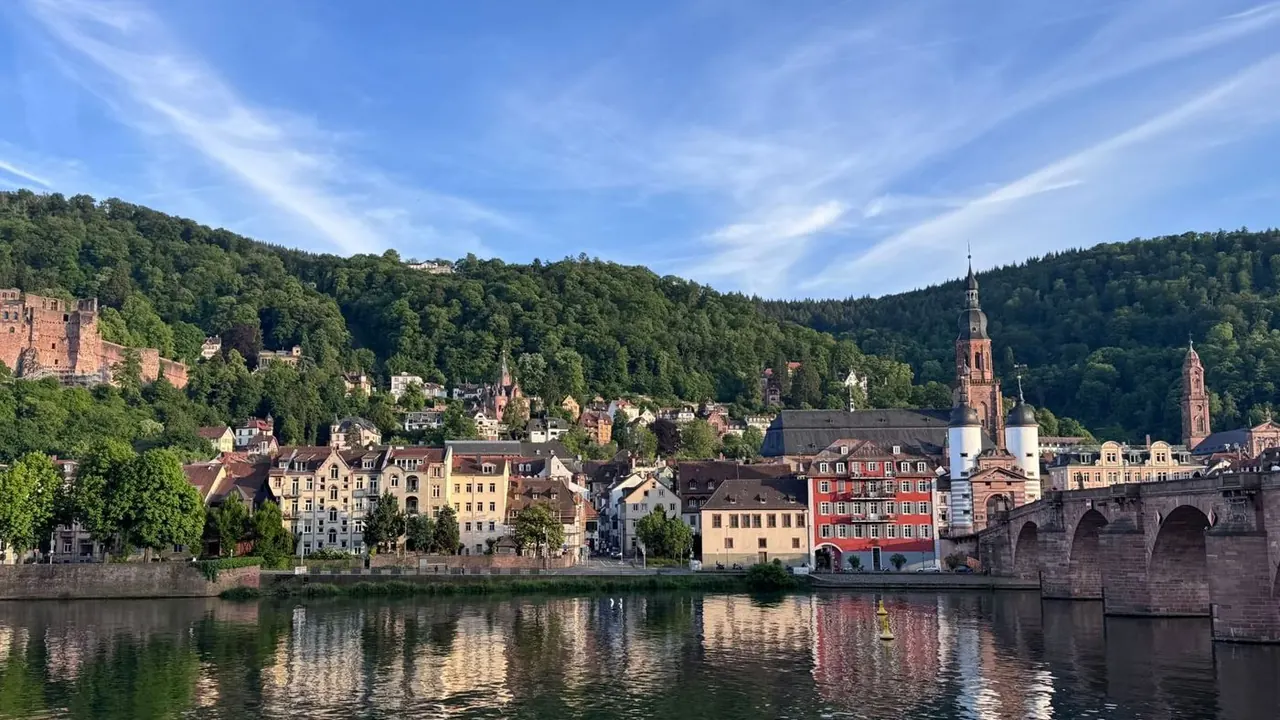
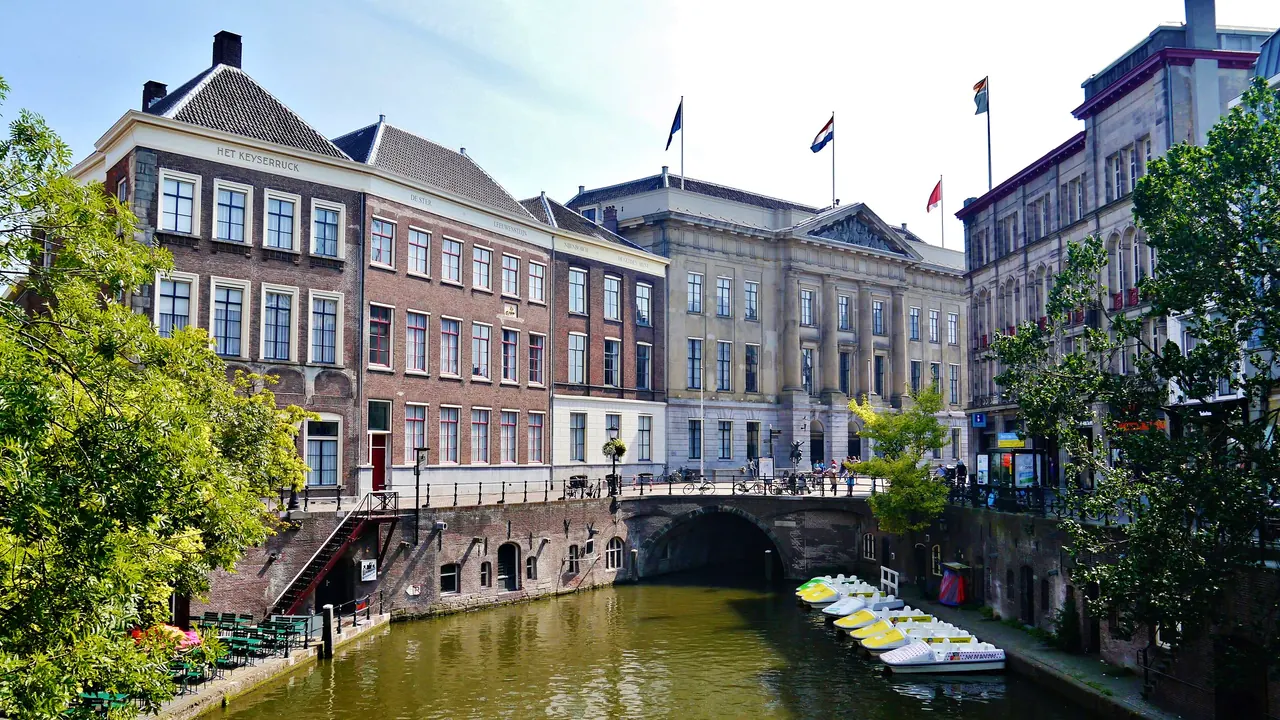
Photos: Heidelberg by Kuanling Chen, Pexels License; Utrecht by Zairon, CC BY-SA 4.0, cropped.
Heidelberg or Utrecht?
Our verdict in twelve categories, each scored against the same fixed benchmark cities, and the climate month by month, so you can choose for your trip.
Choose Heidelberg for
- nature and the outdoors
- prices
- wellness
Heidelberg suits travellers who want a romantic old town with real countryside on its doorstep. The castle ruin, the forest trails up the Königstuhl and the wine villages of the Bergstrasse and Palatinate make it a good choice for walkers, cyclists and wine lovers, and a bed there usually costs a little less than in Utrecht.
Choose Utrecht for
- shopping
- getting around
- live music and the arts
Utrecht is the better pick if you want a lively base for seeing a whole country. Amsterdam, Rotterdam and Delft are each a short train ride away. The canal-side bars stay busy all week, there are independent shops along the wharves and a concert hall with something on most nights, so evenings and rainy afternoons fill more easily than they do in Heidelberg.
Scoreboard
Twelve categories on one fixed scale from 0 to 100. The shaded stretch is the gap between the two.
Your match
Pick a travel style or drag the sliders, and both match scores follow your weighting.
Wins on nature and the outdoors and prices with your weighting.
Wins on shopping and getting around with your weighting.
What matters to you?
Category by category
What the scores mean for a trip.
Beaches & swimming
Neither city is a place for a beach vacation, but Utrecht does a little better on a hot day. The Maarsseveense Plassen and other recreation lakes are on the city's edge, and the North Sea at Zandvoort or Scheveningen is about an hour away by train, cold as it is.
From Heidelberg, swimming means the town's outdoor pools or the gravel-pit lakes on the Rhine plain, about half an hour away. The coast is several hours off.
Food & drink
The two are much alike for eating out, but the appeal differs. Heidelberg has a real regional kitchen, with Schäufele, Maultaschen and spring asparagus, and its main strength is wine, with Riesling and Pinot from vineyards just outside town. The best meals are in the side streets, in Neuenheim and in village wine taverns, not on the tourist-facing Hauptstrasse.
Utrecht has no cuisine of its own. Its pleasure is the setting: you eat at the water's edge on the Oudegracht wharves. Indonesian and Surinamese kitchens add variety, and the brown cafés pour Dutch and Belgian beer, so it is a beer town where Heidelberg is a wine town.
Culture & sights
These two are evenly matched, and both have well-preserved old centres that most visitors can cover in a short stay. Heidelberg's sights are Romantic and academic: the red sandstone castle ruin above the Neckar, the Old Bridge and Germany's oldest university with its graffiti-covered Student Prison. You can see most of it in a day or two.
Utrecht pairs its medieval core with modern design. You can climb the Dom Tower, and the two-level wharves of the Oudegracht are unlike any other canal in the country. The Centraal Museum's De Stijl collection and the UNESCO-listed Rietveld Schröder House give the city a modernist side that Heidelberg lacks.
Nightlife
Both are student towns, but Utrecht's evenings carry more weight. Bars and terraces around the Neude, the Janskerkhof and the canal fill on weeknights as well as weekends, and on summer evenings drinking at the water's edge is the main event.
Heidelberg's going out is concentrated on the Untere Strasse and in the old student taverns with carved tables. It is lively in term time, but the town goes quiet early out of term. For a big club night, Utrecht has Amsterdam close by, while Heidelberg looks to Mannheim or Frankfurt.
Nature & outdoors
Heidelberg has the stronger outdoors. Wooded hills rise straight from the old town. The Philosophers' Walk and the funicular up the Königstuhl lead onto hours of forest trails, the Heiligenberg has Celtic ramparts among the trees, and the sandstone crags of the Palatinate Forest are about an hour away.
Utrecht's countryside is flat and best seen by bike, along the Vecht past estates and windmills or out to the heath and low ridges of the Utrechtse Heuvelrug. The Loosdrecht lakes add open water for sailing and canoeing, where Heidelberg's boating is on the river, but there is nothing to climb.
Day trips
Both make excellent bases, but Utrecht has the edge because it sits at the hub of the Dutch railways. Amsterdam is under half an hour away, Rotterdam and The Hague are well under an hour, and Delft, Leiden, Haarlem and Gouda are all simple outings, so you can see much of the Netherlands without changing hotels.
Heidelberg's range is impressive too: the cathedrals of Speyer and Worms, the palace gardens at Schwetzingen, Maulbronn monastery and castle villages along the Neckar. The wine villages of the Palatinate are easier to reach by car than by train.
Good for families
Both are calm, manageable cities with children, so the choice comes down to the kind of outing. Heidelberg offers a funicular ride to a small fairy-tale park, a riverside zoo and, half an hour away, the Technik Museum Speyer, where children can climb into a space shuttle and a submarine.
Utrecht has the national Railway Museum and a Miffy museum for toddlers, both within easy reach of the centre. The hazards differ too: in Heidelberg it is cobbles and slopes with a pushchair, in Utrecht the constant stream of bikes.
Getting around
Utrecht is the easier city to get around. You step out of Utrecht Centraal straight into the old town, the streets are flat, and a rental bike covers anything beyond walking distance.
In Heidelberg, the main station is well west of the Altstadt, so most arrivals take a tram in. Once there, the sights lie along one long pedestrian street, but the castle approach is steep on foot. Its shared regional fare system does make train trips to Speyer or Mannheim simple.
Shopping & style
Utrecht is the more rewarding place to shop. Independent fashion, design, book and homeware shops line the Oudegracht wharves and lanes such as the Zadelstraat and Twijnstraat, the Hoog Catharijne mall handles the chains, and there are markets on Vredenburg and the Janskerkhof.
Heidelberg's shopping runs along the Hauptstrasse, from chain stores at one end to cuckoo clocks and beer steins at the other, with only a few boutiques in the side lanes. A bottle of Bergstrasse wine is the best thing to take home.
Affordability
Neither is cheap, and in both the bed is the main expense, but Heidelberg comes out somewhat cheaper. Its rooms get dear around congresses and graduations, so many visitors stay in Mannheim and ride in by train. Bakeries, student cafés and simple taverns keep meals reasonable.
Utrecht's central hotels are scarce and priced like those in any large Western European city, and a sit-down dinner with drinks adds up quickly. The compact centre and rental bikes mean you spend almost nothing on getting around.
Live music & performing arts
Utrecht has the fuller programme. TivoliVredenburg stacks several halls in one building, running from the Radio Philharmonic to pop and experimental acts, and the Festival Oude Muziek is one of Europe's leading early-music events. Theatre is mostly in Dutch, though, and there is no opera house.
Heidelberg fills that gap on a smaller scale. Its municipal theatre stages opera alongside drama, the Heidelberger Frühling festival brings chamber music in spring, and in summer the castle courtyard becomes an open-air stage, which is a memorable setting for a play or concert.
Wellness & relaxation
Neither city has baths of its own, and both are about equal for a relaxing stay, so the difference lies in what is nearby. From Heidelberg, warm saline thermal pools in the Kraichgau are about half an hour away and Baden-Baden about an hour, while Utrecht's options are large Dutch sauna complexes in the surrounding green belt.
For simply slowing down, Heidelberg has the Neckar meadows in Neuenheim and forest paths above the Philosophers' Walk. Utrecht has evenings on the canal wharves and the quiet Pandhof cloister garden beside the Dom.
When should you go?
Pick your month. The climate figures are measured averages, not a forecast.
Heidelberg in July
Utrecht in July
Daytime high, °C
Rainfall in the month, mm
Temperature and rainfall are climate normals, averaged over the years shown. Heidelberg: 1991-2020 normals, Heidelberg (4.5 km from centre). Utrecht: 1991-2020 normals, De Bilt (4.3 km from centre).
Both cities are at their best from May to September. Heidelberg runs warmer in summer, with highs around 26°C in July and August against Utrecht's 23°C, and it gets more sunshine from June to August, which suits long days on the Neckar meadows and in the vineyards. Neither gets too hot for walking the streets. Winters are cold, grey and short of sun in both, with daytime highs of about 5 to 7°C. That is fine for museums and brisk walks, but not for sitting outside.
Rain is the bigger difference. Heidelberg's wettest month is July, when showers come between sunny spells, and late winter and April are its driest stretch. Utrecht gets wetter from late summer and stays damp through autumn and winter. October to December are clearly wetter there than in Heidelberg, so outside the summer the German town is the more comfortable of the two. The North Sea within reach of Utrecht only warms to about 19°C in August, so a swim there is for the hardy even at the height of summer.
Which traveller are you?
On an outdoors trip, Heidelberg is the clear choice. The forest starts at the edge of the old town, a funicular climbs to trails on the Königstuhl, and the Neckar cycle path and the Palatinate Forest offer far more variety than Utrecht's flat polders.
For a shopping trip, choose Utrecht. Independent fashion, design and book shops line the canal wharves and the lanes around the Twijnstraat, and there are flower and textile markets, while Heidelberg's Hauptstrasse is mostly chain stores and souvenirs.
On a trip with a tight budget, Heidelberg is a little easier on the wallet. Rooms cost somewhat less, student taverns and bakeries keep meals cheap, and you can sleep in Mannheim and ride in by train. In Utrecht, a scarce supply of central hotels pushes up the cost of a bed.
Before you go
| Measure | Heidelberg | Utrecht |
|---|---|---|
| Official language | German | Dutch |
| Currency | Euro (EUR) | Euro (EUR) |
| Sockets | CF230 V, 50 Hz | CF230 V, 50 Hz |
| Driving side | Right | Right |
| Time zone | UTC+1, UTC+2 in summer | UTC+1, UTC+2 in summer |
| Emergency number | 112 | 112 |
| Elevation | 114 m | 5 m |
| Main airport | Frankfurt Main Airport (FRA)69 km from centre281 non-stop destinations | Amsterdam Airport Schiphol (AMS)34 km from centre287 non-stop destinations |
| Public holidays this year | 12 days | 11 days |
By the numbers
| Measure | Heidelberg | Utrecht |
|---|---|---|
| City population | 156,092 | 359,370 |
| People per km² | 1,433 | 3,619 |
| Museums within 10 km | 17 | 28 |
| UNESCO World Heritage sites within 50 km | 4 | 5 |
| Swim season, months above 21 °C | - | None |
Where else could you go?
Every comparison below shares a destination with this one, so you can follow Heidelberg or Utrecht somewhere new.