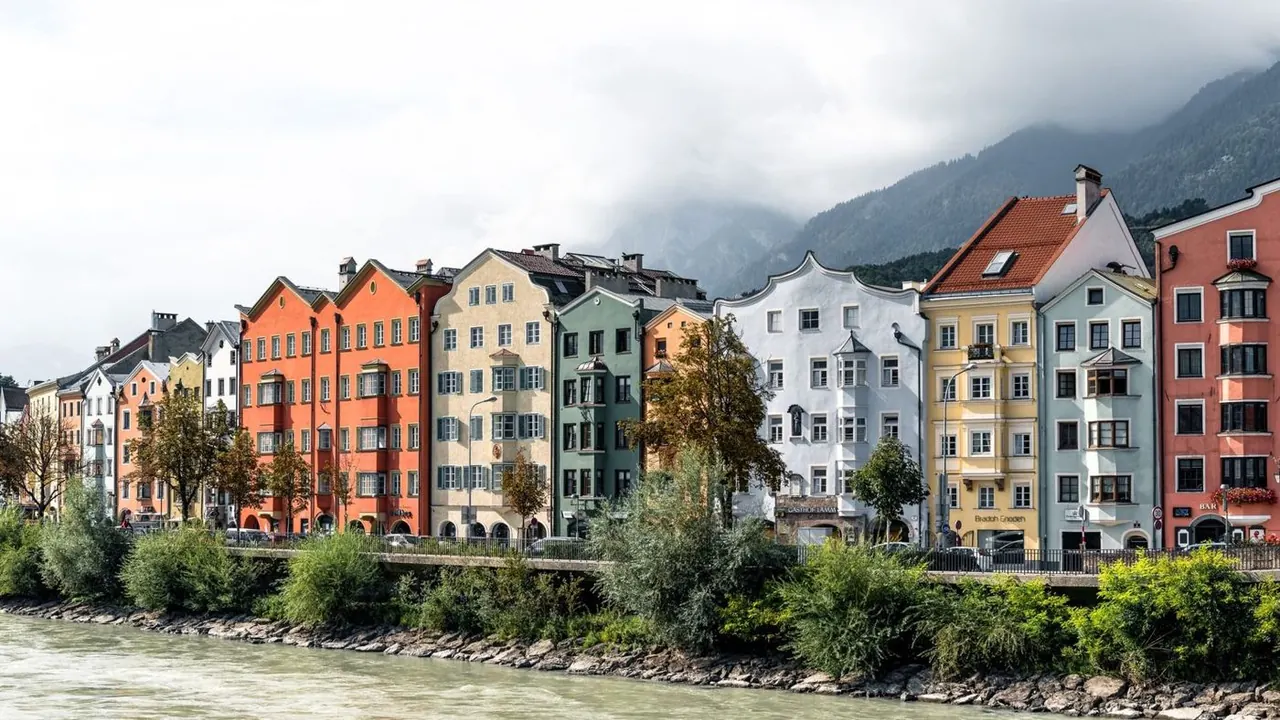
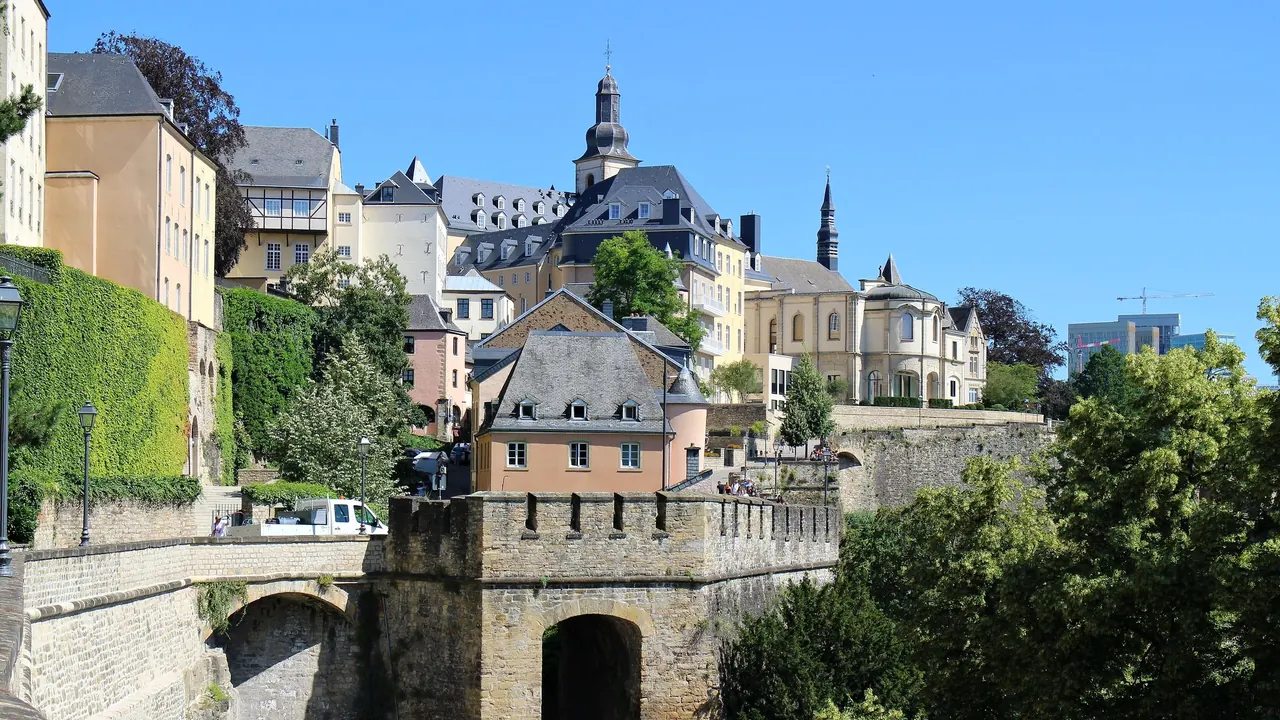
Photos: Innsbruck by Wolfgang Weiser, Pexels License; Luxembourg by Suicasmo, CC BY-SA 4.0, cropped.
Innsbruck or Luxembourg?
Our verdict in twelve categories, each scored against the same fixed benchmark cities, and the climate month by month, so you can choose for your trip.
Choose Innsbruck for
- nature and the outdoors
- prices
- families
Innsbruck is the choice when the mountains are the point of the trip. A funicular from the edge of the old town connects with cable cars that reach high Alpine ridges in minutes, so skiing, hiking, via ferratas and paragliding fit around an ordinary city stay. It also works better for families with children who like the outdoors, and it costs less, though it is not cheap.
Choose Luxembourg for
- food and drink
- live music and the arts
- day trips
Luxembourg suits a calmer trip built around a fortress city, good wine and an evening concert. The old town on its rock above the Grund, the Moselle crémant, a fine-dining tier that is serious for so small a city and the Philharmonie reward an unhurried long weekend. Trier and Metz are close enough for easy day trips, and free public transport takes away much of the effort, if not the cost.
Scoreboard
Twelve categories on one fixed scale from 0 to 100. The shaded stretch is the gap between the two.
Your match
Pick a travel style or drag the sliders, and both match scores follow your weighting.
Wins on nature and the outdoors and prices with your weighting.
Wins on food and drink and live music and the arts with your weighting.
What matters to you?
Category by category
What the scores mean for a trip.
Beaches & swimming
Neither city is for a beach trip, and both offer only short summer swims in lakes. Innsbruck's swimming spots are closer, small lakes such as the Lanser See and Natterer See on the plateaus just above town, with peaks behind them. The clear Achensee is lovely but stays cold.
Luxembourg's options are flatter and further out: the wooded reservoir of the Upper Sûre, about an hour north, and the old gravel pits at Remerschen in the Moselle valley. On ordinary days its large indoor pools stand in.
Food & drink
Luxembourg eats better, mostly because of its mix: French cooking in the better restaurants, Belgian and German brasseries, generations of Portuguese and Italian neighbourhood cooks, and Moselle Riesling and crémant poured by the glass. Its fine dining is unusually serious for the size of the city, though cheap casual food is thin.
Innsbruck's cooking is narrower and heartier: Gröstl, Kaspressknödel, Speck and Kaiserschmarrn. Its best meals come at mountain huts after a walk, not in the old town, where the inns around the Golden Roof mostly serve tour groups.
Culture & sights
Both have a compact set of sights that takes about two days, but they are different kinds of sight. Innsbruck's are Habsburg interiors and collections: the Hofkirche with Maximilian's tomb and its ring of bronze figures, the Hofburg, and the cabinet of curiosities and armour at Ambras Castle.
In Luxembourg the setting is the attraction. The UNESCO-listed fortress wraps around a sandstone plateau, with casemate tunnels to walk through and the Corniche looking down on the Grund. MUDAM's contemporary art on Kirchberg gives it a modern counterpart that Innsbruck covers instead with architecture, such as the Bergisel ski jump.
Nightlife
Both cities offer modest evenings rather than big nights out, but the crowds differ. Innsbruck's comes from its university, filling the bars and small clubs in the brick arches under the railway viaduct late at weekends, while in winter many visitors head for après-ski in the resorts instead.
Luxembourg's crowd is young international professionals, at the Rives de Clausen, the riverside pubs of the Grund and the rougher venues of Hollerich. Thursday and Friday are its big nights, since many residents leave at weekends.
Nature & outdoors
Here the gap is wide. From Innsbruck you can go from the old town to a ridge at about 2,300m on the Nordkette in under half an hour, with the Karwendel nature park behind it and the Stubai valley and its glacier across the valley. Skiing, via ferratas, paragliding, mountain biking and rafting all start close to town.
Luxembourg's landscape is gentler: wooded gorges running through the centre, the mossy sandstone passages of the Müllerthal half an hour away, the rolling Ardennes and cycle paths along the Moselle vineyards. It is good walking country, especially in autumn, but there are no mountains.
Day trips
Both are good bases for crossing borders, and Luxembourg's foreign cities are closer. Trier's Roman remains and Metz's Gothic cathedral are each under an hour by train, and Vianden's castle and the Moselle wine villages are closer still.
Innsbruck's best outings take longer but cover more ground: Munich and Salzburg each a little under two hours, Bolzano and Merano over the Brenner Pass, and Neuschwanstein by car. Medieval Hall in Tirol is just ten minutes down the valley.
Good for families
Innsbruck gives children more to do, because the mountains are on the doorstep. The Alpenzoo with its ibex, bears and wolves is on the funicular line, and summer brings adventure trails, playgrounds by the huts and warm plateau lakes, while winter brings ski schools on gentle slopes.
Luxembourg is just as safe and calmer still, and the casemate tunnels and ramparts feel like an adventure to children. Beyond that there is a natural history museum and the small Parc Merveilleux at Bettembourg, with no zoo or theme park, so it suits a few days rather than a week.
Getting around
Innsbruck's transport is built to reach the mountains. The Hungerburg funicular leaves from the edge of the old town and connects with the Nordkette cable cars, trams run out to Igls and the Stubai valley, and ski buses serve the slopes in winter. The flat centre is quick on foot, though a car helps for the remoter valleys and lakes.
Luxembourg's advantage is that trams, buses and second-class trains are free across the whole country, so Vianden, Clervaux and the Moselle are an easy ride without a ticket. Its centre is more vertical, with public lifts down to the Grund and Pfaffenthal and a funicular up to Kirchberg.
Shopping & style
Innsbruck sells the Alps: loden jackets, dirndls, woodcarvings, Speck and schnapps in the arcades of the old town, plus specialist outdoor and ski shops that are excellent. There is no luxury district, and Maria-Theresien-Strasse is mostly chains.
Luxembourg's Grand-Rue goes the other way, with international luxury and premium fashion for a wealthy local clientele. Porcelain, made in Luxembourg for centuries, and Moselle crémant are the things to take home. Neither city has much in the way of independent design.
Affordability
Innsbruck is the easier bill, though still Western European with an Alpine premium. Spring and autumn are clearly cheaper than ski season, and the guest cards that bundle lifts with transport help an active trip.
Luxembourg is expensive in almost every way: hotels priced for business travel and the European institutions, and restaurants well above the norm. The free transport, free museums and good-value lunch menus soften it, and many visitors sleep in Trier or Metz and come in by train.
Live music & performing arts
Luxembourg has the stronger concert life, centred on the Philharmonie on Kirchberg, with its own orchestra and a steady stream of touring orchestras and soloists. The Grand Théâtre brings in visiting opera and dance, and Neimënster in the Grund adds open-air summer concerts.
Innsbruck's programme is more local, with the Landestheater and the Tyrolean Symphony Orchestra, plus yodelling and brass at folk evenings. Its distinctive draw is the summer Festival of Early Music, held in historic rooms such as the Spanish Hall at Ambras Castle.
Wellness & relaxation
Innsbruck's wellness is the Alpine kind: mountain air, hotel saunas with views of the peaks up in Igls and the plateau villages, and a slow evening in a mountain hut. It has no springs of its own, and the big thermal complexes of the Ötztal and Zillertal are about an hour away.
Luxembourg has a real spa town half an hour off. At Mondorf-les-Bains a warm mineral spring has fed baths, pools and saunas in a landscaped park since the nineteenth century. Back in the city, quiet evenings and river walks through the Grund and the Pétrusse valley set the pace.
When should you go?
Pick your month. The climate figures are measured averages, not a forecast.
Innsbruck in July
Luxembourg in July
Daytime high, °C
Rainfall in the month, mm
Temperature and rainfall are climate normals, averaged over the years shown. Innsbruck: 1991-2020 normals, Innsbruck-Flughafen (3.3 km from centre). Luxembourg: 1991-2020 normals, Luxembourg / Luxembourg (6.3 km from centre).
Innsbruck has the warmer summer, reaching about 26°C in July, but it is also the wetter one, with rain peaking at around 144mm in August, so sunny mornings often turn into showery afternoons. Late spring and September are the most comfortable months for walking and hiking. Winters are cold in both cities, but Innsbruck's are clearly sunnier, which suits crisp days in the mountains.
Luxembourg is a little cooler, peaking near 24°C in July and August, and its rain is spread evenly through the year rather than bunched into summer. Its summers are the sunnier of the two, with long, bright days from May to August that suit the gorges and the vineyards. From November to January it turns grey and gloomy. In both cities the lakes are only warm enough for swimming in July and August.
Which traveller are you?
For an outdoors trip, Innsbruck is the clear pick. Serious mountain walking, skiing, climbing and paragliding all start a short ride from the hotel, in summer and winter alike. Luxembourg suits gentler days on forest trails and riverside cycle paths, with no summits.
On a family trip with children, Innsbruck is better for active families staying a week, because the mountains do the work that theme parks do elsewhere. Luxembourg fits a quieter long weekend with small children, easy with a buggy but thin on things built for them.
On a tight budget, Innsbruck is the more realistic of two pricey places, especially between the ski and summer seasons. Luxembourg is one of the dearest stays in Europe, and what you save there comes from the free extras rather than from cheap beds or meals.
Before you go
| Measure | Innsbruck | Luxembourg |
|---|---|---|
| Official language | German, Austrian Sign Language | French, German, Luxembourgish |
| Currency | Euro (EUR) | Euro (EUR) |
| Sockets | CF230 V, 50 Hz | CF230 V, 50 Hz |
| Driving side | Right | Right |
| Time zone | UTC+1, UTC+2 in summer | UTC+1, UTC+2 in summer |
| Emergency number | 112 | 112 |
| Elevation | 574 m | 300 m |
| Main airport | Innsbruck Airport (INN)4 km from centre40 non-stop destinations | Luxembourg-Findel International Airport (LUX)6 km from centre115 non-stop destinations |
| Public holidays this year | 16 days | 12 days |
By the numbers
| Measure | Innsbruck | Luxembourg |
|---|---|---|
| City population | 132,499 | 137,678 |
| People per km² | 1,263 | 2,663 |
| Museums within 10 km | 28 | 19 |
| UNESCO World Heritage sites within 50 km | 1 | 4 |
Where else could you go?
Every comparison below shares a destination with this one, so you can follow Innsbruck or Luxembourg somewhere new.
- Munichvs Innsbruck
- Cortina d'Ampezzovs Innsbruck
- Salzburgvs Innsbruck
- Maastrichtvs Luxembourg
- Colognevs Luxembourg
- Strasbourgvs Luxembourg