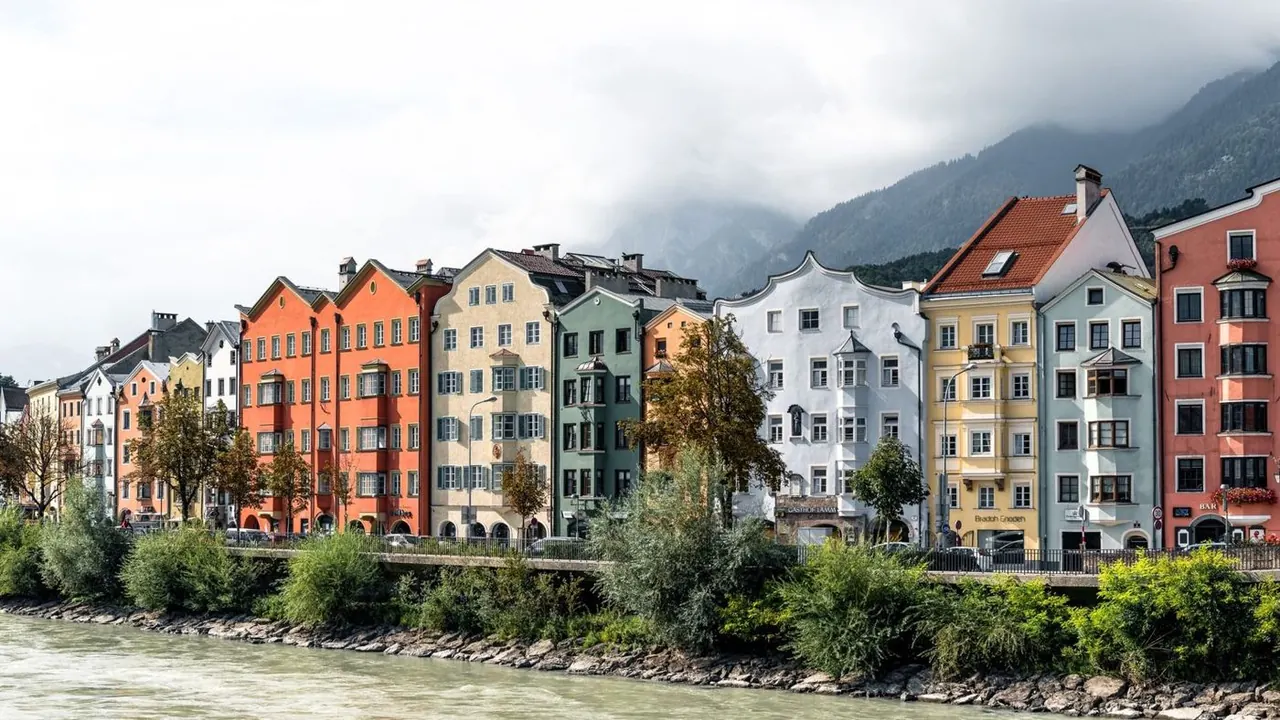
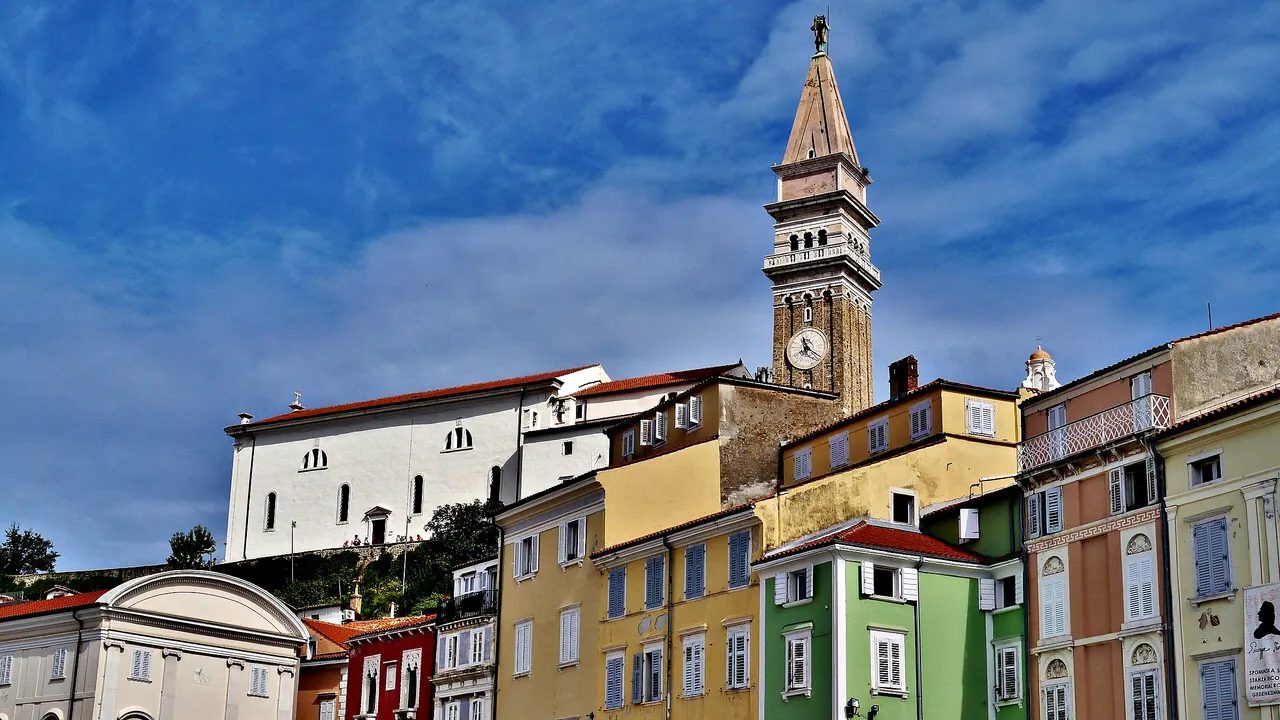
Photos: Innsbruck by Wolfgang Weiser, Pexels License; Piran by Zairon, CC BY-SA 4.0, cropped.
Innsbruck or Piran?
Our verdict in twelve categories, each scored against the same fixed benchmark cities, and the climate month by month, so you can choose for your trip.
Choose Innsbruck for
- nature and the outdoors
- live music and the arts
- shopping
Innsbruck is the choice for anyone who wants mountains on the doorstep. A funicular from the edge of the old town connects with cable cars up the Nordkette, so skiing, hut-to-hut hiking and via ferratas sit right beside a compact Habsburg centre with the Hofkirche, Ambras Castle and a theatre and concert programme that runs through the season. It also has more going on after dark, and it is far easier to get around without a car.
Choose Piran for
- beaches
- wellness
- prices
Travellers who want a slower trip built around the sea will be happier in Piran. Its car-free Venetian peninsula is for swimming off the rocks below the walls, a glass of wine at sunset on Tartini Square and seawater and salt-mud treatments in Portoroz and the salt pans. It costs a little less, the Adriatic stays warm through summer, and Trieste and the Istrian hill towns are close, although a hire car is the easiest way to reach them.
Scoreboard
Twelve categories on one fixed scale from 0 to 100. The shaded stretch is the gap between the two.
Your match
Pick a travel style or drag the sliders, and both match scores follow your weighting.
Wins on nature and the outdoors and live music and the arts with your weighting.
Wins on beaches and wellness with your weighting.
What matters to you?
Category by category
What the scores mean for a trip.
Beaches & swimming
Neither has a long sandy beach, and only one of them is on the sea. In Innsbruck, swimming means the Lanser See and Natterer See on the plateaus, which are pleasant for an afternoon in high summer. The beautiful Achensee is too cold for most swimmers.
Piran has the Adriatic from June to September. You get in from rocks and concrete platforms below the walls and around the Punta, the pebble cove at Fiesa is close by, and there is sand at Portoroz and Strunjan. It is a town for swimming rather than lying in the sun, but it gives you a real seaside vacation, which Innsbruck cannot.
Food & drink
The two eat about equally well, in very different ways. Innsbruck serves Tyrolean mountain food such as Gröstl, Kaspressknödel, Speck and Kaiserschmarrn, and it tastes best at a mountain hut after a cable car ride. The old town's Viennese-style coffee houses are the place for cake and strudel.
Piran is about fish and shellfish by the water, with Istrian olive oil, Malvazija and Refosk wines and its own salt on the table. Both have a narrow range. Piran's harbour menus repeat one another, and in Innsbruck the restaurants around the Golden Roof cater to tour groups, so in both cities the setting matters more than the cooking.
Culture & sights
Innsbruck has more to see. Its Habsburg past left the Golden Roof, the Hofburg and the Hofkirche, where Maximilian I's tomb is surrounded by its bronze figures. Add Ambras Castle with its cabinet of curiosities and armour, and modern architecture such as the Bergisel ski jump.
Piran's appeal is the old town as a whole rather than single sights: Venetian Gothic lanes, the oval Tartini Square, and the views from St George's campanile and the town walls. The maritime museum and the monastery cloister are modest. One day is enough for Piran, while Innsbruck needs two or three.
Nightlife
Neither city is a nightlife destination, but Innsbruck's university gives it a real scene. There are late bars and small clubs in the brick arches under the railway viaduct, pubs and wine bars around the old town, and après-ski in the resorts in winter.
In Piran, the evening is a glass of wine at sunset on Tartini Square or the Punta, and then the town goes quiet. The beach bars, casino and summer clubs of Portoroz are the only other option.
Nature & outdoors
This is Innsbruck's greatest strength. The funicular and the Nordkette cable cars take you from the old town to a ridge at about 2,300m, with the Karwendel nature park just behind it. The Stubai Glacier has skiing for most of the year, and summer brings hiking, via ferratas, paragliding and rafting.
Piran's outdoors is gentler and coastal. There are the flysch cliffs and coastal path at Strunjan, the wading birds of the Secovlje salt pans, kayaking along the shore and the Parenzana cycle route through olive groves. The Karst and the Skocjan caves are within an hour, but there are no high mountains, and spring and autumn are the best seasons for it.
Day trips
Both are close to borders and make good bases, but in different ways. From Innsbruck, the trains take you without a car to Hall in Tirol in ten minutes, to Kitzbühel, to Munich and Salzburg, and over the Brenner Pass to Merano and to Bolzano, home of Ötzi the Iceman.
Piran's day trips are Mediterranean: Trieste in under an hour, Rovinj, Porec and the Istrian hill towns, Predjama Castle and Lipica, Ljubljana, and summer boats to Venice. There is no railway, so most of these need a hire car. That makes Innsbruck the easier base if you do not drive.
Good for families
Innsbruck gives children more to do. The Alpenzoo, with its ibex, bears and wolves, is on the funicular route, and the mountains have adventure trails and playgrounds by the huts. Winter adds ski schools, and the Swarovski Crystal Worlds have a play tower. Rainy days still take some planning.
Piran is safe and car-free, with calm, warm water and a small aquarium, which makes it good for a few days with young children. On a longer stay it gets harder: swimming is from concrete ledges, the lanes up to the church are steep, and little is built for children.
Getting around
Both centres are easy to walk. The difference is in reaching what lies beyond them. Innsbruck has trams and buses, ski buses in winter, regional trains from a central station and a funicular that starts at the old town, so you do not need a car for the mountains or the nearby towns.
You can cross Piran's car-free peninsula on foot in a quarter of an hour, and a shuttle runs to the garage and to Portoroz. There is no railway and the buses are slow for Istria and the Karst, so most visitors hire a car to explore.
Shopping & style
Innsbruck has more shops, though neither is a shopping destination. Maria-Theresien-Strasse has the chains, while the old town arcades sell crystal, loden jackets, dirndls, woodcarvings, Speck and schnapps, and the outdoor and ski shops are excellent.
Piran has a few galleries, craft shops and souvenir stalls on the harbour. Its best buys are things to eat and drink: salt flower from the Secovlje pans, Istrian olive oil and coastal wine.
Affordability
Piran is somewhat easier on the budget. In July and August, rooms in the old town and meals on the waterfront cost more. Simple konobas, local wine, a bed in Portoroz or a visit out of season bring costs down to a fair level, and swimming and walking are free.
Innsbruck adds an Alpine resort premium, which is highest in the ski season and around Christmas, and cable car tickets add up on an active trip. The guest and city cards help, and spring and autumn are clearly cheaper.
Live music & performing arts
Innsbruck has a full programme through the season. The Tiroler Landestheater stages opera, operetta, drama and dance, and the Tyrolean Symphony Orchestra plays in the congress hall. In summer the Festival of Early Music uses venues such as the Spanish Hall at Ambras Castle, and there are folk evenings and small jazz venues as well.
In Piran, music is mainly a summer thing, with Tartini concerts in churches, in the monastery cloister and on the main square, and occasional recitals at the small Tartini Theatre. Outside summer there is little to go to.
Wellness & relaxation
Piran is the better place to unwind. Portoroz grew up as a spa resort and still uses seawater, brine and mud from the salt pans. There is an outdoor thalasso spa among the Secovlje lagoons and a seawater health resort at Strunjan, and Piran's car-free lanes keep the pace slow.
Innsbruck has no thermal springs. Its kind of wellness is mountain air, quiet walks and hotel saunas, which are best in Igls and the plateau villages. The large thermal spas of the Ötztal and the Zillertal are about an hour away.
When should you go?
Pick your month. The climate figures are measured averages, not a forecast.
Innsbruck in July
Piran in July
Daytime high, °C
Rainfall in the month, mm
Temperature and rainfall are climate normals, averaged over the years shown. Innsbruck: 1991-2020 normals, Innsbruck-Flughafen (3.3 km from centre). Piran: 2005-2020 (sunshine 1991-2020, rainfall 1991-2020) normals, Portoroz (1.2 km from centre).
Innsbruck has two good seasons. Summer highs of around 26°C make July and August good for hiking and the plateau lakes, but this is also the wettest part of the year, with about 144mm in August. Winter days stay only a few degrees above freezing, which suits skiing more than strolling, so May, June and September are the most comfortable months for combining the town with the trails.
Piran is warmer and sunnier in summer. July reaches about 30°C, the sea is close to 25°C in July and August, and these are the sunniest months of the year, so the swimming season runs from June to September. The rain comes later than in Innsbruck and is heaviest in autumn, with about 125mm in November. Winters are mild but grey, fine for a quiet walk, though the sea is too cold for swimming.
Which traveller are you?
For a beach and sun trip, Piran wins easily. Long sunny summers and a warm Adriatic make a daily swim from the seafront ladders or the Fiesa cove a pleasure. In Innsbruck, swimming means cool mountain lakes on a few summer afternoons.
On an outdoors trip, Innsbruck is in a different league. The Nordkette ridge is under half an hour from the old town, with the Karwendel behind it, glacier skiing in the Stubai valley, and paragliding, biking and rafting in summer. Piran's cliffs and salt pans are gentle by comparison.
For a culture and arts trip, Innsbruck has more to offer. The Hofkirche, the Hofburg, Ambras Castle and two good museums fill two or three days, and the Landestheater and the Festival of Early Music take care of the evenings. Piran's lovely old town takes a day.
Before you go
| Measure | Innsbruck | Piran |
|---|---|---|
| Official language | German, Austrian Sign Language | Slovene |
| Currency | Euro (EUR) | Euro (EUR) |
| Sockets | CF230 V, 50 Hz | CF230 V, 50 Hz |
| Driving side | Right | Right |
| Time zone | UTC+1, UTC+2 in summer | UTC+1, UTC+2 in summer |
| Emergency number | 112 | 112 |
| Elevation | 574 m | 7 m |
| Main airport | Innsbruck Airport (INN)4 km from centre40 non-stop destinations | Trieste Airport (TRS)34 km from centre32 non-stop destinations |
| Public holidays this year | 16 days | 21 days |
By the numbers
| Measure | Innsbruck | Piran |
|---|---|---|
| City population | 132,499 | 3,787 |
| People per km² | 1,263 | 85 |
| Museums within 10 km | 28 | 5 |
| UNESCO World Heritage sites within 50 km | 1 | 4 |
| Swim season, months above 21 °C | - | 4 months |
Where else could you go?
Every comparison below shares a destination with this one, so you can follow Innsbruck or Piran somewhere new.