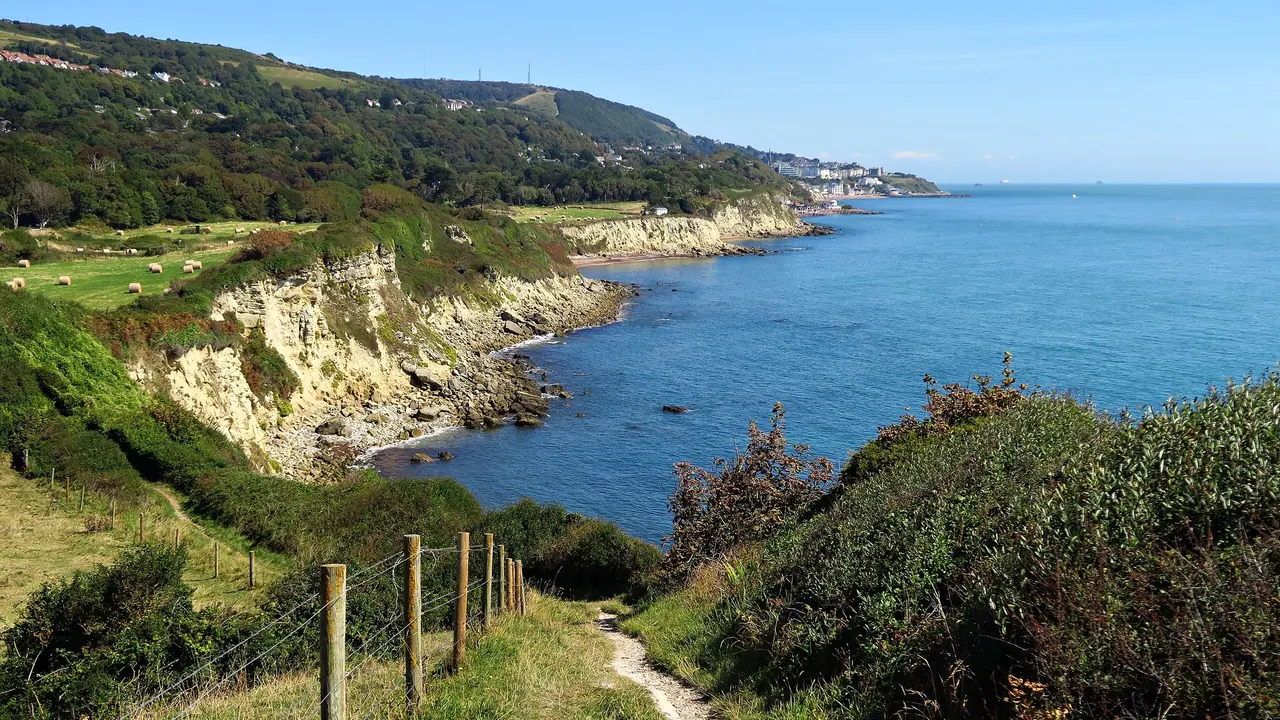
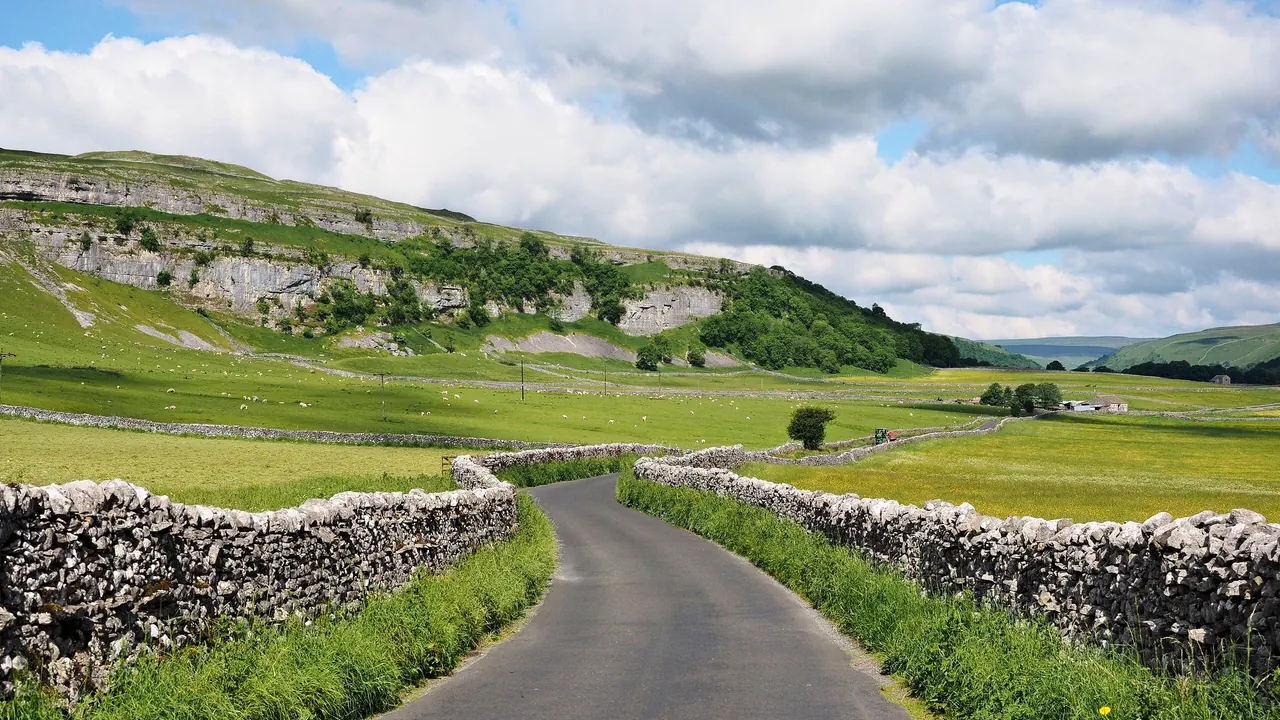
Photos: Isle of Wight by Michael Coppins, CC BY-SA 4.0, cropped; Yorkshire Dales by Kreuzschnabel, CC BY-SA 3.0, cropped.
Isle of Wight or Yorkshire Dales?
Our verdict in twelve categories, each scored against the same fixed benchmark cities, and the climate month by month, so you can choose for your trip.
Choose Isle of Wight for
- beaches
- families
- getting around
The Isle of Wight is the choice for a classic seaside vacation. It has sandy bays on the east coast and attractions built for children, and the island is small enough to cross by bus or electric train without much planning. It is also the drier and sunnier of the two in summer, which matters when the plan revolves around the beach.
Choose Yorkshire Dales for
- day trips
- nature and the outdoors
- wellness
Walkers, and anyone who wants big open country, should head for the Yorkshire Dales instead. Limestone scars, the Three Peaks and deep caves make the landscape far more dramatic than the island's gentle downs. The ring of abbeys, cathedral cities and spa towns around the park also gives much richer days out. The price is that you will need a car for most outings, and there is no sea.
Scoreboard
Twelve categories on one fixed scale from 0 to 100. The shaded stretch is the gap between the two.
Your match
Pick a travel style or drag the sliders, and both match scores follow your weighting.
Too close to call, level with your weighting
Wins on beaches and families with your weighting.
Wins on day trips and nature and the outdoors with your weighting.
What matters to you?
Category by category
What the scores mean for a trip.
Beaches & swimming
Only one of these has a coast. The Isle of Wight has gentle sand in Sandown Bay and at Ryde, surf and coloured cliffs at Compton Bay in the west, and calm Solent water at Colwell Bay. The Channel stays cool, though, so swimming really belongs to late summer.
The Dales are inland hills, and the nearest proper beach is a long drive away. Instead they offer a cold river dip in the Wharfe near Grassington and Burnsall or under the Swale falls at Keld. That is fun on a hot day, but it is not a reason to choose them.
Food & drink
The two eat in a similar way, in pubs, tea rooms and from local produce, and neither is worth the trip for its cooking. The difference is what ends up on the plate. The island leans on the sea, with crab and lobster in the harbour pubs of Bembridge, Ventnor and Yarmouth, fish and chips on the front, and garlic and tomatoes from its farms.
The Dales lean on the land, with Wensleydale cheese from Hawes, Dales lamb, moorland game and bitter brewed in Masham. Their best tables are dining pubs in Wharfedale. The island's few ambitious restaurants are around Cowes and Ventnor.
Culture & sights
Neither has a dense cluster of great sights, and the two lists are about the same size, but they differ in shape. The island has one sight of national standing, Osborne House, Queen Victoria's seaside home. Around it are Carisbrooke Castle, Brading's Roman mosaics and the Tennyson connections at Freshwater.
The Dales spread their heritage more evenly. There are medieval castles at Skipton, Bolton and Richmond, ruined abbeys such as Jervaulx and Bolton Priory, and an industrial past in the lead mines, field barns and Ribblehead Viaduct. It comes down to royal Victoriana on one side, and medieval stone and working countryside on the other.
Nightlife
Both are pub country after dark, and neither should be chosen for going out. The island has a little more: a few late bars and small clubs in Newport and Ryde, and a lively Cowes waterfront during the August regatta week. In the Dales an evening means a village pub with a fire, Skipton is only slightly livelier at weekends, and a real night out means a trip to Leeds.
Nature & outdoors
The island's outdoors is gentle and shaped by the sea. The chalk ridge of Tennyson Down runs out to the Needles, a coastal path loops the whole island, and red squirrels live in the woods. Its real strength is on the water, with sailing on the Solent from Cowes and easy kayaking and paddleboarding.
The Dales offer more, and on a bigger scale. There is limestone scenery at Malham Cove and Gordale Scar, a long day's hike over the Three Peaks above Ribblesdale, and the Pennine Way and Dales Way crossing the park. Under the hills is one of Britain's great caving areas, around Ingleton and Gaping Gill.
Day trips
On the island, days out are mostly hops between small towns: Cowes, Yarmouth, Ventnor and Godshill. Every mainland outing starts with a ferry, though Portsmouth's Historic Dockyard, with HMS Victory and the Mary Rose, is a quick foot-ferry ride from Ryde.
The Dales are surrounded by a far richer set of places, and none of them needs a crossing. There are Fountains Abbey and Studley Royal, Ripon and Harrogate, York and its Minster, Durham north of Richmond, Haworth and Saltaire to the south, and the Lake District to the west. If you want a different outing every day, the Dales win comfortably.
Good for families
The island makes the easier family vacation, because it was built for one. Sandown Bay has sandy shallows, and close by are Blackgang Chine with its smugglers and dinosaurs, Robin Hill, a zoo, a steam railway and fossil hunts on the south-west beaches.
The Dales suit families who prefer walking boots and fresh air to amusements. There are show caves near Ingleton, waterfalls at Aysgarth, river paddling at Bolton Abbey and castles to explore. You will need a car, and a wet day is harder to fill, though older children can try caving and gorge scrambling, which the island cannot offer.
Getting around
The island is easier without a car. It is only about 37km across, buses link every town, open-top buses climb to the Needles in summer, and an electric railway runs from Ryde Pier to Shanklin. The catch is that every arrival is by ferry.
In the Dales a car is close to essential. The narrow walled lanes get busy at Malham and Bolton Abbey on summer weekends, and buses into the high valleys are sparse. The Settle to Carlisle line helps in the western dales, and once you are settled in Grassington, Hawes or Settle you can walk from the door.
Shopping & style
Nobody chooses either of these for shopping. The island's best finds are glassblowers and potters, nautical clothing in Cowes, and garlic and chutney from the farm shops, while Newport's high street is strictly everyday. The Dales are slightly better for browsing, with proper market days in Skipton, Richmond and Hawes, plus antiques, galleries and wool crafts, and Harrogate and York are near enough for bigger shops.
Affordability
Neither is cheap in summer, and in July and August both charge full English high-season rates for cottages and inns. The cost that sets the island apart is the ferry, which is expensive with a car, so foot passengers who use the buses save the most.
In the Dales the main pleasure, walking among the hills, waterfalls and ruins, costs nothing, and bunkhouses, youth hostels and campsites make a low-budget trip a little easier. In both places, travelling outside the school summer break brings prices well down.
Live music & performing arts
Both are quiet outside their festivals, and the festivals are of different kinds. The island's big event is the Isle of Wight Festival, a large rock and pop weekend near Newport each June, whose history goes back to the late 1960s. Beyond that there is the Ventnor fringe and Shanklin's Victorian theatre.
The Dales are smaller in scale and more classical. Richmond has the tiny Georgian Theatre Royal from 1788, the Swaledale Festival puts on concerts in village churches, and there is also the Grassington Festival, along with brass bands and choirs. Choose the island for one big outdoor gig, and the Dales for intimate evenings.
Wellness & relaxation
The island offers rest by the sea, while the Dales offer rest in the hills, with proper Victorian baths close by. On the Isle of Wight, unwinding means the sheltered calm of Ventnor, built as a health resort for its mild climate, along with clifftop benches looking out over the Channel and the gardens and tea room of the monks at Quarr Abbey. Treatments are limited to a few hotels and small rooms.
The Dales give a little more. Several country-house hotels and inns have their own spas, and the nights are dark enough to see the stars. Harrogate's Victorian Turkish Baths, with tiled steam rooms and hot rooms, are a short drive from Nidderdale and Wharfedale, and after a few days on the fells they make a better end to the trip than anything on the island.
When should you go?
Pick your month. The climate figures are measured averages, not a forecast.
Isle of Wight in July
Yorkshire Dales in July
Daytime high, °C
Rainfall in the month, mm
Where the figures come from
Isle of Wight's temperatures are measured 39 km from the centre, at Bournemouth Airport.
Isle of Wight has no rain gauge within 25 km of the centre, so its rainfall comes from a gridded climate dataset read at the destination rather than from a gauge further away.
Yorkshire Dales's temperatures are measured 40 km from the centre, at Leeming.
Yorkshire Dales's station stands 153 m below the place it is measured for, so that place is likely a little cooler than the figures say.
Yorkshire Dales has no rain gauge within 25 km of the centre, so its rainfall comes from a gridded climate dataset read at the destination rather than from a gauge further away.
Temperature and rainfall are climate normals, averaged over the years shown. Isle of Wight: 1991-2020 normals, Bournemouth Airport (38.9 km from centre). Yorkshire Dales: 1991-2020 normals, Leeming (39.7 km from centre).
On the Isle of Wight, summer is the season. Highs reach about 22°C in July and August, sunshine peaks in early summer, and the sea warms to around 18°C by August, so swimming really belongs to July, August and September. Spring is pleasant for walking the coast path, and the weather turns wet from October, with the late autumn and winter months the dampest and greyest.
The Dales run a degree or two cooler all year and are much wetter, even in summer. July brings about 109mm of rain against roughly 50mm on the island, and the Dales get fewer hours of sun. Late spring, especially May, is the driest and most reliable time for long hill walks. From October to December the fells are cold, wet and short of daylight, so a winter visit there means cosy pubs more than long days on the tops.
Which traveller are you?
On a beach and sun trip, the Isle of Wight is the only real option. Sandown Bay's gentle sands, Compton Bay's surf and a summer that is drier and sunnier than the Dales make it a proper seaside vacation, while the Dales offer only cold river pools.
For an outdoors trip, the Yorkshire Dales are the stronger pick. Malham Cove, the Three Peaks, long-distance paths and the caves around Ingleton give bigger, wilder walking than the island's chalk downs, though sailors will still prefer the Solent.
On a family trip with young children, the Isle of Wight is the easier choice. Shallow sand, Blackgang Chine, fossil hunts and a zoo are all close together and reachable by bus. The Dales need a car and struggle to fill a wet day.
Before you go
| Measure | Isle of Wight | Yorkshire Dales |
|---|---|---|
| Official language | English | English |
| Currency | Pound Sterling (GBP) | Pound Sterling (GBP) |
| Sockets | G230 V, 50 Hz | G230 V, 50 Hz |
| Driving side | Left | Left |
| Time zone | UTC, UTC+1 in summer | UTC, UTC+1 in summer |
| Emergency number | 112 or 999 | 112 or 999 |
| Main airport | Southampton Airport (SOU)15 non-stop destinations | Leeds Bradford Airport (LBA)69 non-stop destinations |
| Public holidays this year | 8 days | 8 days |
By the numbers
| Measure | Isle of Wight | Yorkshire Dales |
|---|---|---|
| Population | 140,459 | - |
| People per km² | 369 | - |
| Swim season, months above 21 °C | None | None |
Where else could you go?
Every comparison below shares a destination with this one, so you can follow Isle of Wight or Yorkshire Dales somewhere new.
- Lake Districtvs Yorkshire Dales
- Peak Districtvs Yorkshire Dales
- Cotswoldsvs Isle of Wight
- Devonvs Isle of Wight
- Snowdoniavs Yorkshire Dales
- Normandyvs Isle of Wight