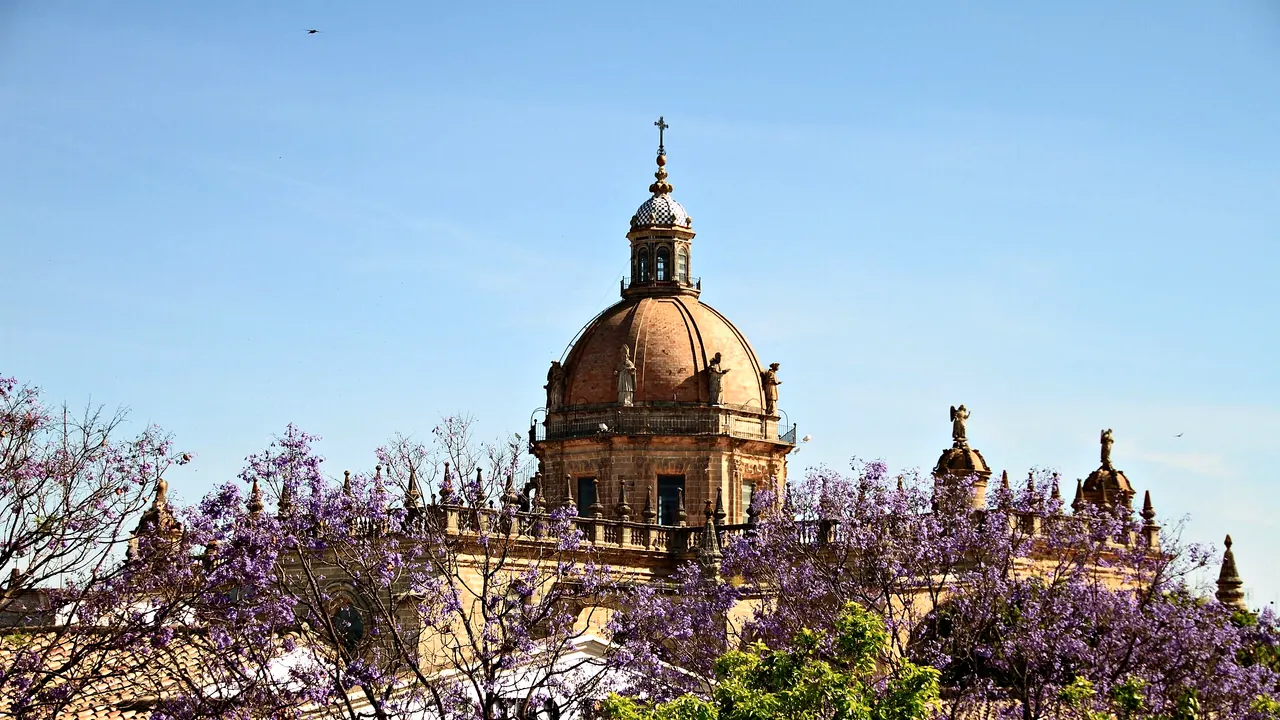
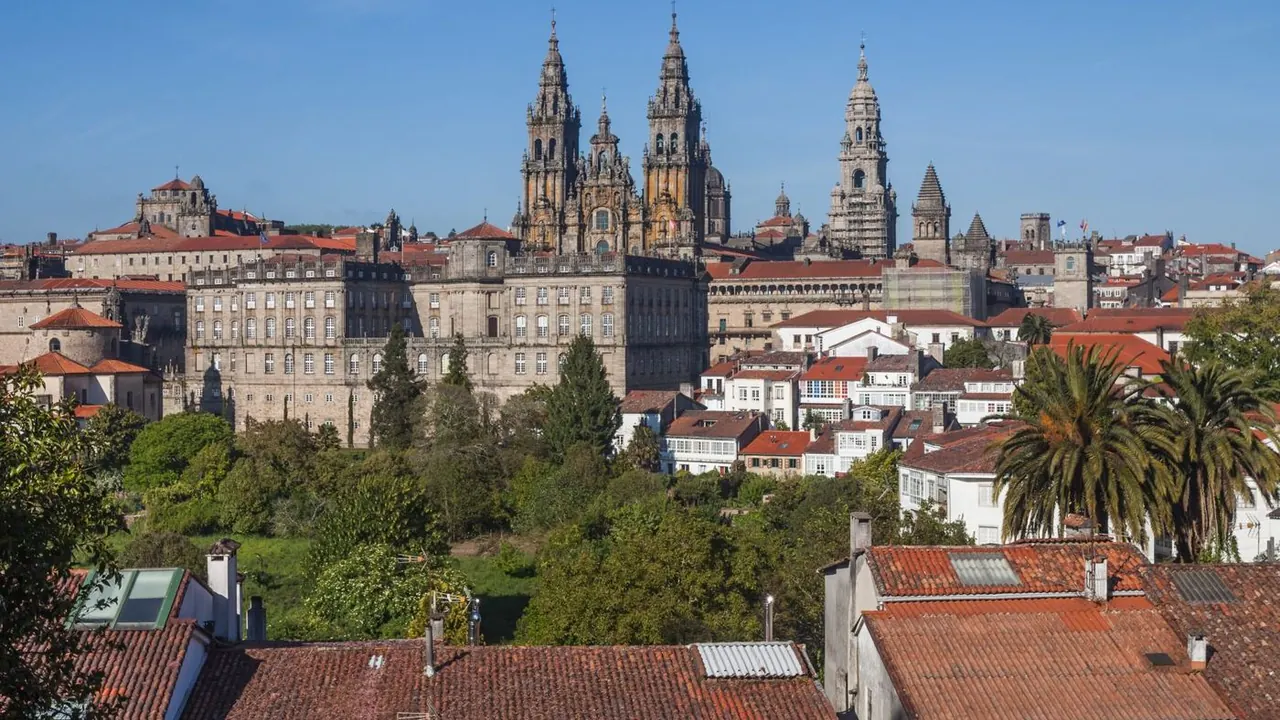
Photos: Jerez de la Frontera by PEPE GADEIRAS, CC BY 4.0, cropped; Santiago de Compostela by Luis Miguel Bugallo Sánchez (Lmbuga), CC BY-SA 3.0, cropped.
Jerez de la Frontera or Santiago de Compostela?
Our verdict in twelve categories, each scored against the same fixed benchmark cities, and the climate month by month, so you can choose for your trip.
Choose Jerez de la Frontera for
- beaches
- live music and the arts
- families
Jerez suits a traveller who wants the warm, sunny south and plenty to do beyond the city itself. Flamenco is a living local art in the peñas and tabancos of the Barrio de Santiago and San Miguel, and the sherry bodegas are a heritage of their own. The long golden beaches of the Costa de la Luz, Seville, Cádiz and the white towns are all within easy reach. It works best as a base for a week of outings, and in summer it suits families too, once the beach is part of the plan.
Choose Santiago de Compostela for
- culture and sights
- getting around
- nightlife
For a trip built around one great monument and a beautiful old town, Santiago de Compostela is the better choice. The cathedral, the Obradoiro and the granite arcades give it the richer sightseeing. Its compact pedestrian centre is easier to cover on foot, and in term the student bars keep evenings livelier. Come for history, Galician seafood and the end of the Camino, and pack a waterproof rather than a swimsuit.
Scoreboard
Twelve categories on one fixed scale from 0 to 100. The shaded stretch is the gap between the two.
Your match
Pick a travel style or drag the sliders, and both match scores follow your weighting.
Too close to call, 2 points apart
Wins on beaches and live music and the arts with your weighting.
Wins on culture and sights and getting around with your weighting.
What matters to you?
Category by category
What the scores mean for a trip.
Beaches & swimming
Neither city is on the sea, but Jerez is far better placed for it. It lies about 12km inland, with Valdelagrana and El Puerto a short ride away and La Caleta and Playa de la Victoria in Cádiz about half an hour by train. These are long, open Atlantic sands where the water is warm enough for a proper swim in summer, though the Levante wind can make some days rough.
Santiago's beaches are a bus ride or a drive away, in the sheltered white-sand inlets of the Ría de Muros e Noia and the Ría de Arousa. They are calmer than the open ocean, but the water stays cold and the Galician summer is short, so they make an outing rather than a reason to come.
Food & drink
Both cities eat well within one regional tradition rather than offering range. What differs is the tradition. Jerez is about sherry: fino and oloroso from the barrel in the tabancos, tastings in the bodegas, kidneys or oxtail cooked in sherry and fried fish from the coast.
Santiago is about Galician seafood. In the granite Mercado de Abastos some counters will cook what you buy, and the taverns of Rúa do Franco serve pulpo á feira, scallops and percebes with Albariño, with tarta de Santiago to finish. Seafood lovers will lean north and sherry lovers south.
Culture & sights
Santiago has the deeper sightseeing. The cathedral, with the Pórtico da Gloria and the shrine of Saint James, is a world-class monument. Around it the Praza do Obradoiro and the UNESCO-listed granite old town, with San Martiño Pinario and the Museo do Pobo Galego, hold together in a way few cities of its size can match.
Jerez has a more modest list, built on things found nowhere else: the Almohad Alcázar with its Arab baths, the cathedral-like sherry bodegas and the Royal Andalusian School of Equestrian Art. Each city is covered well in two or three days.
Nightlife
Santiago has the livelier evenings, thanks to its university. In term the bars around Rúa da Raíña and the Praza de Cervantes fill with students, above all on Thursdays, some of them with Galician folk sessions, and a few clubs run until the early morning. In summer the students give way to pilgrims, who go to bed early.
Jerez is quieter and more provincial. Its nights centre on tapas, tabancos and copa bars around Plaza del Arenal and Calle Larga. The big exception is the Feria del Caballo in May, a week of dancing in the casetas until dawn.
Nature & outdoors
Both cities have fine country within an hour or two, but the landscapes could hardly be more different. Around Jerez lie dry, chalky vineyards. Further out are the limestone gorges of the Sierra de Grazalema, the cork oaks of Los Alcornocales and the wetlands of Doñana, and the coast towards Tarifa is good for kitesurfing, with horse riding easy to arrange.
Santiago sits in green, rain-fed hills, and the Camino paths make walks straight out of town. The cliffs of the Costa da Morte and the ancient woodland of the Fragas do Eume are an hour or two away. In Jerez the summer heat pushes walking to spring and autumn, while in Galicia it is the rain you plan around.
Day trips
Jerez is the stronger base. Seville is about an hour away by train and Cádiz half an hour, and the sherry towns of El Puerto and Sanlúcar are close. With a car you reach the white towns, from Arcos on its cliff to Ronda, and even Tarifa and Gibraltar.
Santiago works well for exploring Galicia. A Coruña with the Tower of Hercules, Pontevedra and the walled city of Lugo can all be reached by train, and the Rías Baixas and Fisterra by car. Even so, Jerez puts more famous places within easy reach.
Good for families
Jerez is the easier choice with children. In summer there are wide, gently sloping beaches within reach, the zoo and botanical garden is one of the better ones in Spain, and the dancing horses usually go down well. The inland heat in July and August is hard on young children, though.
Santiago is safe and relaxed, but its sights are churches and museums, the cobbled hills are awkward with a pushchair and the rain can last for days. The Alameda and Bonaval parks help, and after a day or two most families head for the coast or the aquarium in A Coruña.
Getting around
Santiago is the simpler city on foot. You can cross its pedestrian old town in about twenty minutes, and nearly everything is inside it, though the granite is slippery in the rain and there are some short climbs. Trains link it to A Coruña, Vigo and Ourense.
The centre of Jerez is compact and flat, with the Alcázar, the bodegas and the tapas streets close together, and the airport is a few minutes away by train. In both places the countryside, whether the white towns or the rías, is far easier with a hired car.
Shopping & style
What you carry home from Jerez comes from the barrel and the stable: sherry and brandy bought at the bodegas, riding boots and saddlery from long-established craftsmen who serve the horse world, and flamenco dresses, shawls and guitars from shops near the old quarters. Beyond that, Calle Larga offers Spanish chains and a few older family shops.
Santiago's buys belong to the cathedral and the table. Black jet set in silver, the old pilgrim's amulet, is still sold on the Azabachería, blue-and-white Sargadelos ceramics are the classic Galician gift, and the delicatessens stock tetilla cheese and tinned seafood. You have to look past a lot of scallop-shell souvenirs to find them, and the Ensanche high street is ordinary.
Affordability
Both cities are good value for Western Europe, and you save money in similar ways: cheap tapas, centres you can walk and modest entry fees. In Santiago a tapa often comes free with a drink, and in Jerez the bodega tours cost little. The two differ in when rooms get expensive: in Jerez during the Feria del Caballo, the winter flamenco festival and the motorcycle race weekends, and in Santiago through the summer, above all around the feast of Saint James in July.
Live music & performing arts
Here Jerez is far ahead, because it is one of the places where flamenco was born. The peñas in the Barrio de Santiago and San Miguel open their evenings to visitors, and some tabancos have informal singing up close. The festival in late winter brings major dancers to the Teatro Villamarta.
Santiago's live culture is broader but lighter. The Real Filharmonía de Galicia plays at the Auditorio de Galicia, most theatre is in Galician, and you hear bagpipes and student tunas in the old town. It is charming when you come across it, but not a reason to travel.
Wellness & relaxation
In Jerez the choice comes down to one Arab-style bathhouse with warm pools and massage in the old town, plus a few hotel spas. Santiago has little more within the city, but it has Galicia's hot springs close by. The old spa towns of Caldas de Reis and Cuntis are about half an hour away, and Ourense's riverside thermal pools are about forty minutes by train, an easy outing to rest legs tired from walking.
For simply slowing down, the two are evenly matched in different ways. Jerez offers shaded patios and quiet hours out of the afternoon heat, at its gentlest in spring and autumn. In Santiago it is long lunches and evening walks under the granite arcades once the day's pilgrims have arrived.
When should you go?
Pick your month. The climate figures are measured averages, not a forecast.
Jerez de la Frontera in July
Santiago de Compostela in July
Daytime high, °C
Rainfall in the month, mm
Temperature and rainfall are climate normals, averaged over the years shown. Jerez de la Frontera: 1991-2020 normals, Jerez De La Fronteraaeropuerto (9.9 km from centre). Santiago de Compostela: 1991-2020 normals, Santiago / Labacolla (8.4 km from centre).
Jerez is a hot, dry southern city. The beach season runs from June to September, when there is barely any rain and the Atlantic reaches about 23°C. July and August, though, peak at 34°C in town, too hot for walking the streets in the middle of the day. April, May and October are the best months for sightseeing and the hills. The rain comes back from October to December, but winter stays mild and fairly sunny.
Santiago is cooler and much wetter all year. From November to January more than 200mm of rain falls each month and the days are short and grey, and even spring stays damp. Summer is the time to come: from June to September highs sit around 25°C, which is comfortable for walking, the rain eases and there is far more sunshine than in winter. The sea in the rías reaches only about 17°C, so swimming is for the hardy. Jerez is at its best in spring and autumn, and Santiago in high summer, just when Jerez is at its hottest.
Which traveller are you?
On a beach and sun trip, Jerez is the clear pick. Its summers are long, dry and bright, and the fine golden sands of Valdelagrana, Cádiz and La Barrosa are a short train ride or drive away. Santiago's rías are cold and its summer is short.
For a culture and arts trip, Santiago de Compostela has the stronger sightseeing, with the cathedral and its Pórtico da Gloria, the Obradoiro and a UNESCO-listed granite old town. Jerez answers with flamenco, which is far richer there, so choose Jerez if music matters most.
On a family trip with children, Jerez works better, mainly because of its wide, gently sloping beaches nearby, a good zoo and the dancing-horse show. Santiago has little made for children, cobbles that are hard on pushchairs and rain that can wash out whole days.
Before you go
| Measure | Jerez de la Frontera | Santiago de Compostela |
|---|---|---|
| Official language | Spanish | Spanish |
| Currency | Euro (EUR) | Euro (EUR) |
| Sockets | CF230 V, 50 Hz | CF230 V, 50 Hz |
| Driving side | Right | Right |
| Time zone | UTC+1, UTC+2 in summer | UTC+1, UTC+2 in summer |
| Emergency number | 112 | 112 |
| Elevation | 58 m | 260 m |
| Main airport | Jerez Airport (XRY)10 km from centre26 non-stop destinations | Santiago-Rosalía de Castro Airport (SCQ)10 km from centre29 non-stop destinations |
| Public holidays this year | 12 days | 13 days |
By the numbers
| Measure | Jerez de la Frontera | Santiago de Compostela |
|---|---|---|
| City population | 213,634 | 100,965 |
| People per km² | 180 | 459 |
| Museums within 10 km | 14 | 6 |
| UNESCO World Heritage sites within 50 km | 1 | 2 |
| Swim season, months above 21 °C | 3 months | None |
Where else could you go?
Every comparison below shares a destination with this one, so you can follow Jerez de la Frontera or Santiago de Compostela somewhere new.
- Cadizvs Jerez de la Frontera
- Sevillevs Jerez de la Frontera
- Rondavs Jerez de la Frontera
- Marbellavs Jerez de la Frontera
- Malagavs Jerez de la Frontera
- Farovs Jerez de la Frontera