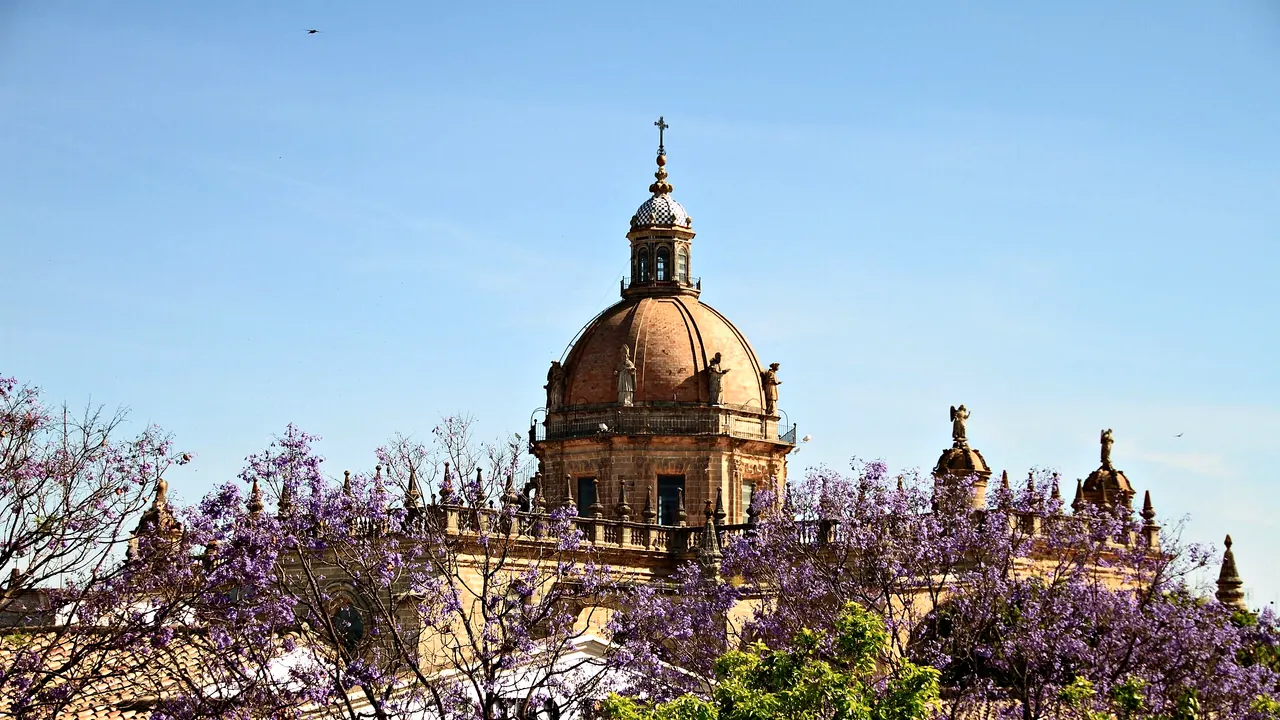
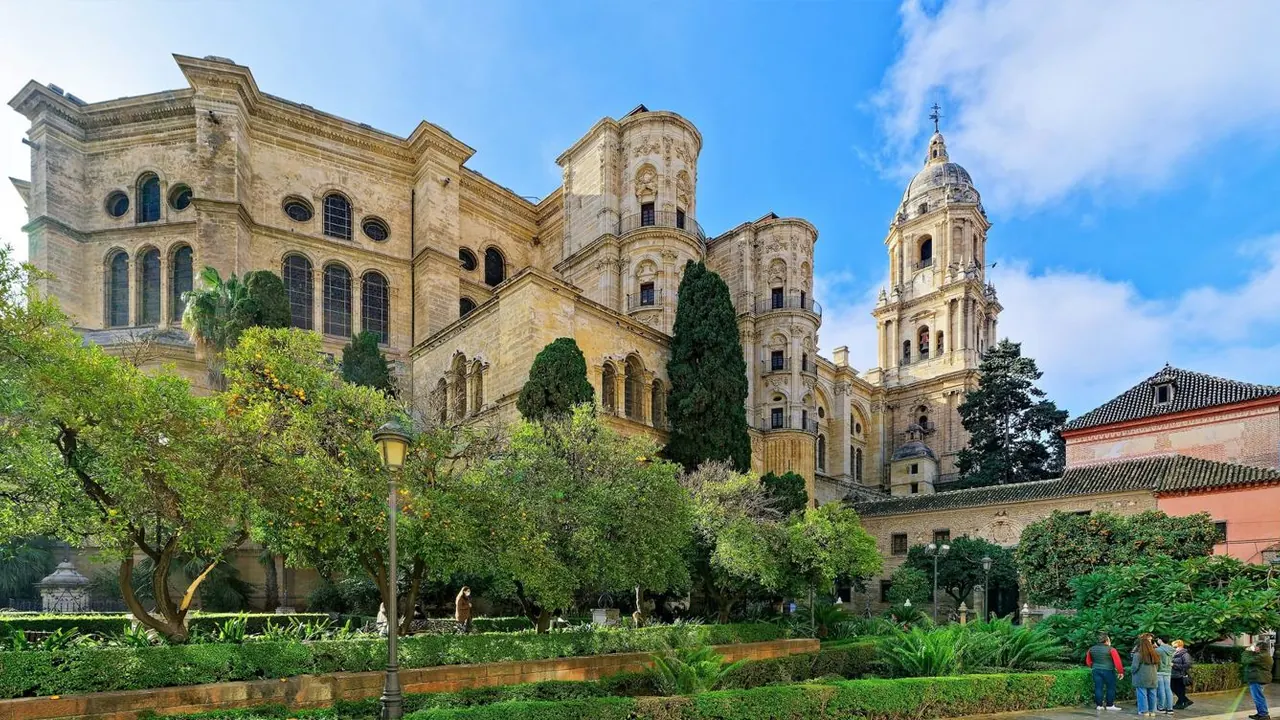
Photos: Jerez de la Frontera by PEPE GADEIRAS, CC BY 4.0, cropped; Malaga by Holger Uwe Schmitt, CC BY-SA 4.0, cropped.
Jerez de la Frontera or Malaga?
Our verdict in twelve categories, each scored against the same fixed benchmark cities, and the climate month by month, so you can choose for your trip.
Choose Jerez de la Frontera for
- live music and the arts
- prices
Jerez suits a traveller who wants to go deep into one tradition rather than tick off a long list. It is the town of sherry and of flamenco, with bodegas to tour, tabancos pouring from the barrel and peñas where the singing is local rather than staged. It is quieter and easier on the wallet, and the beaches of the Costa de la Luz are close but out of town.
Choose Malaga for
- nightlife
- shopping
- beaches
Choose Malaga for a fuller, easier city stay with the sea on the doorstep. A swim is a short walk from the cathedral, the evenings run later and livelier, and the Picasso Museum and the Alcazaba give it more to see. Families get calm city beaches and the coast's zoos and aquariums by train, and Granada, Cordoba and the mountains are all within reach for days out.
Scoreboard
Twelve categories on one fixed scale from 0 to 100. The shaded stretch is the gap between the two.
Your match
Pick a travel style or drag the sliders, and both match scores follow your weighting.
Wins on live music and the arts and prices with your weighting.
Wins on nightlife and shopping with your weighting.
What matters to you?
Category by category
What the scores mean for a trip.
Beaches & swimming
Malaga has a city beach and Jerez does not. La Malagueta starts a few minutes from the cathedral, and Pedregalejo and El Palo carry on east, with the Costa del Sol resorts on the suburban train and the clearer coves of Nerja and Maro an hour away. The sand is grey-brown and practical rather than pretty.
From Jerez, every beach is a trip, by train to Valdelagrana or Cádiz or by car to Sanlúcar, Chipiona and La Barrosa. What you reach is arguably finer: long, open Atlantic strands of golden sand. The catch is the Levante wind, which can make some days rough, and the fact that it is always a day out rather than a dip before lunch.
Food & drink
The two eat about equally well, but around different things. Jerez is built on sherry, from fino to Pedro Ximénez, drunk in bodegas and old tabancos with chicharrones and cheese, alongside dishes cooked in it such as kidneys and oxtail, plus the hearty berza jerezana.
Malaga leans towards the sea: espetos of sardines roasted over driftwood on the beach and plates of fried fish in Pedregalejo and El Palo, with the Atarazanas market in its iron hall for grazing. Its wine is the sweet moscatel poured from the barrel, and its breakfasts of toast with olive oil and tomato are a ritual of their own.
Culture & sights
Malaga has more to fill the days. The Roman theatre, the Alcazaba climbing the hill and Gibralfaro above it make a striking cluster, and Picasso's birthplace, the Picasso Museum, the Carmen Thyssen and the Museo de Malaga give it real depth in art.
Jerez is quieter but more singular. Its Alcázar, cathedral and Gothic-Mudéjar parish churches are fine, and nowhere else has its cathedral-like sherry bodegas or the dressage horses of the Royal Andalusian School of Equestrian Art. The museums are few, so two or three days cover it.
Nightlife
Evenings in Jerez revolve around tabancos, copa bars and terraces near Plaza del Arenal and Calle Larga. The mood is sociable but provincial, with only a handful of clubs. The Feria del Caballo changes that for one week in May, when the casetas keep going until dawn.
On an ordinary night, Malaga gives you more choice. After a late dinner the old town fills up around Plaza de la Merced and Plaza Uncibay, and in summer the beach bars at La Malagueta and Pedregalejo stay open late. Torremolinos, with its clubs and gay scene, is a short train ride away.
Nature & outdoors
Around Jerez the country is gentle: rolling white albariza vineyards that are pleasant to drive or cycle through. The bigger landscapes all need a drive, to the Sierra de Grazalema, the cork forests of Los Alcornocales, or Sanlúcar for the boats to the Doñana wetlands. In return there is horse riding, and the kitesurfing coast towards Tarifa.
Wilder country starts much closer to Malaga. The Montes de Malaga forest begins at the city's edge, and the Caminito del Rey gorge and the stacked limestone of El Torcal are about an hour away. The Sierra Nevada adds winter skiing.
Day trips
For Seville, Jerez is the better base, about an hour by train compared with two from Malaga. Cádiz is half an hour away, and Sanlúcar and El Puerto make up the rest of the sherry triangle. With a car you can reach Arcos, Vejer and the white towns of the Cádiz hills.
Malaga's list is longer and grander. Cordoba's Mezquita is about an hour away by fast train and Granada's Alhambra about an hour and a half, while the dolmens of Antequera are only half an hour off. Ronda, Nerja with Frigiliana, and the white villages of the Axarquia complete the list.
Good for families
Malaga works better with children, mainly because the beach is in town and shelves gently into calm water. The palm-lined Paseo del Parque and the Alcazaba ramparts help, and the coast's Bioparc, Sea Life and Selwo parks are on the suburban train.
Jerez has a good zoo and botanical garden and the dancing-horse show, but little else built for children. Its sandy beaches mean a trip out, and the town is hotter than Malaga in July and August.
Getting around
Both centres are compact and flat enough to see on foot. Malaga goes further on public transport: the suburban train links the airport in about ten minutes with the coast resorts, and fast trains run to Cordoba, Seville and Madrid.
Jerez's station and airport link are handy too, with direct trains to Seville and Cádiz, but beyond that line it relies on slow, infrequent buses. For the white towns, Grazalema and many beaches, a hired car matters more here than in Malaga.
Shopping & style
Malaga offers more choice. Calle Larios is a polished marble street of Spanish chains, Muelle Uno adds shops on the port, Soho has some independents, and Marbella's luxury is an hour away.
Jerez's Calle Larga is pleasant but provincial, and the reason to shop here is craft: saddlery and leather riding boots made for the horse world, flamenco dresses and guitars, and sherry and brandy bought at the bodega door.
Affordability
Jerez is the cheaper stay, and the gap is mostly in rooms. Central hotels are moderately priced, bodega tours are inexpensive, and you walk to nearly everything, though prices jump during the Feria, the flamenco festival and the motorcycle race weekends.
Malaga eats just as cheaply, with tapas, fried fish and local trains all fairly priced, but accommodation near the old town and the beach is in heavy demand from spring to autumn. Staying outside the centre or coming in winter helps.
Live music & performing arts
For flamenco, Jerez is the stronger choice. The art is still a local one in Santiago and San Miguel, where peñas open their evenings to visitors and tabancos host rough, close-up sessions, and the late-winter festival fills the Teatro Villamarta with major dancers and students.
Malaga's flamenco leans more on tablaos for visitors, with a few genuine peñas. Its advantage lies elsewhere: the Teatro Cervantes is home to the Malaga Philharmonic, and Semana Santa turns the streets into a stage of brass bands and processions.
Wellness & relaxation
Neither is a spa destination, and each has an Arab-style bathhouse in the old town with warm pools and massage. The difference is what surrounds it. Jerez relies on shaded patios, slow afternoons and quiet spring and autumn evenings, and Malaga has the resort spas and golf hotels of the coast towards Marbella, plus mild, sunny winters for walks along the Paseo Maritimo.
When should you go?
Pick your month. The climate figures are measured averages, not a forecast.
Jerez de la Frontera in July
Malaga in July
Daytime high, °C
Rainfall in the month, mm
Temperature and rainfall are climate normals, averaged over the years shown. Jerez de la Frontera: 1991-2020 normals, Jerez De La Fronteraaeropuerto (9.9 km from centre). Malaga: 1991-2020 normals, Malaga / Aeropuerto (8.2 km from centre).
Jerez has the harsher summer. Inland, it reaches about 34°C in July and August, too hot for long afternoon walks, though this is when its Atlantic beaches are at their best: the water is near 23°C in August and warm enough to swim in from June to September. The rain starts in October, and October is as wet as December, so the best months for the streets are April and May, and late September once the heat has eased.
Malaga's summer peak is a little lower, around 32°C, and its sea is much the same, so the swimming season matches Jerez's. The main difference is autumn. October is noticeably drier in Malaga, which keeps the walking season going for longer, and its heaviest rain comes in November and December. Winters in both cities are mild, with days of about 17°C, and from June to August both are almost rainless and very sunny.
Which traveller are you?
For a trip on a tight budget, Jerez goes further. Its best pleasures cost very little: an evening of sherry and flamenco, a wander through the old parishes, and cheap train rides to Seville and Cádiz for days out.
For travellers coming for flamenco, Jerez is the place to go. The bulería is its own rhythm, the Andalusian Flamenco Centre keeps its archive here, and the music belongs to ordinary local evenings rather than a stage. Malaga offers a pleasant taste, but not the source.
On a family trip with children, Malaga is the easier pick. The sea is part of every day without planning a trip, nobody needs a car, and the slightly milder summer heat makes long days out with small children less tiring.
Before you go
| Measure | Jerez de la Frontera | Malaga |
|---|---|---|
| Official language | Spanish | Spanish |
| Currency | Euro (EUR) | Euro (EUR) |
| Sockets | CF230 V, 50 Hz | CF230 V, 50 Hz |
| Driving side | Right | Right |
| Time zone | UTC+1, UTC+2 in summer | UTC+1, UTC+2 in summer |
| Emergency number | 112 | 112 |
| Elevation | 58 m | 18 m |
| Main airport | Jerez Airport (XRY)10 km from centre26 non-stop destinations | Málaga-Costa del Sol Airport (AGP)8 km from centre165 non-stop destinations |
| Public holidays this year | 12 days | 12 days |
By the numbers
| Measure | Jerez de la Frontera | Malaga |
|---|---|---|
| City population | 213,634 | 599,063 |
| People per km² | 180 | 1,517 |
| Museums within 10 km | 14 | 32 |
| UNESCO World Heritage sites within 50 km | 1 | 1 |
| Swim season, months above 21 °C | 3 months | 3 months |
Where else could you go?
Every comparison below shares a destination with this one, so you can follow Jerez de la Frontera or Malaga somewhere new.
- Cadizvs Jerez de la Frontera
- Marbellavs Malaga
- Rondavs Malaga
- Sevillevs Jerez de la Frontera
- Rondavs Jerez de la Frontera
- Granadavs Malaga