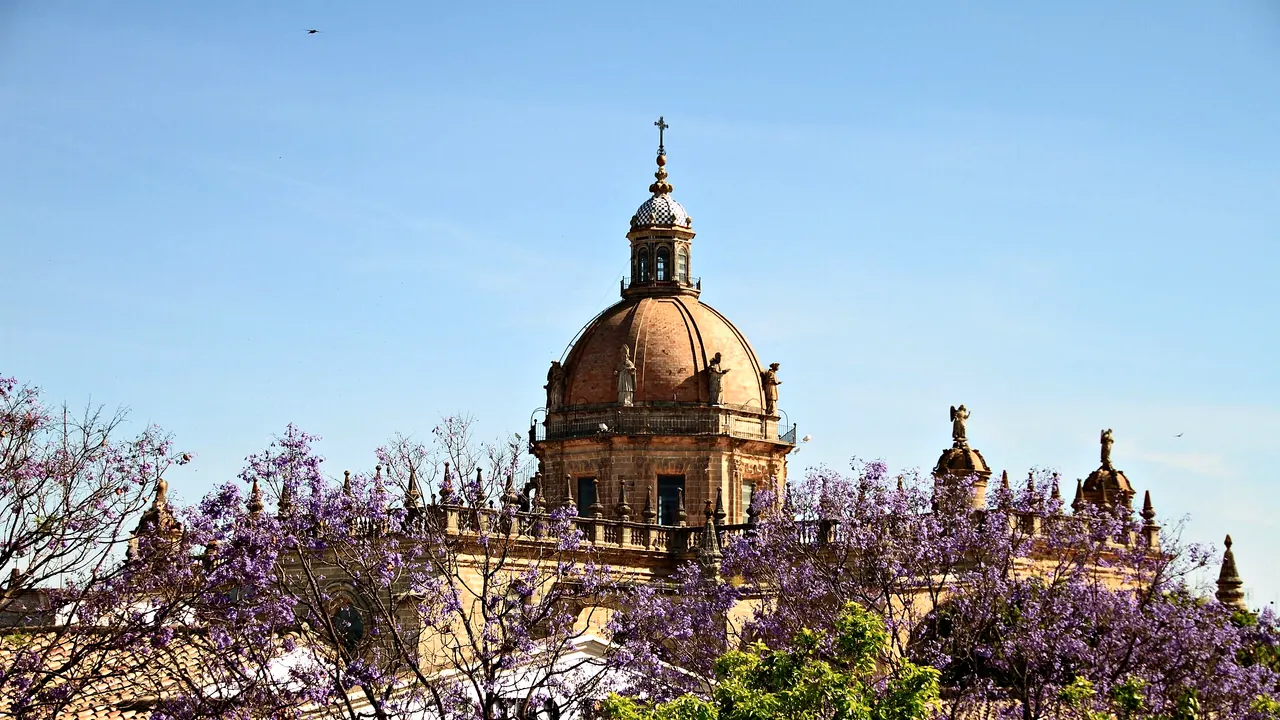
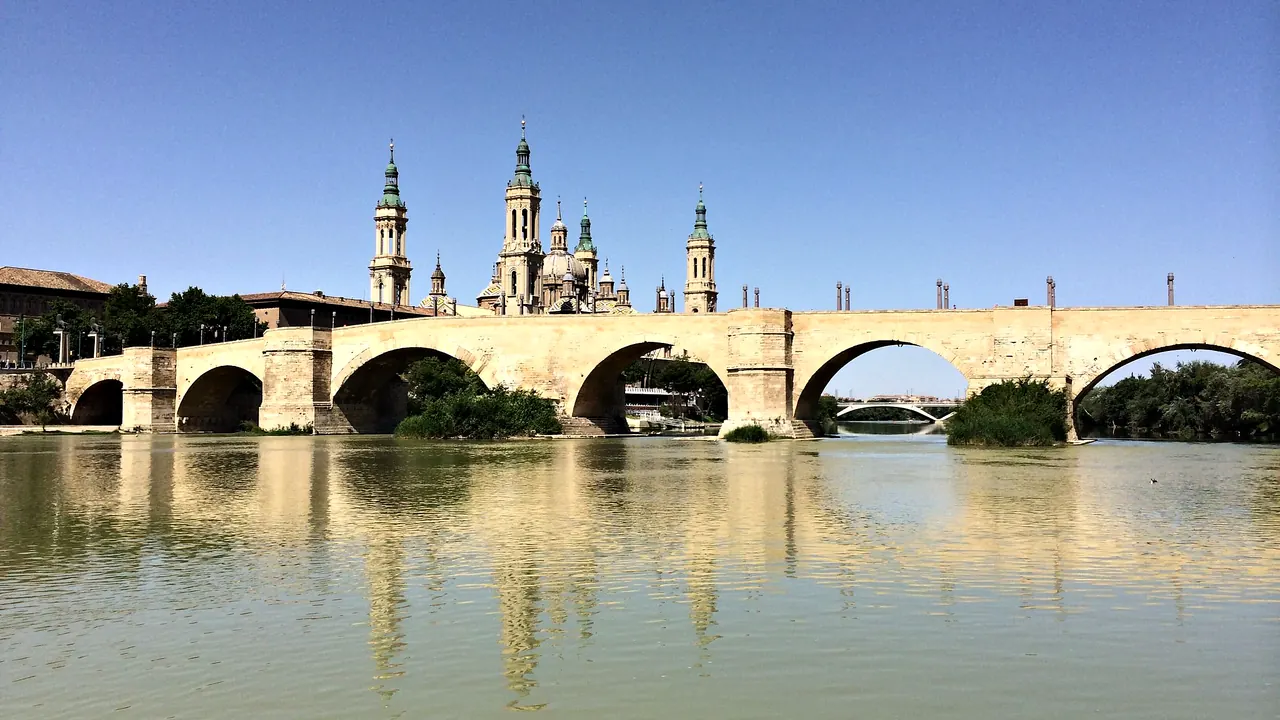
Photos: Jerez de la Frontera by PEPE GADEIRAS, CC BY 4.0, cropped; Zaragoza by Pablo Alejandro Araujo Granda, CC BY-SA 2.0, cropped.
Jerez de la Frontera or Zaragoza?
Our verdict in twelve categories, each scored against the same fixed benchmark cities, and the climate month by month, so you can choose for your trip.
Choose Jerez de la Frontera for
- beaches
- live music and the arts
- nature and the outdoors
Jerez suits travellers who want southern Spain in a single glass: sherry poured from the barrel, flamenco in the old gypsy quarters and wide Atlantic sands a short train ride away. It is the better pick if you want to mix town evenings with beach days, or use a small, easy base for Seville, Cádiz and the white towns.
Choose Zaragoza for
- nightlife
- shopping
- culture and sights
Zaragoza makes more sense if you care most about monuments. The Aljafería, the Pilar and the Roman remains under the streets give it more history to see, and its nights are livelier, with students filling the old quarter. The tram makes it easier to get around, and families have more to do. With Madrid and Barcelona both on the fast line, it also fits well into a longer rail journey across Spain.
Scoreboard
Twelve categories on one fixed scale from 0 to 100. The shaded stretch is the gap between the two.
Your match
Pick a travel style or drag the sliders, and both match scores follow your weighting.
Wins on beaches and live music and the arts with your weighting.
Wins on nightlife and shopping with your weighting.
What matters to you?
Category by category
What the scores mean for a trip.
Beaches & swimming
Jerez wins easily here. It has no beach of its own, but the Costa de la Luz starts about 12km away. You can be on the sand at El Puerto de Santa María or Cádiz's La Caleta within half an hour by train, and the wide beaches at Chipiona, Sanlúcar and La Barrosa are within an hour. Expect cool, sometimes windy Atlantic water rather than a calm Mediterranean bay.
Zaragoza has nothing like this. The Ebro is not for swimming and the sea is too far for a day trip, so in summer the open-air pools are your only option.
Food & drink
Both cities eat well in their own traditions, so the real difference is what fills the glass and the plate. In Jerez it is sherry: fino and oloroso in bodegas and tabancos, with chicharrones, oxtail cooked in sherry, and fried fish and prawns from the nearby coast.
Zaragoza is about food from inland and the vineyards. You work through El Tubo bar by bar, each known for one speciality, with ternasco lamb and borage with clams, washed down with robust reds from Cariñena or Somontano. Neither city offers much variety beyond its own cooking.
Culture & sights
Zaragoza has more to show. In the Aljafería, an eleventh-century Islamic palace, the Basílica del Pilar with ceilings painted partly by Goya, and the Mudéjar wall of La Seo, it holds three landmarks of national importance. Underneath the old town are museums built around the Roman forum, river port and baths, and the Goya Museum adds a fine collection.
The heritage in Jerez is smaller but its own. There is the Almohad Alcázar, Gothic-Mudéjar parish churches, and the quarters where flamenco took shape. Its most memorable sights are the cathedral-like sherry bodegas and the dancing horses of the Royal Andalusian School.
Nightlife
Zaragoza gives you the fuller night out. After tapas in El Tubo, the crowds move to Plaza Santa Marta and the Casco, where bars and a handful of clubs keep going into the early hours on Thursdays and weekends. The Fiestas del Pilar in October keep the streets busy until dawn for more than a week.
Jerez is quieter and more about talking over a drink: sherry in tabancos, terraces around Plaza del Arenal, and only a few clubs. Its big exception is the May Feria del Caballo, when the casetas dance until morning.
Nature & outdoors
Jerez has the more varied landscapes within reach. The limestone gorges and trails of the Sierra de Grazalema, the cork-oak forests of Los Alcornocales and the Doñana wetlands across the Guadalquivir are all manageable outings. Closer in, the bay's salt marshes are good for birdwatching, and the Tarifa coast is a major spot for kitesurfing.
Zaragoza's surroundings are drier and starker. Beyond the riverside paths and Parque del Agua, it means driving to the beech woods of Moncayo, the climbing towers of Riglos, the badlands of the Bardenas Reales or the Pyrenees, about two hours north.
Day trips
Both are excellent bases, but the trips are of different kinds. From Jerez the classics are close and easy by train: Seville in about an hour, ancient Cádiz in half that, and the sherry towns of El Puerto and Sanlúcar. With a car you can add Arcos, Vejer, Ronda and even Gibraltar.
Zaragoza's advantage is the high-speed line, which puts Madrid and Barcelona each about an hour and a half away. Most of its regional outings, such as Loarre castle, the ruins of Belchite, Tarazona and Albarracín, are better done by car.
Good for families
Zaragoza is the easier city with children. The river aquarium at the old Expo site, the playgrounds of Parque del Agua and the small amusement park at Parque Grande give children dedicated places to go, and the October fiestas bring parades of giants and big-heads.
Jerez has a good zoo and botanical garden, and children usually enjoy the horse show. Its real family advantage is in summer, when the gently sloping sandy beaches nearby make up for the heat in town.
Getting around
Both centres are flat and easy to walk, but Zaragoza is spread wider and serves it better. A tram crosses the city, buses and bike-share fill the gaps, and the Delicias station links you to the fast trains.
In Jerez the Alcázar, bodegas and tapas streets are so close together that you hardly need transport, and the airport and coast are a short train ride away. The white towns, Grazalema and the further beaches are hard to reach without a hired car.
Shopping & style
Neither city is a shopping destination, but Zaragoza has more of the usual kind: fashion chains and a classic department store along Paseo de la Independencia, older shops on Calle Alfonso I and a large mall on the southern edge.
What Jerez offers is very specialised. You can buy sherry and brandy straight from the bodegas, riding boots and saddlery from long-standing craftsmen, and flamenco dresses and guitars near the old quarters.
Affordability
For cost, they are a match. Both are cheap by Western European standards, and both have walkable centres that keep spending down. Jerez keeps prices low with its tabanco sherry and inexpensive bodega tours. In Zaragoza it is the generous set lunches, cheap local reds and the free-to-enter Pilar.
Plan your dates carefully in either city. Jerez rooms get scarce during the Feria, the flamenco festival and the motorcycle race weekends, while Zaragoza fills up for the October fiestas.
Live music & performing arts
Jerez is the stronger choice for live performance, because flamenco is still a living local art there. You can hear it close up in the peñas and some tabancos, see more polished shows in the tablaos, and in late winter catch the festival, which brings major dancers to the Teatro Villamarta.
Zaragoza has more conventional venues. The Auditorio hosts touring orchestras and jazz, and the Teatro Principal stages plays and dance. Its own folk tradition, the leaping jota, is mainly seen during the Pilar fiestas.
Wellness & relaxation
Neither city has much in the way of spas: each has an Arab-style bathhouse and a few hotel spas, and that is about it. Jerez makes up for it with shaded patios and slow afternoons, which are most pleasant in spring and autumn. Zaragoza has the thermal spa town of Alhama de Aragón a little over an hour away, but its summers, with heat and the cierzo wind, are less restful.
When should you go?
Pick your month. The climate figures are measured averages, not a forecast.
Jerez de la Frontera in July
Zaragoza in July
Daytime high, °C
Rainfall in the month, mm
Temperature and rainfall are climate normals, averaged over the years shown. Jerez de la Frontera: 1991-2020 normals, Jerez De La Fronteraaeropuerto (9.9 km from centre). Zaragoza: 1991-2020 (rainfall 1971-2000) normals, Zaragoza / Aeropuerto (11.2 km from centre).
Jerez has the longer warm season. From June to September it is hot and dry and good for the beach, with the Atlantic reaching about 23°C in July and August. In those same months the town itself climbs to around 34°C, so sightseeing on foot is best done early or late. Spring and October are the pleasant months for walking. Rain arrives in autumn and stays through the winter, with roughly 85mm a month from October to December, but winter days stay mild and fairly sunny.
Zaragoza has more of a continental climate. Winter highs are around 11°C, and the cierzo wind makes it feel colder. July and August are nearly as hot as in Jerez, with long sunny days and no coast nearby to cool off. Rain is light all year and peaks at about 53mm in May, so late April to early June and late September to October are the best times for walking around the city.
Which traveller are you?
On a beach and sun trip, Jerez is the clear choice. Valdelagrana, Cádiz and the long sands at La Barrosa and Sanlúcar are all easy day outings. From Zaragoza the coast is over 200km away, so you are left with municipal pools.
For a food and nightlife trip, Zaragoza edges ahead. The tapas crawl through El Tubo leads on to late bars around Plaza San Felipe and the Casco, full of students at weekends. Jerez evenings, by contrast, mostly wind down in tabancos and copa bars.
For flamenco lovers, Jerez is the place to go. Its peñas in Santiago and San Miguel hold evenings open to visitors, and the late-winter festival fills the Teatro Villamarta. In Zaragoza the local song and dance is the jota, which you mostly see during the Pilar fiestas.
Before you go
| Measure | Jerez de la Frontera | Zaragoza |
|---|---|---|
| Official language | Spanish | Spanish |
| Currency | Euro (EUR) | Euro (EUR) |
| Sockets | CF230 V, 50 Hz | CF230 V, 50 Hz |
| Driving side | Right | Right |
| Time zone | UTC+1, UTC+2 in summer | UTC+1, UTC+2 in summer |
| Emergency number | 112 | 112 |
| Elevation | 58 m | 200 m |
| Main airport | Jerez Airport (XRY)10 km from centre26 non-stop destinations | Zaragoza Airport (ZAZ)13 km from centre12 non-stop destinations |
| Public holidays this year | 12 days | 12 days |
By the numbers
| Measure | Jerez de la Frontera | Zaragoza |
|---|---|---|
| City population | 213,634 | 693,091 |
| People per km² | 180 | 712 |
| Museums within 10 km | 14 | 22 |
| UNESCO World Heritage sites within 50 km | 1 | 1 |
| Swim season, months above 21 °C | 3 months | - |
Where else could you go?
Every comparison below shares a destination with this one, so you can follow Jerez de la Frontera or Zaragoza somewhere new.
- Cadizvs Jerez de la Frontera
- Sevillevs Jerez de la Frontera
- Rondavs Jerez de la Frontera
- Marbellavs Jerez de la Frontera
- Malagavs Jerez de la Frontera
- Farovs Jerez de la Frontera