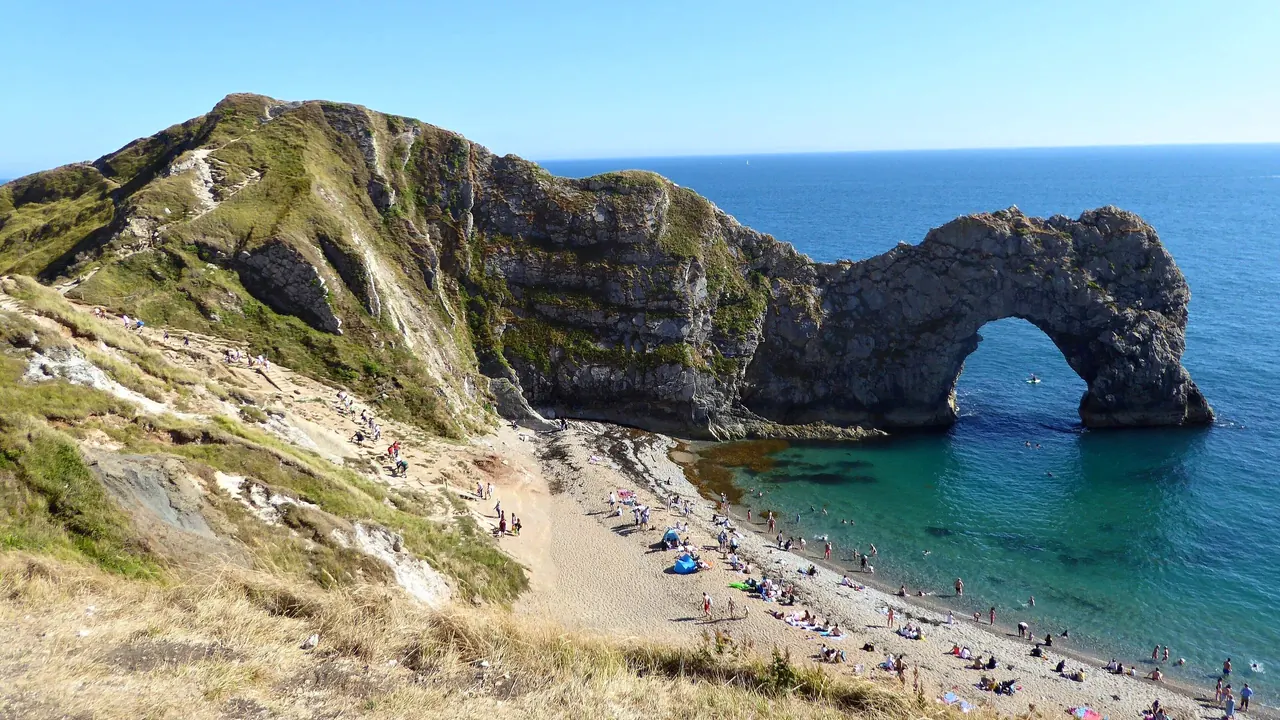
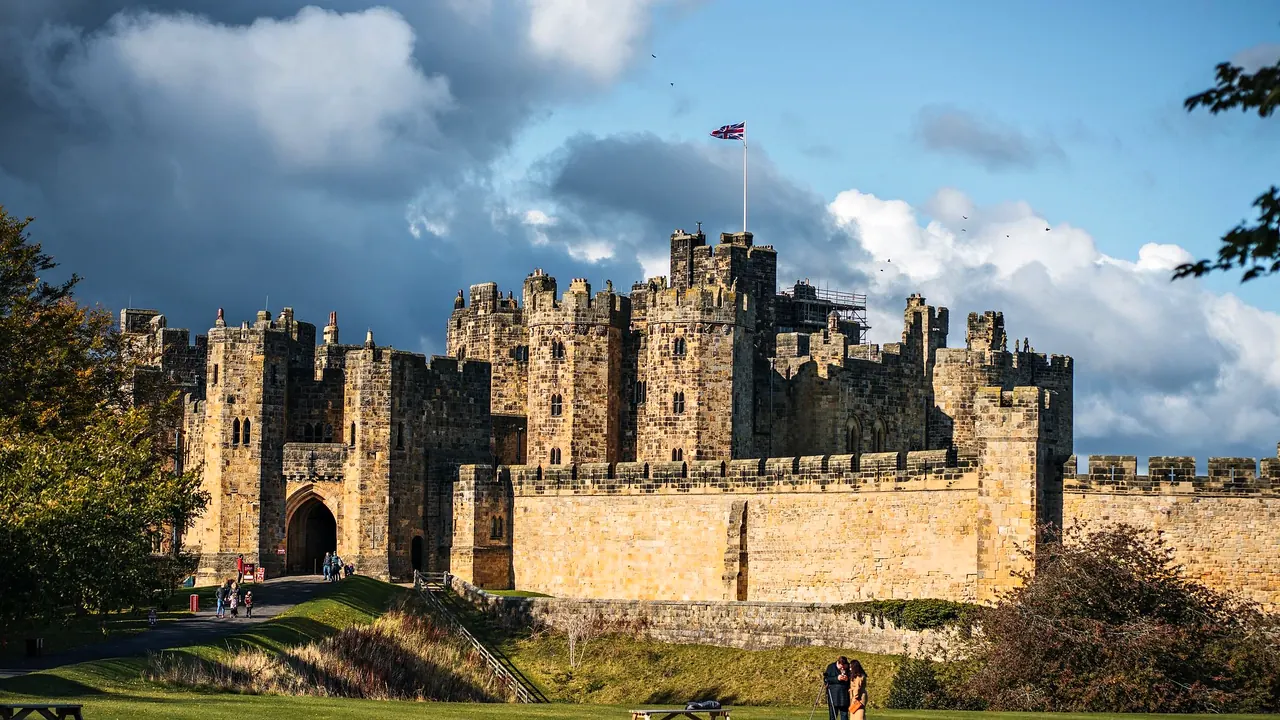
Photos: Jurassic Coast by Ethan Doyle White, CC BY-SA 4.0, cropped; Northumberland by Clément Proust, Pexels License.
Jurassic Coast or Northumberland?
Our verdict in twelve categories, each scored against the same fixed benchmark cities, and the climate month by month, so you can choose for your trip.
Choose Jurassic Coast for
- beaches
- families
- food and drink
The Jurassic Coast suits a classic summer seaside vacation built around the sea. It is the warmer of the two, its beaches at Weymouth and Studland are made for swimming and paddling, and fossil hunting under the cliffs gives children a story to take home. Choose it if you want days on the sand, crab by the harbour and a coast path walk between bays, and you don't mind driving winding lanes to link them up.
Choose Northumberland for
- culture and sights
- getting around
- day trips
Northumberland is the better pick for travellers who care more about history than about bathing. Castles stand along its coast, Hadrian's Wall crosses its moors, and Edinburgh, Durham and Newcastle are all within easy reach for a day out. It is emptier, a little cheaper and easier to cross by train. You give up warm swimming and get wide, quiet sands that are for walking rather than lying on.
Scoreboard
Twelve categories on one fixed scale from 0 to 100. The shaded stretch is the gap between the two.
Your match
Pick a travel style or drag the sliders, and both match scores follow your weighting.
Wins on beaches and families with your weighting.
Wins on culture and sights and getting around with your weighting.
What matters to you?
Category by category
What the scores mean for a trip.
Beaches & swimming
The Jurassic Coast is the better place to swim. Studland and Weymouth have gently shelving sand that suits real bathing, and the sea warms enough by late summer for more than a gasp. Between them, Lulworth and Durdle Door are steep shingle with clear water, and they are dramatic places to be even if they are harder for children.
Northumberland arguably has the finer sand, at Bamburgh, Embleton and Druridge Bay, and far fewer people on it. But the North Sea stays several degrees colder and lifeguards are scarce, so those beaches are for walks, kites and paddling rather than swimming.
Food & drink
Both regions eat from the sea and the pub rather than from a restaurant scene, and the Jurassic Coast is a little more rewarding. Bridport's market and the serious seafood kitchens around Lyme Bay give it a real centre for food, and local cheese, cider and sparkling wine from the Dorset chalk widen what's on offer.
Northumberland's strengths are kippers from the Craster smokehouses, Lindisfarne oysters and upland lamb and game, eaten mostly in coaching inns. Kitchens close early, and for real variety you have to go to Newcastle.
Culture & sights
This is where Northumberland pulls far ahead. It has a chain of great castles, from Bamburgh on its rock to Alnwick and Warkworth, the best stretch of Hadrian's Wall with Vindolanda's writing tablets, and the priory on Holy Island where the Lindisfarne Gospels began. Berwick's Elizabethan walls and Cragside add more on top.
The Jurassic Coast's heritage is gentler and mostly about rocks: Mary Anning's Lyme Regis, the fossil centre at Charmouth and the ruin of Corfe Castle. Dorchester's Hardy connections and Maiden Castle are worth a morning, but there is not enough here to plan a trip around.
Nightlife
Neither region is somewhere to go out late. Both have a pint in a harbour or village inn and lights out by eleven. The small difference is that Weymouth has a seafront strip of bars that fills on summer weekends.
Northumberland has nothing like that. For a proper night out you would drive to Bournemouth from Dorset, or catch the train into Newcastle from Northumberland.
Nature & outdoors
Both regions are superb for the outdoors, but in different ways. On the Jurassic Coast the draw is the rock itself: red sandstone in Devon, the dark cliffs full of ammonites at Charmouth, the Portland limestone arch of Durdle Door and the chalk stacks of Old Harry. The coast path climbs and drops over Golden Cap, and Portland and Weymouth Bay add sea-cliff climbing and sailing.
Northumberland's strength is wildlife and space. Puffins nest and grey seals pup on the Farne Islands, wading birds feed on the flats around Holy Island, and inland the Cheviot Hills and the dark skies over Kielder feel wilder and emptier than the sculpted southern shore.
Day trips
Northumberland has the more impressive neighbours. Edinburgh is under an hour by train from Berwick, Durham's cathedral and Newcastle's quayside are close to the south of the county, and the Scottish Borders abbeys and Beamish make full, varied days out.
The Jurassic Coast's outings are pleasant but smaller in scale: Exeter, Sherborne, Brownsea Island and the Swanage steam railway. Salisbury and Stonehenge are the one big trip, and they mean a longer drive, since most of these places are hard to reach by train.
Good for families
The Jurassic Coast is the easier seaside vacation for children. It has sandy, shallow bays, donkeys and a sea-life centre in Weymouth, guided fossil hunts at Charmouth and indoor options such as the tank museum for rainy days. Parents need to watch for falling rock under the cliffs.
Northumberland suits slightly older children who like adventure: boats to the seal colonies, broomstick lessons at Alnwick Castle and racing the tide across the Holy Island causeway. There is less to fall back on when the weather turns.
Getting around
The Jurassic Coast is long and slow to cross. The lanes clog in summer, the car parks at Lulworth fill early, and going end to end by bus means changing along the way. Without a car, it is best to stay in one town and walk the coast path between bus stops.
Northumberland is the easier of the two. The east coast main line stops at Alnmouth, which serves Alnwick, and at Berwick, and the Tyne Valley line runs out to Hexham and Haltwhistle for Hadrian's Wall. The roads are quiet and distances short, though you should check the tide times before driving to Holy Island.
Shopping & style
Neither region is for serious shopping, though the Jurassic Coast has a little more to browse. Bridport's market and antiques quarter are its best, and Lyme Regis is the place to buy a polished ammonite. Northumberland's highlights are the high streets of Hexham and Alnwick and the huge second-hand bookshop in Alnwick's old station. Otherwise it is mostly farm shops and smokehouse counters.
Affordability
Northumberland is the slightly cheaper of the two. It is priced like rural England, and Hexham and the Tyne Valley are good value as bases, though the castles charge admission.
The Jurassic Coast's prettier villages and Purbeck cottages charge peak rates in high summer, and car parking adds up. Weymouth and the campsites keep costs down, and the coast path, beaches and fossil hunting cost nothing.
Live music & performing arts
Both are thin on stage and concert life. Northumberland has a more distinct character, thanks to the Northumbrian smallpipes and a living folk tradition, plus small arts centres in Hexham and Berwick. The Jurassic Coast offers summer shows at Weymouth's pavilion and small festivals in the market towns. For anything larger you need Poole or Exeter, much as Northumberland needs Newcastle and Gateshead.
Wellness & relaxation
For rest the two are very alike. Neither has a bathing tradition, spas are limited to a few hotels, and the real cure is a quiet cottage and long walks.
What differs is when the quiet comes. On the Jurassic Coast, villages such as Beer and Charmouth are calmest outside August, and cold-water swimming groups and yoga retreats in the Dorset hills can give shape to a slow stay. Northumberland is empty for much of the year, with little traffic and villages that go to sleep early.
When should you go?
Pick your month. The climate figures are measured averages, not a forecast.
Jurassic Coast in July
Northumberland in July
Daytime high, °C
Rainfall in the month, mm
Where the figures come from
Jurassic Coast's temperatures are measured 66 km from the centre, at Bournemouth Airport.
Jurassic Coast has no rain gauge within 25 km of the centre, so its rainfall comes from a gridded climate dataset read at the destination rather than from a gauge further away.
Northumberland has no rain gauge within 25 km of the centre, so its rainfall comes from a gridded climate dataset read at the destination rather than from a gauge further away.
Temperature and rainfall are climate normals, averaged over the years shown. Jurassic Coast: 1991-2020 normals, Bournemouth Airport (65.7 km from centre). Northumberland: 1991-2020 normals, Boulmer (7 km from centre).
The Jurassic Coast is the warmer and sunnier choice. Daytime highs reach about 22°C in July and August, May to August is the sunniest stretch, and the sea is at its least bracing in August and September. Rain picks up sharply from October, and the wet winter months are better for storm-watching and fossil hunting than for the beach. In Northumberland summer peaks at about 18°C and the sea stays colder all year, so even in high season the beach is for walking and paddling. Late spring and early summer are often the most settled months there, while August is unusually wet and autumn brings more rain and wind.
For both, June to September is the season for being outdoors. Spring and early autumn suit walking on either coast, and winter is cold and grey enough on both that only hardy walkers will enjoy it.
Which traveller are you?
On a beach and sun trip, choose the Jurassic Coast. It has warmer summers, sheltered sandy bays at Weymouth and Studland and a sea that is pleasant for a proper dip by late summer. Northumberland's North Sea beaches are lovely, but they are too cold for most swimmers.
For a culture and arts trip, choose Northumberland. Bamburgh, Alnwick and Lindisfarne, the Roman forts along Hadrian's Wall and the walled town of Berwick add up to a weight of history the Jurassic Coast cannot match. The southern coast's heritage is mostly fossils and one ruined castle.
On a family trip with young children, the Jurassic Coast has the edge. It has shallow, safe paddling, donkey rides, guided fossil walks, a steam railway and the tank museum. Northumberland's boat trips and castle activities are memorable, but there is less for children to do on a wet day.
Before you go
| Measure | Jurassic Coast | Northumberland |
|---|---|---|
| Official language | English | English |
| Currency | Pound Sterling (GBP) | Pound Sterling (GBP) |
| Sockets | G230 V, 50 Hz | G230 V, 50 Hz |
| Driving side | Left | Left |
| Time zone | UTC, UTC+1 in summer | UTC, UTC+1 in summer |
| Emergency number | 112 or 999 | 112 or 999 |
| Main airport | Exeter International Airport (EXT)25 non-stop destinations | Newcastle International Airport (NCL)80 non-stop destinations |
| Public holidays this year | 8 days | 8 days |
By the numbers
| Measure | Jurassic Coast | Northumberland |
|---|---|---|
| Population | - | 323,820 |
| People per km² | - | 65 |
| Swim season, months above 21 °C | None | None |
Where else could you go?
Every comparison below shares a destination with this one, so you can follow Jurassic Coast or Northumberland somewhere new.
- Devonvs Jurassic Coast
- Isle of Wightvs Jurassic Coast
- Edinburghvs Northumberland
- Lake Districtvs Northumberland
- Cotswoldsvs Jurassic Coast
- Yorkshire Dalesvs Northumberland