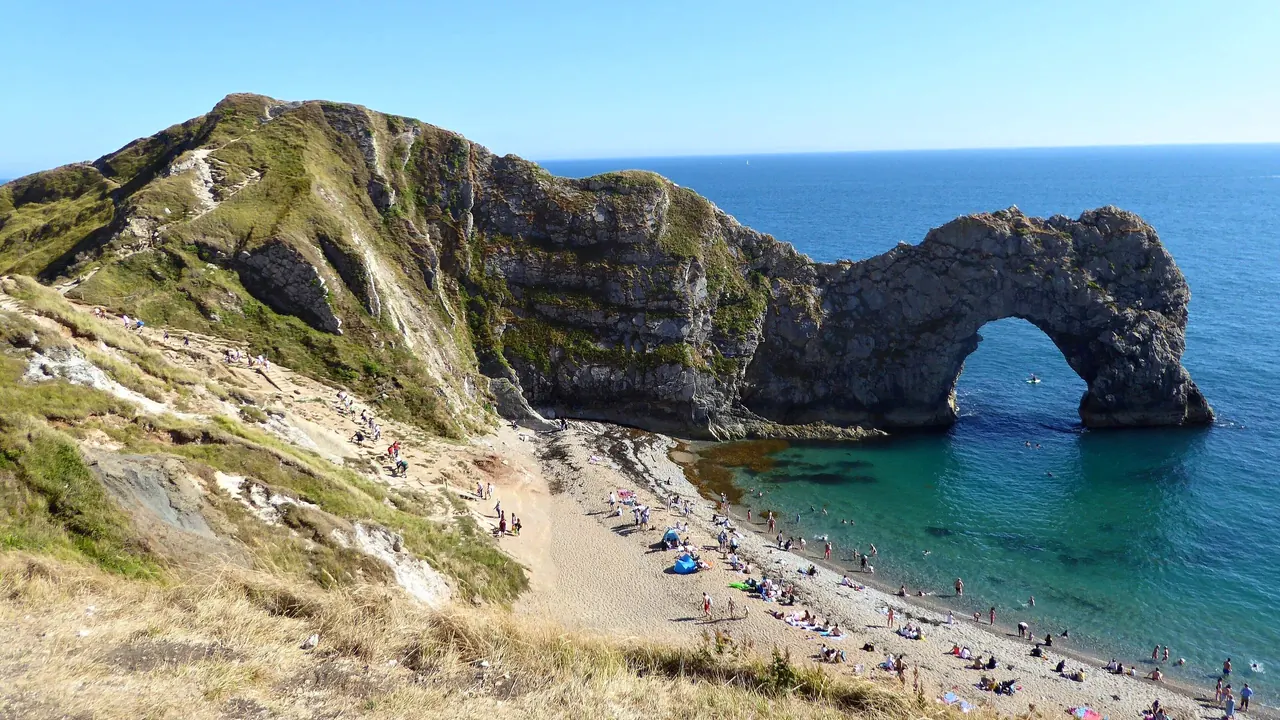
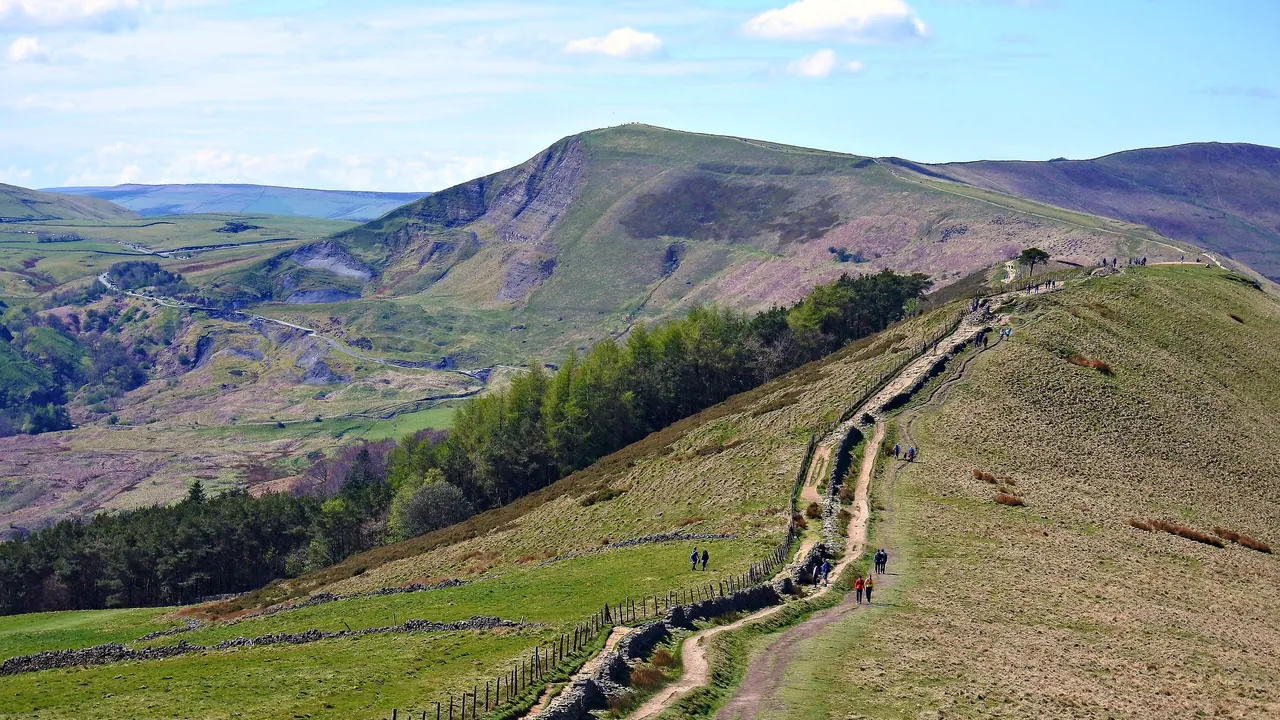
Photos: Jurassic Coast by Ethan Doyle White, CC BY-SA 4.0, cropped; Peak District by Donnchadh H, CC BY 2.0, cropped.
Jurassic Coast or Peak District?
Our verdict in twelve categories, each scored against the same fixed benchmark cities, and the climate month by month, so you can choose for your trip.
Choose Jurassic Coast for
- beaches
- food and drink
- nightlife
The Jurassic Coast is the choice for a summer seaside trip with walking built in. You get sandy bays at Weymouth and Studland, shingle coves under the cliffs, and fossil hunting on the beaches at Charmouth and Lyme Regis. It suits families, swimmers and anyone happy to spend the days on the shore and the coast path, with crab sandwiches on the harbour wall at the end of them.
Choose Peak District for
- culture and sights
- wellness
- live music and the arts
Inland and away from the sea, the Peak District has more to do once the walking boots come off. Chatsworth and Haddon Hall give it the stronger heritage, Buxton adds its spa and opera house, and Manchester and Sheffield are within easy reach for days out. It is also cheaper, and parts of it can be reached by train. It suits walkers, climbers, country-house lovers and anyone after a slow stay by a pub fire, as long as they don't need a beach.
Scoreboard
Twelve categories on one fixed scale from 0 to 100. The shaded stretch is the gap between the two.
Your match
Pick a travel style or drag the sliders, and both match scores follow your weighting.
Wins on beaches and food and drink with your weighting.
Wins on culture and sights and wellness with your weighting.
What matters to you?
Category by category
What the scores mean for a trip.
Beaches & swimming
This is where the two differ most. On the Jurassic Coast the beach is the point of many stays. Studland has sand and dunes, Weymouth has a wide, gently shelving bay, Exmouth and Sidmouth are backed by red cliffs, and Lulworth and Durdle Door are steep shingle with very clear water. The sea stays cool, though, so swimming means short dips.
The Peak District has no coast at all. Its reservoirs are cold, deep and not for swimming, so the choice comes down to Hathersage's heated outdoor pool or a quick dip in a river in the limestone dales.
Food & drink
Neither region has a restaurant scene, and the food in both is about as good as the other's. The difference is in what you eat. The coast is about the sea: crab, lobster, scallops and fish and chips at West Bay, Lyme Regis and Weymouth, with Bridport's market and the Dorset vineyards adding to it.
The Peak District runs on hearty pub food and real ale after a day on the hills, with Bakewell pudding, Hartington cheese and the farm shops around Chatsworth. In both regions the smaller villages leave you with a pub or two in the evening.
Culture & sights
The Peak District has the richer heritage. Chatsworth is one of England's great houses, Haddon Hall is a rare intact medieval manor, and Buxton has a Georgian spa centre. Then there are the plague village of Eyam, the summer well dressings, and the Cromford mills where the factory age began.
The coast's sights are smaller and more scattered, and many of them are about fossils, from Mary Anning's Lyme Regis to the Charmouth heritage centre. Corfe Castle is the one grand sight, with Hardy's Dorchester and Maiden Castle just inland.
Nightlife
Both are early-night regions where the evening means a pub, perhaps with a folk session. Weymouth is the exception on the coast, with a seafront strip of bars that gets lively on summer weekends. Buxton and Matlock stay open only a little later. For a real night out you leave the region, going to Bournemouth from the coast or to Sheffield or Manchester from the Peak.
Nature & outdoors
Both are among England's finest walking country, so the choice is cliffs or hills. The Jurassic Coast is a single 95-mile line of sea cliffs showing millions of years of rock. Durdle Door, Chesil Beach and Old Harry Rocks are along it, and there is fossil hunting, sailing, kayaking and coasteering.
The Peak District is a broad national park to wander in, with the high gritstone moors and climbing edges of the Dark Peak and the green limestone dales of the White Peak. It adds traffic-free cycling on old railway lines and caving underground.
Day trips
The Peak District has the wider choice of days out because cities surround it. Manchester and Sheffield are easy by train, and Derby, Nottingham and the Potteries are close by. There is also a ring of great houses just outside the park, among them Hardwick Hall, Kedleston and Calke Abbey.
From the coast the trips are more rural: Exeter, Sherborne, Shaftesbury, the ferry to Brownsea Island, and a longer drive to Salisbury and Stonehenge. Most of them need a car.
Good for families
Both work well for children, but in different ways. The coast offers a traditional seaside week, with donkeys and sandcastles at Weymouth, shallow water at Studland, guided fossil hunts at Charmouth and the tank museum at Bovington.
The Peak District suits more active families. There are show caves, the cable car at Matlock Bath, the vintage trams at Crich and flat cycling trails, with Alton Towers a short drive away. Wet days are the shared weakness, although the Peak's caves give you more to do under cover.
Getting around
A car helps in both, but the Peak District is the easier of the two without one. Its Hope Valley line and the branches to Buxton and Matlock put walks right outside station platforms.
The coast is longer than it looks, with slow summer lanes and car parks that fill early, and the bus routes along it need changes. The usual answer there is to stay in one town and walk the coast path between bus stops.
Shopping & style
Shopping is small and local in both, with no fashion streets. What you bring home is different. On the coast it is fossils and polished ammonites from Lyme Regis and Charmouth, plus Bridport's market and vintage quarter. In the Peak it is Blue John jewellery from Castleton, outdoor gear in Hathersage, and farm-shop food.
Affordability
The Peak District is the gentler on the budget. It has youth hostels, bunkhouses and campsites across the park, and its hills cost nothing to walk, although stately homes and show caves soon add up for a family.
The coast is pricier in high summer, when cottages in Lyme Regis and Purbeck charge peak rates and short stays are hard to find. Weymouth and the caravan parks are the cheaper bases there, and you should budget for parking at the popular beaches.
Live music & performing arts
A summer evening on the Jurassic Coast is more likely to end with a fiddle playing in the corner of a pub than with a curtain going up. Weymouth's seafront pavilion offers stand-up and seaside shows, and the small halls in Bridport and Lyme Regis can fill a quiet night, but anything orchestral means leaving the region.
The Peak District can give you a proper night at the theatre without leaving the hills. Buxton's ornate Matcham opera house is worth seeing for the building alone, and it stays open outside the summer, so even a wet November break can include a play or the pantomime. In July the town's festival takes over with opera and recitals, plus a long list of fringe shows.
Wellness & relaxation
Both regions are good places to do very little, but they help you unwind in different ways. On the Jurassic Coast the sea does the work: an early swim with one of the cold-water groups, a slow walk down to a cove, an afternoon in a cottage in Beer or a Purbeck hamlet. If you want pampering, there is only the odd hotel spa or a yoga weekend inland.
The Peak District is better if you want some comfort along with the rest. Buxton can turn a walking break into a spa break, and on the way back from the Crescent you can fill a bottle at St Ann's Well. Choose a weekday stay in a quieter dale village rather than Castleton or Bakewell, and long evenings by the fire do the rest.
When should you go?
Pick your month. The climate figures are measured averages, not a forecast.
Jurassic Coast in July
Peak District in July
Daytime high, °C
Rainfall in the month, mm
Where the figures come from
Jurassic Coast's temperatures are measured 66 km from the centre, at Bournemouth Airport.
Jurassic Coast has no rain gauge within 25 km of the centre, so its rainfall comes from a gridded climate dataset read at the destination rather than from a gauge further away.
Peak District's temperatures are measured 43 km from the centre, at Manchester Airport.
Peak District has no rain gauge within 25 km of the centre, so its rainfall comes from a gridded climate dataset read at the destination rather than from a gauge further away.
Temperature and rainfall are climate normals, averaged over the years shown. Jurassic Coast: 1991-2020 normals, Bournemouth Airport (65.7 km from centre). Peak District: 1991-2020 normals, Manchester Airport (43.1 km from centre).
Both regions are at their best from late May to September, and both are wettest from October to December, when each gets more than 90mm a month. Summer is where they differ. On the coast, where most visitors stay, July and August reach about 22°C, with more sunshine and less rain than the Peak. June is usually the driest month there, which makes it a good time for the coast path. The sea is slow to warm and only reaches 17°C in August and September, so even then a swim is a short dip.
The Peak runs a degree or so cooler, and its summer is wetter, with around 80mm in August. That makes May and September as good for walking as high summer. Winter is cold in both and a little colder in the Peak, where snow can settle on the moorland tops. The coast stays milder but is wet and windy, so neither suits a winter break unless you enjoy walking in bad weather.
Which traveller are you?
For a beach and sun trip, the Jurassic Coast is the only real option. It has sandy, shallow bays at Weymouth and Studland, clear water off Lulworth Cove, and a drier, sunnier summer. The Peak District is far inland, and its best swim is a heated outdoor pool.
On a culture and arts trip, the Peak District has more to offer. Chatsworth and Haddon Hall are major country houses, Buxton has a Georgian Crescent and a Matcham opera house, and there are the Arkwright mills at Cromford. The coast's heritage is mostly fossils, Corfe Castle and small museums.
On a relaxing and wellness trip, the Peak District has the better case. In Buxton you can bathe in natural thermal water, there are country-house spas in the dales, and its quiet stone villages are made for slow days. The coast offers calm cottages and cold sea swims, but very little in the way of treatments.
Before you go
| Measure | Jurassic Coast | Peak District |
|---|---|---|
| Official language | English | English |
| Currency | Pound Sterling (GBP) | Pound Sterling (GBP) |
| Sockets | G230 V, 50 Hz | G230 V, 50 Hz |
| Driving side | Left | Left |
| Time zone | UTC, UTC+1 in summer | UTC, UTC+1 in summer |
| Emergency number | 112 or 999 | 112 or 999 |
| Main airport | Exeter International Airport (EXT)25 non-stop destinations | Manchester Airport (MAN)211 non-stop destinations |
| Public holidays this year | 8 days | 8 days |
By the numbers
| Measure | Jurassic Coast | Peak District |
|---|---|---|
| Population | - | 35,901 |
| People per km² | - | 25 |
| Swim season, months above 21 °C | None | - |
Where else could you go?
Every comparison below shares a destination with this one, so you can follow Jurassic Coast or Peak District somewhere new.
- Devonvs Jurassic Coast
- Yorkshire Dalesvs Peak District
- Isle of Wightvs Jurassic Coast
- Snowdoniavs Peak District
- Cotswoldsvs Peak District
- Cotswoldsvs Jurassic Coast