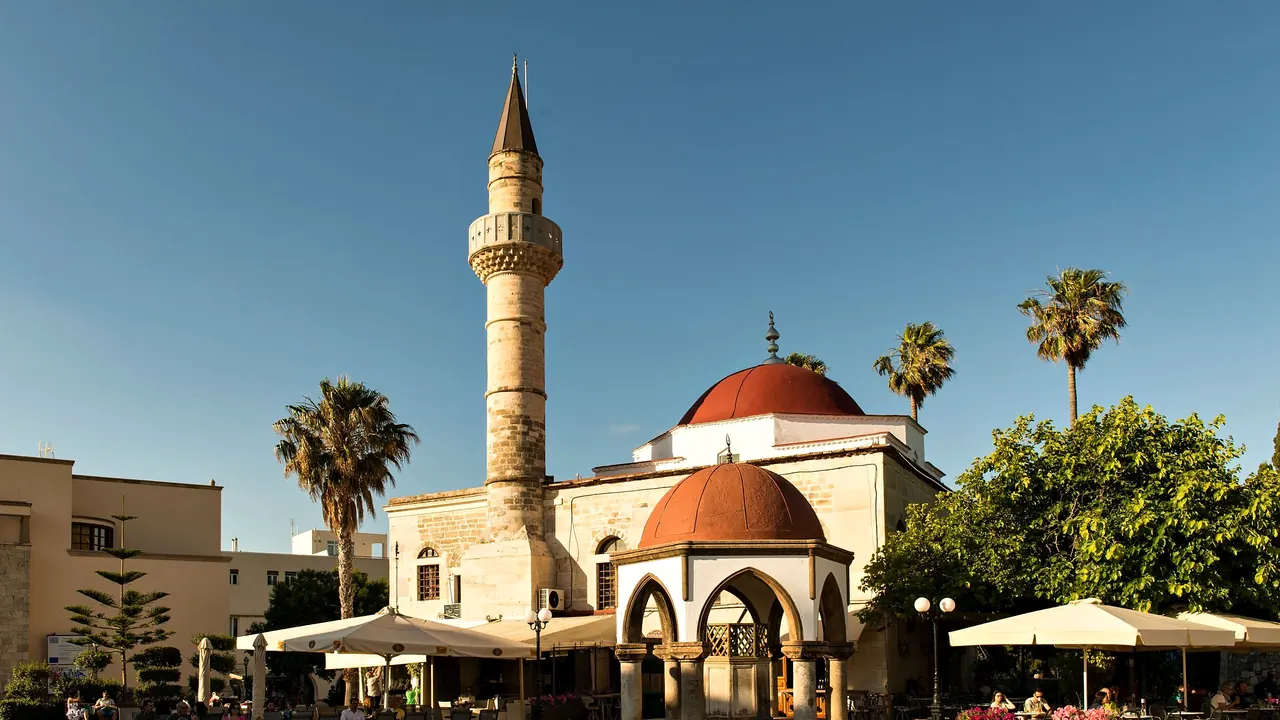
Photos: Kos by Wolfgang Weiser, Pexels License.
Kefalonia or Kos?
Our verdict in twelve categories, each scored against the same fixed benchmark cities, and the climate month by month, so you can choose for your trip.
Choose Kefalonia for
- nature and the outdoors
- food and drink
- beaches
Kefalonia suits travellers who want scenery as much as sand: pebble coves under white cliffs with remarkably clear water, the fir forests of Mount Ainos, the boat ride through Melissani cave and wine tastings in the Omala valley. It is for a slower, quieter trip with a hire car, driving between coasts by day and lingering at harbour tavernas in the evening. The price is very little nightlife and more time on winding roads.
Choose Kos for
- nightlife
- getting around
- culture and sights
For an easier vacation with more going on, choose Kos. Sandy beaches, flat roads, buses and cycle paths make it simpler with children or without a car. Kos Town adds Roman ruins and late bars, and boats run to Bodrum and Nisyros. The landscape is plainer, and the food is less of a reason to go.
Scoreboard
Twelve categories on one fixed scale from 0 to 100. The shaded stretch is the gap between the two.
Your match
Pick a travel style or drag the sliders, and both match scores follow your weighting.
Wins on nature and the outdoors and food and drink with your weighting.
Wins on nightlife and getting around with your weighting.
What matters to you?
Category by category
What the scores mean for a trip.
Beaches & swimming
Both are beach islands first and foremost, and the sea is about as warm on each in late summer, so the difference is in kind. Kefalonia's famous beaches are white pebble under tall cliffs, Myrtos and Petani, where the water is exceptionally clear. They lie on different coasts and drop off quickly, and the sand is in the south at Skala and Lourdas and at Xi on Paliki.
Kos is mostly sand. Long, open strands run along the north coast from Tigaki to Mastichari, though the meltemi can make the sea choppy there in high summer. Its loveliest bays, Paradise Beach and Agios Stefanos, are around Kefalos in the south-west, and Kos Town has easy beaches right next to it.
Food & drink
Kefalonia has the more distinctive food. It has its own meat pie, aliada garlic sauce with salt cod, thyme honey and red mandoles, plus a home-grown white wine, Robola, which you can taste at the wineries of the Omala valley. Harbour tavernas at Fiskardo and Assos are made for long dinners.
On Kos the best meals are in Zia, Pyli and the back streets of Kos Town, with pitaroudia and wine-matured krasotyri to look out for. The big resorts lean on menus in several languages and all-inclusive dining. Neither island is a place for fine dining.
Culture & sights
Kos has far more history to walk through. Roman and Hellenistic ruins sit among the streets of Kos Town, the Knights of St John built the castle at the harbour, and the terraced Asklepieion is a real archaeological site with views to Turkey.
Kefalonia lost most of its old buildings in the 1953 earthquake, so its sights are spread out. They include Venetian Fiskardo, the fortress at Assos, the castle of Agios Georgios and the Mycenaean tomb at Tzanata. They make good stops on driving days but are not a reason to go.
Nightlife
If going out matters, Kos is the clear choice. The lanes of Kos Town's old quarter are full of bars until the small hours, and Kardamena is a proper party resort with late clubs and a young crowd.
On Kefalonia an evening means a long dinner and a drink by the water. It is liveliest around Argostoli's square and the Lithostroto or along the bar strip at Lassi, and most places are quiet before midnight. Quiet Kos resorts such as Tigaki are just as sleepy, so on both islands your base decides the night.
Nature & outdoors
Kefalonia's landscape is far more striking. Mount Ainos, a national park of dark Greek fir rising to about 1,628m, looks across to Ithaca and Zakynthos. The west coast falls away in white cliffs, and the Melissani and Drogarati caves lie in the karst below. Loggerhead turtles feed in Argostoli harbour.
Kos is low and dry by comparison, and its outdoor appeal is in activities more than views. There are trails through pine woods up to Mount Christos in the Dikeos hills, flamingos on the Alikes salt lake in spring and winter, and a steady meltemi that makes Marmari and Tigaki good for windsurfing and kitesurfing.
Day trips
Kos is better placed for days out by boat. Bodrum on the Turkish coast is a short ferry ride away, though you need a passport. Excursion boats call at Nisyros, where buses climb to its volcanic crater, and Kalymnos, Pserimos and Plati are easy crossings.
Kefalonia's best day out is Ithaca, a short ferry from Sami, with Vathy, Kioni and the sites linked to Odysseus. Zakynthos and Lefkada can be reached in summer, and after that the options run out. On both islands most sailings run only in the warmer months.
Good for families
Kos is the easier island with young children. The north-coast beaches shelve gently, many resorts are built around pools and kids' clubs, there is a water park near Marmari, and families can cycle together on the flat paths around Kos Town.
Kefalonia works if you stay in the south at Skala or Lourdas, where the sand slopes gently into the sea. Children usually enjoy the boat through Melissani and spotting turtles in Argostoli harbour. Still, the pebble beaches of the north-west get deep quickly, and every outing means a long, winding drive in summer heat.
Getting around
Plan on a car for the whole stay on Kefalonia. Its best beaches, caves and harbour villages are spread around separate coasts with mountain ridges between them, so even getting from the capital to Fiskardo in the far north takes up most of a morning. The bus service is too thin to rely on, and in summer you will hunt for parking at Myrtos and Assos. Argostoli itself is easy to explore on foot.
On Kos the distances are short and the coastal land is level. Buses link Kos Town, the airport and the main resorts, and many visitors cycle from town to the nearby beaches. Most people rent a car or scooter for only a day or two, to reach the hill villages of Zia and Pyli or the bays around Kefalos.
Shopping & style
Neither island is a place to shop, so the difference is in what you pick up. Kefalonia's best buys are things to eat and drink, like Robola wine, thyme honey and mandoles, with Argostoli's Lithostroto and the boutiques around Fiskardo's harbour for everything else. Kos Town's old quarter has more souvenir shops, selling leather, sandals and sponges, and the Italian-era market hall on Eleftherias Square is good for herbs and local produce.
Affordability
The cost gap comes down to how each island is set up for visitors. On Kefalonia, apartments and small hotels around Skala, Lourdas and Lassi are fair value, but almost everyone pays for a hire car for the whole stay, and rooms in Fiskardo and Assos cost noticeably more.
Kos was built for package and all-inclusive travel, so mid-range rooms are plentiful in Kardamena, Tigaki and Marmari, and buses and bike hire let you leave the car behind on most days. That makes it a little lighter on the budget overall. On both islands, June and September cost less than July and August.
Live music & performing arts
Neither island has a year-round stage, so this comes down to what each offers in summer. On Kos, the Hippokrateia festival puts on concerts, theatre and dance at the Asklepieion, the Roman Odeon and the castle, settings Kefalonia cannot match. Kefalonia has the more individual musical tradition: kantades serenades sung with guitar and mandolin, and Argostoli's philharmonic band, both heard at village festivals and open-air concerts in town.
Wellness & relaxation
On both islands you relax mainly by slowing down, with resort hotel spas for anything more. Kos has one thing Kefalonia lacks: the hot sulphur spring at Therma, where bathers pile up stones on the pebble beach to make pools where the hot water mixes with the sea. Kefalonia has quiet corners instead, on the Paliki peninsula and the north-east coast, along with long lunches in hill villages and evenings at the harbours of Assos and Fiskardo.
When should you go?
Pick your month. The climate figures are measured averages, not a forecast.
Kefalonia in July
Kos in July
Daytime high, °C
Rainfall in the month, mm
Where the figures come from
Kefalonia's temperatures are measured 59 km from the centre, at Zakinthos / Agrilia.
Kefalonia has no rain gauge within 25 km of the centre, so its rainfall comes from a gridded climate dataset read at the destination rather than from a gauge further away.
Kos has no rain gauge within 25 km of the centre, so its rainfall comes from a gridded climate dataset read at the destination rather than from a gauge further away.
Temperature and rainfall are climate normals, averaged over the years shown. Kefalonia: 1991-2020 normals, Zakinthos / Agrilia (58.6 km from centre). Kos: 1993-2020 (rainfall 1991-2020) normals, Kos Airport (23.2 km from centre).
The two islands have much the same summer. It is dry and warm enough for the beach from June, and the sea stays pleasant for swimming until October. Kefalonia runs slightly hotter at its peak, with highs around 33°C in August, so midday walking and hiking get hard going there. Its summer days are long and sunny from May to August. The real split comes in autumn. Kefalonia's rains arrive early, with October already bringing about 100mm, while Kos stays dry through September and gets only about 53mm in October.
For walking and sightseeing in comfortable warmth, May and late September suit both islands. Kos is the safer pick for an October trip. Winter is wet on both, and Kos is especially wet in December and January. Neither is a beach destination from November to April.
Which traveller are you?
On an outdoors trip, Kefalonia is the island to pick. Mount Ainos has trails through fir forest and wide summit views, the cliff coast and Melissani cave are close at hand, and sea kayaking and sailing to Ithaca fill other days. Kos suits windsurfers better than walkers.
On a family trip with young children, Kos makes life simpler. It has sandy, shallow beaches on the north coast, resort pools and kids' clubs, a water park near Marmari and short, flat distances. That means less time in a hot car and more in the water than on Kefalonia.
For a culture and arts trip, Kos gives you more to see. The Roman streets of Kos Town, the Knights' castle and the Asklepieion fill two or three good days, and in summer there is the Hippokrateia festival. Kefalonia's towns were rebuilt after the earthquake, and its sights are scattered.
Before you go
| Measure | Kefalonia | Kos |
|---|---|---|
| Official language | Greek | Greek |
| Currency | Euro (EUR) | Euro (EUR) |
| Sockets | CF230 V, 50 Hz | CF230 V, 50 Hz |
| Driving side | Right | Right |
| Time zone | UTC+2, UTC+3 in summer | UTC+2, UTC+3 in summer |
| Emergency number | 112 | 112 |
| Main airport | Kefalonia International Airport "Anna Pollatou" (EFL)41 non-stop destinations | Kos International Airport "Ippokratis" (KGS)75 non-stop destinations |
| Public holidays this year | 15 days | 15 days |
By the numbers
| Measure | Kefalonia | Kos |
|---|---|---|
| Population | 36,064 | 33,387 |
| People per km² | 49 | 115 |
| Swim season, months above 21 °C | 5 months | 5 months |
Where else could you go?
Every comparison below shares a destination with this one, so you can follow Kefalonia or Kos somewhere new.