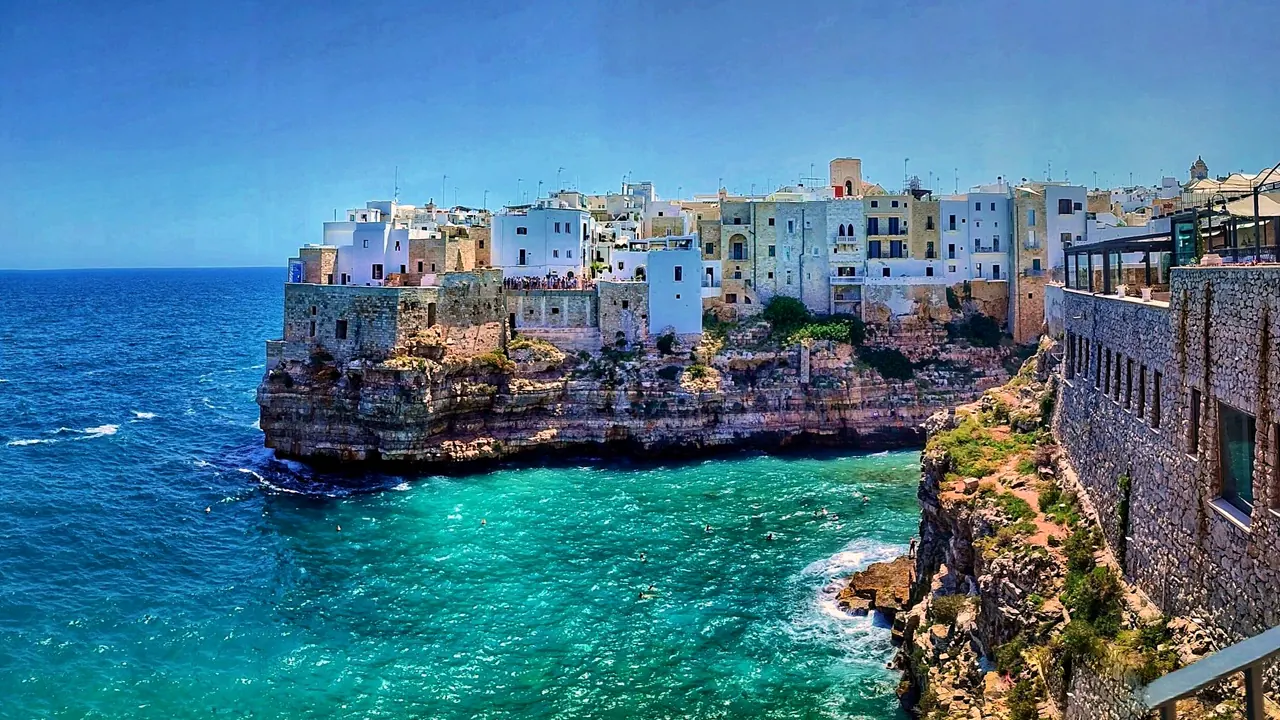
Photos: Puglia by Acquario51, CC BY-SA 4.0, cropped.
Kefalonia or Puglia?
Our verdict in twelve categories, each scored against the same fixed benchmark cities, and the climate month by month, so you can choose for your trip.
Choose Kefalonia for
- nature and the outdoors
- beaches
Kefalonia is the choice for a beach and landscape vacation on one island, with no need to see much else. Its coast is the dramatic one, with white cliffs above Myrtos and Assos, a fir-forested mountain behind, and lake caves underneath. The evenings are slow harbour dinners. You give up most of the culture, food variety and nightlife, and you should expect to spend a lot of time on winding roads.
Choose Puglia for
- culture and sights
- day trips
- nightlife
Puglia suits travellers who want the sea and a lot more besides. Its beaches are as good, and around them sit the baroque streets of Lecce, the trulli of Alberobello, whitewashed hill towns and some of Italy's most generous regional cooking. Summer nights in Gallipoli and Bari are livelier too. It works best as a touring trip, moving between small towns from one or two bases, and Matera is within reach.
Scoreboard
Twelve categories on one fixed scale from 0 to 100. The shaded stretch is the gap between the two.
Your match
Pick a travel style or drag the sliders, and both match scores follow your weighting.
Wins on nature and the outdoors and beaches with your weighting.
Wins on culture and sights and day trips with your weighting.
What matters to you?
Category by category
What the scores mean for a trip.
Beaches & swimming
These are two of the stronger beach destinations around the Ionian Sea, and both have water warm enough for swimming from June. The difference lies in the type of beach. Kefalonia's best-known beaches are white pebble crescents under cliffs, such as Myrtos and Petani, and their water is exceptionally clear but deepens quickly. For sand you go south to Skala and Lourdas or to Xi on the Paliki peninsula.
Puglia offers more long sandy beaches, especially on the Salento's Ionian shore from Porto Cesareo to Pescoluse, where the shallows run out a long way. Many of them are lined with paid lidos. The Adriatic side adds rock platforms and coves at Polignano a Mare and Otranto. A base in the Salento reaches both coasts easily, whereas on Kefalonia the best coves lie on separate coasts and take some driving.
Food & drink
Kefalonia eats well but simply. Family tavernas by the harbours serve meat pie, aliada with salt cod and the local honey, and Robola from the Omala valley is a good reason to visit a winery. Outside Argostoli, though, menus soon start to repeat.
Puglia is a destination for food in its own right. Burrata from around Andria, orecchiette with turnip tops, raw sea urchins on the Bari waterfront and Lecce's pasticciotto are everyday eating there. Its Primitivo and Negroamaro are wines worth seeking out, and grill houses in the Valle d'Itria and farm kitchens at masserie make a meal out into an event.
Culture & sights
The 1953 earthquake decided this comparison. Kefalonia lost nearly all its old towns, which leaves Venetian-era Fiskardo, the fortress ruins at Assos, a Mycenaean tomb and the monastery of Agios Gerasimos. They make pleasant half-days rather than a reason to come.
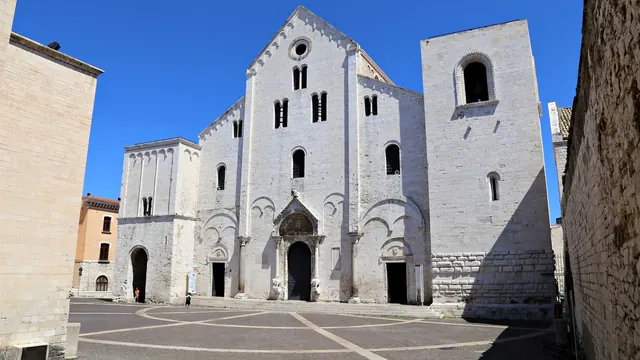
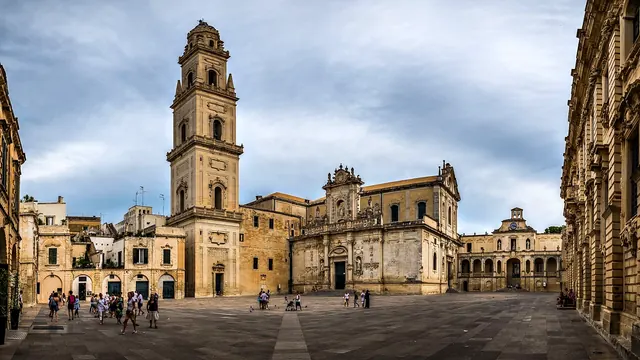
Puglia has whole towns that are attractions in themselves. Lecce's honey-coloured baroque, the conical trulli of Alberobello and Frederick II's octagonal Castel del Monte are each unique. Seafront Trani and Otranto's mosaic floor carry on the thread of great cathedrals. The museums are modest, and the strength lies in the buildings and streets.
Nightlife
On Kefalonia a night out means a late drink on Argostoli's main square or in the bars along Lassi's strip, and outside high summer most places close early. Puglia has a genuine party town in Gallipoli, where beach clubs run past sunset into the small hours, and DJ nights on the Salento coast. Bari's old town keeps some life going all year, which no part of the island can match.
Nature & outdoors
Kefalonia has the more dramatic landscape in a compact area. Mount Ainos rises through a dark national-park forest of Greek fir with semi-wild horses, and the west coast falls away in tall white cliffs. Below ground are the Melissani lake cave and the Drogarati stalactites, and loggerhead turtles feed in Argostoli harbour.
Puglia is mostly gentle olive-grove country, best seen by bicycle through the Valle d'Itria. Its wild scenery is concentrated in the Gargano, with the beech woods of the Foresta Umbra, sea caves and diving off the Tremiti islands, plus the cliff paths of the far Salento.
Day trips
Kefalonia has one excellent day out: the short ferry to Ithaca, for Vathy, Kioni and the Odysseus sites. Beyond that there are summer boats to Zakynthos and Lefkada and outings around the island itself.
Puglia hardly runs out of options. From the Valle d'Itria, Ostuni, Locorotondo and Martina Franca are each a short drive, and the harbour towns of Trani and Molfetta line the coast north of Bari. Matera's cave city, about an hour from Bari, is an outing on a scale the island has nothing to compare with.
Good for families
With children, Kefalonia works if you pick the sandy south around Skala and Lourdas. The Melissani boat ride and turtle-spotting go down well, but there are long hot drives and little else to fill the days.
Puglia makes family life easier. The shallow Salento beaches suit toddlers, and Italian evenings with children playing in the piazza feel natural. The safari and amusement park at Fasano and the fairy-tale trulli of Alberobello give the days some variety, and villas with pools are easy to find.
Getting around
A car is needed in both places, but driving feels different in each. Kefalonia's roads twist over ridges and along cliffs, so even Argostoli to Fiskardo takes about an hour and a half, and the buses are too infrequent to plan around.
Puglia's roads are mostly good and quiet, and the main-line railway through Bari, Polignano a Mare, Monopoli and Lecce makes a car-free stay possible along the coast. The catch is size. The Gargano and the southern tip of the Salento are hours apart, so seeing both means staying in two places.
Shopping & style
On Kefalonia, Argostoli's Lithostroto and a few boutiques in Fiskardo are about all there is, and the best souvenirs are Robola, thyme honey and mandoles. Puglia gives you real crafts to hunt for: ceramics from Grottaglie's workshop quarter, papier-mache from Lecce's studios and linen from the Valle d'Itria. Bari's streets around Via Sparano add mainstream Italian fashion.
Affordability
The overall costs are broadly similar, and in both places car hire and July and August room prices make up most of the bill. Puglia stretches a budget slightly further at the table, because trattoria meals, street snacks and local wine come cheaper there. Its restored masserie and boutique stays in Ostuni push prices up, much as Fiskardo and Assos do on Kefalonia. On the island, the southern resorts and villages are where the fair-value rooms are.
Live music & performing arts
Kefalonia's music is a local tradition rather than a scene. Kantades serenades and the Argostoli philharmonic band are heard at village festivals and summer concerts in the squares.
Puglia has formal stages and a folk tradition that draws crowds. Bari's Teatro Petruzzelli is one of Italy's largest opera houses, Martina Franca stages rare operas in its ducal palace courtyard each summer, and the Salento's pizzica peaks at the huge August Notte della Taranta at Melpignano.
Wellness & relaxation
Neither place has a spa culture to plan a trip around. Kefalonia's rest comes from its pace: quiet Paliki, long village lunches and harbour evenings in Assos, with spa treatments limited to the larger resort hotels.
Puglia offers more ways to unwind. Many masserie among the olive groves have their own pools and spas, and Santa Cesarea Terme has sulphur springs rising from sea caves, with further thermal spas at Torre Canne and Margherita di Savoia.
When should you go?
Pick your month. The climate figures are measured averages, not a forecast.
Kefalonia in July
Puglia in July
Daytime high, °C
Rainfall in the month, mm
Where the figures come from
Kefalonia's temperatures are measured 59 km from the centre, at Zakinthos / Agrilia.
Kefalonia has no rain gauge within 25 km of the centre, so its rainfall comes from a gridded climate dataset read at the destination rather than from a gauge further away.
Puglia's temperatures are measured 64 km from the centre, at Brindisi.
Puglia has no rain gauge within 25 km of the centre, so its rainfall comes from a gridded climate dataset read at the destination rather than from a gauge further away.
Temperature and rainfall are climate normals, averaged over the years shown. Kefalonia: 1991-2020 normals, Zakinthos / Agrilia (58.6 km from centre). Puglia: 1991-2020 (sunshine 1981-2010) normals, Brindisi (64.4 km from centre).
Both are summer destinations, with the beach season running from June to September, and the sea in each reaches about the same warmth by August. Kefalonia gets hotter and sunnier. July and August highs of around 33°C make the hours after mid-morning heavy going for walks or village visits, and almost no rain falls. Puglia peaks nearer 30°C, so summer sightseeing in its towns is a little easier, although August is still hot.
Autumn favours Kefalonia for swimming, because its sea holds at around 23°C in October while Puglia's falls to about 20°C. The rain also arrives harder on the island, though. From October Kefalonia turns wet and peaks at 159mm in November, about twice Puglia's autumn rainfall. Spring is mild in both and suits walking. In winter Puglia's towns remain the more usable of the two, while Kefalonia goes grey and quiet.
Which traveller are you?
For a culture and arts trip, Puglia wins easily. Lecce's baroque, the trulli, Castel del Monte and a line of Romanesque cathedrals give it real substance, and there is opera at the Petruzzelli. The 1953 earthquake left Kefalonia with little more than Fiskardo and some castle ruins.
On a food and nightlife trip, Puglia is again the place. Its burrata, orecchiette, Primitivo and butcher-grill houses outclass Kefalonia's repeating taverna menus. In summer, Gallipoli's beach clubs and Lecce's crowded squares keep going long after the island's harbour bars have emptied.
On an outdoors trip, Kefalonia has a slight edge. You can climb through the fir forest of Mount Ainos, take a boat across the Melissani cave lake, watch turtles in Argostoli harbour and kayak the north-east coast. Puglia's wilder side is mostly confined to the Gargano, far to the north.
Before you go
| Measure | Kefalonia | Puglia |
|---|---|---|
| Official language | Greek | Italian |
| Currency | Euro (EUR) | Euro (EUR) |
| Sockets | CF230 V, 50 Hz | CFL230 V, 50 Hz |
| Driving side | Right | Right |
| Time zone | UTC+2, UTC+3 in summer | UTC+1, UTC+2 in summer |
| Emergency number | 112 | 112 |
| Main airport | Kefalonia International Airport "Anna Pollatou" (EFL)41 non-stop destinations | Bari Karol Wojtyła International Airport (BRI)104 non-stop destinations |
| Public holidays this year | 15 days | 13 days |
By the numbers
| Measure | Kefalonia | Puglia |
|---|---|---|
| Population | 36,064 | 3,866,174 |
| People per km² | 49 | 198 |
| Swim season, months above 21 °C | 5 months | 4 months |
Where else could you go?
Every comparison below shares a destination with this one, so you can follow Kefalonia or Puglia somewhere new.
- Zakynthosvs Kefalonia
- Lefkadavs Kefalonia
- Corfuvs Kefalonia
- Peloponnesevs Kefalonia
- Korčulavs Puglia
- Amalfi Coastvs Puglia