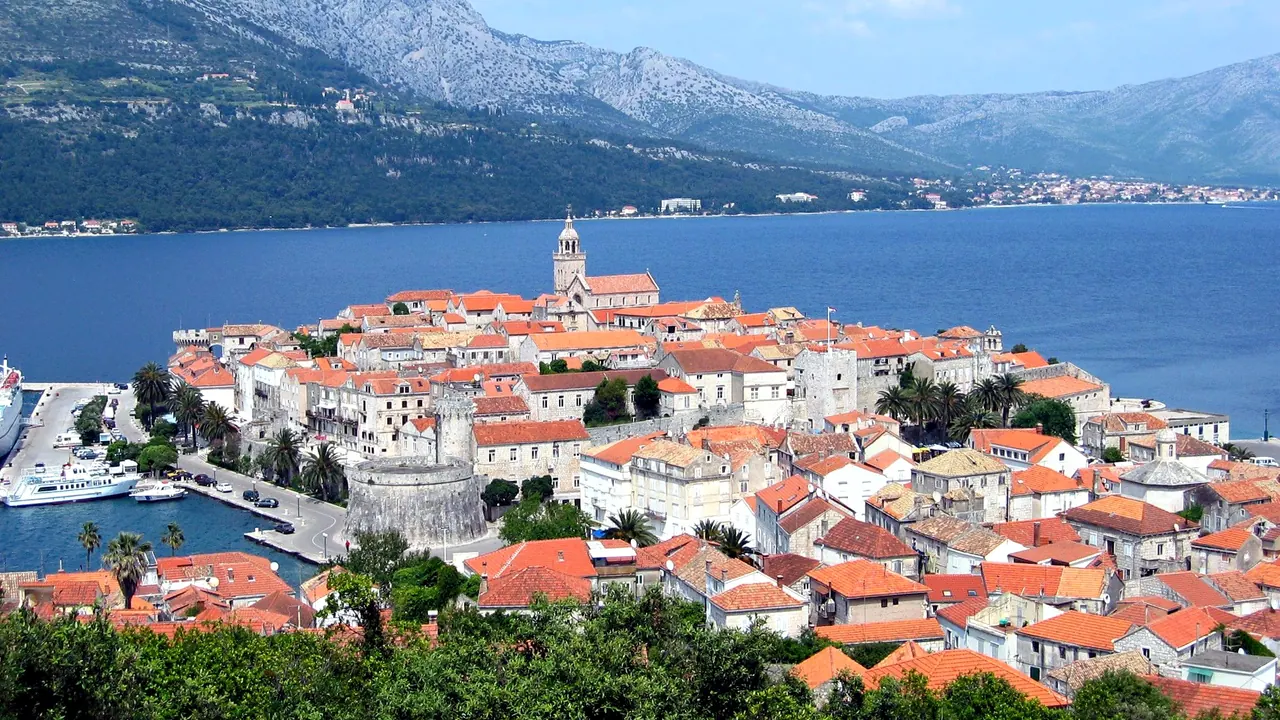
Photos: Korčula by Εὐθυμένης, CC BY-SA 3.0, cropped.
Korčula or Umbria?
Our verdict in twelve categories, each scored against the same fixed benchmark cities, and the climate month by month, so you can choose for your trip.
Choose Korčula for
- beaches
Korčula is the choice for a summer by the sea. It has clear water, coves backed by pine, sandy bays at Lumbarda and a walled stone town small enough to know within a day. It suits travellers who want to swim every day and drink Grk and Pošip with dinner, and who are happy with a short list of sights and quiet evenings in return.
Choose Umbria for
- day trips
- culture and sights
- live music and the arts
For a trip built around art, food and a different town each day, Umbria gives far more. Giotto in Assisi, Orvieto's cathedral, truffles and Sagrantino make it the better base for curious travellers, and prices are gentler. The cost is that the sea is a long drive away and the best swim is usually a farmhouse pool.
Scoreboard
Twelve categories on one fixed scale from 0 to 100. The shaded stretch is the gap between the two.
Your match
Pick a travel style or drag the sliders, and both match scores follow your weighting.
Wins on beaches with your weighting.
Wins on day trips and culture and sights with your weighting.
What matters to you?
Category by category
What the scores mean for a trip.
Beaches & swimming
This is Korčula's strongest point and Umbria's weakest. Korčula has very clear sea and pine-fringed pebble coves. Near Lumbarda, Pržina and Bilin Žal have sand and shallow water, which is rare on this coast, Pupnatska Luka lies on the south coast and taxi boats run out to Badija.
Umbria has no coast at all. The lidos on Lake Trasimeno are warm and safe for paddling, but the water is often cloudy and the bottom muddy in places. Most visitors swim in a farmhouse pool, and the sea is a drive of two hours or more.
Food & drink
Umbria is the better place to eat, though Korčula has a few things it cannot match. Korčula's cooking is plain Dalmatian food done well: grilled fish, black risotto, octopus salad, and lamb or octopus slow-cooked under an iron bell. Žrnovo's hand-rolled makaruni is one of its few dishes of its own, and the menus look much alike from one konoba to the next. What stands out is fresh seafood and wine from grapes grown in few other places, Grk at Lumbarda and Pošip around Čara and Smokvica.
Umbria's food has more depth. Black truffle is shaved over strangozzi, Norcia's butchers set the standard for Italian pork, and Castelluccio lentils and porchetta from market vans fill out the table. Perugia has the widest choice of restaurants, and the Sagrantino estates around Montefalco and the whites of Orvieto make tasting days worth planning.
Culture & sights
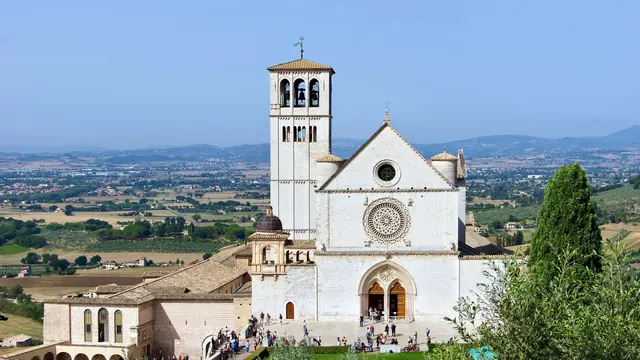
Here Umbria is far ahead. Assisi's basilica holds frescoes by Giotto and Cimabue, Orvieto's cathedral stands on its volcanic cliff and Perugia has the Galleria Nazionale. Towns such as Gubbio, Spoleto and Spello add art of the first rank, enough to fill a week or more.
Korčula Town is handsome and intact. It has herringbone streets, St Mark's Cathedral with its Tintoretto and the house the town claims as Marco Polo's birthplace, and the cave of Vela Spila adds deep prehistory. Even so, most visitors have seen it all in a day or two.
Nightlife
Neither suits clubbers, and in both an evening mostly means a long dinner. The difference is the setting. On Korčula you have cocktails on the town walls and towers as the sun goes down over the channel, and anyone who wants to party takes a boat to a livelier island. In Umbria the only real crowd is in Perugia, where students fill the cathedral steps and the wine bars on warm nights.
Nature & outdoors
Umbria has more to do on land. The Monti Sibillini rise above 2,000m, the Castelluccio plain flowers in early summer and the Valnerina has rafting and canyoning. The Marmore Falls and the Spoleto to Norcia railway path add more variety.
Korčula's outdoors is gentler and centres on the sea. You can walk or cycle across a ridge of pine and vineyards and kayak around the islets. Across the channel on Pelješac are the climb up Sveti Ilija and the windsurfing strait at Viganj.
Day trips
Korčula offers two kinds of outing. On the island itself, Lumbarda's vineyards, Vela Luka with its prehistoric cave, and the inland villages of Blato and Pupnat each fill a day. By ferry or catamaran you can reach the Pelješac wineries, the walls and oysters of Ston, the lake monastery on Mljet and Hvar Town. Dubrovnik and Split are possible, but they make long days.
Umbria has far more within easy reach. From Perugia or Spoleto you can visit a different hill town every day, from Gubbio to Todi and Bevagna. Cortona and Montepulciano are just over the Tuscan border, and Rome is a little over an hour by train from Orvieto.
Good for families
Both suit a quiet family stay rather than a busy one, and neither has much built for children. Korčula's draw is the sandy, shallow bays near Lumbarda and boat trips to the islets, against stepped streets and long ferry journeys. Umbria offers farmhouses with pools and animals, the warm shallows of Lake Trasimeno, the Marmore Falls and an amusement park near Perugia, but its steep towns are just as hard with a pushchair.
Getting around
Umbria is the easier of the two to get around. Short distances, good roads and light traffic make driving simple. Escalators, lifts and funiculars take you up into Perugia, Orvieto and Spoleto, and without a car a rail line links several of the main towns.
Korčula has one main road and buses that do not run often, so a hired car or scooter helps for reaching the coves. Taxi boats link Korčula Town with Lumbarda and the islets, and every arrival and departure depends on ferries.
Shopping & style
Neither is a shopping destination, but Umbria has more to buy. There are the majolica workshops of Deruta, hand-loomed linen in Montefalco and Bevagna, cashmere outlets near Perugia, and hams and truffles in Norcia. On Korčula the souvenir lanes and a few craft studios matter less than what you can take home in a bottle: Grk, Pošip, olive oil and fig liqueur.
Affordability
On Korčula, prices follow the season. July and August bring resort prices in and around the old town, and drinks on the walls, boat trips and car hire soon add up. June and September are noticeably cheaper, and a private apartment in Lumbarda, Vela Luka or one of the villages keeps the cost of a stay down.
Umbria costs less overall, and its expensive times are narrower. Rooms in Assisi and Orvieto go up in summer and around religious festivals, but a base in a smaller town avoids most of that. At the table, truffle dishes are where a bill rises fast, while plain country cooking without them stays modest.
Live music & performing arts
Umbria has a real summer season. Umbria Jazz takes over the streets of Perugia in July, the Festival dei Due Mondi brings opera, theatre and dance to Spoleto, and the theatres in Perugia and Spoleto have their own seasons.
Korčula's stage is local and traditional. Troupes perform the Moreška sword dance in Korčula Town through the summer, and klapa choirs sing in churches and squares. It makes a memorable evening, but there is no theatre or regular concert life.
Wellness & relaxation
Neither has a strong bathing tradition, so both offer a slow pace, but Umbria does it more fully. Its country houses add pools, massage and yoga, Assisi and the hermitages on Monte Subasio offer silence, and there are small spas at San Gemini and Nocera Umbra. Korčula's version is quiet vineyard villages and long lunches in the shade, best in June or September, and spa treatments mostly mean the larger hotels around Korčula Town.
When should you go?
Pick your month. The climate figures are measured averages, not a forecast.
Korčula in July
Umbria in July
Daytime high, °C
Rainfall in the month, mm
Where the figures come from
Korčula's temperatures are measured 69 km from the centre, at Mostar.
Korčula has no rain gauge within 25 km of the centre, so its rainfall comes from a gridded climate dataset read at the destination rather than from a gauge further away.
Umbria's temperatures are measured 53 km from the centre, at Frontone.
Umbria has no rain gauge within 25 km of the centre, so its rainfall comes from a gridded climate dataset read at the destination rather than from a gauge further away.
Temperature and rainfall are climate normals, averaged over the years shown. Korčula: 1991-2020 normals, Mostar (69.2 km from centre). Umbria: 1991-2020 normals, Frontone (52.9 km from centre).
Korčula is a summer island. From June to September the sea is warm enough for swimming, reaching about 25°C in August. July and August are dry, very sunny and hot, with afternoons around 33°C that make walking at midday hard going, so June and September are the most comfortable months. Rain arrives in October and November is the wettest month, and the island stays cool and grey through the winter.
Umbria is inland, so its summers are a little milder and its winters colder. July highs are around 30°C, warm but manageable in the hill towns if you start early. Spring and early autumn are the best times to walk the streets and the countryside. Rain builds through the autumn to about 97mm in November, and winter days of around 7°C are chilly but still fine for frescoed churches.
Which traveller are you?
For a beach and sun trip, Korčula is the clear pick. It has clear sea, pebble coves, sandy shallows around Lumbarda and taxi boats out to the islets, so you can swim somewhere different every day. Landlocked Umbria offers only lake lidos and farmhouse pools.
On a culture and arts trip, Umbria wins easily. Giotto's frescoes in Assisi, Signorelli in Orvieto, Perugino in Perugia and the summer festivals in Spoleto and Perugia fill a week. On Korčula, most visitors have seen the walled old town and its cathedral within a day or two.
On a tight budget, Umbria goes further. Farmhouse stays and village trattorie cost less than Korčula's old town in July and August, local wine is cheap and most churches are free. A hire car is the one cost that is hard to avoid.
Before you go
| Measure | Korčula | Umbria |
|---|---|---|
| Official language | Croatian | Italian |
| Currency | Euro (EUR) | Euro (EUR) |
| Sockets | CF230 V, 50 Hz | CFL230 V, 50 Hz |
| Driving side | Right | Right |
| Time zone | UTC+1, UTC+2 in summer | UTC+1, UTC+2 in summer |
| Emergency number | 112 | 112 |
| Main airport | Dubrovnik Ruđer Bošković Airport (DBV)76 non-stop destinations | Perugia San Francesco d'Assisi – Umbria International Airport (PEG)17 non-stop destinations |
| Public holidays this year | 14 days | 13 days |
By the numbers
| Measure | Korčula | Umbria |
|---|---|---|
| Population | - | 852,085 |
| People per km² | - | 101 |
| Swim season, months above 21 °C | 5 months | - |
Where else could you go?
Every comparison below shares a destination with this one, so you can follow Korčula or Umbria somewhere new.