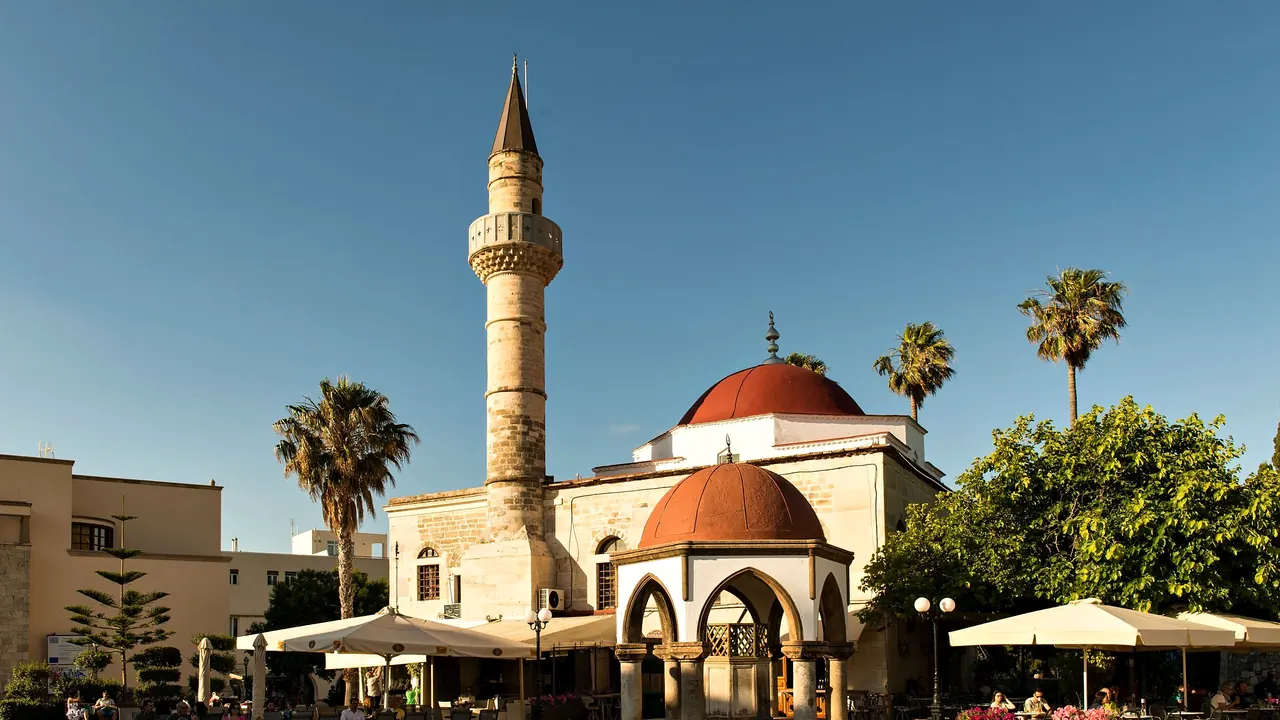
Photos: Kos by Wolfgang Weiser, Pexels License.
Kos or Lefkada?
Our verdict in twelve categories, each scored against the same fixed benchmark cities, and the climate month by month, so you can choose for your trip.
Choose Kos for
- nightlife
- getting around
- culture and sights
Kos suits travellers who want an easy beach vacation with a bit of everything around it. The north coast has long, shallow sandy beaches, Kos Town has Roman ruins and a crusader castle among its streets, and the evenings are livelier. Buses and cycle lanes link the resorts, so families and anyone who would rather not drive all week will find it simpler to manage.
Choose Lefkada for
- nature and the outdoors
- day trips
- live music and the arts
Lefkada is the island for scenery and the sea. Its west coast has beaches under white cliffs in turquoise water, the green mountain interior is good for walking, and Vasiliki and the sheltered channels to the east are some of Greece's best windsurfing and sailing waters. The price is a hired car on winding roads, quieter nights and very little to see beyond the landscape.
Scoreboard
Twelve categories on one fixed scale from 0 to 100. The shaded stretch is the gap between the two.
Your match
Pick a travel style or drag the sliders, and both match scores follow your weighting.
Wins on nightlife and getting around with your weighting.
Wins on nature and the outdoors and day trips with your weighting.
What matters to you?
Category by category
What the scores mean for a trip.
Beaches & swimming
Both islands are beach destinations first, but their beaches are different. On Kos the north coast from Tigaki to Mastichari has long, open, sandy beaches with shallow water, though the summer meltemi wind can make the sea choppy. The calmer coves are on the south coast, and the finest bays, Paradise Beach and Agios Stefanos, are on the Kefalos peninsula.
Lefkada's west coast is more dramatic. Porto Katsiki, Egremni and Kathisma lie under white limestone cliffs in turquoise water, but they face the open sea, shelve steeply, get waves in the afternoon and crowd up in midsummer. For calm swimming, Lefkada's east coast around Nikiana and Nidri and the sheltered bays at Vasiliki and Agiofili are the better choice.
Food & drink
Neither island is a food destination. Both serve simple taverna cooking, and on both the resort strips lean on tourist menus. The local specialities differ: on Kos, look for chickpea fritters and cheese matured in red wine in hill villages like Zia and Pyli or at the fishing harbour of Mastichari. On Lefkada, try the small Eglouvi lentils, the cured salami and the mountain cooking around Karya, or eat fish on the harbours of Lefkada town and Nidri.
Culture & sights
Kos has far more history to see. Kos Town is part archaeological site, with the Ancient Agora, the restored Odeon, Roman mosaics and the Casa Romana among its streets and the Knights' Neratzia Castle at the harbour. The terraced Asklepieion healing sanctuary is a short ride away, and together they fill two or three good days.
Lefkada's sights are things to visit between beach days: the Santa Maura fortress at the causeway, a small museum, Ionian churches with painted ceilings and the Faneromeni monastery above the lagoon. Nothing there is worth planning a trip around.
Nightlife
Kos has the stronger night scene. The lanes of Kos Town's old quarter are lined with bars that stay loud into the small hours, Lambi has beach clubs, and Kardamena is a full party resort with late clubs and a young Northern European crowd.
Lefkada is more for a drink and a stroll than for clubbing. Young Greek visitors fill the cocktail bars in Lefkada town's lanes, sailing crews meet on the harbour at Nidri, and windsurfers gather in Vasiliki's bars after dark. Both islands go quiet outside high summer.
Nature & outdoors
Lefkada is much the more rewarding island outdoors. It is steep and green, with olive and cypress slopes rising to mountains above 1,100m, tall white sea cliffs and walks to the Dimosari waterfall. The afternoon wind at Vasiliki makes it one of the best-known windsurfing bays in the Mediterranean, and its sheltered channels and large marina are a classic start for a week on a yacht.
Kos is low and dry by comparison. The Dikeos hills offer pine-wood trails up to Mount Christos for the sunset, flamingos gather on the Alikes salt lake in spring and winter, and Marmari is good for windsurfing, but the landscape is not the reason to come.
Day trips
The two islands offer about the same amount of day trips, but different kinds. From Kos every trip is by boat: a short ferry to Bodrum in Turkey (bring your passport), a day climbing to the volcanic crater on Nisyros, or a crossing to Kalymnos, the sponge-diving island.
Lefkada mixes the sea with the mainland. Boats from Nidri visit Meganisi, and ferries from Vasiliki cross to Ithaca and to Fiskardo on Kefalonia. Because the island is joined to the mainland by road, you can also drive to the Roman ruins of Nikopolis, to Parga and to the oracle site on the Acheron river without waiting for a ferry.
Good for families
Kos is the more natural choice with young children. Its sandy north-coast beaches shelve gently into shallow water, many resorts have pools, kids' clubs and all-inclusive dining, and there is a water park near Marmari. Families can also cycle the flat paths around Kos Town together.
On Lefkada, families do well in the calm bays of the east and south, but the famous west-coast beaches are steep, get surf on windy afternoons and are sometimes reached down long staircases. Neither island has a zoo or an aquarium.
Getting around
Kos is easier to get around without a car. Kos Town is flat, cycle lanes lead to the beaches on either side, and buses run along the main road between the town, the airport and the main resorts. A hire car is only needed for a day or two to reach the hill villages and the far south-west.
Lefkada is connected to the mainland by a causeway, so there is no ferry to catch on arrival, but the buses are too infrequent for beach-hopping and a car or scooter is close to essential. The roads down the west coast and over the mountains are slow and winding, and in high summer traffic builds up through Nidri and parking at Porto Katsiki fills.
Shopping & style
Neither island is for shopping, and both centre what there is on their main town. In Kos Town's old quarter you will mostly find leather, sandals and sponges, while the Italian-era market hall is good for herbs and spices. Lefkada town's pedestrian street has small clothing shops and stores selling local lentils and olive oil, and the village of Karya sells traditional hand embroidery.
Affordability
The two cost about the same, both in the middle of the Greek island range, but the costs come from different places. Kos is built around package and all-inclusive stays, with cheap buses and bike hire and low entry fees at its ruins. On Lefkada the costs that add up are car hire, boat excursions and August rooms near the west-coast beaches. On both islands, June and September are noticeably easier on the budget than high summer.
Live music & performing arts
On both islands live performance is a summer-only affair, with village saint's-day festivals and little else for the rest of the year. Each has one standout event. On Kos, the Hippokrateia festival puts on concerts, theatre and dance in the Asklepieion, the Roman Odeon and the castle. On Lefkada, an international folklore festival has brought dance groups from many countries to open-air stages every August for decades.
Wellness & relaxation
Kos has a little more to offer for relaxing. At Therma on the south-east coast, a hot sulphur spring runs onto a pebble beach, where bathers build stone pools in which the hot water mixes with the sea, and the larger beach resorts commonly have spas.
Lefkada has no bathing tradition, only a few hotel spas and some yoga and retreat stays in the hills. On both islands the real rest comes from the pace: on Lefkada in the inland villages and small east-coast harbours, on Kos around Kefalos and in Zia and Pyli.
When should you go?
Pick your month. The climate figures are measured averages, not a forecast.
Kos in July
Lefkada in July
Daytime high, °C
Rainfall in the month, mm
Where the figures come from
Kos has no rain gauge within 25 km of the centre, so its rainfall comes from a gridded climate dataset read at the destination rather than from a gauge further away.
Lefkada has no rain gauge within 25 km of the centre, so its rainfall comes from a gridded climate dataset read at the destination rather than from a gauge further away.
Temperature and rainfall are climate normals, averaged over the years shown. Kos: 1993-2020 (rainfall 1991-2020) normals, Kos Airport (23.2 km from centre). Lefkada: 1998-2020 (rainfall 1991-2020) normals, Aktion Airport (24.3 km from centre).
The two islands share much the same beach season. The sea is warm enough from June into early October and reaches about 25°C in August. July and August bring highs of around 31°C on both, which is hot for walking around ruins or village lanes, so May, June and September are more comfortable for anything beyond the beach.
The main difference is rain. Kos is almost completely dry from June to August, and autumn stays fairly dry into October. Its wet season comes in winter, with about 170mm in January. Lefkada gets the odd summer shower and turns wet sooner: rain picks up in September and peaks at about 150mm in November. For a late-season trip, Kos is the safer bet.
Which traveller are you?
On a family trip with young children, Kos asks less of parents. Its gentle beaches lie close to the resorts and most of the island suits small swimmers, so the days run smoothly without planning around a car.
For an outdoors trip, Lefkada is the clear pick. On Lefkada the landscape is the reason to go, and the hills and the water together fill a week of walking, wind and sailing. Kos gives you a pleasant afternoon or two.
On a food and nightlife trip, Kos comes out ahead because of the nights. The meals are the same simple taverna fare on both islands. Kos has proper late nights and a party resort, while on Lefkada the evening usually ends with a drink by the harbour.
Before you go
| Measure | Kos | Lefkada |
|---|---|---|
| Official language | Greek | Greek |
| Currency | Euro (EUR) | Euro (EUR) |
| Sockets | CF230 V, 50 Hz | CF230 V, 50 Hz |
| Driving side | Right | Right |
| Time zone | UTC+2, UTC+3 in summer | UTC+2, UTC+3 in summer |
| Emergency number | 112 | 112 |
| Main airport | Kos International Airport "Ippokratis" (KGS)75 non-stop destinations | Aktion National Airport (PVK)47 non-stop destinations |
| Public holidays this year | 15 days | 15 days |
By the numbers
| Measure | Kos | Lefkada |
|---|---|---|
| Population | 33,387 | 22,652 |
| People per km² | 115 | 64 |
| Swim season, months above 21 °C | 5 months | 5 months |
Where else could you go?
Every comparison below shares a destination with this one, so you can follow Kos or Lefkada somewhere new.