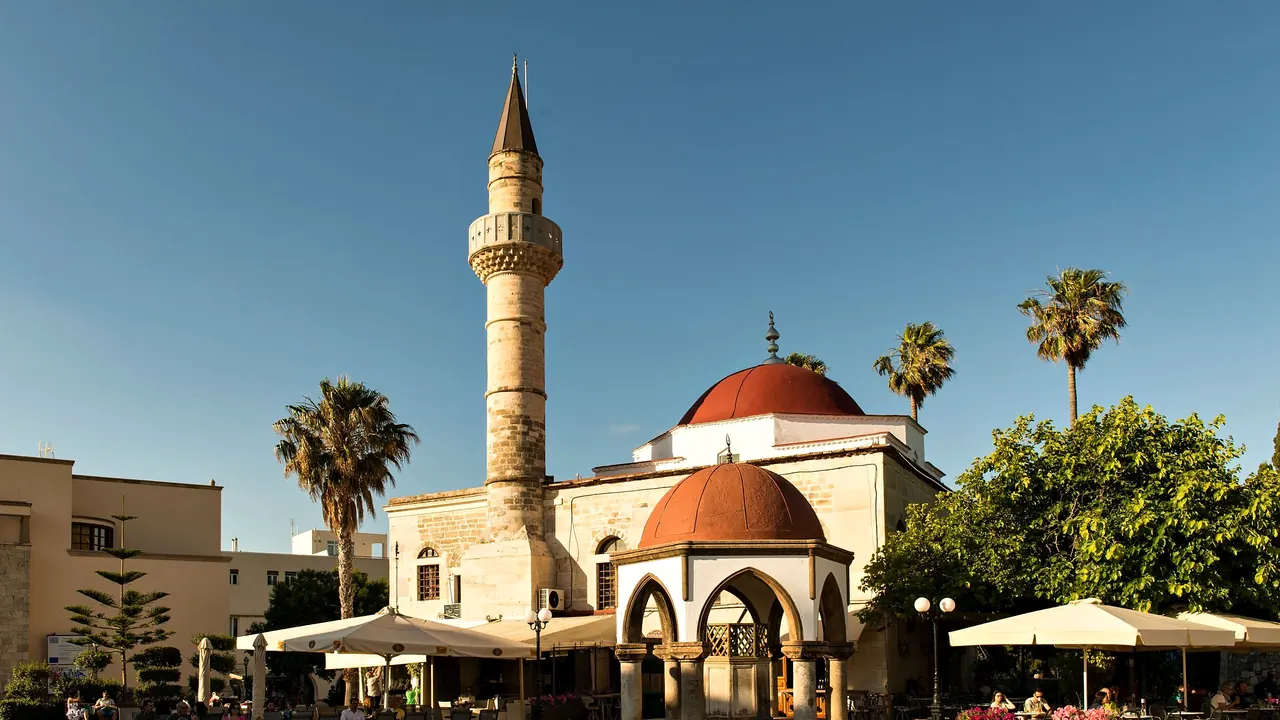
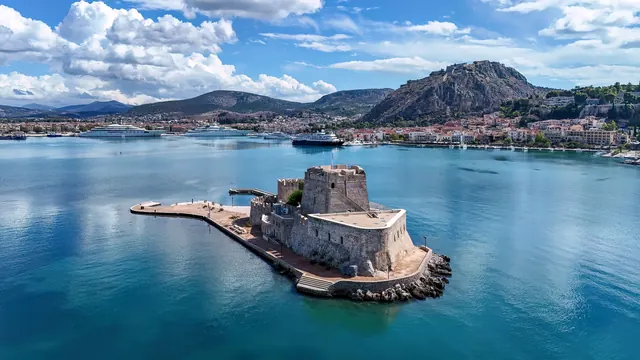
Photos: Kos by Wolfgang Weiser, Pexels License.
Kos or Peloponnese?
Our verdict in twelve categories, each scored against the same fixed benchmark cities, and the climate month by month, so you can choose for your trip.
Choose Kos for
- nightlife
- getting around
- families
Kos suits a beach vacation with few moving parts. The sandy north coast, resorts built around pools and kids' clubs, flat roads you can cycle and a night out in Kos Town or Kardamena when you want one make it the simpler choice for families with young children and for groups who want sun by day and bars after dark. It is also compact enough that you can settle in one place and still see the whole island.
Choose Peloponnese for
- culture and sights
- nature and the outdoors
- food and drink
The Peloponnese rewards travellers who want a trip that moves. Olympia, Mycenae, Epidaurus and Mystras are all here, along with mountain gorges, long trails, country cooking with its own wines and beaches every bit as good as those on Kos. The price is driving: almost everything needs a hire car, and the region is best seen from two bases rather than one.
Scoreboard
Twelve categories on one fixed scale from 0 to 100. The shaded stretch is the gap between the two.
Your match
Pick a travel style or drag the sliders, and both match scores follow your weighting.
Wins on nightlife and getting around with your weighting.
Wins on culture and sights and nature and the outdoors with your weighting.
What matters to you?
Category by category
What the scores mean for a trip.
Beaches & swimming
The beaches are about equally good, but they suit different trips. Kos is mostly sand, and all of it lies within an hour's drive. There are long, open strands from Tigaki to Mastichari, where the meltemi can whip up the sea, sheltered water around Kardamena and the island's finest bays at Paradise Beach and Agios Stefanos on the Kefalos peninsula.
The Peloponnese gives you more variety but makes you choose a coast. In Messinia there is the horseshoe of Voidokilia and the calm of Navarino Bay. Elafonisos has pale, tropical-looking water, and the Mani has pebble coves and rocks to swim from. Outside July and August, many of these beaches are almost empty.
Food & drink
The Peloponnese eats better because its cooking comes from what grows around it: Kalamata olives and oil, slow-cooked goat, the Mani's cured pork and wine from the Nemea vineyards and the Tripoli plateau. Kalamata's covered market and Nafplio's ouzeri give it some range beyond the village taverna.
On Kos you can eat well if you go looking, with pitaroudia and wine-cured krasotyri in the hill villages of Zia and Pyli or fish at Mastichari's harbour. In the big resorts, though, much of the food is cooked for package tourists.
Culture & sights
This is the widest gap between the two. The Peloponnese holds a large share of ancient and medieval Greece: the Lion Gate at Mycenae, the theatre at Epidaurus, Olympia, Messene, the lone temple at Bassae, Mystras, Monemvasia and the Venetian castles at Methoni and Koroni. Nafplio puts the Argolid sites within an hour.
Kos has an attractive layer of history in its main town, where Roman ruins lie among the streets, the Knights' castle guards the harbour and the Asklepieion stands on its hillside above. It makes a satisfying few days, but no more.
Nightlife
Kos is the place to go out, at least from June to September. The old-quarter lanes of Kos Town are full of loud bars until the small hours, there are beach clubs at Lambi, and Kardamena has late clubs for a young crowd.
On the Peloponnese an evening usually means a long dinner and a drink by the harbour in Nafplio or Kalamata. Patras is the only place with a real club scene, and it is far from most bases.
Nature & outdoors
The Peloponnese has real mountains. Taygetos rises to about 2,400m above Kalamata, monasteries cling to the cliffs of the Lousios gorge, the Menalon Trail crosses Arcadia, and there is winter skiing on Chelmos. The Gialova lagoon draws migrating birds, and the coast is good for kayaking.
Kos is low and dry by comparison. It has the Dikeos hills with their sunset view from Mount Christos, peacocks in the Plaka forest and flamingos at Alikes. Its one clear edge is wind: Marmari and Tigaki are good for windsurfing and kitesurfing.
Day trips
With a car, the Peloponnese offers far more. From Nafplio you can reach the Nemea wine villages, take a ferry to car-free Hydra or Spetses, or drive to Athens in about two hours. Further south there are Monemvasia, the Mani tower villages and Elafonisos.
The day trips from Kos all go by boat, and they depend on the ferry timetables. You can cross to Bodrum in Turkey (bring a passport), climb into the volcanic crater on Nisyros or visit the sponge-diving harbour on Kalymnos.
Good for families
Kos still has the edge with younger children, partly because you can pick a base to suit their bedtimes. Tigaki, Marmari and Kefalos are quiet after dark, while Kardamena's late clubs make it the one resort families wanting calm nights should avoid. In July and August the midday heat sets the rhythm, with mornings on the sand and afternoons in the shade. Older children will get a day or two out of the castle and Roman ruins in Kos Town.
On the Peloponnese the history is the bigger draw for older children. Mycenae and Olympia catch their imagination, but the sites have little shade, so go early in the morning. Neither destination has a zoo or an aquarium. Nafplio is the easiest town to manage with a pushchair, and the large Messinian resort hotels have pools and kids' clubs for the beach days.
Getting around
Kos is much easier to get around. It is long and narrow, so nowhere is much more than an hour away. Buses run along the main road between the town and the resorts, and cycle lanes lead out of Kos Town to the beaches. A car for a day or two is enough to reach the hill villages and the far south-west.
On the Peloponnese a car is essential. Motorways link the main towns quickly, but the mountain and Mani roads are slow, and the buses barely reach the sites or the beaches.
Shopping & style
Neither is a shopping destination. On Kos the shopping is in the lanes of the old quarter, which are mostly leather, sandals and sponges, with herbs and local produce in the Italian-era market hall.
The Peloponnese is better for things to eat and drink. You can buy olive oil and honey from the producers, wine at the Nemea wineries and food at the weekly markets in Kalamata and Tripoli. Nafplio's lanes have the best range of jewellery and ceramics.
Affordability
Kos saves you money on getting about. Buses and bike hire cover most journeys, a car is needed for a day or two at most, and the ruins in Kos Town and the Asklepieion cost little to see. Where it takes your money is the seafront: sunbeds and harbour-side tables add up, and the package-built resorts keep rooms mid-range rather than cheap, more so in July and August.
The Peloponnese comes out somewhat cheaper overall, though it spends differently. The hire car and fuel you cannot do without eat into the savings, and Mycenae, Olympia and Epidaurus cost more to enter than anything on Kos. Against that, a family-run room in a Mani or Arcadian village and a taverna dinner with local wine cost noticeably less than a resort stay on the island, especially in May, June and September.
Live music & performing arts
The Peloponnese has one experience Kos cannot match: ancient Greek drama on summer weekend nights in the theatre at Epidaurus, where the acoustics are so clear the actors need no amplification. Concerts at the Little Theatre nearby and Kalamata's July dance festival add to it.
Kos has its summer Hippokrateia festival, staged at the Asklepieion, the Odeon and the castle, and village saints' day festivals. Otherwise there are only the resort Greek nights.
Wellness & relaxation
Both are restful mainly for their slow pace, and the hot springs take different forms. On Kos, the spring at Therma runs down onto a pebble beach, and bathers pile up stones to make pools where the hot water mixes with the sea. It is simple and free-form rather than a spa.
The Peloponnese has old spa towns at Loutraki and Methana, a lake at Kaiafas fed by warm sulphur springs and the most complete spas in the large Messinian resorts.
When should you go?
Pick your month. The climate figures are measured averages, not a forecast.
Kos in July
Peloponnese in July
Daytime high, °C
Rainfall in the month, mm
Where the figures come from
Kos has no rain gauge within 25 km of the centre, so its rainfall comes from a gridded climate dataset read at the destination rather than from a gauge further away.
Peloponnese's temperatures are measured 89 km from the centre, at Kalamata Airport.
Peloponnese has no rain gauge within 25 km of the centre, so its rainfall comes from a gridded climate dataset read at the destination rather than from a gauge further away.
Temperature and rainfall are climate normals, averaged over the years shown. Kos: 1993-2020 (rainfall 1991-2020) normals, Kos Airport (23.2 km from centre). Peloponnese: 1991-2020 normals, Kalamata Airport (89 km from centre).
Both have a long, dry summer and a swimming season that runs from June to October, with the sea at about 25°C in August on Kos and a touch warmer on the Peloponnese coast. July and August are hot in both places, around 31°C on Kos and a degree hotter on the mainland coast. That suits the beach but makes midday sightseeing hard work. May, June and September are the comfortable months for walking streets and ruins in either place.
Where they part is winter. Kos turns properly wet from November, with about 170mm of rain in January, so it is really a May to October island. The Peloponnese coast gets much less rain in winter and plenty of sunshine from March, which makes spring an excellent time for its ancient sites and mountain trails, and a mild winter visit is possible too.
Which traveller are you?
For a culture and arts trip, the Peloponnese is the clear choice. Mycenae, Olympia, Messene and the Byzantine town of Mystras could fill a fortnight, and summer adds drama at Epidaurus. Kos Town's ruins and the Asklepieion fill two or three days.
On a family trip with young children, Kos is easier. Its north-coast beaches shelve gently, the resorts have pools and kids' clubs, there is a water park near Marmari and the transfers are short. On the Peloponnese, families spend long hours in the car.
On an outdoors trip, choose the Peloponnese for the Taygetos peaks, the Lousios gorge, the Menalon Trail and the stark Mani coast. Kos has gentle pine-wood walks up to Mount Christos, but its real outdoor draw is windsurfing on the meltemi.
Before you go
| Measure | Kos | Peloponnese |
|---|---|---|
| Official language | Greek | Greek |
| Currency | Euro (EUR) | Euro (EUR) |
| Sockets | CF230 V, 50 Hz | CF230 V, 50 Hz |
| Driving side | Right | Right |
| Time zone | UTC+2, UTC+3 in summer | UTC+2, UTC+3 in summer |
| Emergency number | 112 | 112 |
| Main airport | Kos International Airport "Ippokratis" (KGS)75 non-stop destinations | Athens Eleftherios Venizelos International Airport (ATH)176 non-stop destinations |
| Public holidays this year | 15 days | 15 days |
By the numbers
| Measure | Kos | Peloponnese |
|---|---|---|
| Population | 33,387 | - |
| People per km² | 115 | - |
| Swim season, months above 21 °C | 5 months | 5 months |
Where else could you go?
Every comparison below shares a destination with this one, so you can follow Kos or Peloponnese somewhere new.