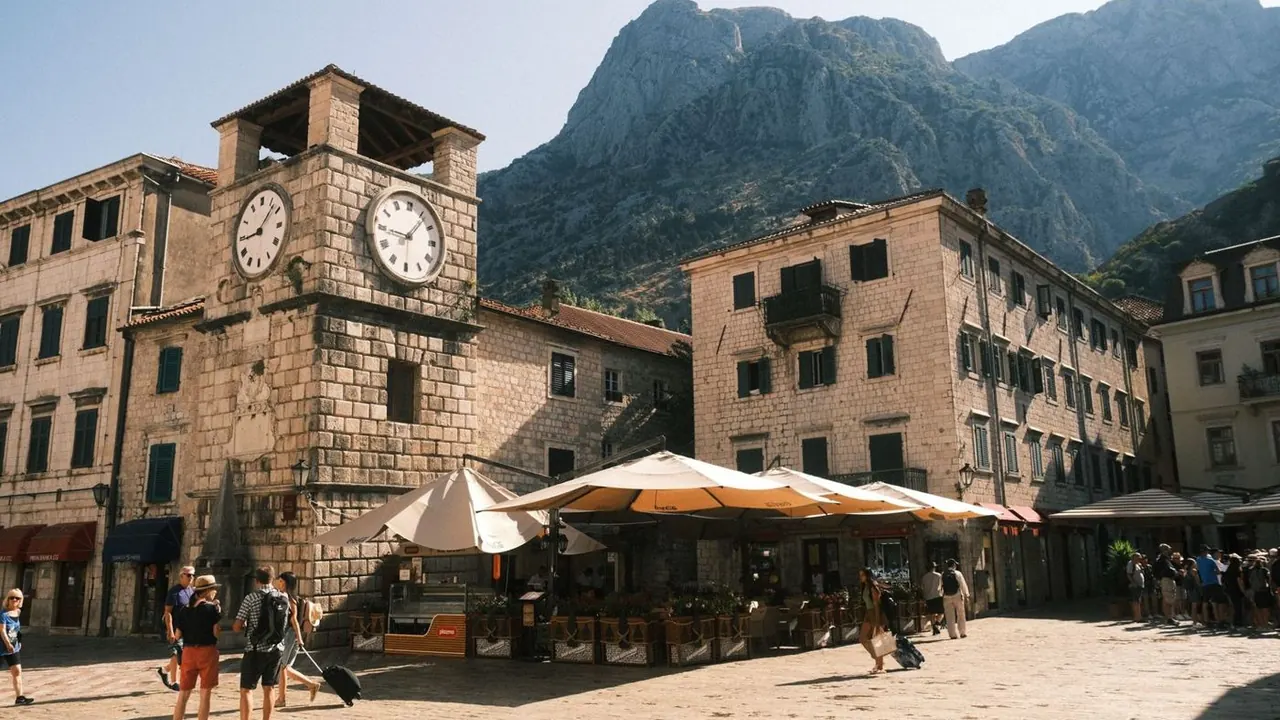
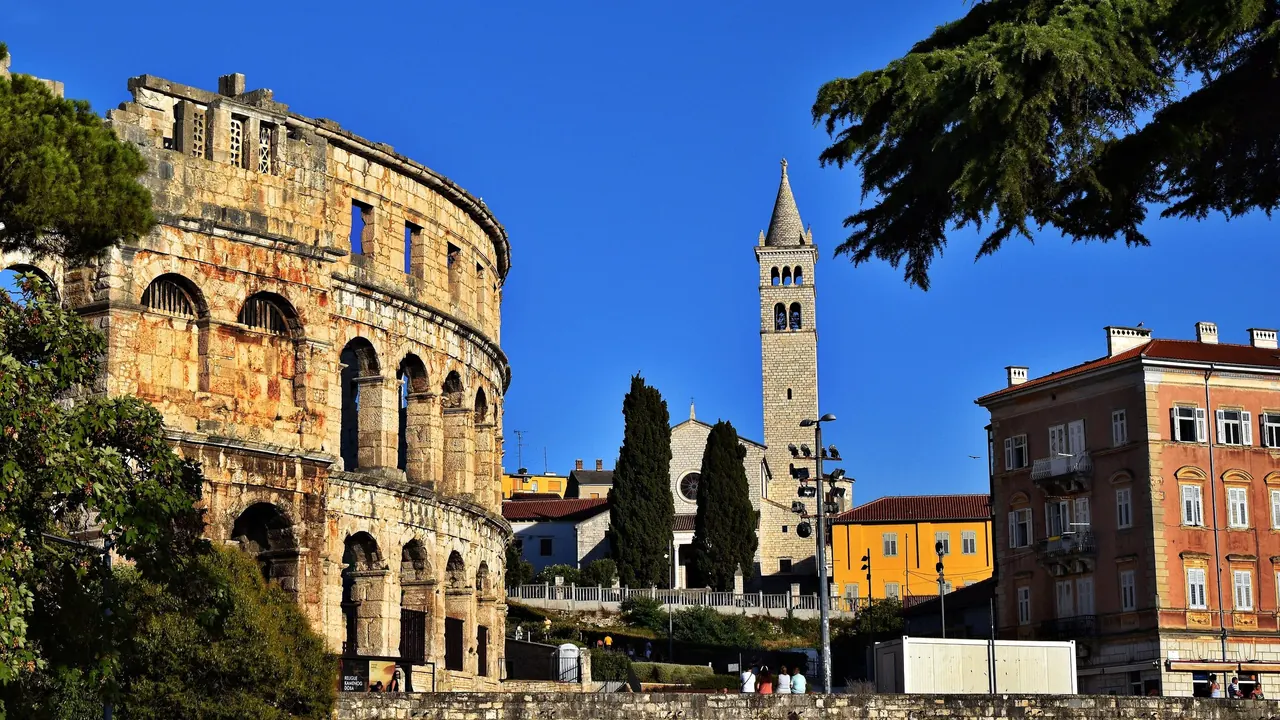
Photos: Kotor by Muhammed Fatih Beki, Pexels License; Pula by Miroslav.vajdic, CC BY-SA 4.0, cropped.
Kotor or Pula?
Our verdict in twelve categories, each scored against the same fixed benchmark cities, and the climate month by month, so you can choose for your trip.
Choose Kotor for
- nature and the outdoors
- prices
Kotor suits travellers who come for the setting. The bay closes in like a fjord, limestone walls rise straight from the water, and the walking starts at the town gates, with mule tracks, the fortress steps and Lovcen National Park above. The walled town is small enough to learn in a couple of days, a stay costs a little less, and evenings are calm. The trade-off is that proper beaches, real nightlife and most things for children are a drive away.
Choose Pula for
- families
- beaches
- food and drink
Pula is the better pick for a sea-and-food trip with some history. The water off its pine-shaded rocks and the coves of Kamenjak is clearer than anything in the inner bay. Istrian cooking with truffles, olive oil and local wine gives the meals more depth, and the Roman Arena doubles as a summer concert stage. Families also do better here, with shallow bays, an aquarium and easy outings across the Istrian peninsula.
Scoreboard
Twelve categories on one fixed scale from 0 to 100. The shaded stretch is the gap between the two.
Your match
Pick a travel style or drag the sliders, and both match scores follow your weighting.
Wins on nature and the outdoors and prices with your weighting.
Wins on families and beaches with your weighting.
What matters to you?
Category by category
What the scores mean for a trip.
Beaches & swimming
Neither town has a sandy beach of its own, but Pula's swimming is far better. Off the Verudela and Stoja peninsulas you swim in very clear water from rocks and pebble coves with pines almost down to the shore. Cape Kamenjak, about 10km south, adds dozens of wild inlets and cliff ledges, and Medulin's sheltered bays suit small swimmers.
Kotor's bathing is a matter of jetties and concrete platforms along the road to Dobrota and Muo, in water that is calm and warm but enclosed and less clear. For a real beach day you go over the hill to Jaz or Sveti Stefan on the Budva riviera.
Food & drink
Pula draws on Istria, one of the more individual kitchens on the Adriatic. That means fuži with truffle or game, scampi buzara, olive oil and Malvazija or Teran from estates just inland, with the covered market hall showing what is in season. The best meals are often in village taverns in the hinterland.
Kotor's table is narrower: bay mussels, black cuttlefish risotto, Njegusi ham with mountain cheese and a glass of dark Vranac. In both towns the tables on the main squares serve tourist menus, and in Kotor the better cooking is along the shore in Dobrota, Prcanj and Perast.
Culture & sights
These two are fairly even, but the history comes in different forms. Kotor's appeal is the whole walled town, a UNESCO-listed triangle of marble lanes, Venetian palazzi and the twelfth-century Cathedral of St Tryphon, held in place by a cliff, with walls climbing to the fortress of St John.
Pula is a working port with Rome scattered through it. The three-storey Arena, the Temple of Augustus on the Forum and the Arch of the Sergii are the headline sights, and the Habsburg naval base left its forts and civic buildings around them. Either can be seen in a day or two.
Nightlife
Neither is a destination for going out, but Pula offers a bit more. In summer, evenings move from the Forum terraces to cocktail and beach bars on Verudela and around Medulin, and a few small clubs fill up at weekends. The university keeps some student bars open through the winter.
In Kotor the evening is usually a drink on a square once the day visitors have gone and the walls are lit on the cliff. Only a handful of bars stay open late. For dancing until dawn, people head half an hour down the coast to Budva.
Nature & outdoors
This is where Kotor pulls well ahead. The bay winds inland between limestone walls that rise more than 1,000m almost from the water. Trails such as the Ladder of Kotor start at the town gates, and the hairpin road leads up into Lovcen's karst meadows and beech woods. Kayaking under the cliffs and the bird-rich wetlands of Lake Skadar add variety.
Pula's landscape is low and gentle by comparison, all macchia, olive groves and red-earth farmland. Kamenjak is lovely for walking, cycling and windsurfing, and naval-era wrecks offer diving, but the nearest real hiking is in the Učka range, about an hour and a half away.
Day trips
Both make good bases, so the choice comes down to what you want to see. From Kotor the outings follow the bay: Perast's baroque waterfront and the boat to Our Lady of the Rocks, Herceg Novi at the mouth, then over Lovcen to the old royal capital of Cetinje, with Dubrovnik possible across the border.
Pula opens up a whole peninsula: Rovinj on its headland, the Byzantine mosaics of the Euphrasian Basilica in Poreč, and the hill towns of Motovun, Grožnjan and Hum among the truffle and wine estates. Brijuni, Piran and Trieste stretch it further, though a car makes most of this far easier.
Good for families
Pula is much easier with children. Medulin and Premantura have shallow, gently shelving bays, the aquarium inside a fort on Verudela fills half a day, and children can scramble through the Arena's underground passages. A dinosaur park, a water park and the animals on Brijuni are all within about an hour.
Kotor is safe and car-free, and children love its street cats, but there is little else made for them. The fortress climb is steep and hot, so families tend to swim off the bay jetties and make the boat trip to Perast's island church their highlight.
Getting around
There is little to choose between them, and the pattern is the same: easy on foot in town, harder beyond it. Kotor's old town is car-free and crossed in minutes, though the marble gets slippery in rain. Leaving it means infrequent buses, water taxis and a single bay road that jams in summer.
Pula's flat centre is just as walkable, and city buses or a bicycle reach Verudela and the southern coves. Istria's rail line is little use to visitors and regional buses are thin, so a car or scooter is the realistic way to reach the hill towns and Kamenjak.
Shopping & style
In both towns the best things to buy are things to eat and drink, and in Kotor there is little beyond that. The lanes inside the walls sell mostly souvenirs, the good wine and ham come from a few delicatessens and the green market by the gates, and if you want any brands at all you have to drive to the Tivat marina.
Pula gives you more ways to shop. Besides the market hall, you can buy oil, truffles and wine directly from the farms and estates on a drive inland, so shopping becomes part of touring Istria. The pedestrian street through the old town also has ordinary fashion chains, so you can replace something you forgot to pack without a special trip.
Affordability
Kotor works out somewhat cheaper. Konoba meals, buses and the fortress walk stay moderate, and renting an apartment in Dobrota or Muo outside July and August keeps costs down further. Pula is mid-priced: fair in spring and autumn, but in high summer rooms approach Western European coastal levels. Car hire and boat trips, which most Istria touring needs, add up quickly.
Live music & performing arts
Pula has a real stage, and it is two thousand years old. On summer nights the Arena hosts touring rock and pop acts, classical galas and the long-running film festival screenings. The Istrian National Theatre puts on drama for the rest of the year, though in Croatian.
Kotor has nothing year-round. Its moments come with the summer festival of recitals and choirs in the squares and churches, the carnival, and Boka Night, when decorated boats fill the bay.
Wellness & relaxation
Neither has a bathing tradition, so in both towns spa time means a resort hotel. Pula's are larger and closer at hand, on Verudela and in Medulin, and pine-shaded coastal paths and quiet inland villages make slowing down easy.
Kotor's calm is more a matter of timing. Early mornings on the water, long lunches in the shore villages and evenings after the day visitors leave are peaceful. The old town at a summer midday is best avoided.
When should you go?
Pick your month. The climate figures are measured averages, not a forecast.
Kotor in July
Pula in July
Daytime high, °C
Rainfall in the month, mm
Where the figures come from
Kotor has no rain gauge within 25 km of the centre, so its rainfall comes from a gridded climate dataset read at the city rather than from a gauge further away.
Kotor's sunshine is measured 42 km from the centre, at Podgorica-Grad.
Pula's temperatures are measured 87 km from the centre, at Trieste.
Pula has no rain gauge within 25 km of the centre, so its rainfall comes from a gridded climate dataset read at the city rather than from a gauge further away.
Temperature and rainfall are climate normals, averaged over the years shown. Kotor: 1991-2020 normals, Tivat (4.2 km from centre). Pula: 1991-2020 normals, Trieste (87 km from centre).
Kotor has the hotter summer. July and August reach about 31°C, and the heat thrown back by the bare limestone makes the fortress steps and mountain trails hard going by midday, though the bay is at its warmest and the days are long and very sunny. That dry spell is short. The rain comes back in September, already about 122mm, three times August's total, and peaks at about 202mm in November, so late autumn and winter are wet and grey. June is the best balance, warm enough to swim but still fine for the hills, and late May suits walkers before the sea has fully warmed. September keeps the warm water, but you should expect some wet days.
Pula's summer is a few degrees gentler and its sea nearly as warm, so swimming runs comfortably from June to late September. The bigger difference is the rest of the year. Pula's winters are cooler, with January highs near 9°C, but much drier. Even November, Pula's wettest month, gets only about half of Kotor's rain, and from autumn through spring it rains far less than it does around the bay. That makes Pula the safer bet for sightseeing in spring and autumn.
Which traveller are you?
On an outdoors trip, Kotor is the clear choice. You can walk straight from the old town up the Ladder of Kotor or the fortress wall, drive into Lovcen's beech woods, and kayak beneath mountains that rise over 1,000m from the bay.
On a family trip with children, Pula works much better. The sheltered, shallow bays around Medulin, the aquarium inside a Habsburg fort, the Arena's underground passages and the Brijuni safari keep children busy. Kotor has little made for them beyond its street cats.
For a food and nightlife trip, Pula has the edge. Istrian truffle pasta, Malvazija and hinterland taverns give more range than Kotor's seafood terraces, and the Verudela beach bars stay up later. In Kotor a real night out means going to Budva.
Before you go
| Measure | Kotor | Pula |
|---|---|---|
| Official language | Montenegrin | Croatian |
| Currency | Euro (EUR) | Euro (EUR) |
| Sockets | CF230 V, 50 Hz | CF230 V, 50 Hz |
| Driving side | Right | Right |
| Time zone | UTC+1, UTC+2 in summer | UTC+1, UTC+2 in summer |
| Emergency number | 112 | 112 |
| Elevation | 10 m | 5 m |
| Main airport | Tivat Airport (TIV)5 km from centre42 non-stop destinations | Pula Airport (PUY)7 km from centre34 non-stop destinations |
| Public holidays this year | - | 14 days |
By the numbers
| Measure | Kotor | Pula |
|---|---|---|
| City population | 562 | 52,220 |
| People per km² | - | 971 |
| Museums within 10 km | 3 | 4 |
| UNESCO World Heritage sites within 50 km | 3 | 1 |
| Swim season, months above 21 °C | 5 months | 4 months |
Where else could you go?
Every comparison below shares a destination with this one, so you can follow Kotor or Pula somewhere new.