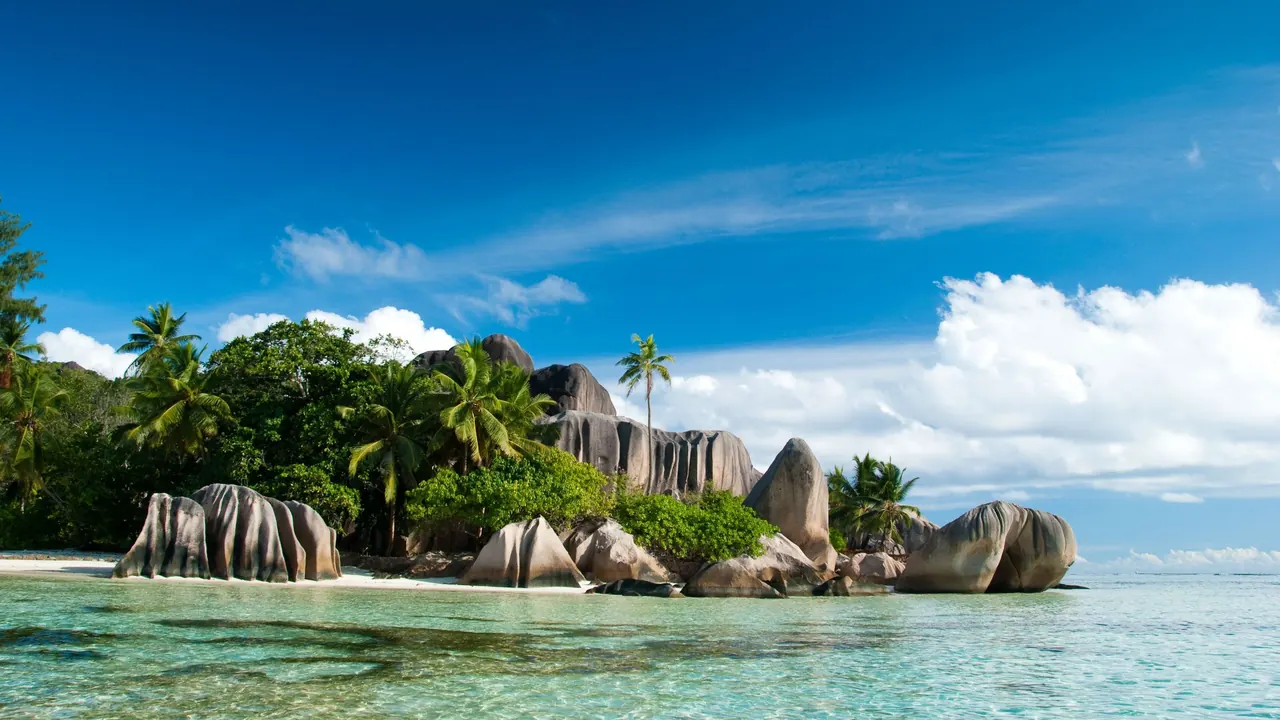
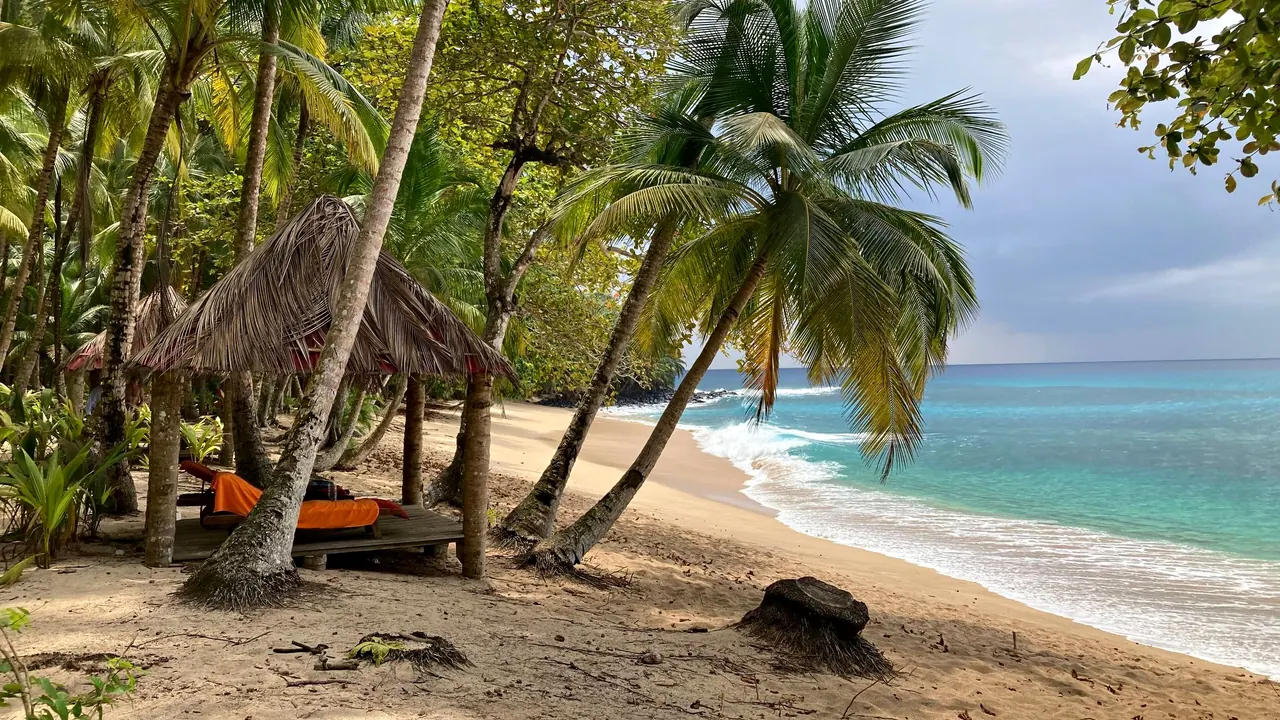
Photos: La Digue by Didier Baertschiger from Genève, Suisse, CC BY-SA 2.0, cropped; Príncipe by Josep M. Gracia, CC BY-SA 4.0, cropped.
La Digue or Príncipe?
Our verdict in twelve categories, each scored against the same fixed benchmark cities, and the climate month by month, so you can choose for your trip.
Choose La Digue for
- getting around
- day trips
- families
La Digue is the better pick if the beach is the point of the trip. Its granite-framed coves on the west and north coasts give calm, clear water for swimming and snorkelling. A bicycle takes you everywhere, and Praslin and Curieuse are an easy boat ride away. It suits couples and families who want long, easy days by the sea with very little to organise.
Choose Príncipe for
- nature and the outdoors
- prices
- live music and the arts
Príncipe rewards travellers who would rather explore than lie on the sand. Roadless rainforest climbs to volcanic spires, endemic birds live in the canopy, whales pass offshore and turtles nest on the beaches, and the old roças add a layer of history. Getting around takes more effort, with rough tracks, four-wheel-drive transfers and guided outings. In return you get a wilder island where few others go, and simple guesthouses in Santo António can keep the cost a little lower.
Scoreboard
Twelve categories on one fixed scale from 0 to 100. The shaded stretch is the gap between the two.
Your match
Pick a travel style or drag the sliders, and both match scores follow your weighting.
Wins on getting around and day trips with your weighting.
Wins on nature and the outdoors and prices with your weighting.
What matters to you?
Category by category
What the scores mean for a trip.
Beaches & swimming
Both islands have exceptional beaches, but La Digue's are better for a beach vacation. On the west coast, Anse Source d'Argent and Anse Union sit among pink-grey granite boulders, with water held calm by the reef. The northern coves are good for proper swimming and snorkelling. The wild southeast beaches, such as Grand Anse and Anse Cocos, are for walking rather than swimming.
Príncipe's coves are golden sand under rainforest, with Praia Banana the best known, and you will often have them to yourself. The price of that solitude is reaching many of them by rough track or by boat, finding almost no facilities, and checking locally about rocks and currents.
Food & drink
Neither island is a reason to travel for food, though La Digue has slightly more choice. Its Creole takeaways around La Passe serve octopus curry and fish cooked in banana leaf, and the fruit stalls on the coast road add fresh coconut and mango.
On Príncipe most meals are eaten where you stay: fresh fish, plantain and the odd calulu stew, with a few simple places and a market in Santo António. What it has that La Digue lacks is cocoa and coffee tastings on the plantations.
Culture & sights
Príncipe has more history to go and see, though neither island adds up to a cultural trip. Its roças are former plantations, with manor houses and workers' quarters half swallowed by forest and a hard history of forced labour. At Roça Sundy, a memorial marks where Eddington's expedition photographed the 1919 eclipse that helped confirm Einstein's theory of relativity.
La Digue's sights fit into a short walk. There is L'Union Estate with its copra mill and plantation house, then the church of Notre Dame de l'Assomption and a few wooden Creole houses in La Passe.
Nightlife
Both islands go quiet after dark. On La Digue the evening is a sunset drink on the west coast and a bicycle ride home along unlit roads. Príncipe has a few small bars in Santo António where locals play music on weekend nights, but most visitors turn in early for a dawn boat trip.
Nature & outdoors
Príncipe is the far bigger nature destination. The whole island is a UNESCO biosphere reserve, and the roadless south rises through Obô Natural Park to about 950m, with phonolite spires such as Pico Papagaio above the canopy. Add endemic birds, whales from July to October, nesting turtles from November to February, and boat trips to the Tinhosas seabird colonies.
La Digue's landscape is beautiful but small. You can climb Nid d'Aigle for the view over Praslin, take the coastal path to Anse Cocos, look for the paradise flycatcher in the Veuve reserve and snorkel off Coco Island or Félicité, all within a few days.
Day trips
La Digue is much better placed for outings. Praslin is a short ferry ride away for the coco de mer forest of the Vallée de Mai, Curieuse and its tortoises fit into the same boat trip, and Mahé makes a long but possible day.
Príncipe has no other towns to visit, so outings stay within the island, into the forest or out to sea. São Tomé is a flight away and works better as a separate stay than as a day out.
Good for families
La Digue is the gentler choice with children. The roads have almost no traffic, so older children can cycle, and the reef-sheltered water at Anse Source d'Argent suits small swimmers. Neither island has anything built for children, though, and on La Digue a rainy day can drag.
Príncipe asks more of a family. There is malaria, medical care is basic, the journey ends with a small-plane hop, and the roads and trails are tiring. Older children who love animals, however, may well remember turtle hatchlings and whales for longer than any beach.
Getting around
On La Digue, getting around is a pleasure. Almost everyone rents a bicycle at the jetty in La Passe, the west coast road is flat and electric buggies fill the gaps. The hard part is getting there, by flight to Mahé and then a ferry that can be rough.
Príncipe is harder work at both ends. Small planes come in from São Tomé, the few roads are rutted and the south has none at all, so you rely on four-wheel-drive drivers and boats to reach the far beaches.
Shopping & style
Neither island is a place to shop. La Digue's stalls by the jetty and L'Union Estate sell pareos, shell crafts and local vanilla. Príncipe's best buys are chocolate and coffee from the plantations, along with carvings and fabrics, and Santo António's market for produce.
Affordability
Both islands are expensive, but Príncipe is a little easier on the budget. Its guesthouses in and near Santo António serve cheap local meals, which helps travellers who can do without comfort, although most of its rooms are in upmarket eco-resorts and the guided trips add up.
La Digue imports nearly everything, so eating out costs more than you would expect. Its family-run guesthouses, Creole takeaways and bicycles keep it manageable by Seychelles standards, but it still costs more overall.
Live music & performing arts
Príncipe has the one memorable performance. In August, during the feast of São Lourenço, the masked Auto de Floripes takes over Santo António's streets for days of music and staged battles between Christians and Moors.
La Digue also celebrates in August, with the procession for the Feast of the Assumption. The rest of the year it offers only the occasional sega and moutya evening at a hotel.
Wellness & relaxation
La Digue makes it easier to slow down. The days settle into swimming, reading and cycling, a couple of resort spas and guesthouse massage rooms offer coconut-oil treatments, and there is nothing to keep you up at night.
Príncipe is quieter still, with forest sounds through the night and hardly any cars, but its spa choice is limited to a resort or two. Much of a stay there goes on early starts, rough tracks and guided outings rather than doing nothing.
When should you go?
Pick your month. The climate figures are measured averages, not a forecast.
La Digue in July
Príncipe in July
Daytime high, °C
Rainfall in the month, mm
Where the figures come from
La Digue's temperatures are measured 49 km from the centre, at Seychelles International Airport.
La Digue has no rain gauge within 25 km of the centre, so its rainfall comes from a gridded climate dataset read at the destination rather than from a gauge further away.
Príncipe has no weather station within reach, so its figures come from a gridded climate model rather than a measured record, and read a broad area rather than one spot.
Temperature and rainfall are climate normals, averaged over the years shown. La Digue: 1991-2020 normals, Seychelles International Airport (48.7 km from centre). Príncipe: 2001-2020 normals, NASA POWER reanalysis grid, no weather station within 90 km.
La Digue is hot all year, with highs around 30°C, so the question is rain rather than warmth. The wettest months are December to February, and January can bring about 456mm. From June to August it is much drier, and April to August gets the most sunshine. Those months are also when the southeast trade winds blow, from about May to September, roughening the east coast and bringing seaweed to some beaches. The sheltered west coast stays good for swimming.
Príncipe is a few degrees cooler, with highs near 26°C from June to September, which makes forest walks easier. This is also its dry season: July and August see only about 40mm of rain. The rain returns in October and November, and again in March and April, when the trails turn heavy going. At both islands the sea is warm enough to swim in every month.
Which traveller are you?
On a beach and sun trip, La Digue wins. Wade among the granite boulders at Anse Source d'Argent, then swim and snorkel at Anse Union or the northern coves, Anse Sévère and Anse Patates. Príncipe's coves are harder to reach.
For an outdoors trip, Príncipe is far stronger. It has the roadless Obô forest, the climb towards Pico do Príncipe, waterfalls and endemic birds, and boat trips to see whales and seabirds. La Digue's walks and reserve are pleasant but small in scale.
On a family trip with children, La Digue suits young ones and a simple seaside stay of paddling and slow days. Príncipe is better kept for teenagers happy to rise at dawn for a forest walk or a whale-watching boat.
Before you go
| Measure | La Digue | Príncipe |
|---|---|---|
| Official language | French, English, Seychellois Creole | Portuguese |
| Currency | Seychelles Rupee (SCR) | Dobra (STN) |
| Sockets | G240 V, 50 Hz | CF220 V, 50 Hz |
| Driving side | Left | Right |
| Time zone | UTC+4 | UTC |
| Emergency number | 112 or 999 | 112 |
| Main airport | Praslin Island Airport (PRI)1 non-stop destination | Principe Airport (PCP)1 non-stop destination |
| Public holidays this year | 13 days | 8 days |
By the numbers
| Measure | La Digue | Príncipe |
|---|---|---|
| Population | 2,200 | 7,344 |
| People per km² | 224 | 54 |
| Swim season, months above 21 °C | 12 months | 12 months |
Where else could you go?
Every comparison below shares a destination with this one, so you can follow La Digue or Príncipe somewhere new.
- Praslinvs La Digue
- Mahevs La Digue
- São Tomévs Príncipe
- Loango National Parkvs Príncipe
- Nosy Bevs Príncipe