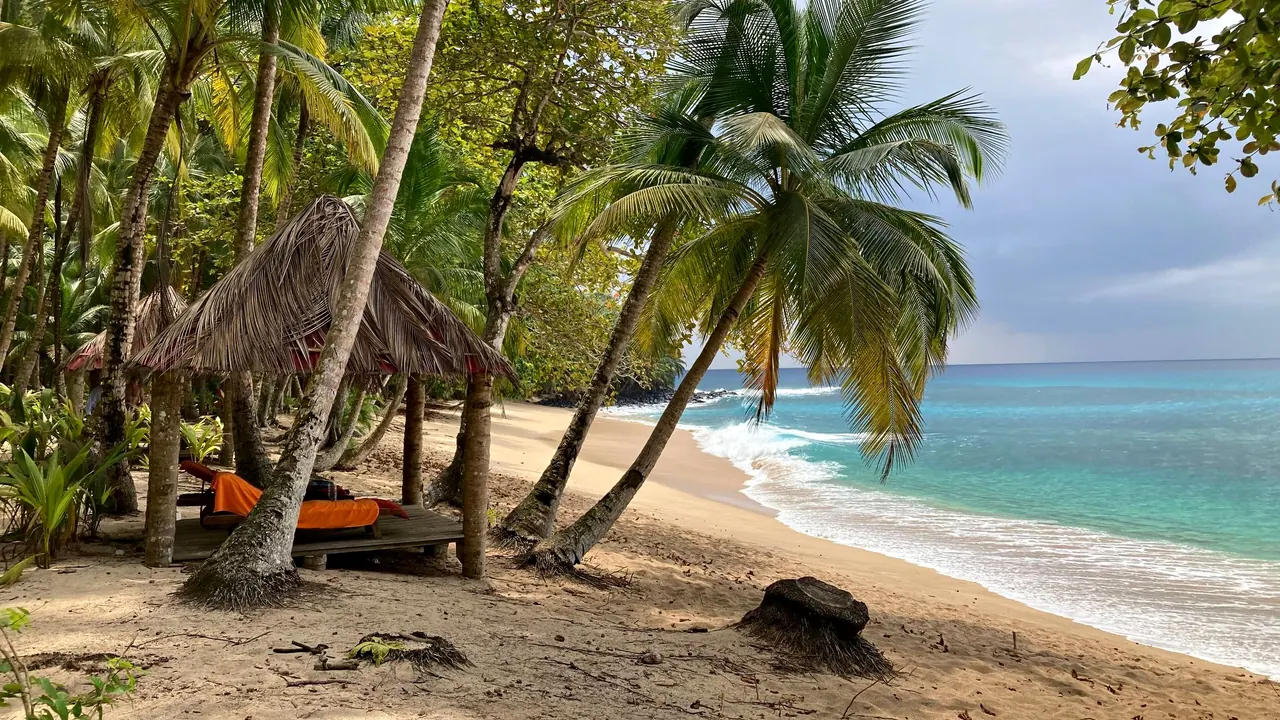
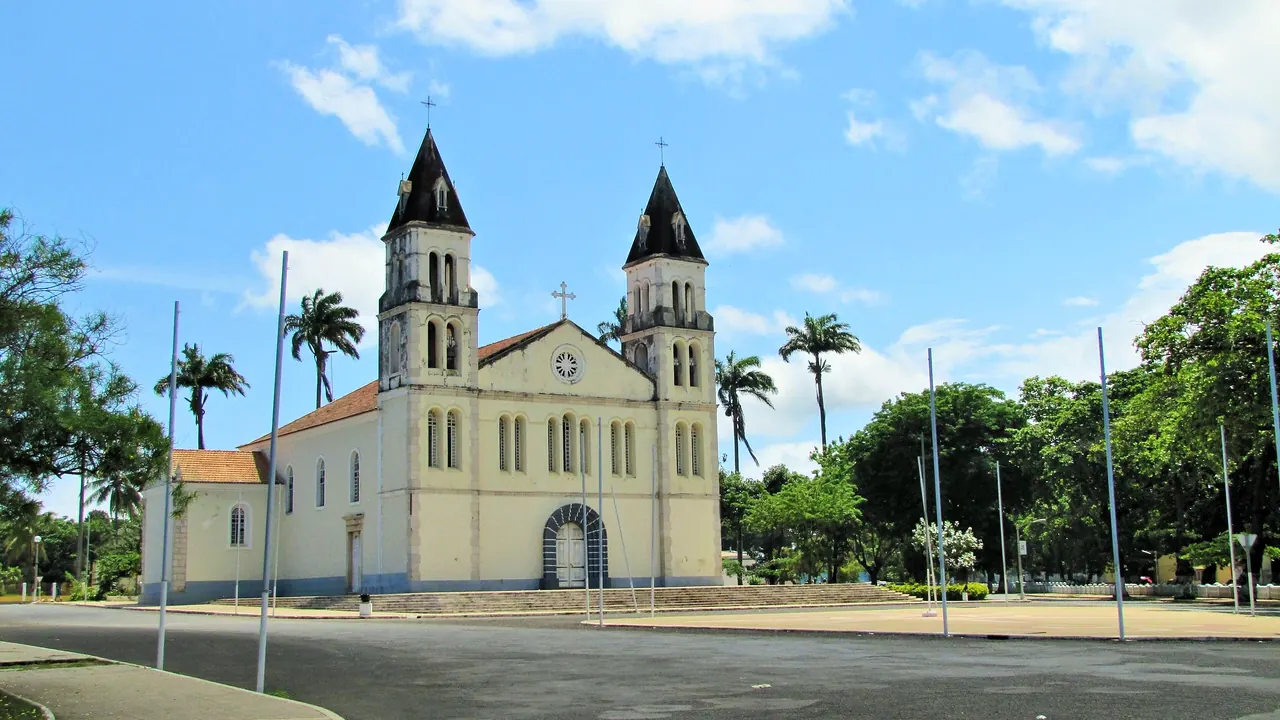
Photos: Príncipe by Josep M. Gracia, CC BY-SA 4.0, cropped; São Tomé by Chuck Moravec, CC BY 2.0, cropped.
Príncipe or São Tomé?
Our verdict in twelve categories, each scored against the same fixed benchmark cities, and the climate month by month, so you can choose for your trip.
Choose Príncipe for
- beaches
- wellness
- nature and the outdoors
Príncipe suits travellers who want the island itself to be the whole trip: empty golden coves where the rainforest meets the sea, the spires of the roadless south, turtles and whales, and a stillness that comes from having almost nothing else to do. It costs more and offers less to eat, see or do after dark, so it is best for couples and nature lovers who are happy to stay in one place and slow right down.
Choose São Tomé for
- day trips
- prices
- food and drink
For more variety and a lower bill, São Tomé is the better choice. It has a small capital with a fort museum and bars along the bay, more Creole cooking, and roça day trips along the east coast and south to the equator. Its beaches are good rather than outstanding, and the best ones are far from town. In return you get a fuller picture of the country and the big mountain walking of Pico de São Tomé.
Scoreboard
Twelve categories on one fixed scale from 0 to 100. The shaded stretch is the gap between the two.
Your match
Pick a travel style or drag the sliders, and both match scores follow your weighting.
Wins on beaches and wellness with your weighting.
Wins on day trips and prices with your weighting.
What matters to you?
Category by category
What the scores mean for a trip.
Beaches & swimming
Príncipe has the finer beaches, and they are close to where you stay. Praia Banana, Praia Macaco and Praia Boi in the north, and the sandbar by the Bom Bom islet, are golden coves with rainforest at the waterline. You reach them by rough track or by boat, and you will rarely share them.
São Tomé's sea is just as warm, and Lagoa Azul north of the capital is good for snorkelling. But the town has little beach of its own, and the postcard sands at Praia Piscina, Praia Jalé and facing Ilhéu das Rolas are a long day out on slow roads, with sand ranging from volcanic grey to gold. Neither island has beach facilities, and both have stretches with strong currents or surf.
Food & drink
São Tomé is the better place to eat, though neither island is worth a trip for the food. The capital has a few seafront restaurants, simple local eating houses and the municipal market, and you can also try palm wine.
Príncipe cooks from the same Creole base of grilled fish, plantain, breadfruit and calulu. But Santo António has only a few simple places, so most meals are taken where you stay. On both islands the highlight is tasting cocoa and coffee on the old estates.
Culture & sights
São Tomé has more to see. The capital has its cathedral, the pink presidential palace and the sixteenth-century Forte de São Sebastião, whose national museum covers the plantation economy, slavery and the 1953 Batepá massacre. The large roças out in the countryside add more.
Príncipe's heritage lies in plantations half swallowed by the forest, such as Roça Belo Monte and Porto Real. At Roça Sundy, Eddington's expedition photographed the 1919 eclipse that helped confirm Einstein's theory. These places are atmospheric, but together with Santo António's few colonial streets they fill only a morning or two.
Nightlife
Neither island is for nights out, but São Tomé at least has some evening life. There are open-air beer bars along the bay, and at weekends a few dance spots play kizomba and zouk until late. On Príncipe an evening means a drink at the resort bar, or a small bar in Santo António on a weekend, and most people go to bed early before a dawn outing.
Nature & outdoors
Both islands are volcanic and covered in forest, and each has its own protected natural park, also called Obô, so the two differ in character rather than quality. Príncipe, which is a UNESCO biosphere reserve as a whole, packs land and sea into a small space. In its roadless south, Pico Papagaio and the Joque rise above the trees, and boats run along the cliffs to the seabird colonies on the Tinhosas islets and out to diving reefs.
São Tomé has the bigger mountain walks. You can hike through cloud forest to the Lagoa Amélia crater, climb Pico de São Tomé at 2,024m over two days, or see the strange volcanic needle of Pico Cão Grande, although the southern sights take hours to reach by road. Both islands have endemic birds, nesting turtles and passing humpback whales, and on both the muddy trails need a guide.
Day trips
São Tomé is far better for days out. Roça Agostinho Neto and Monte Café are close to the capital, and on the east coast São João dos Angolares and Água Izé combine estate ruins with fishing villages. Further south, Porto Alegre looks across to the equator monument on Ilhéu das Rolas.
Príncipe has no towns beyond Santo António, so an outing means a trip into the forest or out to sea rather than a visit somewhere new. From either island the other is a flight away and better as a separate stay.
Good for families
For families the two islands are much alike. Neither has attractions made for children, both have basic medical care, malaria and tiring journeys, and both suit adventurous older children better than toddlers. Príncipe's sheltered coves, turtle hatchlings and whales are a little easier to enjoy once you arrive. Staying on São Tomé saves you the extra small-plane hop that Príncipe requires.
Getting around
Getting about is hard work on both islands, but in different ways. Príncipe is small, so drives are short, but its few roads are rutted, the far beaches can only be reached by boat, and Santo António is only a few minutes' walk from end to end.
São Tomé's capital has yellow taxis and shared taxis. Beyond town you need a driver, a hired four-wheel drive or a tour, and on the slow coast road south a short distance can take most of a day.
Shopping & style
Neither island is a place to shop. São Tomé has slightly more choice: the municipal market, craft stalls with wood carvings and printed cloth, and island chocolate and coffee, which make the best gifts. Príncipe sells the same kinds of things from a few stalls and plantations, so bring everything you need with you.
Affordability
São Tomé is the cheaper of the two. Local food, market produce and shared taxis cost little, and simple guesthouses keep the bill down. The comfortable lodges and plantation houses charge international rates, though, and hired drivers soon add up.
On Príncipe the costs keep adding up: the flight from São Tomé, eco-resorts that hold most of the rooms, and boat trips or guided outings for almost everything worth doing. Staying in a guesthouse near Santo António and arranging your own excursions is the cheaper way to do it.
Live music & performing arts
Each island has one great folk drama and little else. Príncipe's Auto de Floripes takes over the streets of Santo António for days in August, during the feast of São Lourenço, so you can plan a trip around it. São Tomé's masked Tchiloli and the related Danço-Congo are performed at festivals and community events with no set programme, so seeing one is a matter of luck or local contacts.
Wellness & relaxation
On Príncipe it is easier to rest because there is little to pull you away. There are no towns to visit beyond Santo António, and most outings are a slow boat trip or a guided walk, so a stay falls into a rhythm of swimming, reading and early nights without any planning. Neither island has thermal baths or hammams, and on Príncipe the odd resort treatment is a bonus rather than the point.
São Tomé runs on leve-leve, a slow pace that locals treat as a way of life, but a trip there tends to be busier. The roça visits, mountain hikes and long drives south that make it the more varied island also eat into the hours for doing nothing. A few nights in a restored plantation house in the hills bring that calm closer, but massages and treatments are just as hard to find.
When should you go?
Pick your month. The climate figures are measured averages, not a forecast.
Príncipe in July
São Tomé in July
Daytime high, °C
Rainfall in the month, mm
Where the figures come from
Príncipe has no weather station within reach, so its figures come from a gridded climate model rather than a measured record, and read a broad area rather than one spot.
São Tomé has no weather station within reach, so its figures come from a gridded climate model rather than a measured record, and read a broad area rather than one spot.
Temperature and rainfall are climate normals, averaged over the years shown. Príncipe: 2001-2020 normals, NASA POWER reanalysis grid, no weather station within 90 km. São Tomé: 2001-2020 normals, NASA POWER reanalysis grid, no weather station within 90 km.
Both islands are warm all year, with daytime highs of 25°C to 28°C and a sea warm enough to swim in every month. It is never too hot or too cold to walk around, so rain decides the season. Around Santo António, where most visitors to Príncipe stay, the dry spell is short. Only July and August are truly dry, with 40mm or less each, while June and September are still showery. October and November are the wettest months, with more than 220mm each, enough to make the forest trails hard going.
São Tomé's dry gravana is longer and more reliable. It runs from June to September, and August has barely 20mm. From December to May both islands are showery, with a second wet peak in March and April, and Príncipe stays the wetter of the two. The slightly cooler, drier middle of the year is the easiest time for long hikes and beach days on either island.
Which traveller are you?
On a beach and sun trip, Príncipe is the better pick. Golden coves such as Praia Banana and the quiet northern bays lie just below the forest, close to where you stay. São Tomé's best sands are a long, slow drive south of the capital.
On a trip on a tight budget, São Tomé goes further. Shared taxis, market food and simple guesthouses keep daily costs low, and you skip the extra flight to Príncipe, where most rooms are in a few upmarket eco-resorts.
For a relaxing and wellness trip, Príncipe has the deeper quiet. Neither island has a spa culture, but Príncipe has few cars and only a tiny capital, and you hear the forest at night. On São Tomé, real calm depends on choosing a lodge well outside the capital.
Before you go
| Measure | Príncipe | São Tomé |
|---|---|---|
| Official language | Portuguese | Portuguese |
| Currency | Dobra (STN) | Dobra (STN) |
| Sockets | CF220 V, 50 Hz | CF220 V, 50 Hz |
| Driving side | Right | Right |
| Time zone | UTC | UTC |
| Emergency number | 112 | 112 |
| Elevation | - | 137 m |
| Main airport | Principe Airport (PCP)1 non-stop destination | São Tomé International Airport (TMS)5 km from centre6 non-stop destinations |
| Public holidays this year | 8 days | 8 days |
By the numbers
| Measure | Príncipe | São Tomé |
|---|---|---|
| Population | 7,344 | 65,468 |
| People per km² | 54 | 3,851 |
| Museums within 10 km | - | 1 |
| UNESCO World Heritage sites within 50 km | - | 1 |
| Swim season, months above 21 °C | 12 months | 12 months |
Where else could you go?
Every comparison below shares a destination with this one, so you can follow Príncipe or São Tomé somewhere new.
- Librevillevs São Tomé
- Loango National Parkvs Príncipe
- Zanzibarvs São Tomé
- Salvs São Tomé
- Nosy Bevs Príncipe
- La Diguevs Príncipe