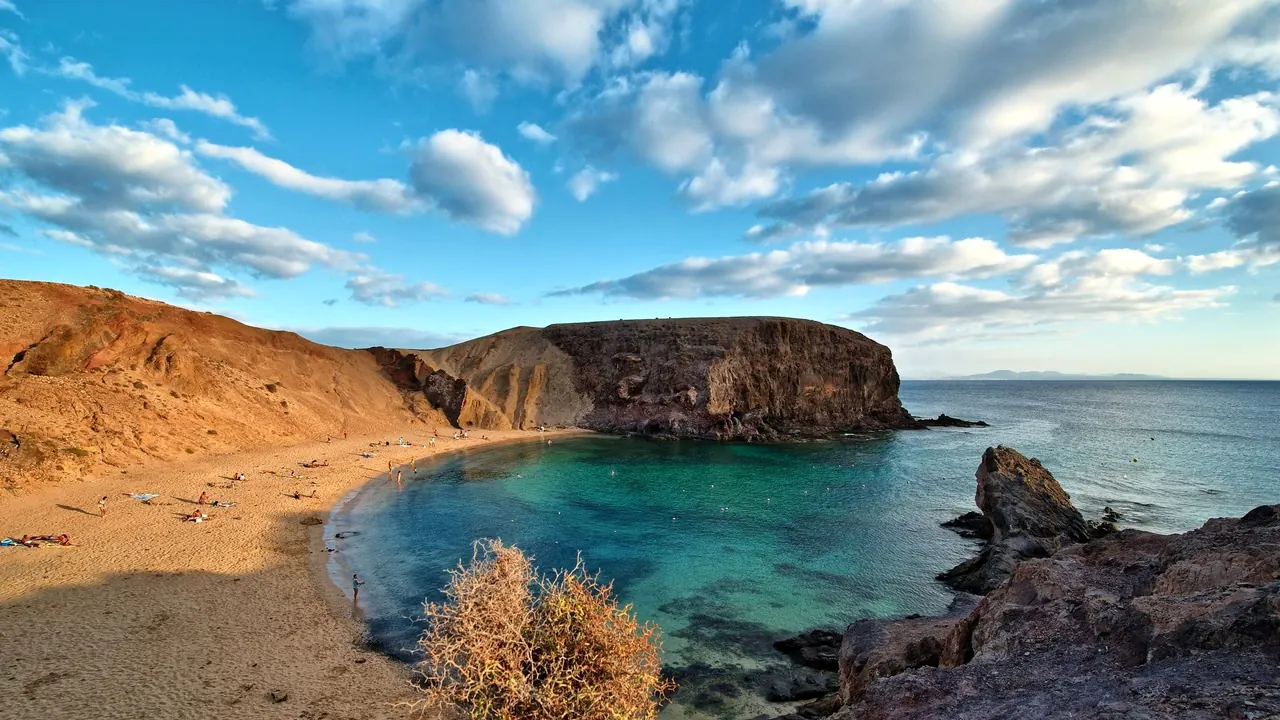
Photos: Lanzarote by Lviatour, CC BY-SA 3.0, cropped.
La Gomera or Lanzarote?
Our verdict in twelve categories, each scored against the same fixed benchmark cities, and the climate month by month, so you can choose for your trip.
Choose La Gomera for
- nature and the outdoors
- prices
La Gomera is the island for walkers and for people who want to drop out of the world for a week. Its cloud-wrapped laurel forest, deep terraced ravines and dense trail network give it the stronger outdoors, and the price is a quiet island with dark, surf-exposed beaches, very little to do after dinner and an extra ferry ride from Tenerife to get there.
Choose Lanzarote for
- families
- nightlife
- getting around
Choose Lanzarote for an easier, more rounded sun trip. It has golden sheltered coves at Papagayo, calm resort beaches that suit children, César Manrique's lava-tube gardens and lookouts to fill the days, and short ferries to La Graciosa and Fuerteventura. Its volcanic landscape is striking but bare, so it suits sightseeing by car and the windy water sports more than long days on foot.
Scoreboard
Twelve categories on one fixed scale from 0 to 100. The shaded stretch is the gap between the two.
Your match
Pick a travel style or drag the sliders, and both match scores follow your weighting.
Wins on nature and the outdoors and prices with your weighting.
Wins on families and nightlife with your weighting.
What matters to you?
Category by category
What the scores mean for a trip.
Beaches & swimming
La Gomera has nothing to set against Lanzarote's golden sand. Its beaches are slivers of dark sand or grey pebbles where the ravines reach the coast, and the swell that rolls in often keeps swimmers on the shore. Around Valle Gran Rey you actually get into the water in the calm corner of La Playa, the rock pool of Charco del Conde or one of the sea pools cut into the rocks.
On Lanzarote the beach is the trip itself. The Papagayo coves east of Playa Blanca have pale golden sand and clear, sheltered water, and Puerto del Carmen's long town beach lets you walk straight in from the promenade. The water is a degree cooler and the trade wind can blow sand about, but this is the island for days spent lying on a beach and swimming.
Food & drink
Both islands cook the same honest Canarian staples, wrinkled potatoes with mojo and grilled fish, but La Gomera's range stops at home cooking. Its own flavours are almogrote, the spicy goat's-cheese spread, and dark palm honey, best found in family places around Valle Gran Rey and Playa de Santiago.
Lanzarote offers more to seek out. The malvasía wine from vines sunk in black ash in La Geria is a reason in itself to visit the bodegas, and fishing villages such as El Golfo and Arrieta serve the day's catch by the sea. Avoid the resort menus, which lean towards international comfort food.
Culture & sights
La Gomera's sights can be done in a day: the Columbus story in San Sebastián, told through the Torre del Conde and the Casa de Colón, plus whitewashed villages such as Agulo. Its most unusual possession is intangible, the whistled language Silbo Gomero.
Lanzarote has much more to visit, almost all of it shaped by César Manrique. Jameos del Agua, the Mirador del Río, his house in volcanic bubbles at Tahíche and the Jardín de Cactus fill several days, and old Teguise and the underwater Museo Atlántico add variety.
Nightlife
On La Gomera, an evening out means watching the sunset from a Valle Gran Rey seafront bar, sometimes to drumming, and then going to bed. Lanzarote is no party island either, but Puerto del Carmen's seafront strip and old harbour have pubs, karaoke and a few late clubs all year, and Arrecife's Charco de San Ginés livens up at weekends.
Nature & outdoors
La Gomera is the greener and better walking island. Garajonay National Park keeps a rare laurel forest hung with moss and often in cloud, and from it terraced ravines fall to the sea beneath volcanic plugs like Roque de Agando. Marked trails cover the whole island, and boats from Valle Gran Rey meet pilot whales and dolphins near the basalt cliffs of Los Órganos.
Lanzarote's nature is stark and dramatic instead: the red and black cones of Timanfaya, the Famara cliffs and the green lagoon at El Golfo. Inside the park you mostly see the lava from a coach, and the island is dry and shadeless. Its outdoor strength lies more in the wind and water, with surfing at Famara, kitesurfing at Costa Teguise and good diving off Playa Blanca.
Day trips
From La Gomera, outings are mostly to the island's own villages, pleasant but small, and the ferry to Tenerife leaves a long day once the drive to La Laguna or Garachico is added. Lanzarote does better: half an hour by boat brings you to car-free La Graciosa or to Corralejo and its dunes on Fuerteventura, and Teguise's Sunday market, Haría and La Geria's wine villages make an easy loop.
Good for families
La Gomera can please active families with dolphin trips, rock pools and easy forest paths, and Playa de Santiago is the gentlest base. But nothing on the island is made for children, beaches are pebbly or surf-exposed, and the mountain roads can upset young passengers.
Lanzarote is built for family vacations. Playa Dorada and Playa Grande have shallow, calm water, the big resorts have pools and kids' clubs, and there is a water park, a small aquarium, camel rides at Timanfaya and glass-bottomed boats to Papagayo. Sun and wind need watching, and Famara is no place to paddle.
Getting around
Reaching La Gomera usually means a flight to Tenerife and then a ferry, and once there the roads twist over the central plateau and in and out of every ravine, so San Sebastián to Valle Gran Rey takes about an hour. Buses are rare and suit point-to-point hikers more than sightseers.
Lanzarote has its own airport and is only about 60km long, with good, quiet roads, so a hire car makes every corner easy. Buses link the airport, Arrecife and the three main resorts well enough, though the interior and the north need a car.
Shopping & style
Neither island is a shopping trip, but Lanzarote gives you more to browse. Teguise's Sunday market fills the old town with stalls, and aloe vera cosmetics, olivine jewellery and Manrique-designed objects make distinctive souvenirs. La Gomera's best buys are edible, palm honey, almogrote and island wine, along with the wheel-less pottery of El Cercado.
Affordability
The two cost much the same overall, but the money goes in different places. On La Gomera, rural houses and apartments are cheaper than on the busier islands and prices hardly change through the year, yet the ferry from Tenerife and car hire weigh on the budget.
Lanzarote is the reverse: package hotels in Puerto del Carmen and Costa Teguise are moderate, and car hire and fuel are cheap, but winter high season pushes rates up and admission to Timanfaya and the Manrique centres adds up over a stay.
Live music & performing arts
La Gomera has no stage at all. Its performance is the baile del tambor danced to drums and chácaras at village fiestas, plus demonstrations of the whistled language. Lanzarote has slightly more, chiefly the occasional classical or jazz concert in the lava-tube auditoriums of Jameos del Agua and Cueva de los Verdes, a setting worth planning around if one falls in your week.
Wellness & relaxation
Both islands are calm places with no bathing tradition, but they slow you down in different ways. La Gomera's relaxation is retreat-style: yoga and meditation houses on Valle Gran Rey's terraces and Atlantic sunsets, with spas limited to a few hotels near Playa de Santiago. Lanzarote is the better pick for treatments, with thalasso pools and saunas in the larger resorts of Playa Blanca and Costa Teguise, while villages such as Haría and Uga offer the quiet.
When should you go?
Pick your month. The climate figures are measured averages, not a forecast.
La Gomera in July
Lanzarote in July
Daytime high, °C
Rainfall in the month, mm
Where the figures come from
La Gomera's temperatures are measured 54 km from the centre, at Tenerife Sur.
La Gomera has no rain gauge within 25 km of the centre, so its rainfall comes from a gridded climate dataset read at the destination rather than from a gauge further away.
Temperature and rainfall are climate normals, averaged over the years shown. La Gomera: 1991-2020 normals, Tenerife Sur (53.5 km from centre). Lanzarote: 1991-2020 normals, Lanzarote / Aeropuerto (7.1 km from centre).
Both islands are mild all year, with winter highs in the low twenties, so neither has a true off-season. The sea is warm enough for a proper swim from June to October. It peaks at about 24°C off La Gomera in early autumn and runs a degree cooler off Lanzarote. In late winter both fall to around 19°C or below, which is bracing rather than warm. Rain falls between October and March on both, but La Gomera is clearly the wetter island, with about 56mm in December. Lanzarote stays drier and gets more sunshine through spring and summer.
Summer is where they part. Lanzarote reaches about 30°C in August, which is hard going on its shadeless lava, so spring and autumn suit sightseeing there better. La Gomera stays a degree or so cooler, its trails can be walked in any month, and spring, after the winter rain, is when they are greenest.
Which traveller are you?
On a family trip with young children, Lanzarote is far easier. Shallow calm beaches such as Playa Dorada, resort pools and kids' clubs, a water park and short drives beat La Gomera's pebbly coves, steep trails and twisting roads.
For a beach and sun trip, Lanzarote also wins. The golden, sheltered Papagayo coves and long town beaches at Puerto del Carmen and Playa Blanca are made for lying and swimming, whereas La Gomera's dark-sand coves often face Atlantic swell.
On an outdoors trip built around walking, La Gomera is the better island. Garajonay's mossy laurel forest, marked paths dropping into green ravines and whale-watching boats beat Lanzarote's bare lava, where Timanfaya is seen mostly from a coach.
Before you go
| Measure | La Gomera | Lanzarote |
|---|---|---|
| Official language | Spanish | Spanish |
| Currency | Euro (EUR) | Euro (EUR) |
| Sockets | CF230 V, 50 Hz | CF230 V, 50 Hz |
| Driving side | Right | Right |
| Time zone | UTC, UTC+1 in summer | UTC, UTC+1 in summer |
| Emergency number | 112 | 112 |
| Main airport | Tenerife Sur Airport (TFS)111 non-stop destinations | César Manrique-Lanzarote Airport (ACE)80 non-stop destinations |
| Public holidays this year | 12 days | 12 days |
By the numbers
| Measure | La Gomera | Lanzarote |
|---|---|---|
| Population | 22,436 | 163,467 |
| People per km² | 61 | 207 |
| Swim season, months above 21 °C | 7 months | 5 months |
Where else could you go?
Every comparison below shares a destination with this one, so you can follow La Gomera or Lanzarote somewhere new.
- Fuerteventuravs Lanzarote
- Tenerifevs La Gomera
- La Palmavs La Gomera
- Gran Canariavs La Gomera
- Gran Canariavs Lanzarote
- Tenerifevs Lanzarote