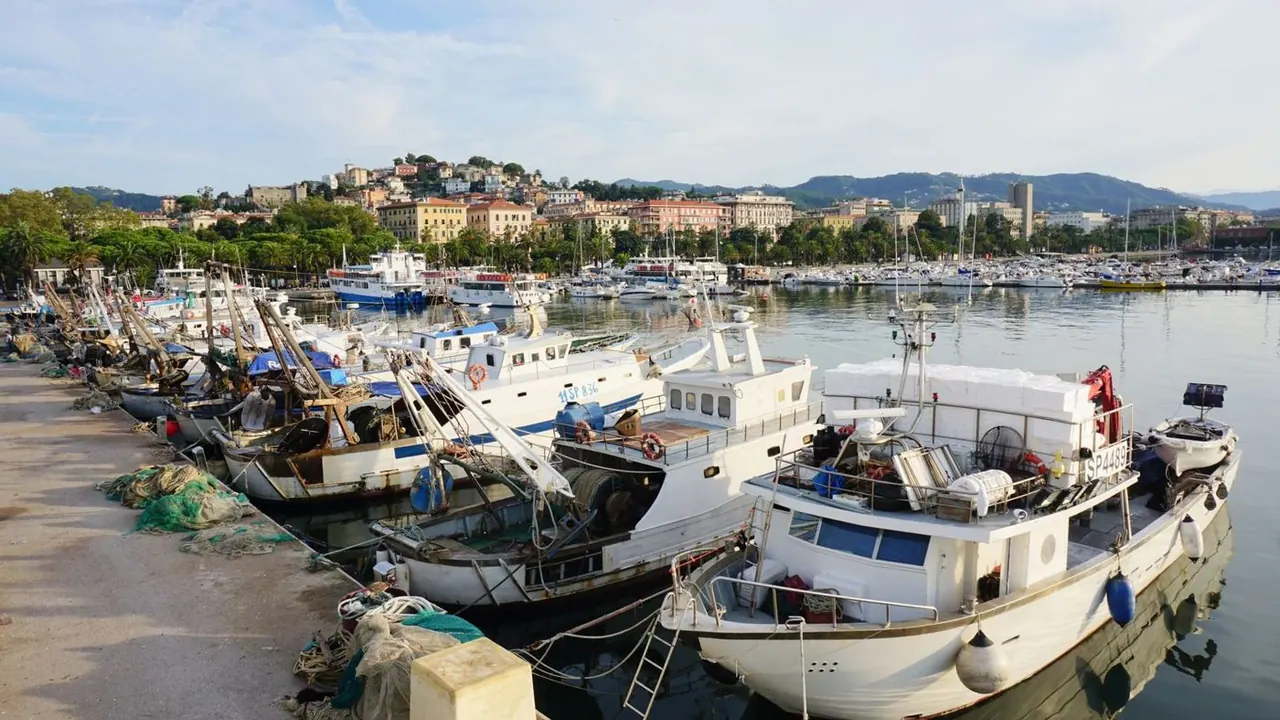
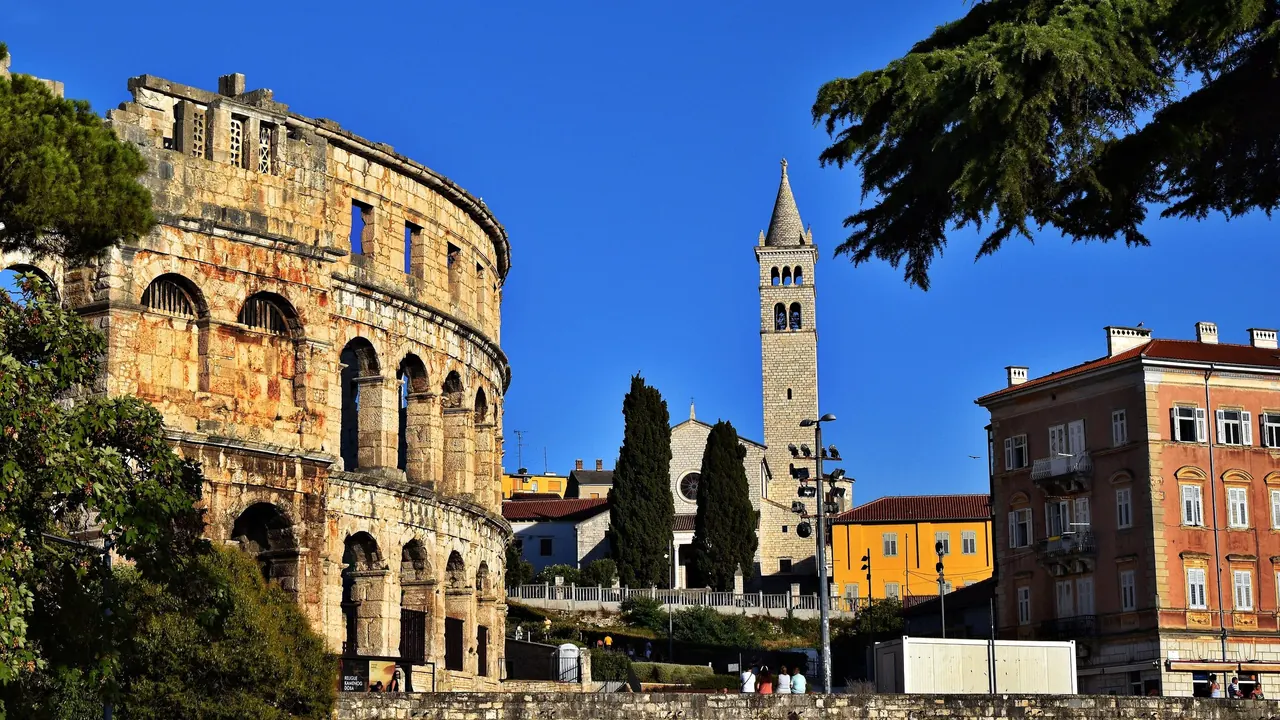
Photos: La Spezia by Irina Balashova, Pexels License; Pula by Miroslav.vajdic, CC BY-SA 4.0, cropped.
La Spezia or Pula?
Our verdict in twelve categories, each scored against the same fixed benchmark cities, and the climate month by month, so you can choose for your trip.
Choose La Spezia for
- getting around
- nature and the outdoors
- day trips
La Spezia is the better pick for walkers and for anyone who wants to explore without a car. The Cinque Terre villages and their cliff paths are minutes away by train, Portovenere and Palmaria are a short boat or bus ride across the gulf, and Pisa and Lucca are easy days out. The town itself has a handful of good museums but not much else to see, so treat it as a practical, well-connected base.
Choose Pula for
- culture and sights
- beaches
- families
Pula has more to offer once you arrive. A complete Roman amphitheatre and a forum temple stand in the middle of town, rocky swimming coves begin just south of the centre, and the shallow bays at Medulin and attractions such as the aquarium make it the easier choice for families. In return you will want a car, because the hill towns, Rovinj and the wild coves of Kamenjak are poorly served by public transport.
Scoreboard
Twelve categories on one fixed scale from 0 to 100. The shaded stretch is the gap between the two.
Your match
Pick a travel style or drag the sliders, and both match scores follow your weighting.
Too close to call, 1 point apart
Wins on getting around and nature and the outdoors with your weighting.
Wins on culture and sights and beaches with your weighting.
What matters to you?
Category by category
What the scores mean for a trip.
Beaches & swimming
Neither town has a sandy beach of its own, but Pula is the better place for swimming. Rocky platforms and pebble coves start on the Verudela and Stoja peninsulas just south of the centre, often with pine shade reaching down to the water. Ten kilometres further on, Cape Kamenjak has dozens of wild inlets. Bring water shoes, because of the sharp rock and sea urchins.
In La Spezia, swimming is always a trip out from a working port. The choices are the small sand and pebble beaches at Lerici and San Terenzo, the clear rocky water at Portovenere and Palmaria, or a train to the long beach at Monterosso. Much of that shore is taken up by paid bathing establishments.
Food & drink
The two are evenly matched, but they reward eating in different places. In La Spezia, the best food is in town and cheap: farinata from wood ovens, mesciua soup, stuffed mussels from the ropes off Portovenere, and crisp Cinque Terre whites with sweet Sciacchetrà to finish. Meals there are also more reliable than in the tourist-heavy villages.
Pula's Istrian cooking is heavier and more rustic, with truffle on fuži pasta, pršut, scampi buzara, Malvazija and Teran. Around the Arena the menus lean towards tourists, though, and the most memorable meals are usually in family taverns out in the hinterland.
Culture & sights
Both towns grew as naval bases, Italy's and Austria-Hungary's. Pula, however, has a far older layer of history on top of that. Its Roman Arena still stands to its full three storeys above the harbour, the Temple of Augustus survives intact on the Forum, and there are Roman gates and mosaics tucked away in the backstreets. The history is part of an ordinary walk through town.
La Spezia's centre is a nineteenth-century grid of arcades and Liberty facades with no medieval core. You go there for what is inside its buildings: the early Italian paintings of the Museo Amedeo Lia and the strange prehistoric stele statues in Castello San Giorgio.
Nightlife
In La Spezia, evenings are built around the aperitivo: a spritz or a glass of Vermentino on Via del Prione, or on the waterfront at Lerici in summer. The town goes quiet soon afterwards, partly because many visitors set off for the trails at dawn.
Pula stays out later in summer, though it is never wild. After drinks around the Forum, people move on to beach bars on Verudela and around Medulin, some of which play music into the night, and a few small clubs fill up at weekends. Out of season, both towns turn in early.
Nature & outdoors
La Spezia has the more dramatic landscape and the more serious walking. Vine terraces drop straight into the sea along the Cinque Terre national park. You can choose between the coastal Sentiero Azzurro and the quieter ridge and sanctuary paths, and the jagged Apuan Alps are about an hour inland.
Pula's country is gentler: low macchia, pine and red earth. It suits cycling, sea kayaking around Kamenjak's islets and windsurfing in Premantura bay better than hiking, and there are dinosaur footprints on the shore. The nearest real mountains, at Učka, are about an hour and a half away.
Day trips
La Spezia is the stronger base for days out, both for the range of places you can reach and for how easy they are to get to. The five Cinque Terre villages are minutes away on the coastal train, and Portovenere is a short boat or bus ride across the gulf. Sarzana, the ruins of Luni, Carrara, Pisa and Lucca can all be done without a car.
Pula has fewer places within easy reach, but they are still well worth the trip. Venetian Rovinj sits on its peninsula, Poreč's basilica has Byzantine mosaics, and the hill towns of Motovun and Hum pair well with truffle and wine estates. Brijuni combines Roman ruins with Tito's safari park. Most of these trips need a hire car, though, and Piran or Trieste is a two-hour drive.
Good for families
Pula has more to keep children busy. There is the aquarium in an Austro-Hungarian fort on Verudela, the Arena's underground passages to explore, shallow bays around Medulin, and a dinosaur park and a large water park within an hour.
La Spezia is safe and easy with a pushchair along the seafront. Its family days are mostly boat trips and the sheltered sand at San Terenzo, and with steep villages and packed summer trains it works better for older children.
Getting around
Both centres are small, flat and easy to walk around, but the gap opens up once you leave town. From La Spezia, coastal trains, gulf buses and seasonal ferries reach almost everywhere you would want to go. A car there is mostly a parking problem, and the only real drawback is the crush on summer trains.
In Pula, city buses reach Verudela and Premantura, and some visitors cycle out to the coves. Beyond that, the slow inland railway and infrequent regional buses mean a car or scooter is close to essential.
Shopping & style
Shopping is no reason to choose either town, and the best purchases in both are things to eat and drink. Take home pesto, Sciacchetrà and Monterosso anchovies from La Spezia, or truffle products, rakija and olive oil bought straight from Istrian producers around Pula. La Spezia's Via del Prione has a few independent boutiques among the chains, while Pula's main old-town street is mostly chains and souvenirs.
Affordability
Both are mid-priced, and both are cheaper out of season, but the extra costs come from different places. Staying in La Spezia costs much less than in the Cinque Terre villages, but national park passes, boat trips and beach clubs add up over a stay.
Pula's private apartments and simple konobas keep the basics reasonable. The cost that builds up there is car hire, which you will need for most day trips, plus tourist-level prices around the Arena.
Live music & performing arts
Pula has the more memorable summer evenings, because the Roman Arena itself becomes the stage for touring concerts, classical galas and the long-running film festival. Outside summer it has the Istrian National Theatre, which mostly performs in Croatian.
La Spezia has the Teatro Civico's season, a long-established summer jazz festival and open-air concerts in castle courtyards around the gulf. For opera you need to go to Genoa or Pisa.
Wellness & relaxation
Neither town has a spa tradition, and the options differ only in kind. La Spezia has the small thermal baths at Equi Terme, about an hour inland, while Pula relies on the spas of the resort hotels on Verudela and in Medulin. Both are restful outside high summer, whether that means a long lunch in Tellaro and a quiet day on Palmaria, or coffee on the Forum and evening walks along the pine-shaded coastal paths.
When should you go?
Pick your month. The climate figures are measured averages, not a forecast.
La Spezia in July
Pula in July
Daytime high, °C
Rainfall in the month, mm
Where the figures come from
La Spezia's temperatures are measured 65 km from the centre, at Pisa / S. Giusto.
La Spezia has no rain gauge within 25 km of the centre, so its rainfall comes from a gridded climate dataset read at the city rather than from a gauge further away.
Pula's temperatures are measured 87 km from the centre, at Trieste.
Pula has no rain gauge within 25 km of the centre, so its rainfall comes from a gridded climate dataset read at the city rather than from a gauge further away.
Temperature and rainfall are climate normals, averaged over the years shown. La Spezia: 1991-2020 normals, Pisa / S. Giusto (64.8 km from centre). Pula: 1991-2020 normals, Trieste (87 km from centre).
The two climates follow a similar pattern. Both are warm enough for the beach from June to September, and in August the sea reaches about 25°C in both places. La Spezia gets a little hotter, with highs around 30°C in July and August, which makes the exposed coastal paths hard going at midday. It also has slightly more sunshine through the summer. For walking, late April to early June and September are the best months in both places.
The biggest difference comes in autumn. La Spezia's rain arrives heavily in October and November, at around 151mm in November, so a late-season hiking trip there is a gamble. Pula's rainfall is more even through the year and peaks at about 107mm in November. On the other hand, Pula's winters are a touch colder, with January highs near 9°C.
Which traveller are you?
On an outdoors trip, La Spezia is clearly better. The terraced Cinque Terre trails, the quieter ridge paths, the loop around Palmaria and the marble peaks of the Apuan Alps give far more serious walking than the low, stony coast around Pula.
For a culture and arts trip, Pula is the better choice. You can walk from the Roman Arena to the Temple of Augustus and through the Arch of the Sergii in minutes. La Spezia's sightseeing comes down to a few good museums.
On a family trip with young children, Pula is the easier choice. There is more for children to do there between beach days, and the swimming suits small children better. La Spezia works better for families once the children are old enough for long walks.
Before you go
| Measure | La Spezia | Pula |
|---|---|---|
| Official language | Italian | Croatian |
| Currency | Euro (EUR) | Euro (EUR) |
| Sockets | CFL230 V, 50 Hz | CF230 V, 50 Hz |
| Driving side | Right | Right |
| Time zone | UTC+1, UTC+2 in summer | UTC+1, UTC+2 in summer |
| Emergency number | 112 | 112 |
| Elevation | 3 m | 5 m |
| Main airport | Pisa International Airport (PSA)65 km from centre82 non-stop destinations | Pula Airport (PUY)7 km from centre34 non-stop destinations |
| Public holidays this year | 13 days | 14 days |
By the numbers
| Measure | La Spezia | Pula |
|---|---|---|
| City population | 92,119 | 52,220 |
| People per km² | 1,792 | 971 |
| Museums within 10 km | 12 | 4 |
| UNESCO World Heritage sites within 50 km | 2 | 1 |
| Swim season, months above 21 °C | 4 months | 4 months |
Where else could you go?
Every comparison below shares a destination with this one, so you can follow La Spezia or Pula somewhere new.