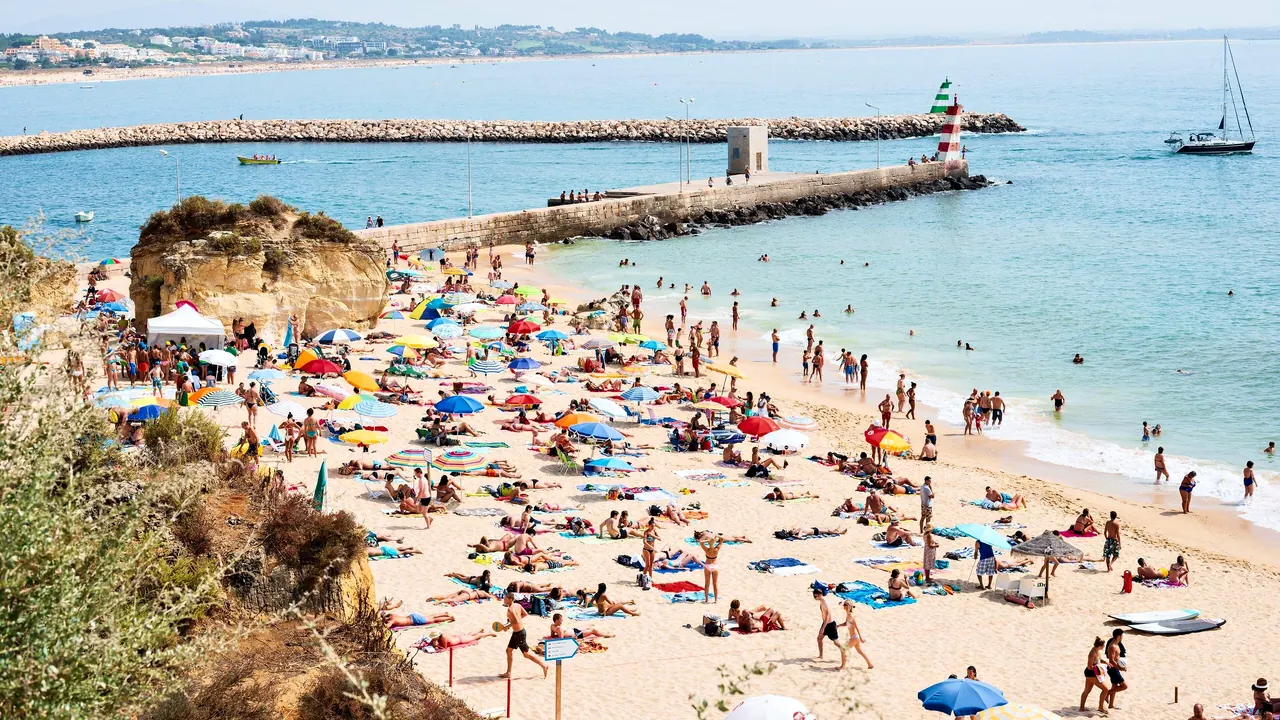
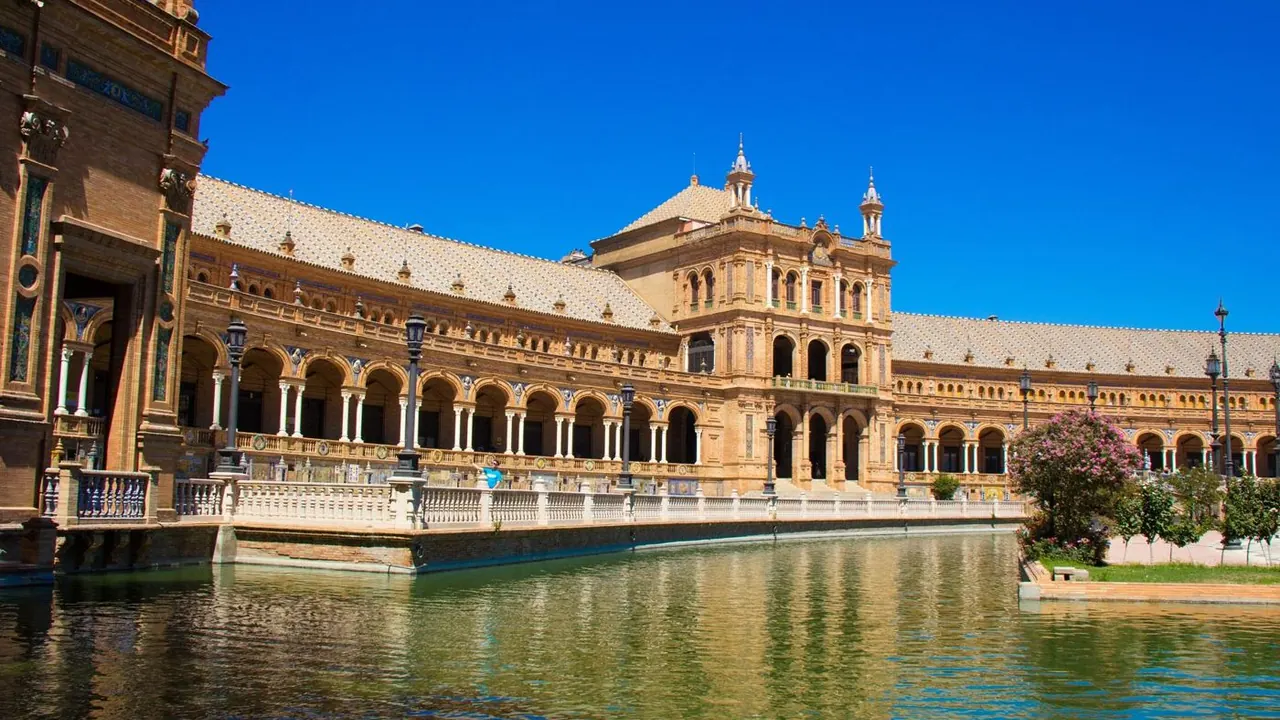
Photos: Lagos, Portugal by Norbert Nagel, CC BY-SA 4.0, cropped; Seville by Tibor Kovacs, CC BY 2.0, cropped.
Lagos, Portugal or Seville?
Our verdict in twelve categories, each scored against the same fixed benchmark cities, and the climate month by month, so you can choose for your trip.
Choose Lagos, Portugal for
- beaches
- nature and the outdoors
- families
Lagos is the choice for a vacation built around the sea. Golden coves below honey-coloured cliffs lie a short walk from the old town, there are kayak trips into the grottoes at Ponta da Piedade, and the wild Costa Vicentina is within easy reach. It suits families, walkers and surfers who want sand and coast paths by day and a relaxed bar town by night. They also need to be content with a historic centre that takes a morning to see.
Choose Seville for
- live music and the arts
- culture and sights
- food and drink
For a city with real depth, Seville wins clearly. The Alcázar, the cathedral and the lanes of Santa Cruz, flamenco every night and evenings spent moving from one tapas counter to the next give it far more to see, eat and hear, and fast trains to Córdoba widen the trip further. What it cannot offer is a beach on the doorstep, and its summer heat is punishing.
Scoreboard
Twelve categories on one fixed scale from 0 to 100. The shaded stretch is the gap between the two.
Your match
Pick a travel style or drag the sliders, and both match scores follow your weighting.
Wins on beaches and nature and the outdoors with your weighting.
Wins on live music and the arts and culture and sights with your weighting.
What matters to you?
Category by category
What the scores mean for a trip.
Beaches & swimming
There is no real contest here. In Lagos the sea is at the end of the streets. Sheltered coves such as Camilo and Pinhão sit beneath the cliffs, the long open sand of Meia Praia lies across the river, and the west coast surf beaches are half an hour away.
Seville is inland, so the sea means a trip to the Huelva coast at Matalascañas or Mazagón, well over an hour by road. A beach day is perfectly possible and the water is pleasant in summer, but in the city itself, swimming means a hotel rooftop or a municipal pool.
Food & drink
Seville is the better place to eat. Tapas are a way of life there. You stand at tile-fronted counters in Triana or El Arenal and work through salmorejo, pork cheek and fried fish with a fino or manzanilla, which makes every evening a meal worth planning.
Lagos is simpler and narrower. Grilled sardines and octopus, cataplana and the catch at the riverside market are very good. But the photo-menu restaurants of the old town pull the average down, and the best meals take some finding in the family places and harbour fish restaurants.
Culture & sights
Here Seville is far ahead. The Real Alcázar, the cathedral with the Giralda and the Archivo de Indias together make one of Europe's great clusters of monuments. Casa de Pilatos, Plaza de España and the Museo de Bellas Artes add several more days.
Lagos has a story of its own as a base for the fifteenth-century voyages along the African coast. It is told through its walls, the harbour fort, the gilded interior of Santo António and the slave market museum, but all of it fits into a morning.
Nightlife
Seville has the fuller evening. Dinner starts at ten, and the night then moves on to the terraces of Triana, the mixed and LGBT-friendly bars of the Alameda de Hércules and, in summer, the bars along the river. It is a local scene that runs all year. Neither city is built for serious clubbing.
Lagos is younger and rowdier in summer. It is a bar town of backpackers, surfers and pub crawls, with a few small clubs open until near dawn, but it goes quiet from November to March.
Nature & outdoors
Lagos puts the outdoors at the edge of town. From the walls you can walk out along the clifftops towards Luz and Burgau, with the sea below you all the way. Boats leave the harbour to look for dolphins, and the Alvor estuary just east of town is a quiet place for watching wading birds. Summer gets hot and dusty once you leave the shore, so spring and autumn are the seasons for long walks.
Seville's outdoor life in town is mostly along the river. You can cycle the riverside paths or row and kayak on the old channel of the Guadalquivir, and María Luisa Park has shade. For wilder country you need a full day out, either a guided 4x4 trip into the Doñana wetlands to see flamingos and migrating birds or an easy hike in the cork-oak hills of the Sierra Norte.
Day trips
Seville is much the better base. Córdoba and its Great Mosque are under an hour away by high-speed train, and Jerez and Cádiz are easy by rail. Carmona, Itálica and the white villages fill further days.
From Lagos, the best outing is to Sagres and Cape St Vincent at the south-western tip of Europe, with Silves's Moorish castle and Tavira for longer days. It is a pleasant list, but you need a car, and many visitors simply move from beach to beach instead.
Good for families
Lagos is the easier family choice, mainly because the vacation can be built around the sand. Meia Praia shelves gently and has room to spread out, and children enjoy the boat trips to the grottoes. The cliff coves mean steep stairways, though, and the cobbles are hard work with a pushchair.
Seville has a flat centre, rowing boats at Plaza de España, the maze in the Alcázar gardens, and a theme park and water park on La Cartuja. Its summer heat, which often passes 40°C, is the real problem, so it works best for families in spring or autumn.
Getting around
Both centres are walkable, but Seville's is flat while some of Lagos's cobbled lanes are steep. Seville also has a tram, a metro line, buses and a bike-share scheme on a wide network of lanes, plus fast trains for days out. Only the midday summer heat gets in the way.
Lagos is easy within town, and a footbridge crosses to Meia Praia. Beyond it, though, the trains are slow and the buses infrequent, so most visitors hire a car for the west coast or the hills.
Shopping & style
Seville has more to buy, and much of it is the real thing. There are tiles and ceramics from the Triana workshops, and flamenco dresses, mantillas and fans on Calle Sierpes and Calle Cuna, made for locals preparing for the Fair. Add the high-street chains and the Thursday market on Calle Feria.
In Lagos, shopping is browsing on the way to dinner: painted ceramics, cork goods, sardine tins and surf gear, with honey and medronho at the market. Neither city has much luxury shopping.
Affordability
Overall the two cost much the same, with Seville a little cheaper day to day, mostly because tapas evenings and a walkable centre keep spending down. Its hotel rates climb steeply during Holy Week and the April Fair but are good value in the summer heat.
Lagos works the other way round. July and August are its expensive months, with resort prices on the main streets, while rooms are much cheaper from October to May. Its beaches are free all year.
Live music & performing arts
Seville is the home of flamenco. There are performances every night in tablaos, cultural centres and local peñas, and the Bienal de Flamenco is held in autumn of even-numbered years. The Teatro de la Maestranza adds opera and the city's symphony orchestra, fitting for the city where Carmen and The Barber of Seville are set.
Lagos offers fado and guitar evenings for visitors, cover bands in the bars and a modest programme at its cultural centre. For serious concerts you have to go to Faro or Lisbon.
Wellness & relaxation
Neither city is a spa destination, and in both the real luxury is the slow pace, though it takes different forms. Lagos offers sea air, sunset walks on the cliffs and a scattering of yoga and surf retreats around Luz and the west coast. The thermal springs of Caldas de Monchique, used since Roman times, are an hour inland.
Seville's version is urban: Arab-style baths in old mansions, cool tiled courtyards and the Alcázar gardens during the afternoon lull. For rest, both are best outside their busiest times, August in Lagos and Holy Week and the Fair in Seville.
When should you go?
Pick your month. The climate figures are measured averages, not a forecast.
Lagos, Portugal in July
Seville in July
Daytime high, °C
Rainfall in the month, mm
Where the figures come from
Lagos, Portugal's temperatures are measured 63 km from the centre, at Faro / Aeroporto.
Lagos, Portugal has no rain gauge within 25 km of the centre, so its rainfall comes from a gridded climate dataset read at the city rather than from a gauge further away.
Temperature and rainfall are climate normals, averaged over the years shown. Lagos, Portugal: 1991-2020 normals, Faro / Aeroporto (63.4 km from centre). Seville: 1991-2020 (sunshine 1981-2010, rainfall 1981-2010) normals, Sevilla / San Pablo (8.1 km from centre).
Lagos is a summer beach town. From June to September the days are in the high twenties, reaching 29°C in July and August, and they are almost completely dry and very sunny. The Atlantic is never warm, peaking around 20°C, so a swim is refreshing rather than balmy. Spring and early autumn are mild and ideal for cliff walks. The rain returns in October, and November and December are the wettest, greyest months.
Seville runs on a different calendar. July and August reach 36°C, far too hot for walking the streets in the middle of the day, while Lagos stays comfortable by the sea. The city is at its best from March to May and again in October, when afternoons are warm but pleasant. Both have mild winters, but Seville's November is the wettest month in either city, with around 122mm of rain.
Which traveller are you?
On a beach and sun trip, Lagos is the obvious pick. The coves at Camilo and Dona Ana are a walk from the old town and Meia Praia offers 4km of open sand. From Seville, the nearest beach is more than an hour away by road.
For a culture and arts trip, Seville is in another league. The Alcázar, the cathedral and Giralda, Murillo at the Bellas Artes and flamenco every night could fill a week. Lagos has a morning's worth of old walls, a gilded church and one museum.
On an outdoors trip, Lagos has the stronger hand: kayaking under the arches of Ponta da Piedade, the Fishermen's Trail on the Costa Vicentina, surf schools all year and the Monchique hills. Seville's countryside is flat farmland, and Doñana is its one great prize.
Before you go
| Measure | Lagos, Portugal | Seville |
|---|---|---|
| Official language | Portuguese | Spanish |
| Currency | Euro (EUR) | Euro (EUR) |
| Sockets | CF230 V, 50 Hz | CF230 V, 50 Hz |
| Driving side | Right | Right |
| Time zone | UTC, UTC+1 in summer | UTC+1, UTC+2 in summer |
| Emergency number | 112 | 112 |
| Elevation | 3 m | 18 m |
| Main airport | Faro - Gago Coutinho International Airport (FAO)63 km from centre91 non-stop destinations | Seville Airport (SVQ)9 km from centre96 non-stop destinations |
| Public holidays this year | 14 days | 12 days |
By the numbers
| Measure | Lagos, Portugal | Seville |
|---|---|---|
| City population | 31,049 | 689,423 |
| People per km² | 146 | 4,896 |
| Museums within 10 km | 6 | 24 |
| UNESCO World Heritage sites within 50 km | 0 | 1 |
| Swim season, months above 21 °C | None | - |
Where else could you go?
Every comparison below shares a destination with this one, so you can follow Lagos, Portugal or Seville somewhere new.
- Albufeiravs Lagos, Portugal
- Farovs Lagos, Portugal
- Jerez de la Fronteravs Seville
- Cadizvs Seville
- Rondavs Seville
- Cordobavs Seville