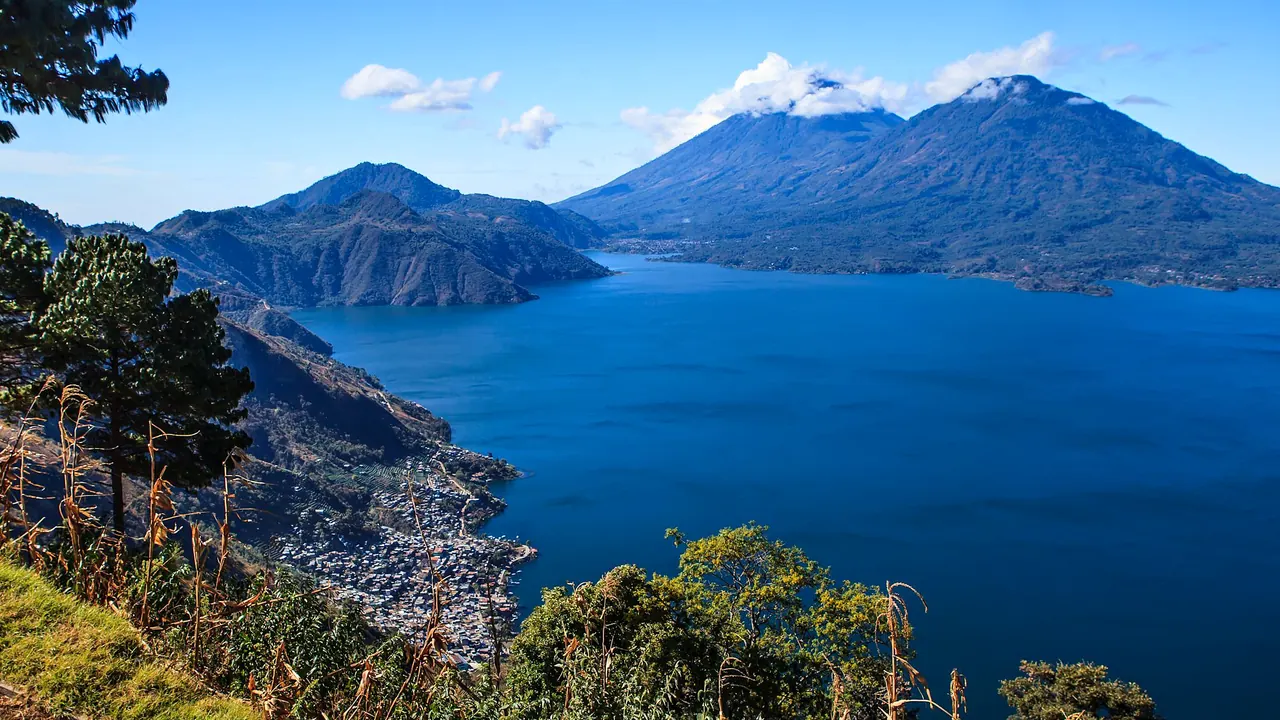
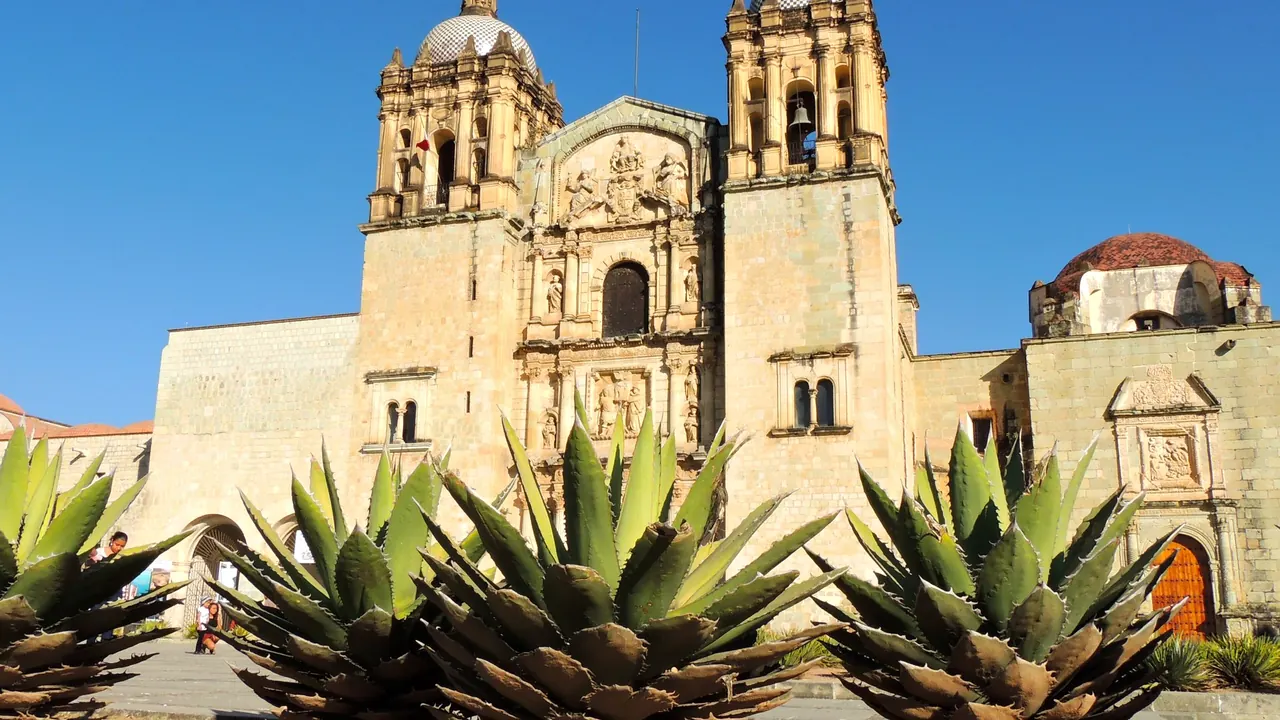
Photos: Lake Atitlan by Murray Foubister, CC BY-SA 2.0, cropped; Oaxaca by Öskr Rck, CC BY-SA 3.0, cropped.
Lake Atitlan or Oaxaca?
Our verdict in twelve categories, each scored against the same fixed benchmark cities, and the climate month by month, so you can choose for your trip.
Choose Lake Atitlan for
- beaches
- nature and the outdoors
- wellness
Lake Atitlan suits travellers who come for landscape and a slower pace rather than for sights. The three volcanoes rising from the far shore, the dawn hikes, the boats between Maya villages and the yoga retreats of San Marcos make it a place to settle for a week or more. It is best for walkers, long-stayers and anyone who wants quiet, as long as they can accept steep steps, early nights and simple food.
Choose Oaxaca for
- food and drink
- culture and sights
- live music and the arts
If you travel to eat and to look around, pick Oaxaca. Its markets, moles and mezcal put it among the best places to eat in Mexico. The colonial centre, Santo Domingo and Monte Albán give it the monuments and museums the lake does not have. It is also the easier base: you can walk the centre, the evenings are more sociable, and craft villages and ruins are an hour or less away.
Scoreboard
Twelve categories on one fixed scale from 0 to 100. The shaded stretch is the gap between the two.
Your match
Pick a travel style or drag the sliders, and both match scores follow your weighting.
Wins on beaches and nature and the outdoors with your weighting.
Wins on food and drink and culture and sights with your weighting.
What matters to you?
Category by category
What the scores mean for a trip.
Beaches & swimming
Neither place has a beach, but the lake at least gives you a swim. You jump from wooden docks or the cliff platform at San Marcos into cool water, which is clearest away from Panajachel and San Pedro. Oaxaca has only hotel pools. Its Pacific coast at Puerto Escondido or Huatulco is several hours away and works best as a separate part of the trip.
Food & drink
Food is where Oaxaca pulls furthest ahead. It has several kinds of mole, tlayudas crisped over charcoal, the grill aisle of the 20 de Noviembre market, mezcal from village distilleries and morning hot chocolate. A group of chefs also cooks tasting menus from heirloom maize.
At Lake Atitlan the good eating is simpler. You get black beans, pepián and lake fish in the comedors of Santiago and San Pedro, and vegetarian traveller cafés in Panajachel and San Marcos. Its strongest point is coffee, with farm and roasting visits run by cooperatives around San Juan.
Culture & sights
The lake's culture is the living kind. In the Tz'utujil and Kaqchikel villages each town has its own weaving, and in Santiago Atitlán you can visit Maximón with his religious brotherhood. Museums are few, and two days covers the main stops.
Oaxaca offers far more to see. Its colonial centre in green stone is listed by UNESCO. Santo Domingo has its gilded interior and the Monte Albán gold in the museum next door, and there are the Tamayo and Textile museums and a long tradition of printmaking. Monte Albán itself is twenty minutes away.
Nightlife
Neither place is for clubbing, but Oaxaca gives you the better evening. Its mezcal tasting bars in the centre and Jalatlaco, the rooftops facing Santo Domingo and the odd salsa night suit a long dinner followed by good drinks. At the lake, going out mostly means the backpacker bars and weekend parties of San Pedro, and the other villages are quiet once the boats stop.
Nature & outdoors
Lake Atitlan is the stronger choice for scenery and the outdoors. The lake fills a volcanic caldera beneath three cones over 3,000m high. You can climb Indian Nose for sunrise, take on San Pedro volcano in half a day, walk the paths between villages and paddle in the calm early mornings.
Oaxaca's best walking takes more effort to reach. The Sierra Norte, where the Pueblos Mancomunados run trails and cabins through cloud forest, is about an hour and a half away. Hierve el Agua's stone waterfalls make a half-day out, and closer to the city you are among dry valleys and agave fields.
Day trips
Oaxaca has the more varied choice of outings, nearly all within an hour. You can follow the road east past the Tule cypress, the weavers of Teotitlán and the mezcal pits of Matatlán to the stone fretwork of Mitla. For a longer day, the Mixteca Alta monasteries are about two hours away.
At the lake, the best outings are on the water: boats let you see two or three villages in a day, including the painted houses of Santa Catarina Palopó. The main trip by road is to Chichicastenango's twice-weekly market, with Iximché as a quieter ruin.
Good for families
Oaxaca is the easier choice with children, though neither is built for them. Pedestrian streets, balloon sellers in the zócalo and workshops for painting alebrijes or making chocolate keep older children busy. However, there are no zoos or theme parks, and the ruins have little shade.
The lake works for adventurous older children, with boat rides, zip lines and hanging bridges near Panajachel. With small children, the steep steps up from the docks, choppy afternoon crossings and care with food and water make it hard work.
Getting around
Oaxaca is simpler to get around. Most of what you want lies within a twenty-minute walk of the zócalo, and cheap taxis, colectivos and day drivers cover the valley.
At the lake you move by boat. The public launches are easy to use but stop early in the evening and are best taken before the afternoon wind. Many hotels have no road access, and getting there from Guatemala City or Antigua takes about three hours on winding mountain roads.
Shopping & style
Both are places to buy crafts rather than fashion, but Oaxaca has the wider and better choice. In the centre, galleries sell textiles, black barro negro pottery, alebrijes and modern design, and the villages sell straight from the workshop: rugs in Teotitlán, carving in Arrazola, and the weekly market at Tlacolula.
At the lake, the buy worth making is weaving from the natural-dye cooperatives of San Juan or Santiago's embroidered birds. The stalls on Panajachel's Calle Santander are long, but much of the stock repeats.
Affordability
Both are cheap, and what differs is where the money goes. At the lake, budget rooms in San Pedro, comedor meals and public boats cost very little, but private boats, guided volcano climbs, shuttles and the boutique lodges add up.
In Oaxaca, market food, fondas and colectivos are cheap. The costs rise with colonial boutique hotels, tasting menus and rooms during Guelaguetza and the Day of the Dead.
Live music & performing arts
Oaxaca has far more to watch. The Guelaguetza each July brings dances from every region of the state, and the Day of the Dead fills the streets with comparsas. On ordinary evenings, the state band plays in the zócalo and the Teatro Macedonio Alcalá stages concerts and dance. At the lake there are open-mic nights in San Pedro and San Marcos, and the village saint's days and Holy Week processions in Santiago Atitlán.
Wellness & relaxation
The lake is the place to go if you want to slow down. San Marcos has yoga shalas, silent retreats and courses that run for weeks, and Tzununa has retreat lodges in gardens above the water. The scene leans spiritual rather than towards spa pampering.
Both places share the Maya and Zapotec tradition of the temazcal steam hut. In Oaxaca it often comes as a ceremony led by a healer in the valley villages, alongside small spas, shaded courtyards and slow mornings, though festival weeks are anything but quiet.
When should you go?
Pick your month. The climate figures are measured averages, not a forecast.
Lake Atitlan in July
Oaxaca in July
Daytime high, °C
Rainfall in the month, mm
Where the figures come from
Lake Atitlan's temperatures are measured 71 km from the centre, at Guatemala Aeropuertola Aurora.
Lake Atitlan has no rain gauge within 25 km of the centre, so its rainfall comes from a gridded climate dataset read at the destination rather than from a gauge further away.
Temperature and rainfall are climate normals, averaged over the years shown. Lake Atitlan: 1998-2020 (rainfall 1991-2020) normals, Guatemala Aeropuertola Aurora (71.4 km from centre). Oaxaca: 1961-1990 (rainfall 1991-2020) normals, Oaxaca, Oax. (1.1 km from centre).
Both destinations are at their best from November to April, when the skies are dry and clear. Around Lake Atitlan the days stay mild all year, with highs in the mid-20s, so walking is never too hot. From May the rains are heavy, and June and September bring around 470mm, which makes trails muddy and hides the volcanoes. Neither place is a beach destination in any month, so plan around dry weather rather than heat.
Oaxaca is warmer and much drier. Spring is the hot spell, with April reaching 33°C, so walk the streets and ruins in the morning in March to May. The summer rains from June to September are far lighter than at the lake, around 150mm a month, and there is still a fair amount of sunshine. November to February is the most comfortable stretch, sunny and warm without the spring heat.
Which traveller are you?
On a food and nightlife trip, Oaxaca is the clear choice. Moles, tlayudas grilled over charcoal, huge markets and serious chefs make every meal worth planning, and the evenings carry on in mezcal bars and on rooftop terraces, while the lake offers comedors and backpacker bars.
For an outdoors trip, choose Lake Atitlan. The volcanoes, the Indian Nose sunrise climb, the trails between villages and the early-morning kayaking all start from your door. In Oaxaca the best walking is in the Sierra Norte, a drive away.
On a relaxing and wellness trip, Lake Atitlan has more to offer. San Marcos is a village built around yoga, meditation and retreats that run for weeks, with garden lodges on the north shore. Oaxaca offers temazcal ceremonies and slow courtyards, but its festivals can be loud.
Before you go
| Measure | Lake Atitlan | Oaxaca |
|---|---|---|
| Official language | Spanish | Spanish, Nahuatl, Yucatec Maya |
| Currency | Quetzal (GTQ) | Mexican Peso (MXN) |
| Sockets | AB120 V, 60 Hz | AB127 V, 60 Hz |
| Driving side | Right | Right |
| Time zone | UTC-6 | UTC-6 |
| Emergency number | Police 110/120, ambulance 128, fire 123 | 911 |
| Elevation | - | 1,555 m |
| Main airport | La Aurora International Airport (GUA)19 non-stop destinations | Xoxocotlán International Airport (OAX)7 km from centre15 non-stop destinations |
| Public holidays this year | 13 days | 9 days |
By the numbers
| Measure | Lake Atitlan | Oaxaca |
|---|---|---|
| Population | - | 258,913 |
| People per km² | - | 3,028 |
| Museums within 10 km | - | 10 |
| UNESCO World Heritage sites within 50 km | - | 2 |
Where else could you go?
Every comparison below shares a destination with this one, so you can follow Lake Atitlan or Oaxaca somewhere new.
- Puerto Escondidovs Oaxaca
- Huatulcovs Oaxaca
- Pueblavs Oaxaca
- Acapulcovs Oaxaca
- Mexico Cityvs Oaxaca
- Caye Caulkervs Lake Atitlan