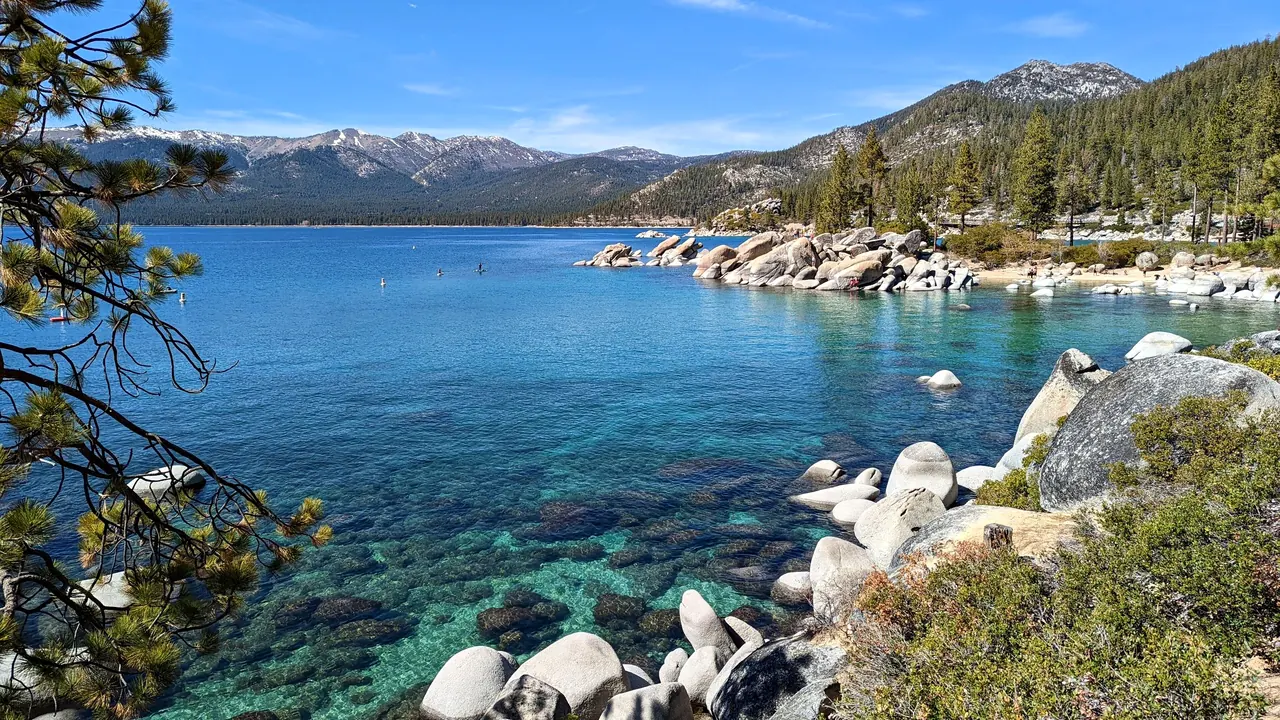
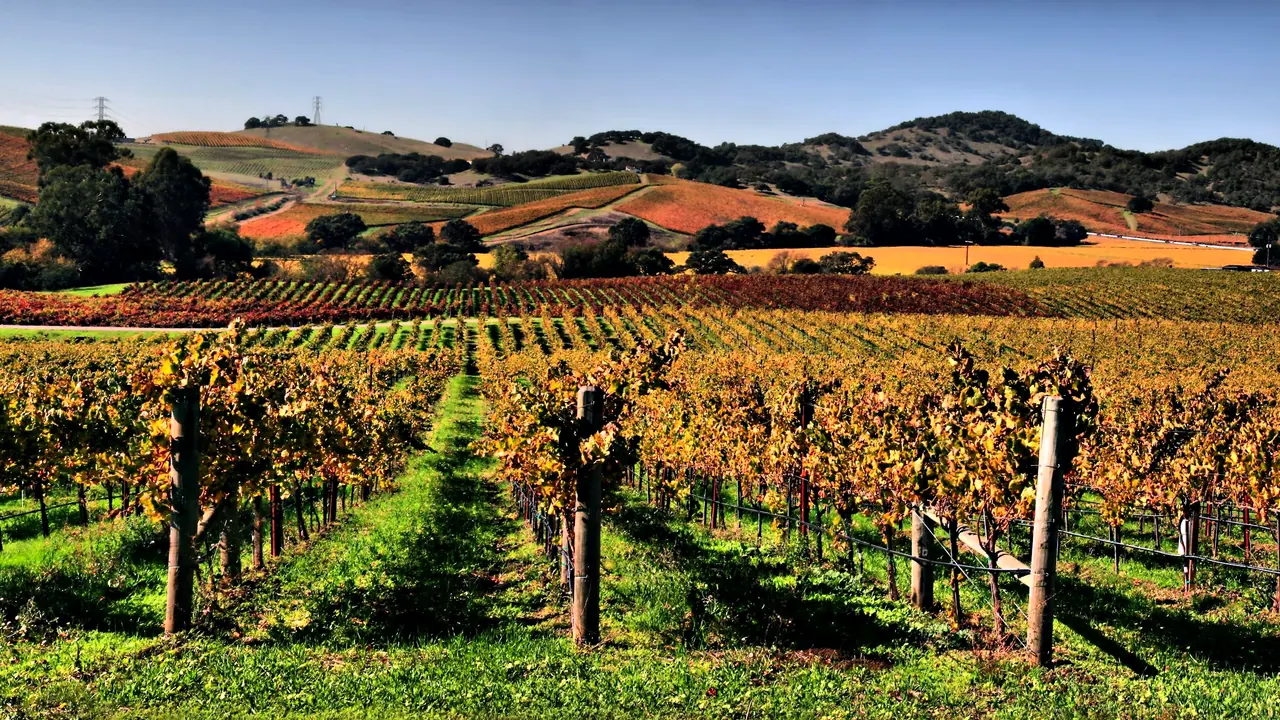
Photos: Lake Tahoe by Blake Everett Carroll, CC BY-SA 4.0, cropped; Napa Valley by Brocken Inaglory, CC BY-SA 3.0, cropped.
Lake Tahoe or Napa Valley?
Our verdict in twelve categories, each scored against the same fixed benchmark cities, and the climate month by month, so you can choose for your trip.
Choose Lake Tahoe for
- beaches
- nature and the outdoors
- families
Lake Tahoe suits travellers who want to be active outdoors. In summer the granite peaks, the Desolation Wilderness and the Rim Trail give you hiking, paddling and cold-water swims, and in winter a dozen ski areas take over. Families do well here too, with sandy shallows on the north and south shores and ski schools at every resort. In return you give up good food and any real sense of indulgence.
Choose Napa Valley for
- food and drink
- wellness
- day trips
For a slower, more grown-up trip built around eating and drinking, Napa Valley is the clear winner. Its wineries, Yountville's fine dining and Calistoga's mud baths and mineral pools make it a place to eat, drink and unwind rather than tire yourself out, and San Francisco and Sonoma are close enough for a day out. It is the more expensive of the two, has almost no swimming and suits couples far better than children.
Scoreboard
Twelve categories on one fixed scale from 0 to 100. The shaded stretch is the gap between the two.
Your match
Pick a travel style or drag the sliders, and both match scores follow your weighting.
Too close to call, 2 points apart
Wins on beaches and nature and the outdoors with your weighting.
Wins on food and drink and wellness with your weighting.
What matters to you?
Category by category
What the scores mean for a trip.
Beaches & swimming
Tahoe has real swimming and Napa does not. The clear water, the granite coves at Sand Harbor and the long sandy beaches on the south shore make a summer day by the lake the heart of a visit. The catch is that the alpine water stays cold, and the season runs only from July to early September.
Napa is inland, so a swim means the hotel pool or a drive over the eastern hills to Lake Berryessa, a reservoir that warms up well in summer but has nothing like Tahoe's beaches. The Pacific on the Sonoma coast is too cold and rough for swimming.
Food & drink
Tahoe eats like a resort, with grills, pizza and breakfast diners. The better kitchens are in Truckee, Tahoe City and Incline Village, and the best moments are a sunset drink on a lakeside deck rather than any meal worth travelling for.
In Napa Valley, eating and drinking are the whole point of the trip. Wineries range from the grand estates on Highway 29 to small cellars on Spring Mountain, Yountville has a concentration of fine dining that few places can match, and the public market in downtown Napa covers casual eating. The one thing it lacks is cheap, everyday food.
Culture & sights
Neither is a sightseeing destination, and a day or two covers the highlights of each. Tahoe's history is in its lakeside summer estates, Vikingsholm on Emerald Bay and the Tallac Historic Site, along with the story of the Donner emigrant party near Truckee.
Napa's heritage is bound up with wine: nineteenth-century stone cellars, the old Greystone cellars in St. Helena, the Victorian buildings of downtown Napa and the Bale Grist Mill, all easy to fit in between tastings.
Nightlife
Tahoe has more going on after dark, almost all of it at Stateline. There the Nevada casino hotels keep their gaming floors and lounges open very late, and South Lake Tahoe adds sports bars. Elsewhere it is après-ski in winter or a beer on a lakeside deck in summer.
In Napa, evenings end with dinner. A few wine bars and taprooms along the river in downtown Napa are the whole scene, and the up-valley towns go quiet once the restaurants close.
Nature & outdoors
This is Tahoe's great strength. A huge, clear lake ringed by Sierra Nevada granite, Emerald Bay, the Desolation Wilderness and the Tahoe Rim Trail give serious hiking, biking and paddling in summer. In winter a dozen ski areas, including the valley that hosted the 1960 Olympics, make it just as good.
Napa's landscape is farmland rather than wilderness: vineyards between oak-covered ranges that turn gold in autumn and fill with yellow mustard in late winter. A dawn balloon flight, cycling the Silverado Trail and the climb up Mount St. Helena are all pleasant, but they are gentler and less dramatic than Tahoe.
Day trips
From Tahoe, day trips mean slow mountain highways down from the lake. To the east are Virginia City, with its wooden sidewalks, and Reno. To the west are the Gold Rush towns of Coloma and Placerville. Each makes a good day, but the list runs out quickly.
Napa Valley has the better choice, above all San Francisco, about an hour and a half away and partly reachable by ferry. Sonoma, Healdsburg and Berkeley are also close, although apart from the city many outings are simply another valley of vineyards.
Good for families
Tahoe is the better choice for families. It is a classic outdoor vacation of sandy shallows at Kings Beach and Commons Beach, bike paths and glass-bottom boat trips, with ski schools and sledding hills in winter. Cabins with kitchens make it practical, though little is built specifically for children.
Napa is designed for adults, with days in tasting rooms and many resorts aimed at couples. Calistoga's geyser and petrified forest and the wildlife park in Vallejo fill a short stop, but few families make the valley their whole trip.
Getting around
You will want a car in both, and local buses only cover the basics. The difference is the shape of the place. Tahoe's single road around the lake runs about 115km and is winding and slow on summer weekends, and winter storms bring chain requirements and the occasional closure above Emerald Bay.
Napa is compact, about 50km from end to end on easy roads. Because the day revolves around wine, though, many visitors hire a driver, join a tour or cycle the flat valley floor instead of driving.
Shopping & style
At Tahoe, shopping is mostly about kit for the mountains: outdoor gear, ski hire and souvenirs, with the resort basics in Tahoe City and the gondola village on the south shore. Only downtown Truckee is worth a browse, with independent clothes shops and galleries in its old railroad-era buildings. For anything larger, you have to drive down to Reno.
Napa gives you more to take home, though it is still not a shopping destination. What people buy here is wine from the estates themselves, including labels that are hard to find once you leave the valley, and sending a case home is routine. Beyond the wine there is a short list of polished shops, such as the homeware and kitchen boutiques on St. Helena's Main Street, olive oil and cheese at the Napa market, and an outlet centre. Fashion choice is thin, and there are no real markets or local crafts.
Affordability
Both are expensive, and Napa more so. At Tahoe the big costs are lift tickets in winter and lakefront rentals in summer. The casino hotels at Stateline and the older motels in South Lake Tahoe soften the bill, and the beaches and trails are mostly free apart from state park entry and parking.
Napa is a splurge however you plan it. Up-valley inns are priced for special occasions, tasting fees add up through the day and the well-known restaurants are costly. Staying in Napa town and picnicking from the delis helps only a little.
Live music & performing arts
Both have modest calendars, so the difference is mainly in kind. Tahoe's performances come almost entirely in summer. The highlight is Shakespeare on an outdoor stage among the boulders at Sand Harbor, and the casino showrooms and a lakeside stage at Stateline host touring bands.
Napa has a slight edge because it has something on all year. Downtown Napa has the restored opera house and an Art Deco theatre, and there is a big rock and pop festival in late spring and concerts on winery lawns in summer.
Wellness & relaxation
At Tahoe, relaxation comes from the setting rather than from spas: quiet mornings on the west and north shores and evenings by a cabin fire. There are resort spas in Incline Village, and hot springs such as Grover are a drive away.
Napa is the stronger choice here. Calistoga was founded as a hot-springs resort, and its volcanic-ash mud baths and geothermal pools are the centre of a stay there. Resorts in Yountville and along the Silverado Trail combine spas with fine dining close by.
When should you go?
Pick your month. The climate figures are measured averages, not a forecast.
Lake Tahoe in July
Napa Valley in July
Daytime high, °C
Rainfall in the month, mm
Where the figures come from
Lake Tahoe has no rain gauge within 25 km of the centre, so its rainfall comes from a gridded climate dataset read at the destination rather than from a gauge further away.
Napa Valley has no rain gauge within 25 km of the centre, so its rainfall comes from a gridded climate dataset read at the destination rather than from a gauge further away.
Napa Valley's sunshine is measured 76 km from the centre, at Sacramento Executive Airport.
Temperature and rainfall are climate normals, averaged over the years shown. Lake Tahoe: 2000-2020 (rainfall 1991-2020) normals, South Lake Tahoe / Tahoe Valley (5.3 km from centre). Napa Valley: 1991-2020 (sunshine 1981-2010) normals, Napa / Middleton (21.9 km from centre).
Lake Tahoe has two very different seasons. Around the lake, summer days are warm, about 27°C in July, and almost dry from June to September. This is the time for beaches, hiking and paddling, although swimming only really works from July to early September. From November to March it turns cold and wet, with highs near 6°C and heavy winter precipitation, and that is when the ski season runs. Spring and autumn are cool and changeable.
Napa Valley is milder all year and never really cold, though December to February are the wettest months, at around 140mm a month. From June to September it is dry, sunny and steady at around 26°C. These are the best months for tasting and cycling, although afternoons can feel hot. October stays warm while the vines change colour, and late winter is wet but has the mustard flowers between the rows.
Which traveller are you?
On a family trip with children, Lake Tahoe is the easier choice. Shallow sandy beaches at Kings Beach and Pope Beach, lakeside bike paths and ski schools in winter keep children busy. Napa's tasting rooms and long dinners are made for adults.
For an outdoors trip, Tahoe is far ahead. It has day hikes into the Desolation Wilderness, the Rim Trail, the Flume Trail for mountain biking and deep winter snow. Napa offers balloon flights, gentle vineyard cycling and the climb up Mount St. Helena.
On a relaxing and wellness trip, Napa Valley is the better choice. Calistoga's volcanic-ash mud baths and geothermal pools, resort spas among the vines and long, unhurried lunches do more for you than Tahoe's quiet cabin evenings and hot springs a drive away.
Before you go
| Measure | Lake Tahoe | Napa Valley |
|---|---|---|
| Currency | US Dollar (USD) | US Dollar (USD) |
| Sockets | AB120 V, 60 Hz | AB120 V, 60 Hz |
| Driving side | Right | Right |
| Time zone | UTC-8, UTC-7 in summer | UTC-8, UTC-7 in summer |
| Emergency number | 911 | 911 |
| Main airport | Reno Tahoe International Airport (RNO)25 non-stop destinations | San Francisco International Airport (SFO)143 non-stop destinations |
| Public holidays this year | 13 days | 13 days |
Where else could you go?
Every comparison below shares a destination with this one, so you can follow Lake Tahoe or Napa Valley somewhere new.
- Sonomavs Napa Valley
- Yosemitevs Lake Tahoe
- Big Survs Napa Valley
- Yosemitevs Napa Valley
- Kings Canyonvs Lake Tahoe
- Sequoiavs Lake Tahoe