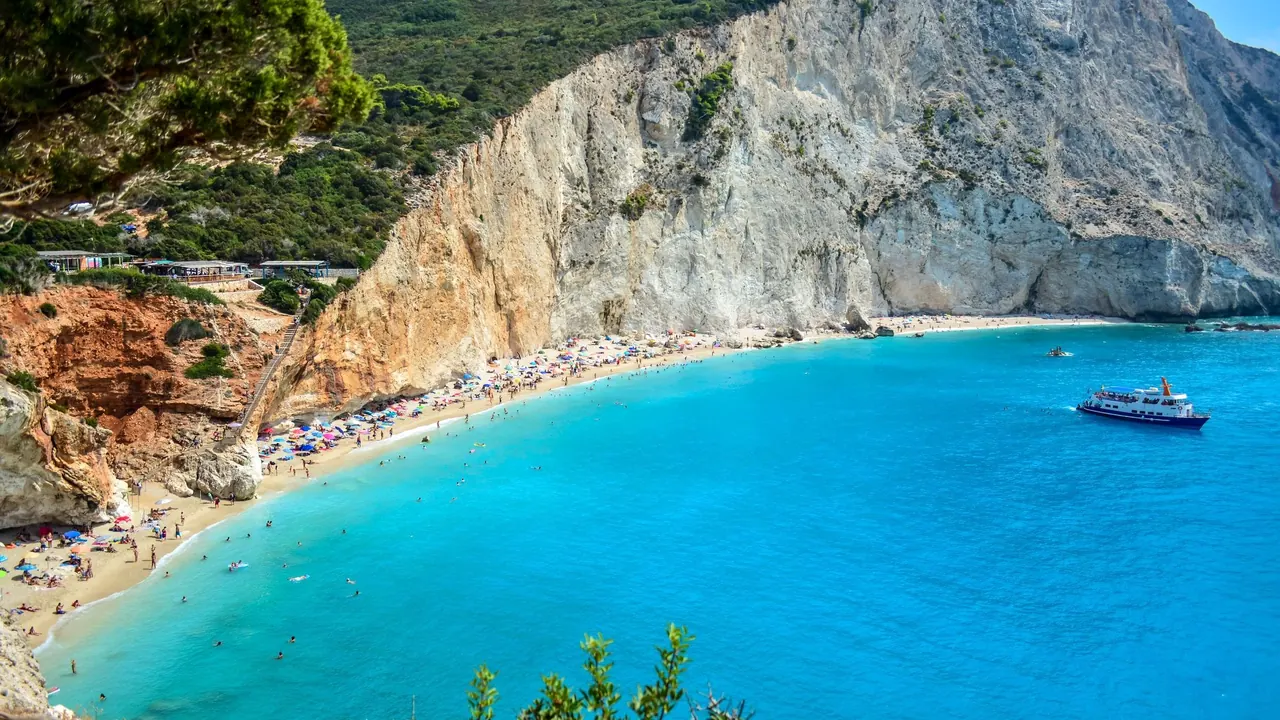
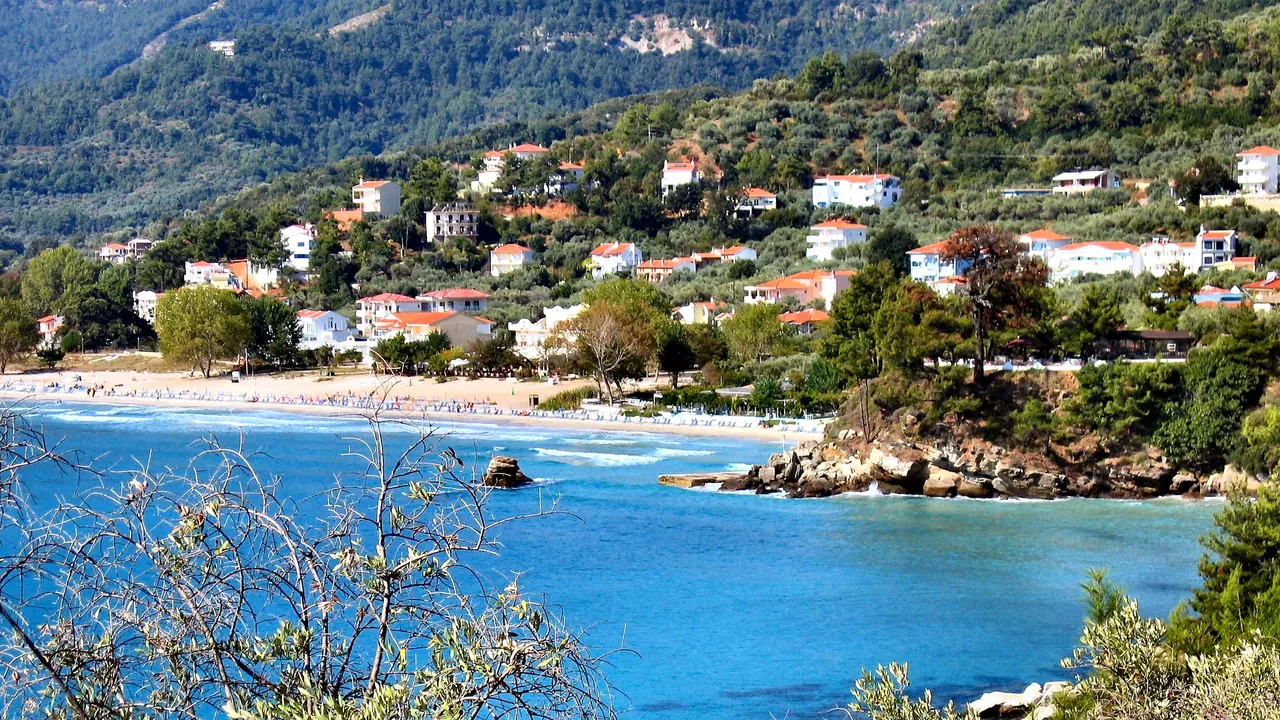
Photos: Lefkada by Antone Adi, Pexels License; Thassos by Ronald Saunders from Warrington, UK, CC BY-SA 2.0, cropped.
Lefkada or Thassos?
Our verdict in twelve categories, each scored against the same fixed benchmark cities, and the climate month by month, so you can choose for your trip.
Choose Lefkada for
- day trips
- nature and the outdoors
- shopping
Lefkada suits travellers who want to spend the week on or by the water. Its west coast has the more dramatic beaches, turquoise sea below white cliffs, and the island is a real base for sailing, windsurfing at Vasiliki and boat days out to Meganisi, Ithaca and Kefalonia. In return you pay a little more, drive slower roads and swim off steep, wave-washed shores on the famous side.
Choose Thassos for
- prices
- getting around
- culture and sights
Thassos is the easier and cheaper choice, and the better one for a calm family beach week. One ring road links every bay, the sandy beaches such as Golden Beach and Pefkari shelve gently, and the ancient city at Limenas gives more to see than anything on Lefkada. What it gives up is variety beyond the island: apart from Kavala and Philippi, most days are spent moving between its own beaches and villages.
Scoreboard
Twelve categories on one fixed scale from 0 to 100. The shaded stretch is the gap between the two.
Your match
Pick a travel style or drag the sliders, and both match scores follow your weighting.
Too close to call, 1 point apart
Wins on day trips and nature and the outdoors with your weighting.
Wins on prices and getting around with your weighting.
What matters to you?
Category by category
What the scores mean for a trip.
Beaches & swimming
These are two of the strongest beach islands in Greece, but the beaches differ in kind. Lefkada's fame rests on its west coast, the long strands of Porto Katsiki, Egremni and Kathisma beneath white cliffs, with water of an extraordinary turquoise. They face the open Ionian, so expect afternoon waves, steep shelving and full coves in midsummer, with the calmer swimming on the east side around Nikiana and Ligia.
Thassos is less dramatic but more varied and gentler. Golden Beach is a long curve of fine sand, Paradise Beach and Aliki are pine-backed coves of clear water, Saliara has white marble pebbles, and the rock pool of Giola adds something different. Quiet bays are easier to find here even in high summer.
Food & drink
Both islands are taverna country, where you eat fresh and simply rather than chase a food scene. Lefkada's particular tastes are the small lentils of the Eglouvi plateau and its cured salami, with the most traditional cooking in the villages around Karya and grilled fish on the harbours at Lefkada town and Nidri.
Thassos leans on its pine honey, black olives and spoon sweets of walnut, fig and bitter orange, with slow-roasted goat in Theologos and Panagia and an afternoon tsipouro by the water. On both, the resort menus repeat themselves and the hill villages are where to eat best.
Culture & sights
Thassos has more history on the ground. The ancient city-state around Limenas left an agora by the harbour, a theatre in the pines, a climb to the acropolis and long runs of wall with carved gates, plus a museum with its outsized ram-bearing kouros, and Aliki adds a sanctuary beside old marble quarries.
Lefkada's sights are smaller in scale: the fortress of Santa Maura at the causeway, the earthquake-proof timber houses and painted churches of Lefkada town, the Faneromeni monastery and the Sappho legend at Cape Lefkatas. On either island culture fills a morning between beach days, but Thassos gives that morning more substance.
Nightlife
Evenings are much alike, drinks and late dinners in July and August with no real club scene on either island. Lefkada's best night out is in Lefkada town, where the narrow lanes fill with cocktail bars and young Greek visitors, while Nidri draws sailing crews and Vasiliki the windsurfers.
On Thassos the bars spread along the old port at Limenas, Potos has a strip for younger visitors, and beach bars at Golden Beach play music late. Outside high summer both go quiet early.
Nature & outdoors
Both islands are greener and steeper than most in Greece, but Lefkada has the edge because of what it offers on the water. Vasiliki's reliable afternoon winds make it a windsurfing name across the Mediterranean, Agios Ioannis serves kitesurfers, and the sheltered channels and large marina make it a natural start for a sailing week. On land there are the cliff drive to Cape Lefkatas and the Dimosari waterfall.
Thassos is the better island for walking in forest. Pine, plane and chestnut climb to Mount Ypsario, with views to Mount Athos, and streams cut gorges near Kallirachi and Maries. Its rocky coast suits kayaking, snorkelling and diving rather than wind sports.
Day trips
Lefkada is clearly the better base for days away. Boats from Nidri reach Meganisi, Kalamos and Kastos, ferries from Vasiliki cross to Fiskardo on Kefalonia and to Ithaca, and on the mainland there are Roman Nikopolis, Parga under its Venetian castle and the oracle at the Acheron. That is enough for a full week of outings.
From Thassos the choice is narrower. Kavala, with its castle, Ottoman quarter and aqueduct, pairs well with ancient Philippi in one day, and Xanthi's old town is a longer drive, but every trip begins with a ferry, so most visitors make only one or two.
Good for families
Thassos is the easier island with children. Its small resorts are simple to manage, and sandy bays such as Golden Beach, Skala Prinou and Pefkari shelve gently, so families can base themselves almost anywhere on the sandier stretches of coast.
Lefkada works too, but more selectively. The calm bays around Nikiana, Ligia and Agiofili are good for paddling, while the celebrated west-coast beaches, with surf, steep drops and long cliff staircases, are best kept for an occasional day. Neither island has attractions built for children.
Getting around
Thassos is simpler to move around once you are there. A single coastal road circles the island, so no beach or village is a long drive, and each resort is walkable, though you must queue for a ferry from Keramoti or Kavala first.
Lefkada wins on arrival, joined to the mainland by a causeway, with Aktion airport about half an hour away and no ferry to catch. After that it is slower going: winding roads down the west coast and over the mountains, and summer congestion through Nidri and at Porto Katsiki. On both, a hired car or scooter beats the infrequent buses.
Shopping & style
Neither island is a shopping destination, but Lefkada gives a little more to browse. Its evening stroll along the pedestrian main street of Lefkada town passes clothing shops and jewellers, and Karya is known for hand embroidery.
Thassos shopping is mostly edible: pine honey, olives and spoon sweets from village stalls, plus a few workshops carving local marble along Limenas's short shopping street.
Affordability
Thassos is the cheaper island. Its studios and tavernas are priced for the many visitors who drive down from the Balkans, and meals stay modest even in the busiest resorts, with the ferry and a hire car the main extras.
Lefkada sits mid-range among the Greek islands. Taverna meals are reasonable, but summer rooms near the famous west-coast beaches, car hire and boat excursions add up. On both, June and September bring the same warm sea for noticeably less than August.
Live music & performing arts
Neither island has a year-round programme, and what they offer is summer and open-air on both. Lefkada's fixture is the international folklore festival in Lefkada town every August, with dance groups from many countries on outdoor stages.
On Thassos the setting is the draw: some plays and concerts are staged in the ancient theatre above Limenas during a regional summer festival, and mid-August feast days bring music and dancing to the village squares.
Wellness & relaxation
Rest on either island means slow days rather than treatments, with spas limited to a few better hotels. Lefkada adds a handful of yoga and retreat stays in the hills and quiet evenings in the east-coast harbours, though its busiest resorts are far from restful in August.
Thassos offers long lunches under the plane trees of Theologos and Panagia and peaceful bays on the south-east coast, with loud evenings largely confined to Limenas and Potos.
When should you go?
Pick your month. The climate figures are measured averages, not a forecast.
Lefkada in July
Thassos in July
Daytime high, °C
Rainfall in the month, mm
Where the figures come from
Lefkada has no rain gauge within 25 km of the centre, so its rainfall comes from a gridded climate dataset read at the destination rather than from a gauge further away.
Thassos has no rain gauge within 25 km of the centre, so its rainfall comes from a gridded climate dataset read at the destination rather than from a gauge further away.
Temperature and rainfall are climate normals, averaged over the years shown. Lefkada: 1998-2020 (rainfall 1991-2020) normals, Aktion Airport (24.3 km from centre). Thassos: 1997-2020 (rainfall 1991-2020) normals, Chrysoupoli Airport (24.5 km from centre).
Both islands follow the same summer pattern: warm enough to swim from June, hot and almost dry in July and August with highs around 31°C, and best for walking in spring and early autumn. The sea warms at the same pace on both, but Lefkada holds its warmth longer, still about 23°C in October against 20°C on Thassos, so it is the better pick for a late-season swim.
The difference is in the rain. Lefkada, on the Ionian side, turns wet from September and is far wetter through winter, with about 150mm in November, while Thassos stays drier into autumn and makes September a settled month. In winter Lefkada is a few degrees milder, Thassos cooler and greyer, though neither is a winter beach destination.
Which traveller are you?
For an outdoors trip, Lefkada is the stronger pick. The steady afternoon winds at Vasiliki make it a windsurfing base of real reputation, the channels to its satellite islands are classic sailing waters, and there are walks to the Dimosari waterfall and the hill villages.
On a trip on a tight budget, Thassos goes further. Its family-run studios and tavernas are priced for visitors driving down from the Balkans rather than for luxury travellers, and quiet coves stay easy to find without paying for a sought-after west-coast address.
On a family trip with young children, Thassos is the easier island. Gently shelving sandy bays such as Golden Beach and Skala Prinou, small safe resorts and one simple ring road suit small children better than Lefkada's steep, surf-prone west coast.
Before you go
| Measure | Lefkada | Thassos |
|---|---|---|
| Official language | Greek | Greek |
| Currency | Euro (EUR) | Euro (EUR) |
| Sockets | CF230 V, 50 Hz | CF230 V, 50 Hz |
| Driving side | Right | Right |
| Time zone | UTC+2, UTC+3 in summer | UTC+2, UTC+3 in summer |
| Emergency number | 112 | 112 |
| Main airport | Aktion National Airport (PVK)47 non-stop destinations | Kavala Alexander the Great International Airport (KVA)15 non-stop destinations |
| Public holidays this year | 15 days | 15 days |
By the numbers
| Measure | Lefkada | Thassos |
|---|---|---|
| Population | 22,652 | 13,100 |
| People per km² | 64 | 35 |
| Swim season, months above 21 °C | 5 months | 4 months |
Where else could you go?
Every comparison below shares a destination with this one, so you can follow Lefkada or Thassos somewhere new.
- Paxosvs Lefkada
- Kefaloniavs Lefkada
- Corfuvs Lefkada
- Zakynthosvs Lefkada
- Halkidikivs Thassos
- Skopelosvs Thassos