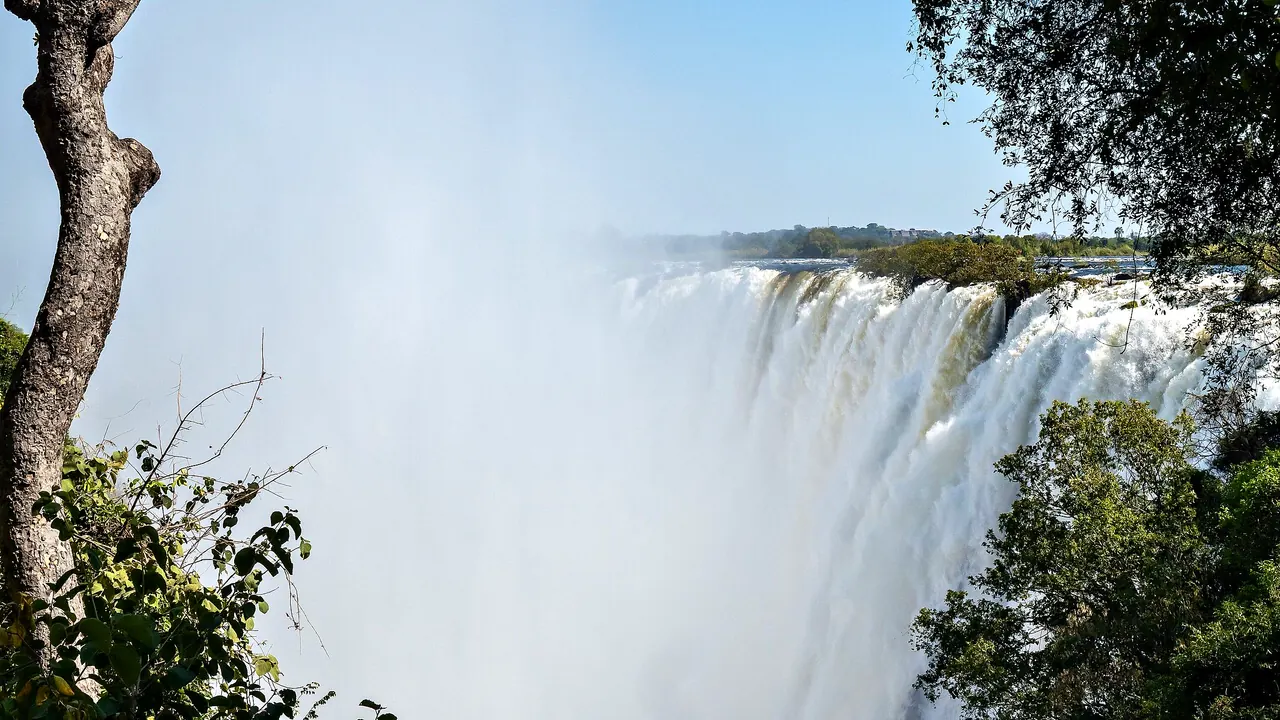
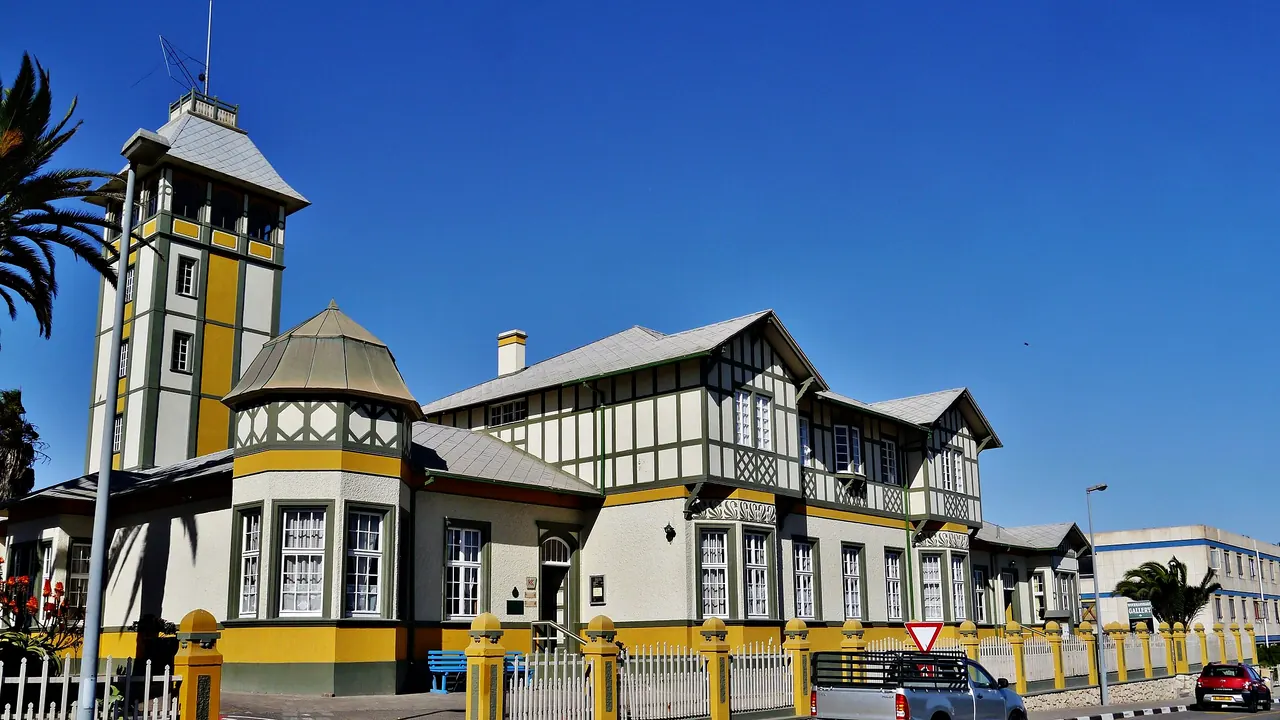
Photos: Livingstone by Matti Blume, CC BY-SA 4.0, cropped; Swakopmund by Zairon, CC BY-SA 4.0, cropped.
Livingstone or Swakopmund?
Our verdict in twelve categories, each scored against the same fixed benchmark cities, and the climate month by month, so you can choose for your trip.
Choose Livingstone for
- nature and the outdoors
- wellness
- live music and the arts
Livingstone suits travellers who want the landscape to do the work: Victoria Falls in full spray, rafting in the Batoka Gorge, walking safaris to find white rhino and an easy crossing to Chobe's elephants. It is best for active adults and older teenagers who are happy to spend most of each day on excursions. The town itself, its food and its evenings don't matter much to the trip.
Choose Swakopmund for
- prices
- food and drink
- families
Swakopmund makes more sense as a gentler and cheaper stop, especially as part of a Namibian road trip. The desert is still the main draw, with dune sports, seals and flamingos close by, but the town has more to offer in its own right. It has a walkable colonial centre, good fish, a proper café culture and cool sea air, and it is calm enough to work well with younger children.
Scoreboard
Twelve categories on one fixed scale from 0 to 100. The shaded stretch is the gap between the two.
Your match
Pick a travel style or drag the sliders, and both match scores follow your weighting.
Wins on nature and the outdoors and wellness with your weighting.
Wins on prices and food and drink with your weighting.
What matters to you?
Category by category
What the scores mean for a trip.
Beaches & swimming
Neither is a beach destination. Livingstone is far inland, and the Zambezi is home to crocodiles and hippos, so swimming means the lodge pool. The one exception is the guided dip in Devil's Pool on the edge of the falls when the river is low, which is a thrill rather than a beach day.
Swakopmund at least has a shore: long sandy beaches either side of town and a sheltered stretch by the Mole. They are good for sunset walks, fishing and sandcastles. The cold Benguela Current, though, keeps the water fit for little more than a paddle.
Food & drink
Livingstone's eating is mostly lodge menus and a few restaurants on the main road. Whole grilled Zambezi bream and nshima with relishes are worth trying, but the memorable part is usually the setting: a deck over the river or a cruise at sunset.
Swakopmund eats noticeably better. Its German heritage shows in the bakeries, the Black Forest cake and the beer. The cold Atlantic supplies Walvis Bay oysters, kob and kingklip, and the land adds oryx and kudu. A week covers the best of it, but the meals are a real pleasure.
Culture & sights
Both towns fill an afternoon or two rather than a whole trip, but their sights are of different kinds. Livingstone's interest lies in its collections and its engineering. There is Zambia's oldest museum, which holds David Livingstone's letters, a railway museum with steam locomotives, and the steel arch of the Victoria Falls Bridge over the gorge.
Swakopmund's attraction is the town itself. Its German colonial buildings, with their gables and turrets, run from Woermann House to the old station and the iron jetty, and are easy to see on foot. A tour of Mondesa township shows present-day Namibian life.
Nightlife
Evenings are quiet in both towns, built around a sundowner and dinner, and neither has clubs. Livingstone's few lively spots are its backpacker bars, and early starts for rafting and game drives end most nights soon after dinner. In Swakopmund the evening drink is in a German-style pub, and a handful of bars stay busy at weekends with locals and overland travellers.
Nature & outdoors
Livingstone has the bigger and wilder outdoors. Victoria Falls, more than 1.7km wide, is one of the world's great natural sights. Around it are rafting in the Batoka Gorge, bungee jumps and gorge swings, canoeing among hippos and elephants, rhino walks in Mosi-oa-Tunya and a day in Chobe among its elephant herds.
Swakopmund's desert is superb in its own way. There is sandboarding and quad biking on the dunes, living desert tours, kayaking with seals at Walvis Bay, and Sandwich Harbour, where the dunes fall into the sea. It has less big game, and its coast is grey and cool, so it complements the Zambezi rather than matching it.
Day trips
Neither town has many other places to visit nearby, and from both the best outings head into the landscape. From Livingstone the choices cross borders: over the bridge to Zimbabwe's Victoria Falls town for a second view of the falls and a craft market, which needs a visa, or about an hour and a half to Kasane in Botswana, the starting point for Chobe. Closer to home, a guided visit to Mukuni village introduces the Toka-Leya, whose chief is the traditional custodian of the falls.
From Swakopmund every outing stays inside Namibia and most follow the coast. Walvis Bay, half an hour south, is a working port with oyster bars and boat departures. Cape Cross combines a reminder of a fifteenth-century Portuguese landing with its huge seal colony. Inland, the rock paintings at Spitzkoppe are the main cultural trip, and Sossusvlei is too far for a day and needs a night away.
Good for families
Livingstone works well for teenagers, who will remember the rhino walks, the spray of the falls and the hippo cruises. Rafting, gorge swings and Devil's Pool all carry minimum ages, though. Malaria all year and the heat of October and November put off many parents of young children.
Swakopmund is the easier place to bring children. It is compact, flat and orderly, and the climate is mild. The aquarium tunnel, the snake park and the seal boat trips work even for small children, although the long drives on gravel roads can tire them.
Getting around
Both centres are small and walkable, and activity operators collect guests in either town. The difference is how much of the trip lies within walking distance. In Livingstone the falls are about 10km out and the lodges are spread along the river, so taxis and shuttles do the work. Walking the roads outside town is unwise because elephants roam there.
In Swakopmund the seafront, jetty, museum and restaurants are minutes apart on foot. A hire car lets you explore the coast and the desert on your own schedule.
Shopping & style
Neither town is a place for fashion, and both sell crafts, but Swakopmund has more worth carrying home. In Livingstone the curio markets offer carvings, baskets, beadwork and copper, all bargained for, and a length of chitenge cloth is often the best buy.
In Swakopmund the craft stalls near the lighthouse are only the start. There are also Namibian tourmaline and amethyst, karakul rugs, kudu-hide shoes and Herero dolls.
Affordability
Livingstone can be cheap if you stay in town, with hostels, local meals and minibuses. But the main reasons to go are priced for international visitors: entry to the falls and the parks, visas, and above all rafting, helicopter flights and Chobe safaris. A full itinerary costs far more than the town itself suggests.
Swakopmund is the cheaper stay. Self-catering flats, guesthouses, fish dinners and beer cost little, and only the flights, skydives, dune tours and a hire car really add up. Rooms fill in December and January, so book early for those months.
Live music & performing arts
Neither town has a theatre or concert programme. What Livingstone has and Swakopmund lacks is traditional dance. Drum troupes play at cultural centres and lodge dinners, sometimes with the masked Makishi dancers, and the Toka-Leya people hold the Lwiindi ceremony. In Swakopmund the most you will find is a weekend band in a pub or an occasional community show.
Wellness & relaxation
Livingstone is the better place to switch off, as long as you choose a quiet lodge on the upper river. Decks over the water, birdsong at dawn and long empty hours between a morning game walk and an evening cruise make for real calm, and the larger lodges have spas.
Swakopmund offers a gentler, small-town kind of rest: cool sea air, walks on the promenade, and coffee and cake, with a few day spas. It works better as a pause in a road trip than as a place to stay for rest alone.
When should you go?
Pick your month. The climate figures are measured averages, not a forecast.
Livingstone in July
Swakopmund in July
Daytime high, °C
Rainfall in the month, mm
Where the figures come from
Swakopmund's temperatures are measured 26 km from the centre, at Walvis Bay-Pelican Point.
Swakopmund has no rain gauge within 25 km of the centre, so its rainfall comes from a gridded climate dataset read at the city rather than from a gauge further away.
Temperature and rainfall are climate normals, averaged over the years shown. Livingstone: 1991-2020 (sunshine 1981-2010) normals, Livingstone (6.5 km from centre). Swakopmund: 2005-2025 (rainfall 1991-2020) normals, Walvis Bay-Pelican Point (26.2 km from centre).
Livingstone has a clear wet season and a clear dry season. The rains run from November to March, with the most rain in January at about 154mm. From April to October the skies are almost always clear and the sun shines for long hours. June and July are the most comfortable months for being out all day, with highs near 26°C. By October it reaches about 35°C before the rains break, which makes it hard going. To see the falls at their fullest, go from March to May. For the rapids and the rock pools on the lip of the falls, go in the later dry months.
Swakopmund barely has seasons in the same sense. It is mild and almost rainless all year, with highs in the low to mid twenties. It is slightly warmer from March to May and coolest around August and September. The sea never gets much above 18°C, so the shore is for walking rather than swimming, and the dunes are good in any month. In every season it is a cool break from the heat of the Namibian interior.
Which traveller are you?
On an outdoors trip, Livingstone is the stronger pick. Victoria Falls, white-water rafting in the Batoka Gorge, canoeing past hippos on the upper Zambezi and rhino walks offer more variety and more drama than Swakopmund's dunes and lagoon, impressive as those are.
On a family trip with young children, Swakopmund is far easier. It is small, flat and mild rather than hot, and it has an aquarium tunnel and seal trips that suit all ages. It also avoids the malaria and minimum ages that hold families back in Livingstone.
For a trip on a tight budget, Swakopmund makes a small sum last longer. Much of its appeal costs nothing: the colonial streets, the promenade and sunset on the beach. In Livingstone, almost everything beyond the falls walkways is a paid excursion.
Before you go
| Measure | Livingstone | Swakopmund |
|---|---|---|
| Official language | English | English |
| Currency | Zambian Kwacha (ZMW) | Namibia Dollar (NAD) |
| Sockets | CG230 V, 50 Hz | M220 V, 50 Hz |
| Driving side | Left | Left |
| Time zone | UTC+2 | UTC+2 |
| Emergency number | 991 or 999 | 112 |
| Elevation | 931 m | 6 m |
| Main airport | Harry Mwanga Nkumbula International Airport (LVI)6 km from centre6 non-stop destinations | Walvis Bay International Airport (WVB)37 km from centre2 non-stop destinations |
| Public holidays this year | 16 days | 13 days |
By the numbers
| Measure | Livingstone | Swakopmund |
|---|---|---|
| City population | 177,393 | 75,921 |
| People per km² | - | 419 |
| Museums within 10 km | 2 | 1 |
| UNESCO World Heritage sites within 50 km | 1 | 0 |
| Swim season, months above 21 °C | - | None |
Where else could you go?
Every comparison below shares a destination with this one, so you can follow Livingstone or Swakopmund somewhere new.
- Victoria Fallsvs Livingstone
- Windhoekvs Swakopmund
- Johannesburgvs Livingstone
- Windhoekvs Livingstone
- Victoria Fallsvs Swakopmund
- Cape Townvs Swakopmund