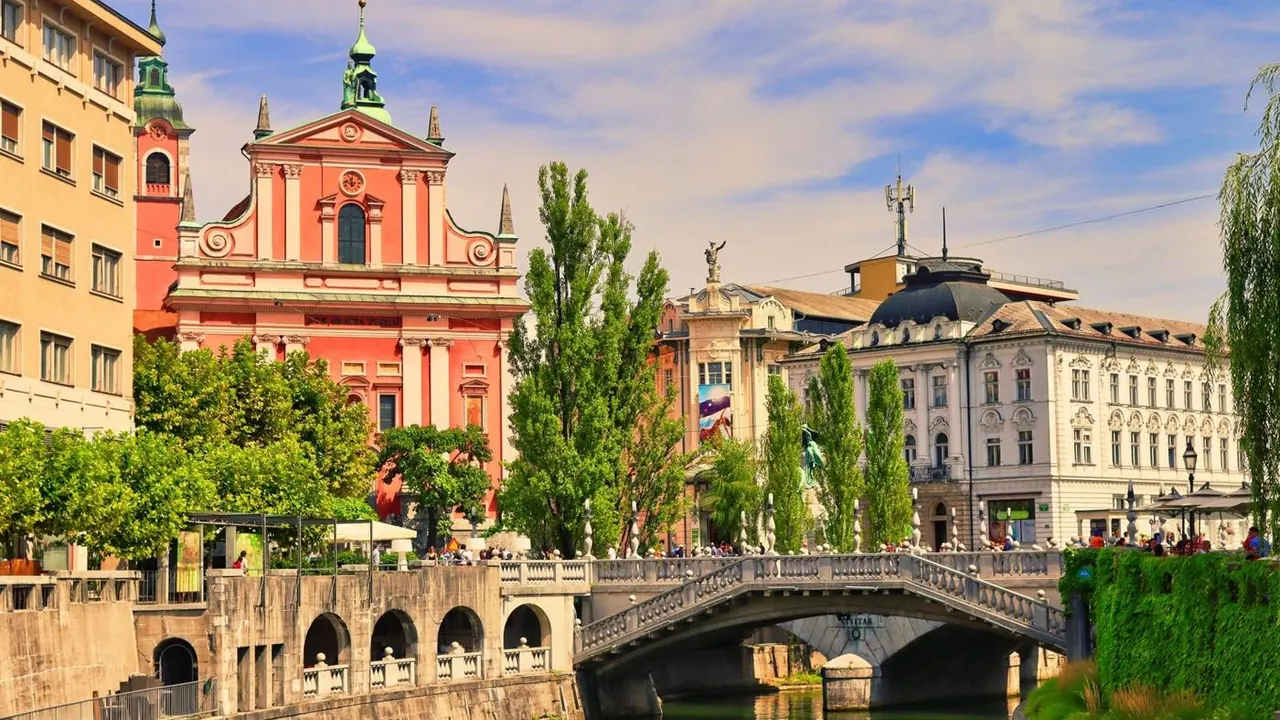
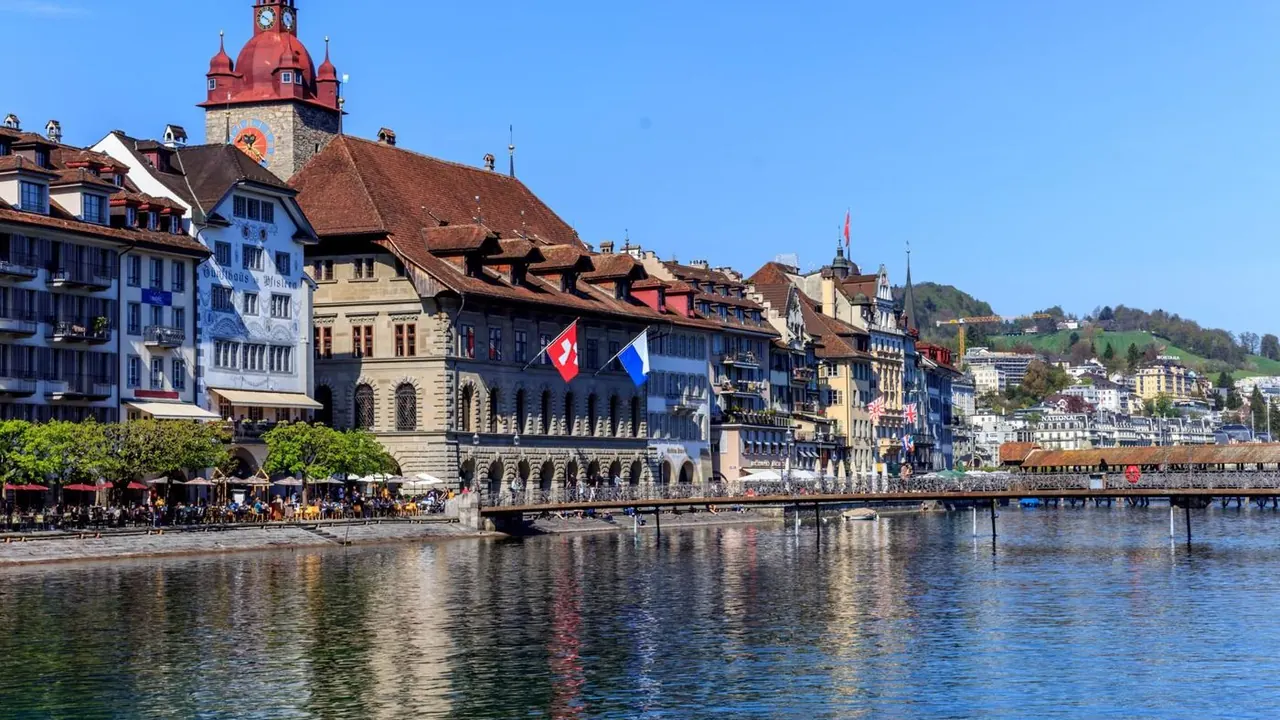
Photos: Ljubljana by detait, Pexels License; Lucerne by ILOVESwitzerland, Pexels License.
Ljubljana or Lucerne?
Our verdict in twelve categories, each scored against the same fixed benchmark cities, and the climate month by month, so you can choose for your trip.
Choose Ljubljana for
- prices
- food and drink
- nightlife
Ljubljana suits travellers who want a relaxed, affordable European capital with good wine, lively riverside evenings and the Alps within easy reach. Its money goes further, its food and drink are more rooted in the country around it, and Metelkova and the student crowd give it more after-dark life. It is the better base for a slower week mixing city cafés with lakes, caves and hill towns.
Choose Lucerne for
- live music and the arts
- beaches
- shopping
For those whose budget allows, Lucerne delivers the grander mountain scenery and the smoother logistics. Cogwheel railways, cable cars and paddle steamers leave almost from the station, so peaks like Pilatus and Rigi fit into a day without a car, and the Transport Museum and the classical music festival add real weight. It suits families, hikers and music lovers who accept that everything costs a great deal.
Scoreboard
Twelve categories on one fixed scale from 0 to 100. The shaded stretch is the gap between the two.
Your match
Pick a travel style or drag the sliders, and both match scores follow your weighting.
Too close to call, 1 point apart
Wins on prices and food and drink with your weighting.
Wins on live music and the arts and beaches with your weighting.
What matters to you?
Category by category
What the scores mean for a trip.
Beaches & swimming
Neither city is a beach destination, but Lucerne gives you swimming on the doorstep. In summer you can step into the clean lake from the Lido, the old wooden lake baths or the lawns at Ufschötti, all close to the centre, with mountains behind.
Ljubljana makes you travel for it: the Sava on the northern edge, Lake Bled an hour away, or the pebble and concrete shore at Piran about an hour and a half off. Water there is a day out rather than part of daily life.
Food & drink
Ljubljana is the better place to eat and drink. Its Central Market under Plečnik's colonnades, hearty dishes such as štruklji and jota in traditional inns, and wine bars pouring Vipava and Brda bottles, including the western orange wines, give a stay real flavour.
Lucerne offers well-made Swiss comfort food, from Chügelipastete to lake perch and fondue in guild houses, but the range is narrow and the restaurants near the Chapel Bridge cater largely to tour groups. It is good, expensive food rather than a reason to come.
Culture & sights
The two are evenly matched, and both can be seen in two or three days, but their appeal differs. Ljubljana's draw is a single architect's cityscape: Plečnik's UNESCO-listed bridges, embankments and library, with the castle above and Metelkova's murals for an alternative edge.
Lucerne relies on a few famous set pieces, the covered Chapel Bridge and Water Tower, the carved Lion Monument and the towers of the Musegg Wall, plus the Rosengart Collection's Picasso and Klee, which is stronger art than anything in Ljubljana's galleries.
Nightlife
Ljubljana has more going on after dark. Terraces on both banks of the Ljubljanica fill on warm nights, students keep it lively in term, and Metelkova's scruffy clubs run late at weekends. Lucerne's evenings are a drink by the water and a small club scene near the station, with the lakefront empty by midnight, except during Fasnacht, when the whole town stays out until dawn.
Nature & outdoors
Both are superb bases for the outdoors, but Lucerne puts the mountains right at its edge. Pilatus and Rigi rise straight from the lake, reached by historic cogwheel railways, and Titlis keeps its glacier snow all year about an hour away, all linked by paddle steamer.
Ljubljana's landscapes are wider rather than closer: Šmarna Gora and Tivoli in town, the Julian Alps and Triglav National Park about an hour off, rafting on the Soča and the Postojna and Škocjan caves in the karst. They are wonderful, but they take more travelling to reach.
Day trips
A day out from Ljubljana can cover much of Slovenia: Bled's island church, the painted façades of Radovljica, Predjama Castle built into its cliff, and Venetian-style Piran on the coast. Trieste and Zagreb, each about two hours away, let you add a foreign city. A car helps for the smaller places.
From Lucerne, the outings are other Swiss cities and the lake itself. Zurich, Bern and Basel are each under an hour by train. Boats carry you to Weggis, the Rütli meadow and the William Tell country around Altdorf, so the journey is part of the day.
Good for families
Lucerne gives children more to do, mainly thanks to the Swiss Museum of Transport, which easily fills a day, and to boat trips, cogwheel trains and the summer toboggan run on Pilatus, all of which depend on fine weather and add up in cost.
Ljubljana is calm, safe and pushchair-friendly, with the castle funicular, the Dragon Bridge, Tivoli's playgrounds, a modest zoo and a puppet theatre young children can follow. Most families will have seen it all within a couple of days.
Getting around
Both centres are small and flat enough to walk, but Lucerne goes further. Its station, boat piers and Old Town sit together on the lakefront, and the steamers, trains and cable cars into the mountains share one integrated ticket system, so a car is never needed.
Ljubljana is just as easy on foot within town, with a pedestrianised core and bike share, but it has no metro or tram, the rail network is slow, and the remoter Alpine valleys are much easier with a hired car.
Shopping & style
What you bring home is quite different in each city. Ljubljana's shopping is local and small-scale: honey, pumpkin-seed oil and coastal salt from the Central Market, Idrija lace, a Sunday antiques market on the embankment and a few design boutiques around Trubarjeva. There is little international fashion and no luxury quarter.
Lucerne gives a shopper more to aim for, though it is mostly the Swiss watch trade. Big jewellery and watch houses line Schwanenplatz, alongside shops selling army knives, chocolate and cuckoo clocks. Beyond those, there is little fashion or design.
Affordability
This is the widest gap between the two. Ljubljana costs a middling European amount, with good-value set lunches, cheap entry to sights and almost nothing spent on transport, although summer rooms in the old town are expensive.
Lucerne is very expensive in every respect: central hotels, even simple meals, and the mountain railways that make the visit worthwhile. Swiss travel passes and lakeside picnics help, but it cannot be done cheaply.
Live music & performing arts
Lucerne is the stronger choice for classical music. The Lucerne Festival brings world-leading orchestras to Jean Nouvel's lakefront hall, famous for its acoustics, and the hall keeps a year-round programme.
Ljubljana has solid foundations in its Philharmonic, the National Opera and Ballet and the summer festival in Plečnik's Križanke courtyard. It also has more rock and alternative music at Metelkova, but less to plan a trip around.
Wellness & relaxation
Neither city has a bathing tradition of its own, so both offer calm more than spas. Ljubljana's peace comes from its car-free centre and riverside cafés, with a water park on the edge and a choice of Slovenian thermal spa towns within an hour's drive.
Lucerne relies on hotel spas, slow steamer trips and Mario Botta's mineral bath high on the Rigi, though its Old Town gets crowded at midday when the tour groups arrive.
When should you go?
Pick your month. The climate figures are measured averages, not a forecast.
Ljubljana in July
Lucerne in July
Daytime high, °C
Rainfall in the month, mm
Where the figures come from
Lucerne has no rain gauge within 25 km of the centre, so its rainfall comes from a gridded climate dataset read at the city rather than from a gauge further away.
Lucerne's sunshine is measured 42 km from the centre, at Zurich Town / Ville..
Temperature and rainfall are climate normals, averaged over the years shown. Ljubljana: 1991-2020 normals, Ljubljana / Bezigrad (1.9 km from centre). Lucerne: 2005-2025 (sunshine 1991-2020, rainfall 1991-2020) normals, Emmen (4.2 km from centre).
Both cities share the same cold, grey winters, with highs around 4°C in December and January, so the cobbles are best walked from May to September. Ljubljana's summers are noticeably hotter and sunnier, peaking at 28°C in July and August, which suits a swim in the Sava or at Bled but can feel warm for long afternoons of sightseeing. Lucerne stays milder at about 24°C, better for walking and hiking, and the lake is only comfortable for swimming in high summer.
Rain falls through the year in both, but at different times. Lucerne's wettest months are May to August, and low cloud can hide the peaks, while its autumn is drier. Ljubljana turns wettest in September and October, at up to 159mm a month, so late spring and early summer are its most reliable stretch, while early autumn is the better time to aim for Lucerne's mountains.
Which traveller are you?
On a trip on a tight budget, Ljubljana is the clear choice. Set lunch menus at the inns, fairly priced local wine and a walkable centre keep costs moderate, while Lucerne's hotels, meals and mountain railways make it one of Europe's most expensive stays.
For an outdoors trip, Lucerne has the edge. Pilatus, Rigi, the Stanserhorn and Titlis rise right around the lake, and boats, trains and cable cars link hikes without a car. Ljubljana's Julian Alps are superb but usually need a car or bus.
On a food and nightlife trip, Ljubljana wins. Its market, gostilna cooking and orange wines from the west beat Lucerne's narrower round of fondue and rösti, and the riverside bars and Metelkova's late weekend clubs outlast Lucerne's early-closing lakefront.
Before you go
| Measure | Ljubljana | Lucerne |
|---|---|---|
| Official language | Slovene | French, German, Italian, Romansh |
| Currency | Euro (EUR) | Swiss Franc (CHF) |
| Sockets | CF230 V, 50 Hz | CJ230 V, 50 Hz |
| Driving side | Right | Right |
| Time zone | UTC+1, UTC+2 in summer | UTC+1, UTC+2 in summer |
| Emergency number | 112 | 112 |
| Elevation | 309 m | 436 m |
| Main airport | Ljubljana Jože Pučnik Airport (LJU)20 km from centre32 non-stop destinations | Zürich Airport (ZRH)49 km from centre226 non-stop destinations |
| Public holidays this year | 21 days | 12 days |
By the numbers
| Measure | Ljubljana | Lucerne |
|---|---|---|
| City population | 284,293 | 86,234 |
| People per km² | 1,736 | 2,963 |
| Museums within 10 km | 14 | 14 |
| UNESCO World Heritage sites within 50 km | 3 | 1 |
Where else could you go?
Every comparison below shares a destination with this one, so you can follow Ljubljana or Lucerne somewhere new.