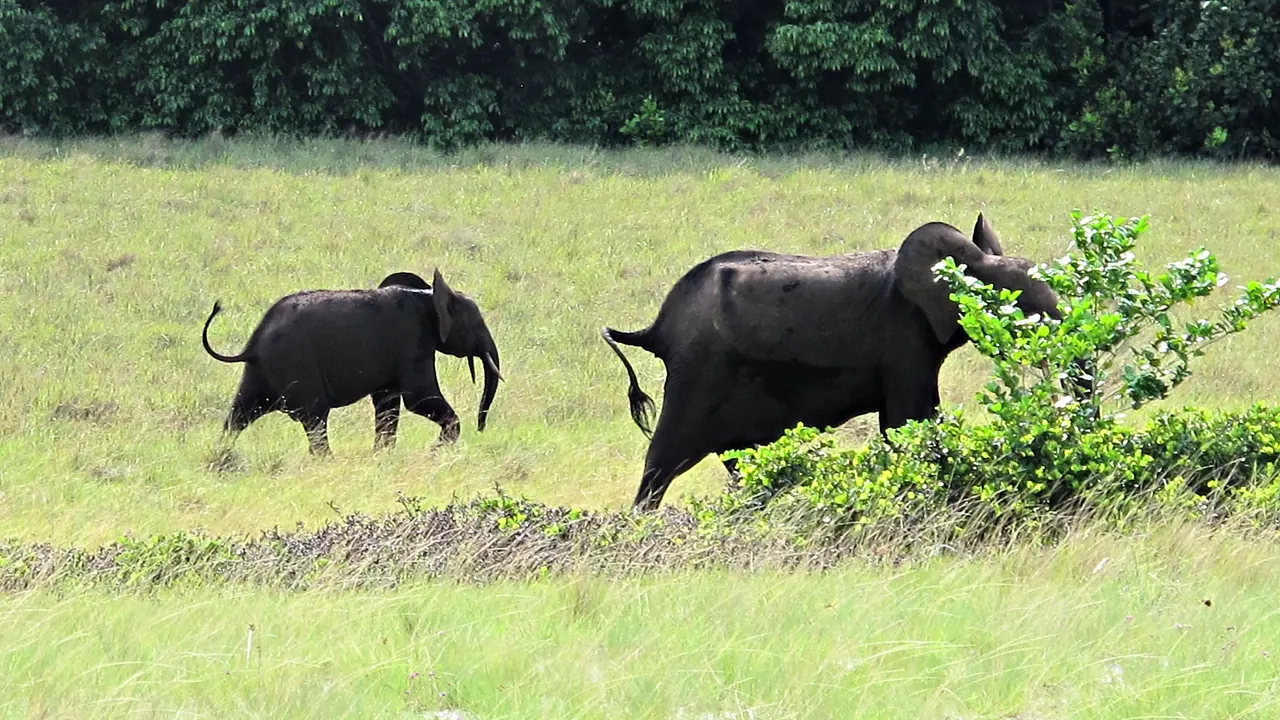
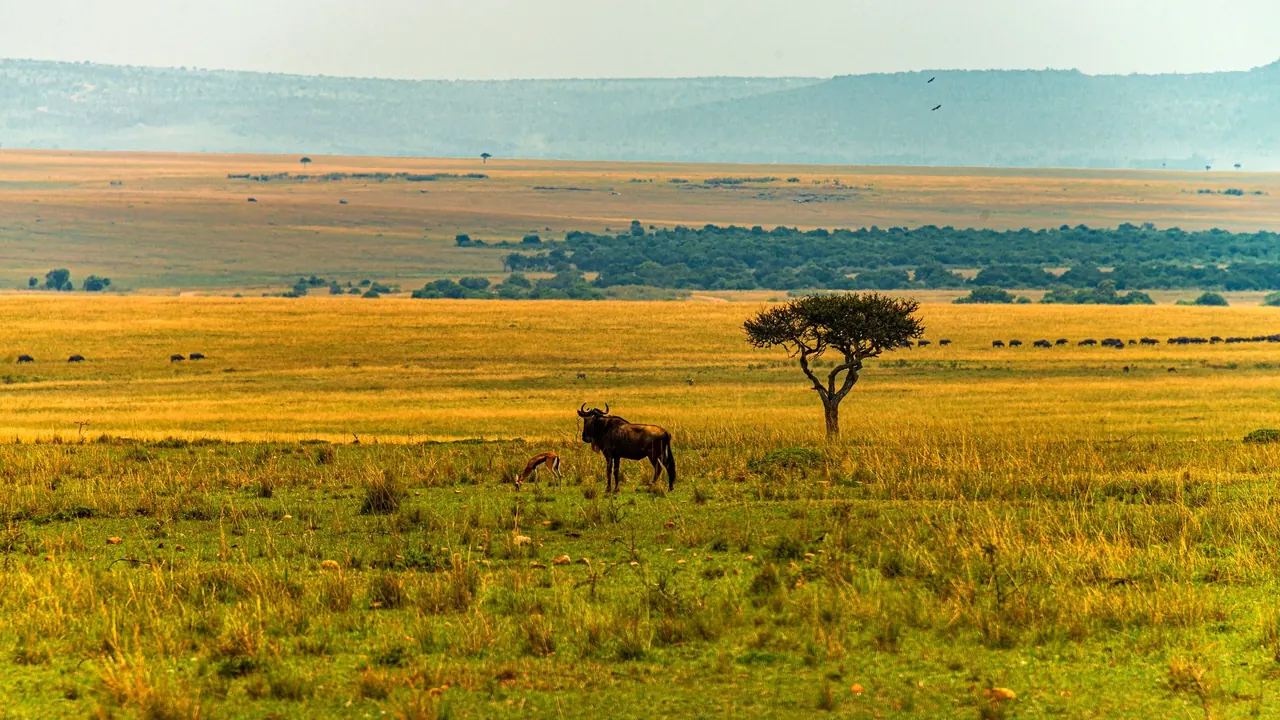
Photos: Loango National Park by Kurt Dundy at English Wikipedia, CC BY 3.0, cropped; Masai Mara by Daniel Case, CC BY-SA 4.0, cropped.
Loango National Park or Masai Mara?
Our verdict in twelve categories, each scored against the same fixed benchmark cities, and the climate month by month, so you can choose for your trip.
Choose Loango National Park for
- beaches
- day trips
Loango is for the traveller who has done the classic safari, or wants something few people ever see: rainforest, savannah, mangrove lagoons and an empty Atlantic shore all in one park. Gorilla tracking on foot, elephants walking the sand, hippos in the surf, whales offshore in the dry months and nesting turtles later in the year make it a wildlife trip unlike any other. You pay for that with a long, complicated journey, very few beds and no cheaper way in.
Choose Masai Mara for
- families
- getting around
- wellness
Masai Mara suits a first safari, and anyone who wants big cats and the great migration. The open plains make lion, leopard and cheetah easy to watch, and the river crossings are the reason many people go. It is also the easier trip of the two: a short flight from Nairobi, more camps that take families, and a budget option in group camping safaris by road. What it lacks next to Loango is the sea and the rainforest.
Scoreboard
Twelve categories on one fixed scale from 0 to 100. The shaded stretch is the gap between the two.
Your match
Pick a travel style or drag the sliders, and both match scores follow your weighting.
Wins on beaches and day trips with your weighting.
Wins on families and getting around with your weighting.
What matters to you?
Category by category
What the scores mean for a trip.
Beaches & swimming
Loango has an actual shoreline, about 100km of wild sand between lagoon mouths and forest, with sea that stays warm most of the year. It is a beach for dawn walks looking for elephant and hippo tracks, not for bathing, because the surf is heavy, the currents are strong and nobody is on watch.
The Mara has nothing like it. It lies on high plains far inland, its rivers belong to crocodiles and hippos, and the only swim is a camp pool, often a small plunge pool. Visitors who want sand there add a separate stay on the Kenyan coast.
Food & drink
Neither is a food trip, and in both you eat at the camp where you sleep. The Mara does a little more with it: Kenyan touches such as sukuma wiki, ugali and chapati, picnic breakfasts set out on the plains after a morning drive, and a wider range of camps whose kitchens get better as the price goes up.
Loango's menus are shorter because supplies come in by boat. Its strength is fresh fish from the lagoons and the sea, and if the cook decides to make it, fish or chicken in nyembwe palm-nut sauce.
Culture & sights
Both are wildlife destinations with very little built heritage, and the human interest in each is different. Loango has one real landmark, the iron-framed church of the Sainte-Anne mission on the Fernan Vaz lagoon, as well as Nkomi fishing villages that are best visited with a guide.
In the Mara the cultural side is the Maasai, who own most of the conservancies. Visits to a manyatta can feel staged, and they are more worthwhile when a conservancy camp arranges them with Maasai guides.
Nightlife
There is no going out in either park, and in both an evening means a drink, dinner and an early night before a dawn start. What you hear after dark is the difference: frogs and the odd passing elephant by a Loango lagoon, lions and hyenas around an unfenced Mara camp, where an askari walks you to your tent.
Nature & outdoors
Both are among Africa's great wildlife areas, and they are very different. Loango is a mosaic where forest, savannah, lagoon and ocean meet. Its signature sights are gorillas tracked on foot, forest elephants and buffalo on the beach, and boat trips through the creeks of the Iguéla and Fernan Vaz lagoons. Whales and turtles add a marine season, but leopards and chimpanzees are rarely seen.
The Mara is open grassland where the big cats are the main event and are seen with unusual reliability. From about July the migration arrives from the Serengeti, with its river crossings. The conservancies along the borders add walks, night drives and fewer vehicles, and dawn balloon flights show the plains from above. In both parks every outing is guided.
Day trips
In practice there are no day trips from either park, and both are places to stay put. Loango at least has a boat outing on the Fernan Vaz lagoon that passes fishing villages and the small town of Omboué. From the Mara the only places within reach are the trading centres by the gates and Narok, which are not worth a day out, and the Rift Valley lakes belong to a different leg of the trip.
Good for families
The Mara is clearly the better choice with children. Many of its camps cater for families, with connecting tents, private vehicles that can turn back when a child gets tired, and tracking or bead-making with Maasai guides, and it works well from about the age of eight. Both parks are malarial, and both have minimum ages for some activities.
Loango is really only for older children and teenagers who love animals. The trip in takes flights, roads and boats, medical care is far away, nothing is set up for families, and the sea is too rough for children to swim.
Getting around
The Mara is much simpler to reach. A light aircraft from Nairobi's Wilson Airport lands on a grass strip in under an hour, and a long day by road is the cheaper alternative. Inside the reserve the distances are large and the tracks bumpy, but camp vehicles take care of everything.
Getting to Loango is a real undertaking. You fly to Port-Gentil, then continue by road and boat through Omboué and across the lagoons, or charter a light aircraft. Once there you travel by lodge boat, vehicle or on foot with a guide, and in the rainy months some tracks become heavy going.
Shopping & style
There is almost nothing to buy in either park. The Mara's Maasai beadwork, often sold by the women who made it, is a genuinely local souvenir. Loango's lodges carry only a few carvings and fabrics, and Gabonese masks and crafts are better bought in Libreville.
Affordability
Both are expensive, but the Mara gives you more room to choose. Group camping safaris from Nairobi, simple tented camps outside the gates and lower green-season rates bring the cost down, even though park fees and the migration months push it up.
Loango has no cheaper route at all. Visits are sold as packages that bundle transfers, full-board stays and guiding, and with so few beds and such a remote setting it sits near the top of African wildlife travel. The one advantage is that once the package is paid, there is little left to spend.
Live music & performing arts
Neither park has a stage of any kind, and in Loango music comes down to chance. Drumming or dancing may turn up at a lodge or on a village visit, and the Bwiti ceremonial music of the wider Gabonese region exists, but none of it keeps to a schedule you could build a day around.
The Mara is more dependable in one respect. The adumu, the Maasai jumping dance, in which young warriors spring upward one after another to the chanting of the group, is part of most manyatta visits and some camps put it on after dinner. It lasts minutes rather than an evening, though, so concerts or theatre have to be saved for Nairobi at either end of the trip.
Wellness & relaxation
Neither has a spa culture, but the Mara is the more restful of the two. Long middays on a tent veranda over the plains, often with no phone signal, and massage tents at the more expensive camps give it the edge, even though days start before dawn.
Loango is just as quiet, with long afternoons over the lagoon and no traffic or towns. However, its heat and humidity and its very simple lodges mean you rest through remoteness rather than comfort.
When should you go?
Pick your month. The climate figures are measured averages, not a forecast.
Loango National Park in July
Masai Mara in July
Daytime high, °C
Rainfall in the month, mm
Where the figures come from
Loango National Park has no weather station within reach, so its figures come from a gridded climate model rather than a measured record, and read a broad area rather than one spot.
Masai Mara has no weather station within reach, so its figures come from a gridded climate model rather than a measured record, and read a broad area rather than one spot.
Temperature and rainfall are climate normals, averaged over the years shown. Loango National Park: 2001-2020 normals, NASA POWER reanalysis grid, no weather station within 90 km. Masai Mara: 2001-2020 normals, NASA POWER reanalysis grid, no weather station within 90 km.
Neither park is ever cold, and the difference between them through the year is rain. Loango has one long dry spell, June to September, when the coast gets almost no rain (2mm in July). These are its coolest months and the sea drops to about 23°C, and this is also when whales pass offshore. From October the rains return heavily, peaking at 315mm in November, and stay wet until May. The sea is at its warmest then, close to 28°C, and turtles nest on the beaches.
The Mara's year divides more evenly. It has a long rainy season from March to May, at its wettest around 173mm in April, a shorter one in November and December, and a drier stretch from June to October with only light showers. Daytime highs stay in the mid to high twenties all year, so game drives are comfortable in any month. For the driest roads and the open views of the plains, June to October is the best time, and it lines up roughly with Loango's dry season, so one window suits both.
Which traveller are you?
On a beach and sun trip, Loango is the only one of the two with a coast: a long, empty strand of pale sand and warm water. The heavy Atlantic surf means walking and paddling rather than swimming, but the Mara has no beach at all.
On a family trip with children, the Mara works far better. Camps there offer family tents, private vehicles and junior ranger activities, and the flight in is short. Loango's long boat and road transfers and remote location are hard going for younger children.
On a trip on a tight budget, neither is cheap, but the Mara at least has a way in: group camping safaris by road from Nairobi and lower rates in the green seasons. Loango is sold almost only as costly full-board packages.
Before you go
| Measure | Loango National Park | Masai Mara |
|---|---|---|
| Official language | French | English, Swahili |
| Currency | CFA Franc BEAC (XAF) | Kenyan Shilling (KES) |
| Sockets | C220 V, 50 Hz | G240 V, 50 Hz |
| Driving side | Right | Left |
| Time zone | UTC+1 | UTC+3 |
| Emergency number | Police 1722, ambulance 1300, fire 18 | Police 112/999, ambulance 112/999, fire 112/999 |
| Main airport | Port Gentil International Airport (POG)3 non-stop destinations | Jomo Kenyatta International Airport (NBO)60 non-stop destinations |
| Public holidays this year | 11 days | 10 days |
By the numbers
| Measure | Loango National Park | Masai Mara |
|---|---|---|
| Swim season, months above 21 °C | 12 months | - |
Where else could you go?
Every comparison below shares a destination with this one, so you can follow Loango National Park or Masai Mara somewhere new.
- Serengetivs Masai Mara
- Ngorongorovs Masai Mara
- Príncipevs Loango National Park
- Dianivs Masai Mara
- Okavango Deltavs Masai Mara
- Okavango Deltavs Loango National Park