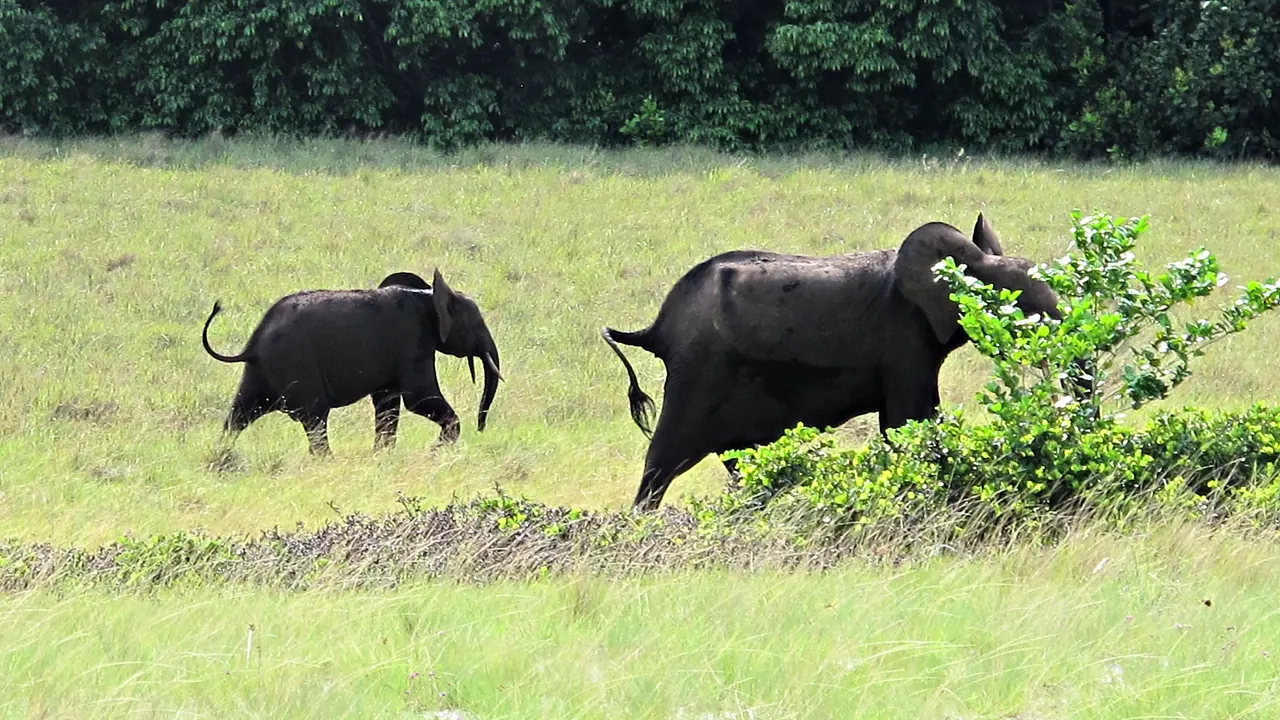
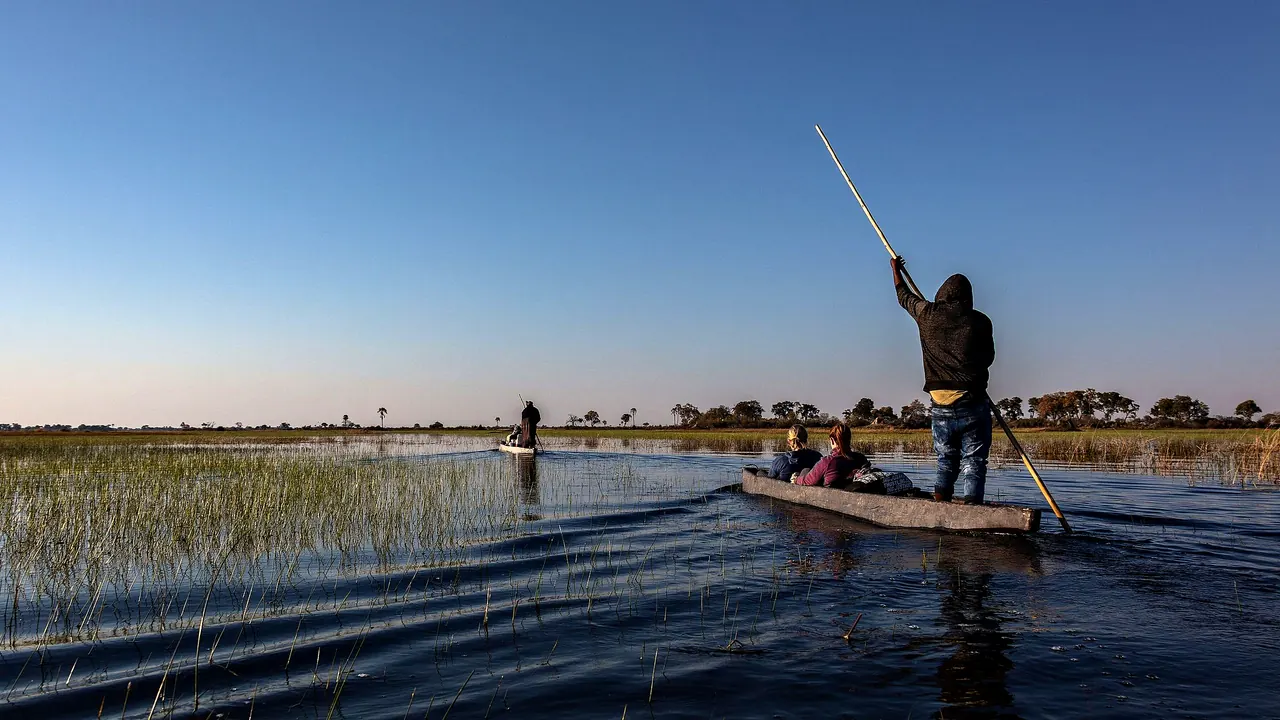
Photos: Loango National Park by Kurt Dundy at English Wikipedia, CC BY 3.0, cropped; Okavango Delta by Diego Delso, CC BY-SA 4.0, cropped.
Loango National Park or Okavango Delta?
Our verdict in twelve categories, each scored against the same fixed benchmark cities, and the climate month by month, so you can choose for your trip.
Choose Loango National Park for
- beaches
- prices
- day trips
Loango is for the traveller who wants wildlife and the ocean in the same frame: forest elephants and hippos on an empty Atlantic beach, gorilla tracking in the rainforest, whales offshore in the dry months and turtles nesting later in the year. It suits someone happy with a rougher, less polished trip into a corner of Africa few people reach, and who would rather walk a wild shore at dawn than tick off a list of big cats.
Choose Okavango Delta for
- wellness
- families
- food and drink
The Okavango Delta is the stronger pure safari, with lions, leopards and wild dogs alongside elephants and buffalo, seen by mokoro, on foot, by vehicle and from the air. Its camps are more refined, rest days on a deck above the floodplain come more easily, and families with animal-mad teenagers have more camps that welcome them. You give up the sea and pay even more, but the game viewing is about as good as it gets.
Scoreboard
Twelve categories on one fixed scale from 0 to 100. The shaded stretch is the gap between the two.
Your match
Pick a travel style or drag the sliders, and both match scores follow your weighting.
Too close to call, 1 point apart
Wins on beaches and prices with your weighting.
Wins on wellness and families with your weighting.
What matters to you?
Category by category
What the scores mean for a trip.
Beaches & swimming
Loango has a real coast: a long, wild strand of pale sand between the lagoon mouths and the forest, with warm water and animals walking out of the trees onto the beach. The catch is the heavy Atlantic surf and strong currents, so you walk and paddle rather than swim.
The Okavango Delta has no beach at all. Its channels belong to crocodiles and hippos, so bathing means the plunge pool on your camp deck. For anyone who wants sand underfoot, Loango wins easily.
Food & drink
Neither place is a reason to travel for food, but the delta eats better. Its upmarket camps put real care into the rhythm of the day, from brunch after the morning drive and sundowners in the bush to fireside dinners with South African wine, and Maun offers seswaa if you pass through.
Loango's lodges cook simply from supplies brought in by boat, so menus are short. The fresh lagoon fish and the occasional dish in nyembwe palm-nut sauce are the highlights.
Culture & sights
Both are wildernesses with little built heritage, and each has one standout site. In Loango it is the iron-framed mission church of Sainte-Anne on the Fernan Vaz lagoon, easy to reach by boat. The delta's equivalent, the San rock paintings of the Tsodilo Hills, carries more weight but sits far up in the north-west and needs a separate journey. Otherwise culture in each means time with local people: Nkomi fishing villages in Loango, Bayei and Hambukushu guides in the delta.
Nightlife
There is no nightlife at either. Evenings in both end with a drink, dinner and an early bed before a dawn start. The difference is in what you hear after dark: frogs and the odd elephant passing in Loango, lions and hyenas in the delta, where you are walked back to your tent. Only Maun has a few bars, used mostly by guides and pilots.
Nature & outdoors
Both are among Africa's great wild places, but the delta goes further. Its floodplains, papyrus lagoons and palm islands concentrate elephants, buffalo, lions, leopards, wild dogs and red lechwe, and the private concessions feel properly empty. Mokoro, walking, driving, motorboat and flight give you five ways to see it.
Loango's strength is variety of habitat rather than predators. Rainforest, savannah, mangrove lagoons and ocean meet, so you get habituated gorillas, hippos in the surf, whales from about July to September and nesting turtles in the wet season. Leopards and chimpanzees are there but seldom seen.
Day trips
Neither works as a base for outings to other places, since in both almost every day is spent inside the wilderness. Loango's nearest change of scene is a lagoon boat trip to fishing villages and the small transfer town of Omboué. From the delta, the salt pans of Makgadikgadi and Nxai or the Chobe riverfront are separate safari legs, not day trips, and you move between camps by light aircraft.
Good for families
Both suit older children who already love animals more than they suit toddlers, but the delta does more to help. A number of camps offer family tents, private vehicles and guided activities for young guests, and travelling in the dry season with teenagers works well.
Loango asks more of families. The journey in combines flights, roads and boats, gorilla tracking has age limits, medical care is far away and the sea is too rough for children to swim. Both are malarial and unfenced, with nothing built for children.
Getting around
Both are hard to reach and impossible to explore on your own, and once there your lodge handles everything. The delta's system is a little smoother: you land at Maun and hop by small plane to the airstrip beside each camp, with a self-drive route into Moremi for experienced 4x4 drivers.
Loango's usual route is longer and more piecemeal, a flight to Port-Gentil and then road and boat transfers across the lagoons, unless you charter a light aircraft. Inside the park, long distances and heavy tracks in the rains slow things further.
Shopping & style
There is next to nothing to buy in either, but the delta has one craft worth seeking out. The palm-fibre baskets of the Ngamiland villages, coloured with natural dyes, are sold in Maun's craft outlets. Loango offers only lodge souvenirs, so save Gabonese masks and crafts for Libreville.
Affordability
Loango comes out marginally less expensive, but it gives you no way to trim the bill. There are no independent guesthouses, cheap transport or local restaurants, and nearly every visit is a package of transfers, full-board lodge stays and guiding, with little left to spend once you arrive.
The Okavango Delta is about as costly as safari travel gets, because Botswana has long kept visitor numbers low and prices high, and the light-aircraft hops between camps add a good deal. It does offer two ways to spend less: lower rates in the green season from about November to March, and self-drive camping in Moremi from Maun. Park fees, vehicle hire and the experience that route demands keep even that far from cheap.
Live music & performing arts
Music in Loango turns up only by chance, as drumming or dance on a lodge or village visit, and Gabon's Bwiti ceremonial music belongs to the wider region rather than to anything you can attend. In the delta it is part of camp life, with staff singing in close harmony in Setswana and the local languages to welcome guests or after dinner. Both are brief, informal moments, and there is no theatre or concert hall in either, Maun included.
Wellness & relaxation
Loango's lodges keep to simpler comforts than the delta's polished camps, some of which have a massage room. In Loango the heat, humidity and dawn starts shape the day, and rest comes from the quiet itself: no traffic, no towns, and long afternoons on a veranda over the lagoon.
The delta makes that downtime easier. Its small camps leave the hot middle of the day for resting on a deck above the floodplain while elephants drink below, often with no phone signal at all. The schedule still starts before sunrise, though, so it is the mind that unwinds more than the body.
When should you go?
Pick your month. The climate figures are measured averages, not a forecast.
Loango National Park in July
Okavango Delta in July
Daytime high, °C
Rainfall in the month, mm
Where the figures come from
Loango National Park has no weather station within reach, so its figures come from a gridded climate model rather than a measured record, and read a broad area rather than one spot.
Temperature and rainfall are climate normals, averaged over the years shown. Loango National Park: 2001-2020 normals, NASA POWER reanalysis grid, no weather station within 90 km. Okavango Delta: 1961-1990 (rainfall 1991-2020) normals, Maun (0.5 km from centre).
Both destinations are at their most comfortable in the southern winter, and for the same reason: it is dry. On the coast around Loango, June to September brings almost no rain and the mildest days, around 24°C, with the sea cooling to about 23°C; this is also when whales pass offshore. From October to May the rains are heavy, peaking in November at around 315mm, and some tracks get hard going, though the sea is at its warmest and turtles nest from about November.
The delta runs on a sharper cycle. May to September is dry and pleasant, with cool mornings and the floodwater at its highest, but by October and November the heat builds to around 34°C before the storms arrive. December to March is the green season, wetter and hot, though its rain is lighter than Loango's. If you want to combine both on one trip, June to August is the window that suits each.
Which traveller are you?
On a beach and sun trip, Loango is the only real choice. Its 100km of pale, empty sand and warm Atlantic water make for dawn walks among elephant tracks, even if the surf is too rough for swimming, while the delta is landlocked.
For an outdoors trip built around wildlife, the Okavango Delta edges ahead. The predators are easier to find, and mokoro trips, guided walks, game drives and scenic flights give more ways to see them than Loango's boats and forest walks.
On a family trip with children, the Okavango Delta is the easier bet. Both are malarial and remote, but the delta has more camps with family tents, private vehicles and activities for young guests. Loango has almost nothing set up for children.
Before you go
| Measure | Loango National Park | Okavango Delta |
|---|---|---|
| Official language | French | English |
| Currency | CFA Franc BEAC (XAF) | Pula (BWP) |
| Sockets | C220 V, 50 Hz | GM230 V, 50 Hz |
| Driving side | Right | Left |
| Time zone | UTC+1 | UTC+2 |
| Emergency number | Police 1722, ambulance 1300, fire 18 | 911 |
| Main airport | Port Gentil International Airport (POG)3 non-stop destinations | Maun International Airport (MUB)9 non-stop destinations |
| Public holidays this year | 11 days | 11 days |
By the numbers
| Measure | Loango National Park | Okavango Delta |
|---|---|---|
| Swim season, months above 21 °C | 12 months | - |
Where else could you go?
Every comparison below shares a destination with this one, so you can follow Loango National Park or Okavango Delta somewhere new.
- Victoria Fallsvs Okavango Delta
- Príncipevs Loango National Park
- Krugervs Okavango Delta
- Ngorongorovs Okavango Delta
- Serengetivs Okavango Delta
- Masai Maravs Okavango Delta