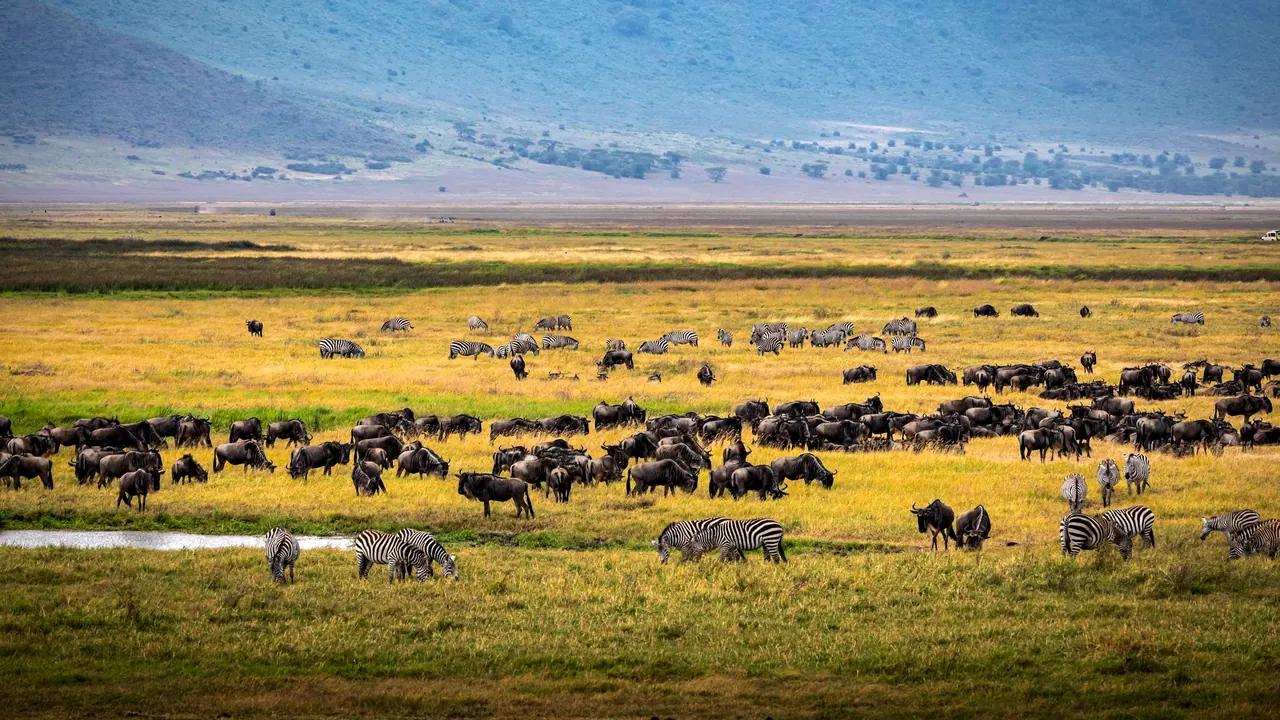
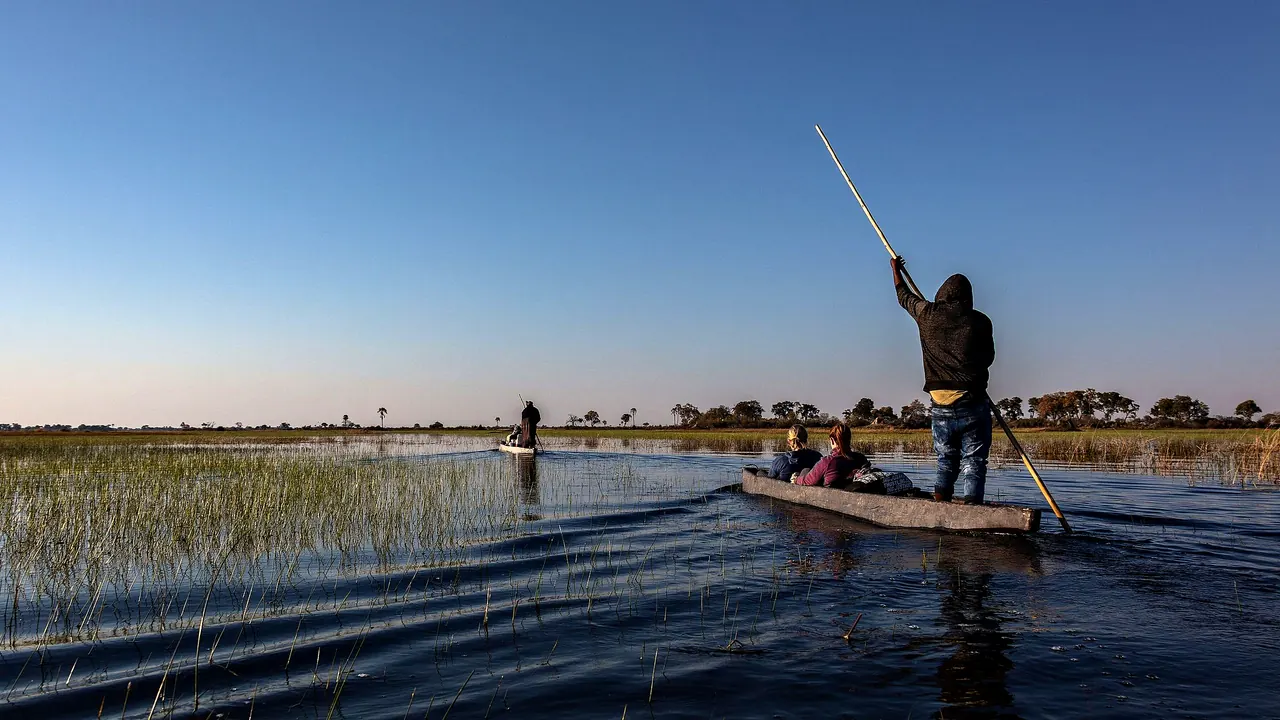
Photos: Ngorongoro by Sergey Guk, Pexels License; Okavango Delta by Diego Delso, CC BY-SA 4.0, cropped.
Ngorongoro or Okavango Delta?
Our verdict in twelve categories, each scored against the same fixed benchmark cities, and the climate month by month, so you can choose for your trip.
Choose Ngorongoro for
- culture and sights
- day trips
- families
Ngorongoro suits a first safari, a family with school-age children, or anyone who wants a little more than wildlife. The crater packs lions, elephants and black rhino into one caldera you can drive in a day, the road from Arusha means no small planes are needed, and between drives there is real substance nearby: Olduvai Gorge, Maasai land, coffee farms around Karatu and a morning with the Hadzabe at Lake Eyasi. It is still expensive, but basing yourself in Karatu or camping keeps it within closer reach.
Choose Okavango Delta for
- wellness
- beaches
- nightlife
The Okavango Delta is for travellers who want wilderness and little else, and can pay for it. Here the experience is water: poling through papyrus in a mokoro, walking islands with an armed guide, flying between remote camps where few other visitors are about. There is almost no heritage and nothing to drive out to, but the long, quiet middle of the day on a deck above the floodplain makes it the more restful of the two for adults and older teenagers.
Scoreboard
Twelve categories on one fixed scale from 0 to 100. The shaded stretch is the gap between the two.
Your match
Pick a travel style or drag the sliders, and both match scores follow your weighting.
Wins on culture and sights and day trips with your weighting.
Wins on wellness and beaches with your weighting.
What matters to you?
Category by category
What the scores mean for a trip.
Beaches & swimming
Neither place has anywhere to swim. Ngorongoro's lakes are shallow soda flats left to the flamingos, and the highland chill on the rim means lodge pools often go unused; anyone wanting sand usually flies on to Zanzibar.
The delta's water is clear and tempting but full of crocodiles and hippos, so swimming means the camp's plunge pool. In the delta's heat that pool earns its keep between drives in a way a cool crater-rim pool rarely does.
Food & drink
Neither is a place to travel for food, and in both you mostly eat what your lodge serves. Ngorongoro gives a little more to explore beyond the lodge: farm kitchens and coffee estates around Karatu, and roadside nyama choma and chips mayai in Karatu and Mto wa Mbu.
In the delta, meals are part of the all-inclusive camp routine, with brunch after the morning drive, sundowners out in the bush and dinner by the fire. Maun's grills and a plate of seswaa are the only taste of local cooking.
Culture & sights
Ngorongoro has the stronger heritage, and it is human prehistory rather than buildings. Olduvai Gorge, where the Leakeys found early hominin remains, sits on the way to the Serengeti with a museum above it, and Laetoli's ancient footprints lie further south. The conservation area is also Maasai grazing land, so herders and cattle are part of every drive, even if boma visits can feel staged.
The delta offers far less. Its one major site, the San rock paintings of the Tsodilo Hills, needs a long drive or a charter flight, so most visitors miss it. Culture here comes mainly from your guides and their knowledge of how Bayei and Hambukushu communities have fished and poled the channels.
Nightlife
There is no going out in either. At Ngorongoro the evening is a drink at the lodge bar as the crater darkens below, and night driving in the conservation area is banned. In the delta you are walked to your tent after dark because animals pass through camp, and a few bars in Maun where pilots and guides drink are the only other choice.
Nature & outdoors
Both are among Africa's great wildlife areas, but they differ in landscape and in how you see it. Ngorongoro is a single intact volcanic caldera about 19km across, with grassland, swamp and soda lake inside steep forested walls. Lions, elephants, buffalo and one of the last reliable groups of black rhino live on the crater floor, and you see nearly all of it from a vehicle with a guide. Beyond the rim, the Ndutu plains fill with the calving wildebeest migration early in the year, and ranger-led walks reach Olmoti's waterfall and the flamingo lake inside Empakaai crater.
The Okavango is a sprawling flooded wetland of channels, lagoons and palm islands rather than a bowl, and much more of it can be explored without a vehicle. You can pole through the reeds in a mokoro, walk with an armed guide, take a motorboat in the panhandle or fly low over the floodplain. Leopards, wild dogs and red lechwe stand out among the animals, and the private concessions, with few visitors allowed, feel truly remote.
Day trips
Ngorongoro has a few real outings beyond the game drives. The market village of Mto wa Mbu under the rift escarpment, the coffee farms around Karatu, and a morning with Hadzabe and Datoga people at Lake Eyasi, about two hours away on rough roads, all give a day a different shape.
The delta has nothing similar. Maun is the only town, and the salt pans and Chobe are separate safari legs, so you spend each day in the landscape around your camp.
Good for families
Ngorongoro is easier with children, though neither is built for them. The crater rewards a few hours of driving with big animals and hippos at the picnic pools, and Karatu lodges offer gardens, pools and space, though early starts, bumpy roads and malaria precautions still apply.
The delta asks more of a family. Camps are unfenced, many set minimum ages for mokoro and walking outings or for staying at all, and transfers in small aircraft come with strict luggage limits. Teenagers who already love animals are the ones who get the most from it.
Getting around
Both are fully guided, and neither lets you wander on your own. Ngorongoro is reached by road: a paved stretch from Arusha through Karatu, then rutted rim tracks and steep crater descents in a 4x4 with a driver-guide.
The delta mostly runs by air, with small planes from Maun to grass strips and then the camp's vehicles, boats and mokoros. Self-driving into Moremi is possible, but only for experienced drivers ready for deep sand and flooded crossings.
Shopping & style
Shopping is an afterthought in both. Ngorongoro's roadside curio stops in Mto wa Mbu and Karatu sell Maasai beadwork, carvings, shukas and tinga tinga paintings, with bargaining expected.
The delta has less choice but one craft of real distinction: the palm-fibre baskets of the Ngamiland villages, best bought in Maun before you fly out to camp.
Affordability
Both are expensive, but Ngorongoro is the easier one to bring within reach. Daily conservation fees, the crater vehicle charge and the hire of a guided 4x4 cannot be avoided, but staying in Karatu or on a camping safari brings the bill down noticeably.
The delta sits at the very top of safari pricing, with all-inclusive camps and light-aircraft transfers on top. The green season from November to March lowers rates, and self-drive camping in Moremi is the only real budget route, which demands both kit and experience.
Live music & performing arts
Neither has any stage or concert venue, and the music each offers is different in character. Ngorongoro's is the Maasai song and jumping dance, performed for visitors at bomas and sometimes at lodges. In the delta it is the unplanned harmony singing of camp staff greeting guests or gathering after dinner, less of a show and often more moving.
Wellness & relaxation
The delta is the more restful of the two. Its camps are tiny and often without signal, and the hot midday hours are spent idle on a deck above the floodplain, though the dawn schedule still sets the pace.
Ngorongoro is quiet too, with fires in rim lodge rooms and green farm lodges around Karatu, several with a spa. The rough rim roads and long drives make it harder on the body, and real rest comes only on an afternoon off.
When should you go?
Pick your month. The climate figures are measured averages, not a forecast.
Ngorongoro in July
Okavango Delta in July
Daytime high, °C
Rainfall in the month, mm
Where the figures come from
Ngorongoro has no weather station within reach, so its figures come from a gridded climate model rather than a measured record, and read a broad area rather than one spot.
Temperature and rainfall are climate normals, averaged over the years shown. Ngorongoro: 2001-2020 normals, NASA POWER reanalysis grid, no weather station within 90 km. Okavango Delta: 1961-1990 (rainfall 1991-2020) normals, Maun (0.5 km from centre).
Ngorongoro's dry season runs from June to September, when rain all but stops (about 3mm in July) and daytime highs sit in the mid-20s, ideal for clear game drives, though the crater rim is cold at night. Rain comes twice: the long rains peak in April at around 143mm and turn the tracks to mud, and the shorter rains return in November and December. January to March is wet but broken, and it is the calving season on the Ndutu plains.
The Okavango Delta is hotter and drier in a single, cleaner pattern. From May to October hardly any rain falls, and June to August, with highs around 25°C, are the most comfortable months as well as the peak of the flood. Heat builds sharply after that, to about 34°C in October and November, before storms take over from December to March, with January the wettest at around 130mm.
Which traveller are you?
For a culture and arts trip, Ngorongoro is the clear pick. At Olduvai Gorge and Laetoli you stand where early humans left their bones, tools and footprints, and Maasai herders share the land. The delta's one great site, Tsodilo, lies far off the safari circuit.
On a family trip with children, Ngorongoro is the gentler choice. One morning in the crater can bring lions, elephants and rhinos before attention fades, and the afternoon is free back at the lodge. The delta suits teenagers who can enjoy its quieter, more watchful days.
On a relaxing and wellness trip, the Okavango Delta wins. After the early outing, the day slows to long, idle hours watching the floodplain from camp, with a pool close by. At Ngorongoro more of each day goes on bumpy hours in a vehicle.
Before you go
| Measure | Ngorongoro | Okavango Delta |
|---|---|---|
| Official language | English, Swahili | English |
| Currency | Tanzanian Shilling (TZS) | Pula (BWP) |
| Sockets | G230 V, 50 Hz | GM230 V, 50 Hz |
| Driving side | Left | Left |
| Time zone | UTC+3 | UTC+2 |
| Emergency number | Police 112, ambulance 115, fire 114 | 911 |
| Main airport | Kilimanjaro International Airport (JRO)14 non-stop destinations | Maun International Airport (MUB)9 non-stop destinations |
| Public holidays this year | 13 days | 11 days |
Where else could you go?
Every comparison below shares a destination with this one, so you can follow Ngorongoro or Okavango Delta somewhere new.
- Serengetivs Ngorongoro
- Masai Maravs Ngorongoro
- Victoria Fallsvs Okavango Delta
- Dianivs Ngorongoro
- Zanzibarvs Ngorongoro
- Krugervs Okavango Delta