Tanzania
Ngorongoro
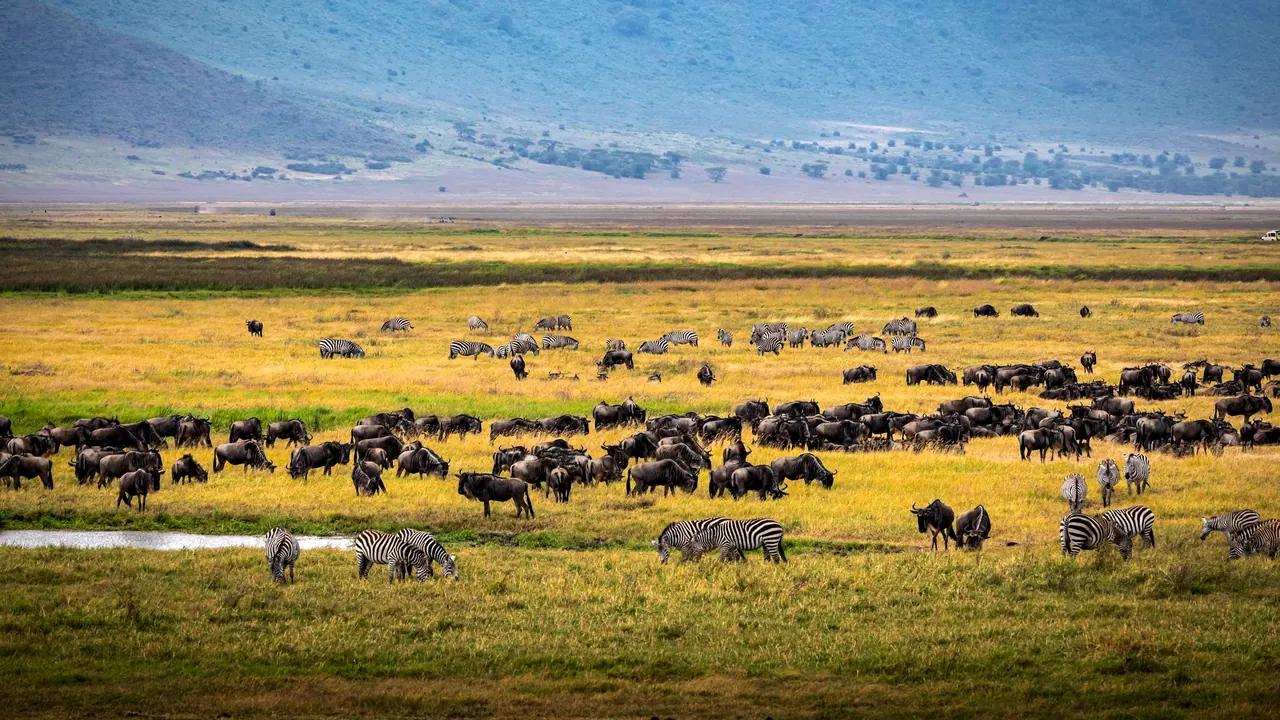
Zebras and wildebeest grazing on the crater floor
- Nature & outdoors97
- Families35
- Culture & sights30
Photo: Sergey Guk, Pexels License
Match
23
Every category weighted equally
- Beach & sun23
- Culture & arts20
- Food & nightlife15
- Family trip27
- Outdoors33
- Relax & unwind27
- Shopping & style19
- On a budget22
Ngorongoro in twelve categories
Our verdict on each, scored 0 to 100 against the same fixed benchmark cities, so a score means the same thing on every page.
Beaches & swimming. Scores 2 out of 100.
Food & drink. Scores 20 out of 100.
Culture & sights. Scores 30 out of 100.
Nightlife. Scores 3 out of 100.
Nature & outdoors. Scores 97 out of 100.
Day trips. Scores 22 out of 100.
Good for families. Scores 35 out of 100.
Getting around. Scores 18 out of 100.
Shopping & style. Scores 8 out of 100.
Affordability. Scores 10 out of 100.
Live music & performing arts. Scores 5 out of 100.
Wellness & relaxation. Scores 28 out of 100.
Ngorongoro category by category
Beaches & swimming
2There is no swimming here. The area sits on the high ground of northern Tanzania, far from the Indian Ocean, and its lakes, from Magadi on the crater floor to Natron in the north, are shallow, alkaline soda lakes meant for flamingos, not people. A few lodges have pools, though the crater rim at about 2,300m is often too cool for them to tempt. Travellers who want sand and sea usually finish a safari with a flight to Zanzibar.
Food & drink
20Meals happen where you sleep. Rim lodges and tented camps serve set dinners and buffets, often good and generous, and game-drive days run on packed lunches eaten at picnic sites on the crater floor. The highlands around Karatu add some real character, with farm kitchens growing their own vegetables and coffee estates on the volcanic slopes where you can taste the local arabica. Beyond that there are simple roadside places serving nyama choma, chips mayai and chai in Karatu and Mto wa Mbu. Nobody comes here to eat, and there is no restaurant scene to explore.
Culture & sights
30The heritage here is ancient rather than architectural. Olduvai Gorge, between the crater and the Serengeti plains, is where the Leakeys found some of the earliest human ancestors and their stone tools, and a small museum on the rim explains the finds above the gorge itself. Further south, Laetoli preserved footprints left in volcanic ash by early hominins more than three million years ago, presented through a replica and a modest display.
The conservation area is also Maasai land, where herders graze cattle beside the wildlife, and some bomas welcome visitors, though these visits can feel staged. There are no towns of note, no historic buildings and few museums, so culture is a stop or two between game drives.
Nightlife
3Evenings end around the fire. Lodges have a bar for a drink after the day's drive, often with the crater fading below, but game drives start at first light and most guests are asleep early. Driving after dark is not allowed in the conservation area, and there is nowhere to go out.
Nature & outdoors
97The crater is the heart of it: an intact volcanic caldera about 19km across, its floor of grassland, swamp and soda lake ringed by forested walls some 600m high. Lions, hyenas, elephants, buffalo, huge herds of wildebeest and zebra and one of the last reliable populations of black rhino live inside, and game drives descend from the rim at dawn. Mists roll over the forested rim in the cool mornings, and the views down are among the great landscapes of Africa.
Beyond the crater, the short-grass plains around Lake Ndutu fill with the wildebeest migration and its calving season from December to March, with predators following. On the highlands, ranger-led walks lead to Olmoti's waterfall and down into Empakaai crater, whose soda lake is often pink with flamingos. Far to the north, outside easy reach of the crater, Ol Doinyo Lengai and Lake Natron add an active volcano and a stark rift valley landscape. Most wildlife viewing is from a vehicle with a guide, and the long rains from April to May turn tracks muddy.
Day trips
22Outings from the crater rim or Karatu are mostly further safaris, which belong to the landscape rather than to places. What remains as a day out is modest: the market village of Mto wa Mbu below the rift escarpment, with banana plantations and cycling tours through mixed communities; coffee farms around Karatu; and Lake Eyasi, about two hours away on rough roads, where visitors spend a morning with Hadzabe hunter-gatherers and Datoga blacksmiths. There are no other towns or heritage sites worth the journey, and Arusha lies three to four hours away.
Good for families
35For a child old enough to sit through long drives, a day on the crater floor can be unforgettable, with lions, elephants and rhinos visible in a few hours and hippos at the picnic pools. The rest is harder. Days start before dawn, roads are bumpy and dusty, the rim is cold at night, malaria precautions are needed and there is nothing here built for children. Some rim lodges and tented camps do not take young children at all. Families tend to do best with school-age children, a private vehicle and a base in Karatu, where lodges have gardens, pools and more space.
Getting around
18Every visit is a safari. A paved road runs from Arusha through Karatu to the conservation area gate, roughly three to four hours by vehicle, but beyond it the rim road is rutted and dusty, the crater descents are steep, and the tracks onward to Olduvai and the Ndutu plains are slow going. Visitors cannot walk freely or move around on their own; game drives require a 4x4 and, in practice, a guide-driver arranged with an operator. That makes the logistics effortless once booked, but rigid. Small planes serve nearby airstrips for travellers combining the area with the Serengeti.
Shopping & style
8Shopping amounts to Maasai beadwork, carved wooden animals, shukas and tinga tinga paintings sold at curio stops along the road through Mto wa Mbu and Karatu and at village visits. Bargaining is expected. Anyone looking for a wider choice of crafts does better in Arusha.
Affordability
10This is an expensive place to visit, and most of the cost is unavoidable. Conservation area entry is charged per person per day, the crater descent carries a separate charge for each vehicle, and a 4x4 with a driver-guide has to be hired for every day spent here. Lodges on the crater rim are among the costliest in Tanzania. Staying in Karatu just outside the gate is noticeably cheaper, and camping safaris lower the bill further, but park fees keep even a modest trip far above the price of everyday travel in the rest of the country.
Live music & performing arts
5Live performance means Maasai song and the famous jumping dance, put on for visitors at bomas and occasionally at lodges in the evening. There are no theatres, concert venues or regular music.
Wellness & relaxation
28There is no bathing or spa tradition here, and a safari is not a slow vacation: drives start at dawn and the roads are hard on the body. What the area does offer is quiet. Lodges on the crater rim and the farm lodges in the green hills around Karatu are calm, with fires in the rooms, long views and gardens, and several have a spa for a massage after a day on the tracks. An afternoon off between drives is the closest a visitor comes to real rest.
Where to stay in Ngorongoro
The crater rim is the base for a first visit and for anyone whose priority is the crater itself. Lodges and tented camps sit at about 2,300m and look straight down into the caldera, so the drive to the descent road at dawn is short. Evenings are cold and quiet, and most guests go to bed early. This is the most expensive place to sleep in the area, and some camps do not take young children.
Karatu, in the farming highlands just outside the gate, is the practical alternative. Lodges here cost noticeably less and have gardens, pools and more space, set among coffee estates and farm kitchens in green hills. It suits families, travellers watching the budget and anyone who wants a calm afternoon off between drives. The trade-off is a longer climb up to the rim each morning. Mto wa Mbu, below the rift escarpment, is a simpler and cheaper stop on the road in from Arusha.
From December to March, a few nights in a camp on the plains around Lake Ndutu put you in the middle of the migration's calving season, and this pairs naturally with the Serengeti. Lake Natron, far to the north, is better kept for a second visit. Most trips need one or two bases, and every move between them is a slow drive.
When should you go?
Pick a month to see what it is like. The climate figures are measured averages, not a forecast.
Ngorongoro in July
Daytime high, °C
Rainfall in the month, mm
The whole year
Shaded against this destination’s own year: the deepest cell is its best month for that figure and the palest its weakest.
Where the figures come from
Ngorongoro has no weather station within reach, so its figures come from a gridded climate model rather than a measured record, and read a broad area rather than one spot.
Temperature and rainfall are climate normals, averaged over the years shown. Ngorongoro: 2001-2020 normals, NASA POWER reanalysis grid, no weather station within 90 km.
Before you go
| Measure | Ngorongoro |
|---|---|
| Official language | English, Swahili |
| Currency | Tanzanian Shilling (TZS) |
| Sockets | G230 V, 50 Hz |
| Driving side | Left |
| Time zone | UTC+3 |
| Emergency number | Police 112, ambulance 115, fire 114 |
| Main airport | Kilimanjaro International Airport (JRO)14 non-stop destinations |
| Public holidays this year | 13 days |
Compare Ngorongoro with
Every comparison with a written verdict behind it.