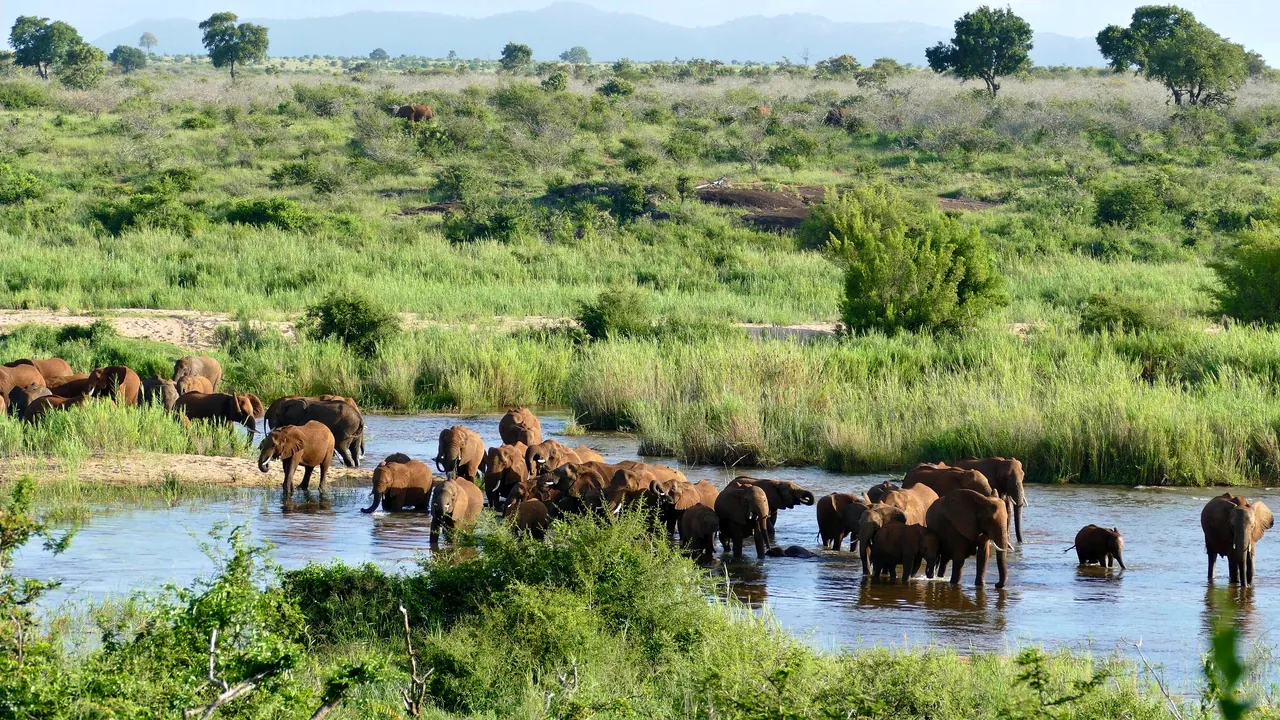
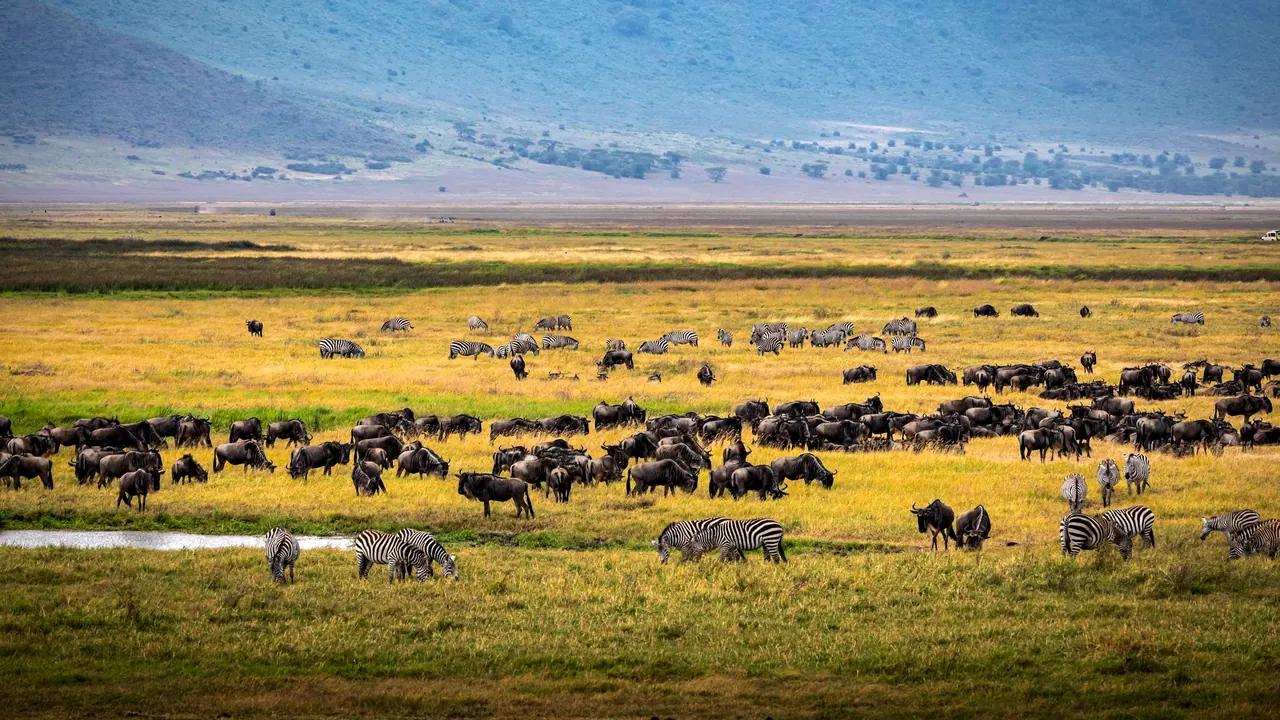
Photos: Kruger by Bernard DUPONT from FRANCE, CC BY-SA 2.0, cropped; Ngorongoro by Sergey Guk, Pexels License.
Kruger or Ngorongoro?
Our verdict in twelve categories, each scored against the same fixed benchmark cities, and the climate month by month, so you can choose for your trip.
Choose Kruger for
- prices
- getting around
- wellness
Kruger suits travellers who want to run their own safari. You can hire an ordinary car, drive the tarred roads of the south around Skukuza and Lower Sabie, sleep in national park rest camps and cook on a braai, all for far less than a guided trip costs. It is also the easier choice with children. And if you want comfort, the Sabi Sand lodges add spas and plunge pools to the game drives.
Choose Ngorongoro for
- culture and sights
- nature and the outdoors
Ngorongoro is the pick for one extraordinary landscape rather than a road network to explore. The crater floor holds lion, elephant and black rhino inside a caldera you can see across, the Ndutu plains add the wildebeest calving, and Olduvai Gorge tells the story of human origins nearby. It costs far more and every day runs through a guide and a 4x4, so it suits travellers happy to hand over the logistics, often as one leg of a Serengeti or Zanzibar journey.
Scoreboard
Twelve categories on one fixed scale from 0 to 100. The shaded stretch is the gap between the two.
Your match
Pick a travel style or drag the sliders, and both match scores follow your weighting.
Wins on prices and getting around with your weighting.
Wins on culture and sights and nature and the outdoors with your weighting.
What matters to you?
Category by category
What the scores mean for a trip.
Beaches & swimming
Neither place has a beach, and both have good reasons not to swim in the wild. Kruger's rivers hold crocodiles and hippos, and Ngorongoro's lakes are alkaline soda lakes. Kruger's camp and lodge pools at least earn their place in the summer heat, while on Ngorongoro's high rim they often feel too cool to use. For a beach you need a separate leg: the Mozambique coast from Kruger, or a flight to Zanzibar from Ngorongoro.
Food & drink
In both places you eat where you sleep, and the styles are different. Kruger's rest camps are made for self-catering, with braai stands outside the bungalows and boerewors and firewood from the camp shop. Its private lodges serve polished dinners in open-air bomas, and the farm stalls around White River sell macadamias and avocados.
At Ngorongoro, the lodge serves you set dinners or buffets, and game-drive days run on packed lunches eaten on the crater floor. What makes it different is the highlands around Karatu, where you can taste arabica on the coffee estates and buy nyama choma and chips mayai at roadside spots in Mto wa Mbu.
Culture & sights
Ngorongoro has the more significant history. Olduvai Gorge, where the Leakeys found early human ancestors, and the 3-million-year-old footprints of Laetoli give a stop between game drives real depth. The area is also Maasai grazing land, though visits to the bomas can feel staged.
Kruger's sites are smaller in scale but more varied. There is the Iron Age hilltop citadel at Thulamela in the far north, the iron-smelting site at Masorini and the museum at Skukuza. On the escarpment, Pilgrim's Rest is a gold-rush town from the 1870s that survives almost whole.
Nightlife
There is no going out in either place, and evenings end early by a fire. The difference is after dark. Kruger offers guided night drives, where a spotlight picks out leopards, hyenas and owls. At Ngorongoro, driving at night is not allowed, so the evening is a drink at the lodge bar as the crater fades from view.
Nature & outdoors
Both are among Africa's finest wildlife destinations, but they are built on different scales. Kruger is a vast stretch of bush about 350km long, open to the unfenced reserves of Sabi Sand, Timbavati and Klaserie. You can drive it yourself, walk it with rangers or cross it on wilderness trails over several days. The Blyde River Canyon and the waterfalls on the escarpment add mountain scenery.
Ngorongoro packs its wildlife into a single caldera about 19km across. It is one of the last reliable places to see black rhino, and the view from the misty rim is one of the great sights in Africa. Beyond the crater lie the migration herds on the Ndutu plains and the flamingos of Empakaai, but nearly all viewing is from a guided vehicle.
Day trips
Kruger has a little more to offer beyond the park, and it is easier to reach. The Panorama Route links Pilgrim's Rest, Graskop and Sabie with the canyon viewpoints in one good day by car, and Hoedspruit has wildlife rehabilitation centres.
Ngorongoro's choices are fewer and rougher. You can visit the market village of Mto wa Mbu or the coffee farms around Karatu. Lake Eyasi, two hours away on poor roads, offers something unusual: a morning with Hadzabe hunter-gatherers and Datoga blacksmiths.
Good for families
Kruger is clearly the easier place to bring children. The big rest camps such as Skukuza and Lower Sabie have pools, open lawns and bungalows that suit families, and in your own car you can stop whenever a child needs a break. It is still a malaria area, and many private lodges limit or refuse young children.
At Ngorongoro, a day on the crater floor can thrill a school-age child. Around it, though, are pre-dawn starts, dusty roads, a cold rim and nothing designed for children. A Karatu lodge with a garden and a pool makes the most workable base.
Getting around
Kruger gives you far more freedom. Small airports at Skukuza and Hoedspruit put you near the gates, the drive from Johannesburg is long but simple, and an ordinary car can manage the park's tarred and gravel roads. The catch is distance: crossing from south to north takes days, so most visitors explore one section at a time.
At Ngorongoro you cannot move around independently at all. Every game drive needs a 4x4 and a driver-guide, the rim road is rutted and the descents into the crater are steep. Once booked, the trip runs smoothly, but it is fixed in advance and the drive from Arusha takes three to four hours.
Shopping & style
Neither place is worth visiting for shopping, and what you find is crafts. Kruger has field guides and safari clothing in the camp shops, plus baskets and carvings at the stalls near God's Window, while Mbombela's malls cover practical needs. Ngorongoro's roadside curio stops in Mto wa Mbu and Karatu sell Maasai beadwork, shukas and tinga tinga paintings, where you are expected to bargain, but Arusha has a wider choice.
Affordability
Kruger is far cheaper, mainly because you can do it all yourself. Rest camps, groceries and fuel cost little, and if you drive yourself you see the same animals as lodge guests, though car hire and the daily conservation fee for international visitors add up. The all-inclusive lodges in Sabi Sand are a different matter, and among the most expensive in Africa.
At Ngorongoro, some high costs come with every trip. You pay a fee per person per day and a separate charge for each vehicle that goes down into the crater, and you need a 4x4 with a guide for every day. Sleeping in Karatu instead of on the rim saves a real amount, and a camping safari saves more, but the park fees alone keep even a simple trip expensive.
Live music & performing arts
Neither place has a theatre or concert life. Performances are staged for guests and come from different traditions. In Kruger you may see Shangaan song and dance at a lodge or cultural village. At Ngorongoro it is Maasai singing and the well-known jumping dance at the bomas.
Wellness & relaxation
Kruger offers more real rest. Many private lodges in Sabi Sand have open-sided treatment rooms looking out over the bush, and the long midday break is spent by a plunge pool watching elephants come to drink. The national park rest camps offer no treatments, only quiet, dark nights.
Ngorongoro is harder on the body, with rough tracks every day. Its calm comes from fires in the rooms on the cool crater rim and the gardens of the farm lodges around Karatu, a few of which have a spa. Both places get you up before dawn.
When should you go?
Pick your month. The climate figures are measured averages, not a forecast.
Kruger in July
Ngorongoro in July
Daytime high, °C
Rainfall in the month, mm
Where the figures come from
Ngorongoro has no weather station within reach, so its figures come from a gridded climate model rather than a measured record, and read a broad area rather than one spot.
Temperature and rainfall are climate normals, averaged over the years shown. Kruger: 1991-2020 (rainfall 1981-2010) normals, Skukuza (1.6 km from centre). Ngorongoro: 2001-2020 normals, NASA POWER reanalysis grid, no weather station within 90 km.
Kruger has one wet season and one dry one. From May to September hardly any rain falls. Through June and July the days are warm rather than hot, in the high 20s, and the heat comes back in September at 31°C. In these months the bush thins and animals gather at water, so this is the best time for game viewing. The rains return in October, and from November to March highs reach 33°C, with about 100mm of rain in each of the wettest months. Then the bush turns green and fills with migrant birds and newborn antelope, but long hours in the car are hot work and the malaria risk is higher.
Ngorongoro is milder, with daytime highs between 24°C and 29°C where the figures are measured. The coolest days come in June and July, the warmest in September and October, and the high crater rim is cooler than that and cold at night. It has two rainy seasons. The long rains fall from March to May and are heaviest in April, when the tracks turn to mud. The short rains come back in November and last through January. June to September is dry and the easiest time for crater drives. The calving on the Ndutu plains from December to March falls in the rainy months, with a drier spell in February, so the wildlife is at its best then but the weather is unsettled.
Which traveller are you?
On a trip on a tight budget, Kruger wins easily. You can self-drive, stay in rest camps or guesthouses near Hazyview and cook your own meals, and still see the same animals. Ngorongoro's daily fees and compulsory 4x4 hire keep even a modest trip expensive.
On a family trip with children, Kruger is the gentler choice. Camps such as Berg-en-Dal have pools, lawns and family bungalows, and you set your own pace in your own car. Ngorongoro means bumpy roads, cold nights and lodges that often turn young children away.
For travellers who want to see the great wildebeest migration, Ngorongoro has what Kruger cannot offer. From December to March the herds calve on the short-grass plains around Lake Ndutu, with predators close behind, and you can combine it with a day in the crater.
Before you go
| Measure | Kruger | Ngorongoro |
|---|---|---|
| Official language | English, Zulu, Xhosa, Afrikaans, Venda, Northern Sotho, Swazi, Tswana, Tsonga, Sesotho, Southern Ndebele, South African Sign Language | English, Swahili |
| Currency | Rand (ZAR) | Tanzanian Shilling (TZS) |
| Sockets | CMN230 V, 50 Hz | G230 V, 50 Hz |
| Driving side | Left | Left |
| Time zone | UTC+2 | UTC+3 |
| Emergency number | 112 | Police 112, ambulance 115, fire 114 |
| Main airport | Kruger Mpumalanga International Airport (MQP)8 non-stop destinations | Kilimanjaro International Airport (JRO)14 non-stop destinations |
| Public holidays this year | 13 days | 13 days |
Where else could you go?
Every comparison below shares a destination with this one, so you can follow Kruger or Ngorongoro somewhere new.
- Serengetivs Ngorongoro
- Masai Maravs Ngorongoro
- Dianivs Ngorongoro
- Zanzibarvs Ngorongoro
- Okavango Deltavs Kruger
- Garden Routevs Kruger