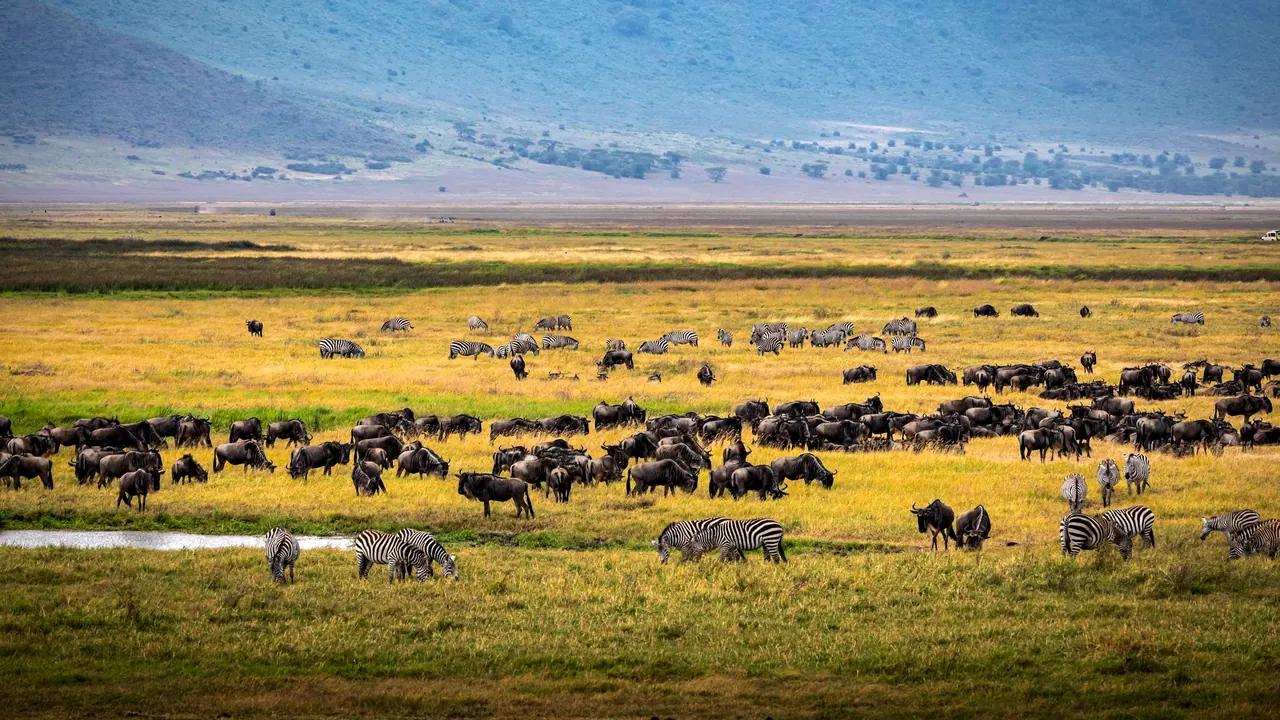
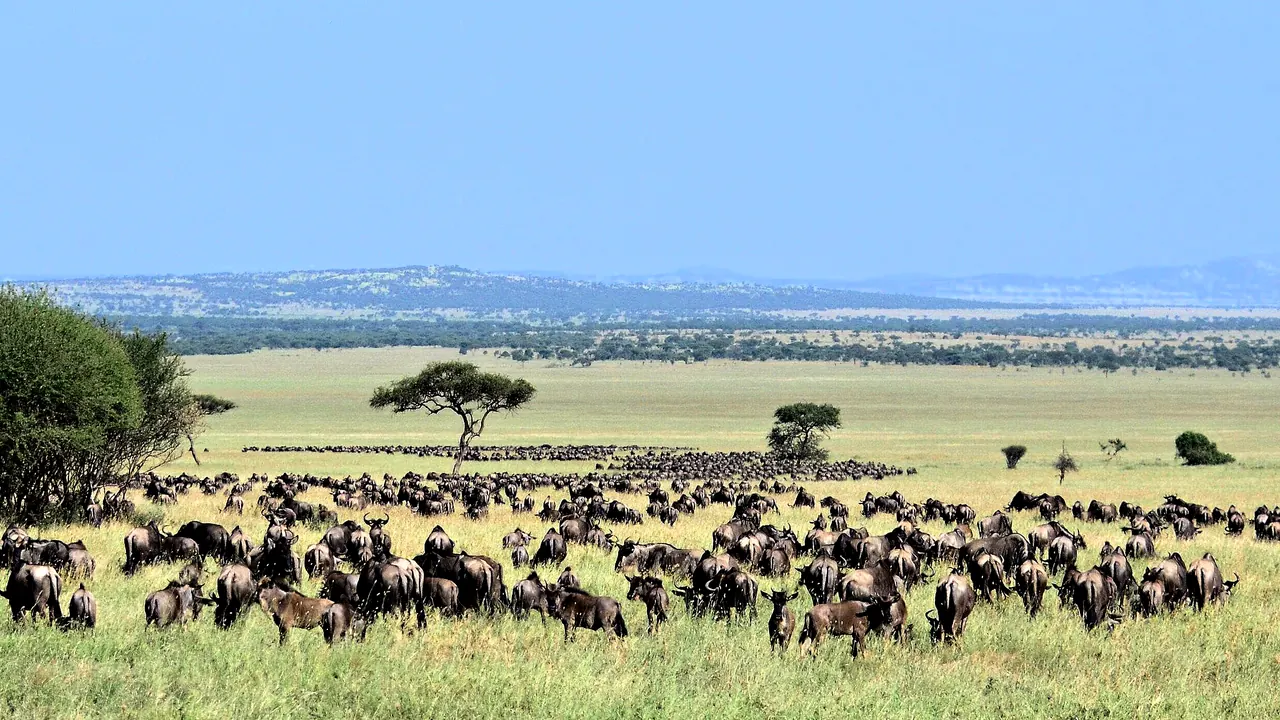
Photos: Ngorongoro by Sergey Guk, Pexels License; Serengeti by DipaliLath, CC BY-SA 4.0, cropped.
Ngorongoro or Serengeti?
Our verdict in twelve categories, each scored against the same fixed benchmark cities, and the climate month by month, so you can choose for your trip.
Choose Ngorongoro for
- culture and sights
- food and drink
- day trips
Ngorongoro suits a traveller who wants a lot in a short time. A single day on the crater floor can bring lions, elephants and black rhino inside one caldera, and the highlands around it add Olduvai Gorge, the flamingos of Empakaai and the coffee farms of Karatu. It is the better pick for a shorter safari, for families with school-age children who need breaks from the vehicle, and for anyone curious about where humans came from.
Choose Serengeti for
- beaches
Choose the Serengeti to follow the migration across open country. Plains, kopjes and rivers carry the herds through the year, from calving at Ndutu to the Mara River crossings in the north, and the Seronera valley is among the best places anywhere to watch big cats. Allow more days, pick your area by the season, and expect very little here beyond the wildlife itself.
Scoreboard
Twelve categories on one fixed scale from 0 to 100. The shaded stretch is the gap between the two.
Your match
Pick a travel style or drag the sliders, and both match scores follow your weighting.
Wins on culture and sights and food and drink with your weighting.
Wins on beaches with your weighting.
What matters to you?
Category by category
What the scores mean for a trip.
Beaches & swimming
Neither has anywhere to swim except a lodge pool, and on the Ngorongoro rim the pool is often too cool to tempt. The lakes are no help either: Magadi and Natron are shallow soda lakes left to the flamingos, and Lake Victoria beyond the Serengeti's western corridor carries a parasite risk. From either one, the usual answer is a flight to Zanzibar once the safari is done.
Food & drink
In both places you eat where you sleep, but Ngorongoro has a little more around it. In the highlands near Karatu there are farm kitchens growing their own vegetables and coffee estates where you can taste the local arabica, and Karatu and Mto wa Mbu have simple roadside stalls for nyama choma and chips mayai.
In the Serengeti the camp is the whole offer: set menus with pilau and ugali, a packed breakfast under an acacia, perhaps a dinner in the bush by lantern light. The cooking can be good for somewhere so remote, but there is nowhere else to go and eat.
Culture & sights
The region's human story belongs to Ngorongoro. Olduvai Gorge, where the Leakeys found early human ancestors and their stone tools, has a small museum above the ravine. At Laetoli, footprints left in volcanic ash more than three million years ago are shown through a replica. Maasai herders graze cattle across the conservation area, and some bomas take visitors, though these visits can feel staged.
Inside the Serengeti there is much less to see: faded rock paintings and the hollow gong rock at the Moru Kopjes, and a visitor centre at Seronera that explains the ecosystem. Most of its visitors meet the human history on the drive in, outside the park.
Nightlife
Neither has anywhere to go out. In both, the ban on driving after dark and the dawn game drives send people to bed early. What differs is the setting for the last drink: a lodge bar on the Ngorongoro rim with the crater fading into darkness below, or a campfire on the open Serengeti plains, with lions calling and a sky full of stars.
Nature & outdoors
Both are among Africa's great wildlife landscapes, and the difference is one of scale. Ngorongoro gathers its animals inside a single caldera about 19km across, home to one of the last reliable populations of black rhino. Around the crater are ranger-led highland walks to Olmoti's waterfall and down into Empakaai crater, where the soda lake is often pink with flamingos.
The Serengeti is all distance: short-grass plains, granite kopjes, acacia woodland and northern rivers, with well over a million wildebeest moving through them and the Seronera valley among the best big-cat country anywhere. The two meet on the Ndutu plains, where the calving herds draw predators early in the year.
Day trips
Neither is a base for day trips in the usual sense, since most outings are just more game drives. From the crater rim or Karatu the options are close by and about people: the market village of Mto wa Mbu below the rift escarpment, the coffee farms, and Lake Eyasi, about two hours away, for a morning with Hadzabe hunter-gatherers and Datoga blacksmiths.
From the Serengeti it depends which edge you are on. From the south you can reach Olduvai Gorge and Maasai villages, and from the western corridor a long drive brings you to the fishing shores of Lake Victoria.
Good for families
Both work best with school-age children who can cope with long, bumpy drives and malaria precautions, and neither has anything built for small ones. Ngorongoro's advantage is that everything is close together. The crater floor can show lions, elephants and rhinos in a few hours, with hippos at the picnic pools, and Karatu lodges have gardens and pools, though some rim camps do not take young children.
The Serengeti means more hours in the vehicle and closer watching in unfenced camps. Some lodges make up for it with family tents, junior ranger activities and private vehicles.
Getting around
Neither lets you move around on your own. Both need a 4x4 with a guide-driver, and the tracks are slow and dusty. Ngorongoro is easier to reach, with a paved road from Arusha to the gate in three to four hours, after which the rutted rim road and steep crater descents take over.
The Serengeti lies beyond it, most of a day by road, and its regions are so far apart that visitors choose one or two depending on where the herds are. Small planes to airstrips such as Seronera, Kogatende and Ndutu save many hours.
Shopping & style
There is little to buy in either: Maasai beadwork, blankets and carvings from curio stops and village visits, where bargaining is expected. The road to Ngorongoro through Mto wa Mbu and Karatu adds roadside stalls selling shukas and tinga tinga paintings, while inside the Serengeti it comes down to lodge gift shops. For crafts, textiles or tanzanite, Arusha is the place to shop.
Affordability
Both are expensive, and neither has a cheap way in, because daily park fees are charged per person and a guided vehicle is needed every day. Ngorongoro adds a separate charge for each vehicle on the crater descent, and its rim lodges are among the dearest in Tanzania. Sleeping in Karatu outside the gate cuts the bill noticeably.
In the Serengeti, the remoteness pushes lodge costs up and flying between airstrips adds more. Camping in public campsites is the cheapest way to see it, and lodges charge less in the green season, outside the peak migration months.
Live music & performing arts
Neither has theatres or concerts. In both, live performance means Maasai song and the jumping dance put on for visitors. Around Ngorongoro you see it at bomas inside the conservation area and sometimes at lodges in the evening. In the Serengeti it comes at some lodges and on village visits near the park boundaries, so the experience is much the same in either place.
Wellness & relaxation
Neither has a spa culture, and early starts on rough roads make both hard on the body. The quiet comes in different forms. At Ngorongoro it is the rim lodges with fires in the rooms and the farm lodges in the green hills around Karatu, several with a spa, suited to cool highland evenings.
In the Serengeti, rest is the long midday break between drives, spent by a pool or on a tent veranda looking out over the plains. Spas there are found only at a few of the more expensive lodges.
When should you go?
Pick your month. The climate figures are measured averages, not a forecast.
Ngorongoro in July
Serengeti in July
Daytime high, °C
Rainfall in the month, mm
Where the figures come from
Ngorongoro has no weather station within reach, so its figures come from a gridded climate model rather than a measured record, and read a broad area rather than one spot.
Serengeti has no weather station within reach, so its figures come from a gridded climate model rather than a measured record, and read a broad area rather than one spot.
Temperature and rainfall are climate normals, averaged over the years shown. Ngorongoro: 2001-2020 normals, NASA POWER reanalysis grid, no weather station within 90 km. Serengeti: 2001-2020 normals, NASA POWER reanalysis grid, no weather station within 90 km.
The two lie side by side and share one rhythm. Both are driest from June to September. Around the crater, July sees only about 3mm of rain, and the Serengeti is nearly as dry, though a little more rain lingers there into August and September. The long rains peak in March and April at around 140mm a month in both, turning the tracks muddy. The short rains return in November and December and fall a touch more heavily on the Serengeti.
Heat is never the problem. Daytime highs where visitors stay sit between about 24°C and 29°C all year, coolest from May to July and warmest in October, though nights on the high crater rim turn cold. The real choice is the herds. Calving on the Ndutu plains falls in the wetter months early in the year, while the Serengeti's northern river crossings come in the dry season.
Which traveller are you?
For a culture and arts trip, Ngorongoro is the one to choose. Fossil sites and Maasai herding land lie inside the conservation area itself, so a morning on prehistory fits between game drives. In the Serengeti, what history there is mostly lies outside the park gates.
On a family trip with children, Ngorongoro makes the days easier to manage. Everything is close together, so a family can stay in one place for several nights and break up wildlife days with farms and villages in the highlands. In the Serengeti the distances mean more moves between camps.
On an outdoors trip, the Serengeti gives more space. You can range over open grassland from more than one camp, and a hot-air balloon at dawn or a guided bush walk shows the plains from the air and on foot. Ngorongoro's wild country is compact and seen mostly from a vehicle.
Before you go
| Measure | Ngorongoro | Serengeti |
|---|---|---|
| Official language | English, Swahili | English, Swahili |
| Currency | Tanzanian Shilling (TZS) | Tanzanian Shilling (TZS) |
| Sockets | G230 V, 50 Hz | G230 V, 50 Hz |
| Driving side | Left | Left |
| Time zone | UTC+3 | UTC+3 |
| Emergency number | Police 112, ambulance 115, fire 114 | Police 112, ambulance 115, fire 114 |
| Main airport | Kilimanjaro International Airport (JRO)14 non-stop destinations | Kilimanjaro International Airport (JRO)14 non-stop destinations |
| Public holidays this year | 13 days | 13 days |
Where else could you go?
Every comparison below shares a destination with this one, so you can follow Ngorongoro or Serengeti somewhere new.
- Masai Maravs Serengeti
- Masai Maravs Ngorongoro
- Dianivs Ngorongoro
- Zanzibarvs Ngorongoro
- Zanzibarvs Serengeti
- Okavango Deltavs Ngorongoro