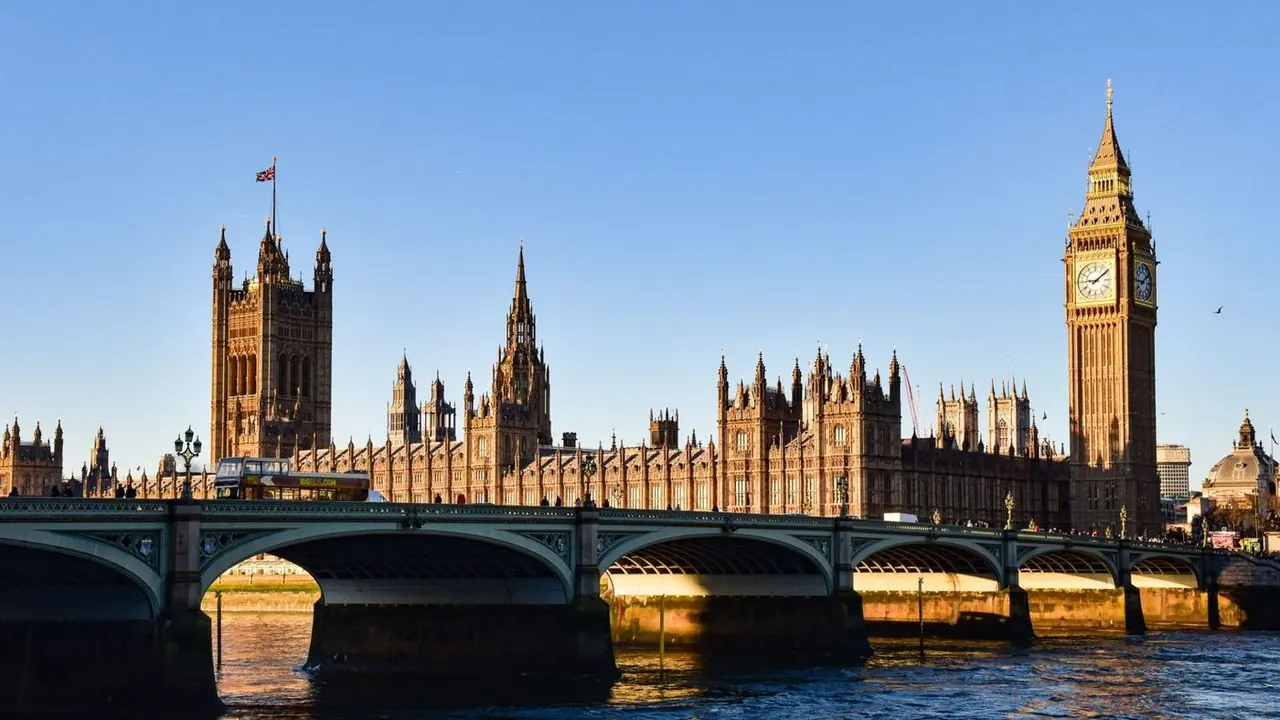

Photos: London by AXP Photography, Pexels License; St Andrews by Holger Uwe Schmitt, CC BY-SA 4.0, cropped.
London or St Andrews?
Our verdict in twelve categories, each scored against the same fixed benchmark cities, and the climate month by month, so you can choose for your trip.
Choose London for
- live music and the arts
- nightlife
- shopping
London suits the traveller who wants a big city at full stretch: great free museums, the West End and the concert halls, food from every corner of the world, serious shopping and a long weekend night out. It also works as a base, because the rail network puts Oxford, Bath and Canterbury within easy reach. Come for depth and variety, and be ready for crowds and high costs.
Choose St Andrews for
- prices
- beaches
- nature and the outdoors
St Andrews is for a slower, smaller trip by the sea. It suits golfers above all, along with anyone who likes medieval ruins, long beach walks, coastal paths and quiet evenings in a university town that can be walked end to end. Two or three days covers the town itself. After that, the East Neuk villages, Dundee and Edinburgh fill out a longer stay.
Scoreboard
Twelve categories on one fixed scale from 0 to 100. The shaded stretch is the gap between the two.
Your match
Pick a travel style or drag the sliders, and both match scores follow your weighting.
Wins on live music and the arts and nightlife with your weighting.
Wins on prices and beaches with your weighting.
What matters to you?
Category by category
What the scores mean for a trip.
Beaches & swimming
Neither city is a beach destination, but the two are different. London has no shore of its own. Its nearest seaside is Brighton's pebble beach, about an hour away by train, and the city's real swimming is done in fresh water at the lidos and the Hampstead Heath ponds.
St Andrews has sand right at the edge of town: West Sands with its dunes, sheltered East Sands by the harbour, and little Castle Sands below the cliffs. The North Sea is colder than the Channel, though, so its beaches are better for walking and kite flying than for swimming.
Food & drink
London is far ahead here. The city's strength is the cooking of its communities, from Brick Lane curry houses and Chinatown to the Turkish grills of Green Lanes and Caribbean kitchens south of the river. On top of that come Borough Market, a large fine-dining scene and the rituals of the Sunday roast and afternoon tea.
St Andrews offers good Scottish produce, such as East Neuk crab, Fife lamb and harbourside fish and chips down the coast, plus a well-loved ice cream habit. The choice is small, though, and quiet outside term time, so food is a pleasant part of a visit rather than a reason to go.
Culture & sights
London's collections are among the deepest anywhere, and the British Museum, the National Gallery, the V&A and the Tates cost nothing to enter. Around them are a thousand years of landmarks, from the Tower and Westminster Abbey to Wren's St Paul's and the Royal Observatory at Greenwich. A week only begins to cover them.
St Andrews tells one medieval story in a small space. You can climb St Rule's Tower above the ruined cathedral and crawl through the castle's siege tunnels. Then walk past the quadrangles and St Salvator's Chapel of a university founded in 1413. Golf adds its own heritage at the Swilcan Bridge and the British Golf Museum, but the whole town fits into a day or two.
Nightlife
This is one of the widest gaps between the two. In London, a night out means picking a district: Soho for late cocktail bars and the gay scene, the east for warehouse parties and clubs, Brixton and Peckham for big venues and rooftops. Behind all of these sit thousands of pubs.
In St Andrews, evenings mean a pint in a traditional bar or a golf lounge. In term time the students liven up a few places, but in summer the town is quiet. Anyone after a club night takes the bus to Dundee or Edinburgh.
Nature & outdoors
The two are roughly level, but the outdoors means different things in each. London's green space is mostly parkland: Hampstead Heath's views over the skyline, the deer and ancient oaks of Richmond Park, Kew's gardens, and the gentle chalk downs an hour away by train.
St Andrews has wilder coast close at hand. The Fife Coastal Path passes sea stacks and caves, wading birds gather on the Eden estuary, and seals haul out at Tentsmuir. There are links courses all around, and the Lomond Hills are close enough for proper hill walking if you have a car.
Day trips
London has the edge because it sits at the centre of the rail network. Oxford, Cambridge and Windsor are about an hour away, and Bath, Canterbury, Brighton and Stonehenge are all easy days out without a car.
St Andrews is a better base than its size suggests. The East Neuk harbours, Falkland Palace and Dundee are all close, and Edinburgh makes a full day out. The castles and abbeys further inland, such as Glamis, Stirling and Scone, are much easier with a car than by bus.
Good for families
London gives children far more to do. The dinosaurs at the Natural History Museum, the Science Museum's hands-on galleries and the Young V&A are all free. On top of that come the Diana Memorial Playground, the zoo, and Legoland and the Harry Potter studio tour outside the city. The trade-off is long distances, stairs at Tube stations and crowds in the school vacations.
St Andrews is the gentler choice, small and safe enough for older children to roam a little. It offers rock pools on East Sands, the castle siege tunnels, Craigtoun Park's miniature railway and the putting green by the Old Course. It suits a few relaxed days rather than a packed itinerary.
Getting around
London's transport reaches almost everywhere. The Underground, the Elizabeth line, buses and riverboats can all be paid for with one contactless card, so you never need a car. The cost is time, because the city is huge and the Tube is packed at rush hour.
St Andrews is the opposite: everything in town is a short walk, from the cathedral to the Old Course. Things only get harder beyond the town. The nearest station is Leuchars, about 8km away, and the countryside is far easier to see with a car.
Shopping & style
London is one of the world's great shopping cities. It has luxury houses on Bond Street, bespoke tailoring on Savile Row, department stores such as Liberty and Harrods, and markets from Portobello Road to Columbia Road.
Shopping in St Andrews fills an afternoon on its three main streets. Golf gear and Old Course souvenirs are the speciality, alongside cashmere, tartan and independent bookshops. Serious shoppers go to Edinburgh.
Affordability
Neither is cheap, but London is clearly the more expensive. Central hotel rooms are small and costly, and meals, rounds of drinks and theatre tickets add up. The free national museums and parks are the big saving, and so is staying further out along a Tube line.
St Andrews is easier on the budget day to day. Meals cost about the UK average, and walking and buses keep transport cheap. Rooms are limited and jump in price around tournaments and graduation, though, and a round on the famous courses is a big expense.
Live music & performing arts
The gap is enormous here. In London you can choose between a West End musical, a new play at the Royal Court and Shakespeare at the Globe on the same evening, and small fringe rooms above pubs add more. Opera and ballet play at Covent Garden and the Coliseum, the city has five major orchestras, and the Proms fill the Royal Albert Hall each summer. The programme is year-round, and it is a reason to plan a trip around the evenings.
St Andrews has the Byre Theatre, choral and chamber concerts in the university's halls and chapel during term, and folk sessions in some pubs. The programme is modest and goes quiet in the summer break. For opera or an orchestra, you need to go to Edinburgh or Dundee.
Wellness & relaxation
Neither city is a spa destination, and they relax you in different ways. London has bathing heritage, with surviving Victorian and Edwardian Turkish baths in Bayswater and Islington and spas in the grand hotels, but the city's pace is fast. Bath's thermal waters are a day trip away.
St Andrews has no public baths, but the town is calmer. Long walks on West Sands, sea air, quiet evenings and the golf resorts' hotel spas make up for it, and the hardy can join the locals' cold sea dips off East Sands.
When should you go?
Pick your month. The climate figures are measured averages, not a forecast.
London in July
St Andrews in July
Daytime high, °C
Rainfall in the month, mm
Temperature and rainfall are climate normals, averaged over the years shown. London: 1992-2020 (sunshine 1991-2020, rainfall 1991-2020) normals, London Weather Centre (1.3 km from centre). St Andrews: 1991-2020 normals, Leuchars (6.5 km from centre).
London is the warmer of the two all year, reaching about 23°C in July and August against about 19°C in St Andrews. Neither city ever gets too hot for walking, so high summer is the easiest time for both. London is driest in spring and gets wetter from October. St Andrews is wetter through the summer and peaks at around 80mm in October. St Andrews gets as much sunshine as London in May, but less than London through June, July and August.
The North Sea at St Andrews only reaches about 14°C in August, so summer there means beach walks and quick dips rather than lazy swims. Winters in both are cool, grey and short of daylight. London's museums and theatres make a winter visit work, while St Andrews is at its best from late spring to early autumn, when the coastal path and the links are most pleasant.
Which traveller are you?
For a culture and arts trip, choose London. The British Museum, the National Gallery and the Tates are free to enter, and the West End, the National Theatre, the Royal Opera House and five orchestras fill the evenings. St Andrews has handsome ruins, but one or two days covers them.
On a food and nightlife trip, London wins easily. You can eat Bangladeshi food on Brick Lane, graze at Borough Market and then choose between Soho's late bars and the clubs of Dalston and Shoreditch. St Andrews has pleasant cafés and pubs, and the town goes to bed early.
For golfers, St Andrews is the obvious pilgrimage. The Old Course, the Swilcan Bridge and the British Golf Museum are all here, with links courses all around town and golf shops on the main streets. London has nothing to match the Home of Golf.
Before you go
| Measure | London | St Andrews |
|---|---|---|
| Official language | English | English |
| Currency | Pound Sterling (GBP) | Pound Sterling (GBP) |
| Sockets | G230 V, 50 Hz | G230 V, 50 Hz |
| Driving side | Left | Left |
| Time zone | UTC, UTC+1 in summer | UTC, UTC+1 in summer |
| Emergency number | 112 or 999 | 112 or 999 |
| Elevation | 4 m | 24 m |
| Main airport | London Heathrow Airport (LHR)23 km from centre224 non-stop destinations | Edinburgh Airport (EDI)56 km from centre163 non-stop destinations |
| Public holidays this year | 8 days | 10 days |
By the numbers
| Measure | London | St Andrews |
|---|---|---|
| City population | 8,799,728 | 16,460 |
| People per km² | 5,598 | - |
| Museums within 10 km | 216 | 5 |
| UNESCO World Heritage sites within 50 km | 4 | 0 |
| Swim season, months above 21 °C | - | None |
Where else could you go?
Every comparison below shares a destination with this one, so you can follow London or St Andrews somewhere new.
- Edinburghvs St Andrews
- Brightonvs London
- Cambridgevs London
- Oxfordvs London
- Aberdeenvs St Andrews
- Glasgowvs St Andrews