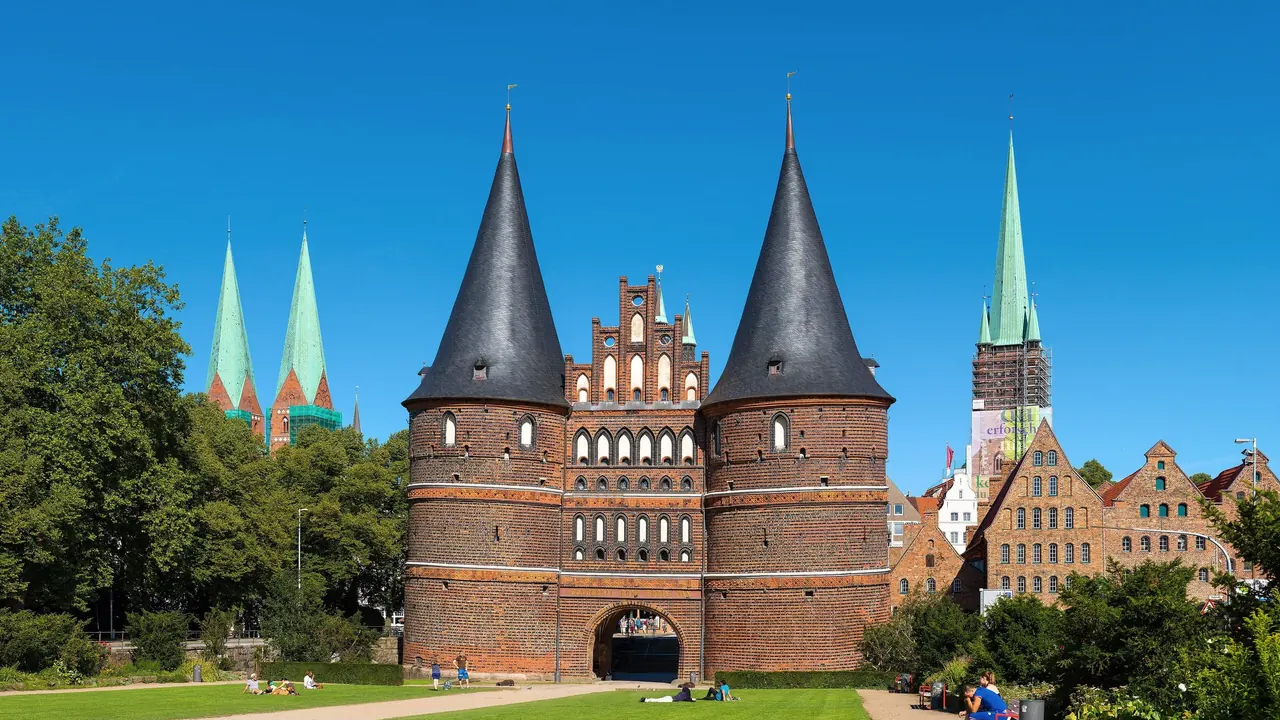
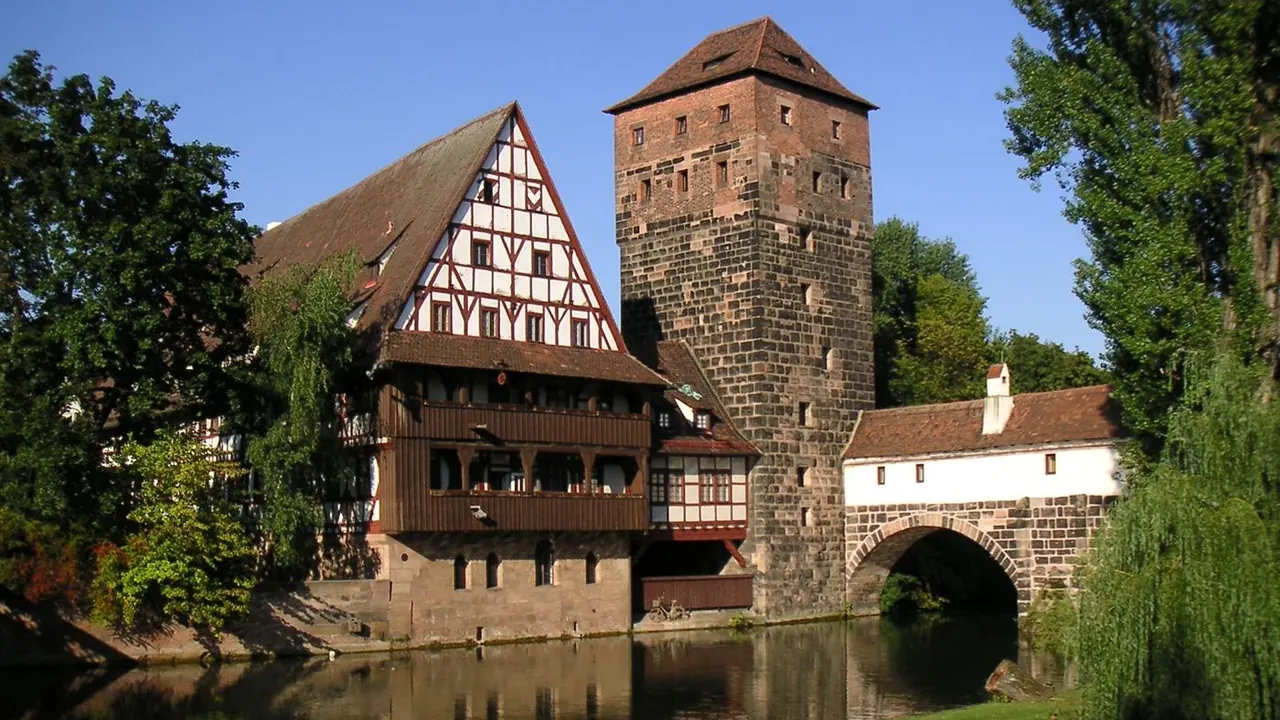
Photos: Lubeck by Christian Wolf (www.c-w-design.de), CC BY-SA 3.0 DE, cropped; Nuremberg by Horst Gutmann, CC BY 2.0, cropped.
Lubeck or Nuremberg?
Our verdict in twelve categories, each scored against the same fixed benchmark cities, and the climate month by month, so you can choose for your trip.
Choose Lubeck for
- beaches
- prices
Lübeck suits a slower trip that mixes a compact brick Gothic old town with the Baltic. In summer you can spend the morning among merchants' houses and church spires and the afternoon in a wicker beach chair at Travemünde, a short train ride away. The quiet evenings are part of what makes it restful.
Choose Nuremberg for
- day trips
- nightlife
- food and drink
Choose Nuremberg if you want more to fill the days and the evenings. Its beer taverns and the bars of Gostenhof make for livelier nights, and trams and the U-Bahn reach the outer sights. With Bamberg, Regensburg, Würzburg and Rothenburg within easy reach, it works as a base for a week as well as for a weekend. There is no sea, but the trails and crags of Franconian Switzerland are close.
Scoreboard
Twelve categories on one fixed scale from 0 to 100. The shaded stretch is the gap between the two.
Your match
Pick a travel style or drag the sliders, and both match scores follow your weighting.
Wins on beaches and prices with your weighting.
Wins on day trips and nightlife with your weighting.
What matters to you?
Category by category
What the scores mean for a trip.
Beaches & swimming
Lübeck has a real seaside within its own city limits. Travemünde has a long sandy beach lined with hooded wicker chairs, and more resorts follow the Bay of Lübeck north. The water stays cool, but it is calm, shallow and has no tides.
Nuremberg has nothing comparable. Swimming there means the city's pools, or about an hour's trip to the Brombachsee and the other Franconian reservoirs. In a hot summer the lakes are actually warmer than the Baltic, but they make a side trip rather than a beach stay.
Food & drink
Each city has a sweet emblem made for centuries: marzipan in Lübeck and Lebkuchen in Nuremberg. Their savoury sides differ. Lübeck's is the food of the coast: herring, plaice and fish sandwiches from the harbour kiosks, Rotspon from the cellars, and a meal under the ship models at the Schiffergesellschaft.
Nuremberg gives someone who travels for food more to work with. It has the small bratwurst served on pewter plates and Schäufele with crackling. Above all it has Franconian brewery culture, with local lagers and Kellerbier in beer gardens along the Pegnitz, and that is a stronger reason to linger over a meal.
Culture & sights
These are two of Germany's finest old towns and broadly level; the difference is in character. Lübeck is a Hanseatic merchant city of brick Gothic, with the Holstentor and seven spires on an island that is almost entirely UNESCO-listed. The Hansemuseum and the Buddenbrookhaus anchor a compact set of sights that two days covers well.
Nuremberg is imperial and half-timbered, with the Kaiserburg rising above walled streets that were carefully rebuilt after the war. The Germanisches Nationalmuseum alone can fill a day. The Rally Grounds and Courtroom 600 add a sobering twentieth-century layer that Lübeck has no equivalent for.
Nightlife
Neither is a party city, but Nuremberg gives you more of an evening. Gostenhof, west of the walls, has small bars and alternative venues, and students from Erlangen keep the squares and riverbanks busy at weekends.
Lübeck winds down early. You get a pub or wine bar on the Obertrave, a summer stroll along Travemünde's promenade, and for clubbing, the train to Hamburg.
Nature & outdoors
Lübeck's outdoors is about water and flat land. You can canoe the Wakenitz through reeds, walk above the sea on the Brodtener clay cliff, cycle long level routes along the coast and the old border strip, and sail on the bay in summer.
Nuremberg has more range. Pine forest begins at the edge of the city, and Franconian Switzerland adds wooded valleys, caves, limestone towers and some of Germany's best-known rock climbing. In summer the Franconian lakes are good for paddling. Neither city has mountains.
Day trips
Lübeck has one outstanding day out in Hamburg. Wismar and Schwerin's island castle are about an hour away, and the lake towns of Ratzeburg and Eutin are closer, but after those the list runs short.
Nuremberg is the better base for a longer stay. Bamberg, Regensburg and Würzburg are each around an hour by train, and Rothenburg and Dinkelsbühl on the Romantic Road are slightly further. Add Munich and Bayreuth, and you could fill a week without repeating yourself.
Good for families
Nuremberg has more made for children, and it works all year. There is the Toy Museum, the railway museum with its full-size locomotives, the zoo in old quarries with its dolphin house, and a toy brand's play park in Zirndorf. Only the steep, cobbled climb to the castle is hard on small legs.
Lübeck is more of a summer family destination. Travemünde's calm, shallow water suits toddlers, and Hansa-Park and the bay resorts are about half an hour away. Out of season, it relies mostly on its museums.
Getting around
Both centres are walkable, both main stations sit right by the old town, and you won't need a car in either. Nuremberg goes further. Its U-Bahn, trams and S-Bahn all run on one ticket and reach the zoo, the Rally Grounds and Fürth, which Lübeck's buses can't match.
Lübeck's island is flat apart from the cobbles, and the regional train to Travemünde is easy. The lakes and small coastal villages beyond are easier to reach by car.
Shopping & style
Neither city is a shopping destination, and their main streets carry the same German chains. What differs is what you take home. In Lübeck it is marzipan, plus whatever you find in the galleries and craft shops tucked into the courtyard passages around Hüxstrasse.
Nuremberg has more to buy. There are Lebkuchen in decorated tins, wooden toys and tin figures, and crafts from the workshops of the Handwerkerhof. In Advent it also has the Christkindlesmarkt, one of Germany's oldest Christmas markets.
Affordability
Day to day, the two cost much the same: mid-range for Western Europe, with filling tavern meals, cheap local transport and old towns that cost nothing to walk. What differs is when they become expensive. In Lübeck it is the beach in July and August, when Travemünde and the bay resorts charge more and book up early.
In Nuremberg it is the trade fair weeks and the Advent market season, when rooms become scarce. The cheaper times to visit are roughly the reverse of each other.
Live music & performing arts
Lübeck's musical identity lives in its churches. Buxtehude was organist at the Marienkirche, and hearing that organ tradition under the brick vaults is the evening worth planning around. Theater Lübeck and the Philharmonic by the river provide a steady season of opera, plays and symphonic music, and the Schleswig-Holstein Music Festival adds bigger names in summer. For a band or a jazz set, though, most people end up on the train to Hamburg.
Nuremberg gives you more to choose from across a week. The Staatstheater adds ballet to its opera and drama, and with two orchestras sharing the calendar there is more classical music on offer. Summer is when it moves outdoors: an orchestral evening in the Luitpoldhain park, the Bardentreffen's free weekend of folk and world music across the old town squares, and a major rock festival by the Zeppelinfeld on the former rally grounds.
Wellness & relaxation
Neither city has a bathing tradition of its own, and they are close to level, but the way you unwind differs. In Lübeck it is the seaside spa: Travemünde has been a resort since the early nineteenth century, and the bay has wellness hotels and the seawater pool complex at Scharbeutz.
In Nuremberg it is the German sauna habit. There is a large thermal spa with sauna gardens in Fürth, leisure pools where the saunas are nude and mixed, and Bad Windsheim's saline pools about an hour west.
When should you go?
Pick your month. The climate figures are measured averages, not a forecast.
Lubeck in July
Nuremberg in July
Daytime high, °C
Rainfall in the month, mm
Temperature and rainfall are climate normals, averaged over the years shown. Lubeck: 1991-2020 normals, Luebeck-Blankensee (6 km from centre). Nuremberg: 1991-2020 normals, Nuernberg (5.5 km from centre).
On land the two cities follow almost the same calendar. Winters are cold and grey, with daytime highs around 4°C in January, and the comfortable months for walking the streets run from May to September. Lübeck also has a beach season, but a short one. The Baltic reaches only about 19°C in August, so swimming is for warm afternoons between late June and early September. May is often Lübeck's sunniest month, which makes it good for the old town and the cliff path before the wetter summer months.
Nuremberg is a little warmer in high summer, peaking around 25°C. July is its wettest month, with about 77mm of rain. Its winters are slightly drier and less gloomy than Lübeck's dark Decembers, though neither city is mild out of season.
Which traveller are you?
For a beach and sun trip, Lübeck is the only real choice. Travemünde's sandy beach and the resorts on the bay are close by, the calm, shallow Baltic suits paddling, and the old town is there for grey days. From Nuremberg, the nearest swimming is at reservoirs an hour away.
On a food and nightlife trip, Nuremberg pulls ahead. You can eat beechwood-grilled bratwurst and Schäufele and drink smoky Kellerbier in riverside beer gardens, then move on to Gostenhof's small bars, which keep going at weekends long after Lübeck has gone quiet.
For an outdoors trip, Nuremberg is the better base. The Reichswald forest starts at the edge of town, and Franconian Switzerland, about an hour away, has limestone towers, caves, rock climbing and marked trails between villages. Lübeck offers gentle cycling and canoeing, but less variety.
Before you go
| Measure | Lubeck | Nuremberg |
|---|---|---|
| Official language | German | German |
| Currency | Euro (EUR) | Euro (EUR) |
| Sockets | CF230 V, 50 Hz | CF230 V, 50 Hz |
| Driving side | Right | Right |
| Time zone | UTC+1, UTC+2 in summer | UTC+1, UTC+2 in summer |
| Emergency number | 112 | 112 |
| Elevation | 13 m | 209 m |
| Main airport | Hamburg Helmut Schmidt Airport (HAM)53 km from centre120 non-stop destinations | Nuremberg Airport (NUE)5 km from centre56 non-stop destinations |
| Public holidays this year | 10 days | 12 days |
By the numbers
| Measure | Lubeck | Nuremberg |
|---|---|---|
| City population | 217,061 | 531,159 |
| People per km² | 1,013 | 2,848 |
| Museums within 10 km | 23 | 50 |
| UNESCO World Heritage sites within 50 km | 1 | 1 |
| Swim season, months above 21 °C | None | - |
Where else could you go?
Every comparison below shares a destination with this one, so you can follow Lubeck or Nuremberg somewhere new.
- Hamburgvs Lubeck
- Munichvs Nuremberg
- Karlovy Varyvs Nuremberg
- Stuttgartvs Nuremberg
- Heidelbergvs Nuremberg
- Frankfurtvs Nuremberg